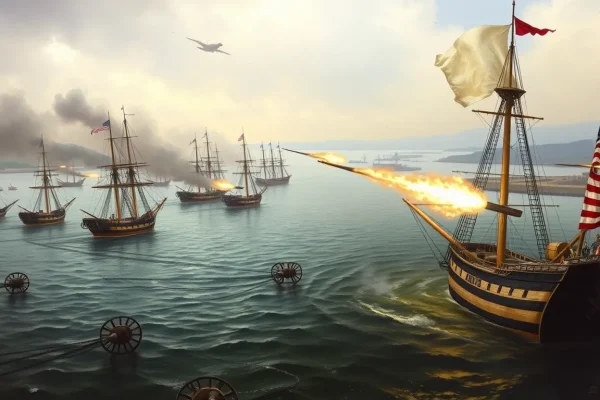
British Invasion of the Chesapeake (War of 1812)

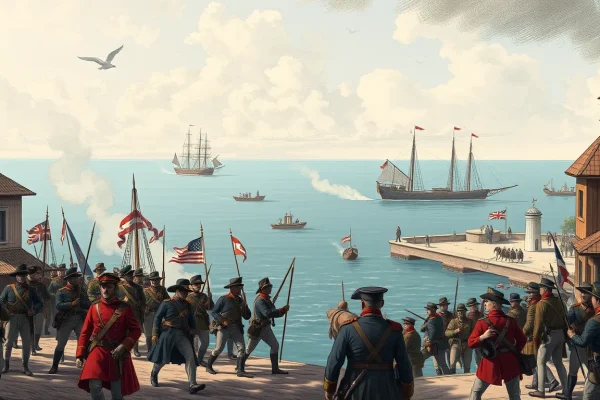
The British Invasion of the Chesapeake (1813–1814) was a campaign of naval raids and military operations during the War of 1812, culminating in the burning of Washington, D.C., and the bombardment of Baltimore’s Fort McHenry. It represented Britain’s attempt to pressure the United States by striking at its political and commercial heart.

Read More →

Capture of USS Essex at Valparaíso

On 28 March 1814, the British frigate HMS Phoebe and sloop HMS Cherub captured the American frigate USS Essex off Valparaíso, Chile, ending the most successful American commerce-raiding cruise of the War of 1812. The engagement demonstrated the vulnerability of carronade-armed ships against long-gun opponents.

Read More →

Why Did the British Burn Washington in 1814?

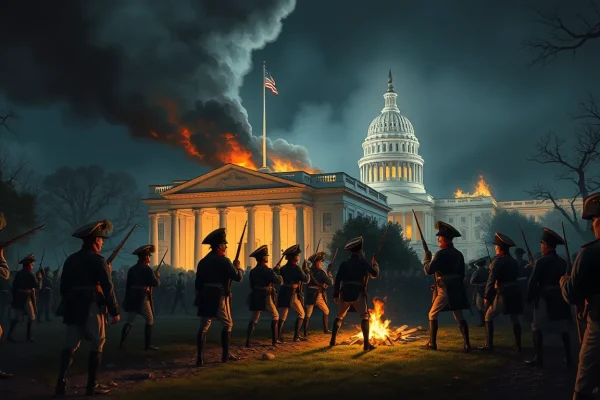
In August 1814, British forces under Major General Robert Ross and Rear Admiral George Cockburn captured Washington, D.C., and set fire to its public buildings. The burning was an act of retaliation for American destruction of Canadian towns, particularly York and Newark, and a strategic blow to undermine U.S. morale. It remains the only time a foreign power captured and occupied the American capital.

Read More →

The Race to Build Warships on the Great Lakes

During the War of 1812, the United States and Great Britain engaged in a frantic naval construction race on the Great Lakes, building increasingly powerful warships to secure control of these inland waters. This competition ultimately produced the massive HMS St. Lawrence and spurred American vessels never completed, shaping the war’s strategic stalemate and post-war disarmament agreements.

Read More →

Fort Detroit During the War of 1812

Fort Detroit, a key American frontier post on the Detroit River, was surrendered to British and Indigenous forces under Isaac Brock and Tecumseh on August 16, 1812, after a failed American invasion of Upper Canada. The surrender was a major early American defeat, but the fort was recaptured in 1813 following the Battle of Lake Erie.

Read More →

How Infantry Fought in the War of 1812

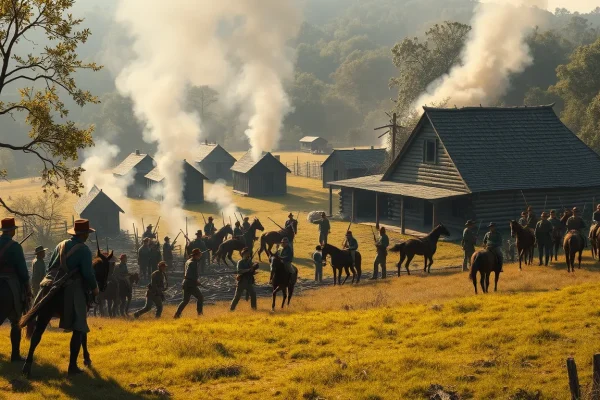
During the War of 1812, infantry on both sides fought with smoothbore muskets, massed formations, and bayonet charges, adapting European linear tactics to North American terrain. The war saw the evolution of American regulars from inexperienced troops to competent professionals, while militia proved unreliable in cross-border operations.

Read More →

The Burning of the U.S. Capitol (1814)

On August 24, 1814, British forces captured Washington, D.C., and burned the U.S. Capitol, the President’s House, and other public buildings in retaliation for American destruction of York (Toronto) in 1813. It was the only time a foreign power occupied and burned the American capital.

Read More →

Choctaw Fighters at the Battle of New Orleans

At the Battle of New Orleans on January 8, 1815, about fifty to sixty Choctaw warriors, led by Pierre Juzan, fought alongside Andrew Jackson’s forces. They played a key role in skirmishing and holding the American left flank, contributing to the American victory and demonstrating the vital contributions of Indigenous allies in the War of 1812.

Read More →

British Campaign Against Maine

The British Campaign Against Maine (1814–1815) was a series of combined naval and military operations that occupied eastern Maine, then part of the District of Massachusetts, establishing the short-lived colony of ‘New Ireland’. Led by Sir John Coape Sherbrooke, the British captured Castine, Hampden, and Bangor, holding the territory until the Treaty of Ghent restored it to the United States.

Read More →