
Short Answer
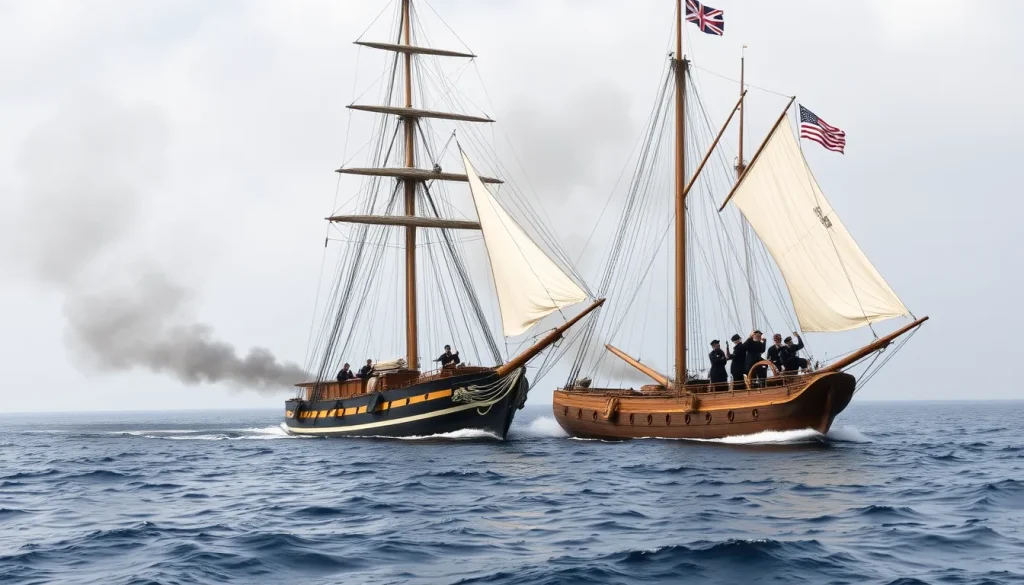
The battle between USS Wasp and HMS Reindeer was a ship-to-ship naval action fought in the Atlantic Ocean roughly 225 miles west of Plymouth, England, on 28 June 1814, during the final year of the War of 1812. Master Commandant Johnston Blakeley’s American sloop-of-war defeated Captain William Manners’s smaller British brig-sloop after a brief and exceptionally violent engagement that ended when the American crew boarded and seized the battered British vessel. The fight is widely regarded as one of the best-fought sloop actions of the war and a signature example of the U.S. Navy’s commerce-raiding strategy in European waters.
Historical Context
By 1814, the Royal Navy’s tightening blockade of the American Atlantic coast had severely curtailed U.S. naval operations. Secretary of the Navy William Jones, confronting a two-front war on the borders and at sea, shifted strategic emphasis toward commerce raiding with fast, economical sloops-of-war rather than frigates. His goal was to strike British merchant shipping in the home approaches and to force the Royal Navy to divert blockading strength toward protecting trade routes. The Wasp, built as a 22-gun ship-sloop, was dispatched in the spring of 1814 to cruise the western approaches to the English Channel, a zone teeming with British and neutral merchant traffic. The cruise was part of a broader American campaign that also saw the Argus and other sloops harry British commerce.
What Happened
The Wasp, commanded by Master Commandant Johnston Blakeley, departed Portsmouth, New Hampshire, in early May 1814 and crossed the Atlantic unobserved. By late June she had made several captures and destroyed her prizes, cruising west-southwest of Plymouth. On the morning of 28 June, lookouts sighted a sail to windward: the British brig-sloop Reindeer, Captain William Manners, which had been escorting a convoy and was returning to Plymouth when she sighted the strange sail. Manners, commanding a highly drilled crew known as “the pride of Plymouth,” closed to investigate. Both ships spent the afternoon manoeuvring for the weather gauge, the advantage of being to windward; the Reindeer won it.
At about 3:15 p.m., the Reindeer, approaching on the Wasp‘s starboard weather quarter, opened fire with her forecastle boat-carronade. The Wasp held her fire, letting the British shoot pass until her own broadside could bear. At about 3:26, having luffed into position, the Wasp opened fire with her 32-pounder carronades. A close and furious cannonade followed at ranges of sixty yards or less. The American ship was larger, heavier, and more heavily crewed. Her 18-pounder long guns and 32-pounder carronades tore through the Reindeer‘s hull and upper works, while American riflemen in the tops picked off British officers and sailors on deck.
The British fought back with great spirit. Captain Manners, though both his legs were shattered by shot, refused to leave the deck, encouraging his men and calling for a boarding attempt. As the Reindeer—her sails and rigging shot away—fell alongside the Wasp‘s quarter, Manners climbed into the rigging to lead his men over the side. He was struck twice in the skull by rifle fire and fell dead on his own deck. With nearly all their officers killed or wounded and more than half the crew casualties, the surviving British sailors could not resist the American boarders, who swept over the Reindeer‘s deck and received her surrender at about 4:00 p.m. The Reindeer was so shattered that Blakeley, after taking off the prisoners and wounded, set her on fire on the evening of 29 June.
Why It Matters
The victory mattered for several reasons. It demonstrated that a well-handled American sloop-of-war could defeat a British vessel of the same nominal class despite giving away the weather gauge, and it underscored the effectiveness of Jones’s commerce-raiding strategy: the Wasp continued her cruise, capturing or destroying six merchant vessels, then captured the brig-sloop HMS Avon in a night action on 7 September 1814. The Reindeer duel became a fixture in American and British naval literature, with the British historian William James judging it “one of the best fought sloop actions of the war.” For the Royal Navy, the loss was a sharp reminder that American sloops could operate with impunity in the approaches to the home islands. For the U.S. Navy, the action burnished the service’s reputation for gunnery and courage, even though Blakeley and his crew were lost at sea on the voyage home, a fate that later scholars and naval officers remembered with particular poignancy.
Prelude
The Wasp was the fourth American warship of that name to see service in just two years, a successor to the ship-sloop captured by the British in October 1812 and to two short-lived namesakes. She was a larger and faster vessel than her predecessors, built for extended ocean cruising. Blakeley, an Irish-born North Carolinian with years of naval experience, received orders to take the Wasp into the Western Approaches and to destroy British commerce. He sailed from Portsmouth, New Hampshire, in early May 1814, rounded the British Isles undetected, and by late June had captured five merchant ships. The appearance of the Reindeer on 28 June presented Blakeley with a warship rather than a merchantman, but he accepted the challenge.
Forces and Commanders
The American force was the ship-sloop USS Wasp, 539 tons, mounting twenty 32-pounder carronades and two 18-pounder long guns, with a crew of 173 men and 2 boys (about 175 total) under Master Commandant Johnston Blakeley (1781–1814). The British force was the brig-sloop HMS Reindeer, 385 tons, mounting sixteen 24-pounder carronades and two 6-pounder long guns, plus a shifting 12-pounder boat-carronade, with a crew of 98 men and 20 boys (118 total) under Captain William Manners (1783–1814). The Wasp, therefore, carried a broadside of 338 pounds against the Reindeer‘s 198 pounds, and the American crew outnumbered the British by roughly three to two. The Reindeer‘s crew was exceptionally well drilled and had served together for years.
Battlefield and Map Context
The battle took place in the open Atlantic Ocean at approximately 48°36′ N, 11°15′ W, about 225 miles west of Plymouth, England, in the Western Approaches at the mouth of the English Channel. This was a major shipping lane crowded with merchant vessels, fishing boats, and men-of-war, and it lay just beyond the range of Royal Navy harbor defense. The sea was smooth and the wind light, which favored gunnery and boarding actions over manoeuvre. No shoreline or landmark figured in the action; the combatants were wholly dependent on their sails and seamanship.
Battle Chronology
~2:00 p.m. The Wasp and Reindeer, having manoeuvred within hailing distance, exchanged the customary challenge: each hoisted colours and fired a gun to windward.
~3:15 p.m. The Reindeer, holding the weather gauge, opened fire from her forecastle boat-carronade at about sixty yards’ range. She fired several rounds without reply.
~3:26 p.m. The Wasp luffed up and opened fire with her after carronades in succession, beginning the main cannonade.
~3:30–4:00 p.m. A close, furious exchange of round shot, grape, and musket fire; the Reindeer‘s casualties mounted; her rigging and hull were cut to pieces.
~4:00 p.m. The Reindeer fell alongside the Wasp bow-first. Captain Manners was killed leading a boarding attempt. American riflemen and then boarders swept the British deck, and the Reindeer surrendered. Blakeley officially reported the action lasted nineteen minutes, while British historian William James wrote that the close cannonade endured about half an hour.
Casualties and Losses
The Reindeer suffered 25 killed, including Captain Manners and the purser, and 42 wounded, many dangerously; her total losses of 67 out of a complement of 118 represented more than half her crew. The Wasp lost 11 killed or mortally wounded, including two midshipmen, and 15 wounded wounded, a total of 26 out of roughly 175. The damaged Reindeer, her foremast toppling the day after the fight, was judged too shattered to save and was burned. The Wasp herself suffered six round shot in the hull and a 24-pounder ball through her foremast, but remained seaworthy.
Result
Decisive American victory. The Reindeer was captured, stripped of prisoners and wounded, then destroyed by fire. The Wasp proceeded to L’Orient, France, arriving 8 July 1814, where she was repaired and refitted.
Strategic Consequences
The victory had little direct effect on the course of the broader war, but it contributed to British awareness of the vulnerability of home waters and to the American record of successful single-ship duels. It also validated Secretary Jones’s commerce-raiding strategy and raised the prestige of the young U.S. Navy. After repairs in France, the Wasp resumed raiding and captured HMS Avon in September, but she vanished with all hands near Madeira after mid-September 1814, depriving the U.S. Navy of one of its most successful commanders. The battle’s memory persisted in both navies as an example of skill, courage, and the high cost of close-range naval combat.
Primary Accounts
Master Commandant Blakeley’s official report, dated L’Orient, 8 July 1814, and addressed to Secretary of the Navy William Jones, provides the most complete American account of the action, including the positions, the order of events, and casualty lists; it was printed in the American State Papers. The British historian William James, relying on British officers’ reports and his own research, gives the fullest British perspective in The Naval History of Great Britain (1824), with a detailed narrative and a comparative force table. Both accounts agree on the fundamentals, though James’s timing of the cannonade (~30 minutes) differs from Blakeley’s official 19 minutes.
Battlefield Today
The site of the battle lies in the open Atlantic and carries no surviving physical remnants; the ocean floor there is deep and no wreck of the Reindeer has been located. The nearest accessible historical landmarks are the maritime museums and archives in the Plymouth, Devon, region of England, which hold records and artifacts relating to the Royal Navy in the Napoleonic and War of 1812 era, and the U.S. Naval Academy Museum and National Archives, which hold American naval records and Blakeley’s papers.
Primary Sources
Primary sources for the battle include: (1) Johnston Blakeley’s official dispatches to Secretary Jones, dated 8 July 1814 from L’Orient, printed in American State Papers, Naval Affairs, vol. 1, which include a detailed action report and casualty lists. (2) William James’s The Naval History of Great Britain (London, 1824), which reprints British and American reports and adds critical commentary. (3) The British court-martial and prize proceedings, held in the National Archives of the United Kingdom (ADM 1–4 series), which contain the testimony of surviving British officers. Each source carries bias: Blakeley wrote to justify his conduct and his loss of British lives; James wrote as a British partisan critical of American claims; the court-martial testimony reflects the legal and professional interests of the Royal Navy.
Further Reading
- William James, The Naval History of Great Britain, from the Declaration of War by France in 1793 to the Accession of George IV, 6 vols. (London, 1824).
- Theodore Roosevelt, The Naval War of 1812 (New York: G.P. Putnam’s Sons, 1882).
- David Curtis Skaggs, “The Cruise of the Wasp,” Naval History Magazine 28, no. 6 (December 2014).
- William S. Dudley, ed., The Naval War of 1812: A Documentary History, 4 vols. (Washington, DC: Naval Historical Center, 1985–2015).
- Robert Malcomson, Historical Dictionary of the War of 1812 (Lanham, MD: Scarecrow Press, 2006).
References
- Rickard, J. “USS Wasp vs HMS Reindeer, 28 June 1814.” History of War, 22 September 2011. https://www.historyofwar.org/articles/battles_wasp_reindeer.html
- James, William. The Naval History of Great Britain. London, 1824. Text at https://www.1812privateers.org/NAVAL/reindeer.html
- Skaggs, David Curtis. “The Cruise of the Wasp.” Naval History Magazine 28, no. 6 (December 2014). https://www.usni.org/magazines/naval-history-magazine/2014/december/cruise-wasp
- “Wasp.” The United States Navy Memorial. https://navylog.navymemorial.org/wasp
- “Capture of the Reindeer and Other Vessels, by the Wasp.” American State Papers, 13th Congress, 3rd Session, no. 114, October 17, 1814. http://www.ibiblio.org/pha/USN/1814/18141013Reindeer.html
FAQ
Why did Captain Manners fight despite his ship being weaker?
Captain Manners likely believed the vessels were more evenly matched than they were; both were rated 'sloops', and he may have hoped that his crew's superior drill and the advantage of the weather gauge would compensate. British honor and the Royal Navy's culture of engaging enemies of the same class also discouraged retreat. William James praised him as 'a great hero' and described the decision as justifiable.
How long did the battle actually last?
Blakeley's official report gives an action time of nineteen minutes from the commencement of the American fire. However, British historian William James, who had access to the Reindeer's log, narrates a cannonade lasting about half an hour from the Reindeer's opening fire to the boarding. The discrepancy may reflect different definitions of when the action started.
What happened to Captain Blakeley and the Wasp afterwards?
After the battle, the Wasp reached L'Orient, France, repaired, and resumed raiding in September 1814, capturing HMS Avon. She was last sighted near Madeira on 15 September 1814 and then lost with all hands, likely to a storm or sinking. Blakeley left a widow and daughter; he and his crew were never heard from again.



Leave a Reply