
Short Answer
The Fort Mims Massacre was the August 30, 1813, destruction of a stockade at Samuel Mims’s plantation in the Tensaw District of the Mississippi Territory, in present-day Baldwin County, Alabama. A Red Stick Creek force attacked a mixed community of Mississippi Territorial Volunteers, American settlers, Lower Creek allies, and enslaved African Americans, killing many and taking captives. Occurring during the War of 1812, the attack became the most notorious event of the Creek War of 1813–14 and helped turn an internal Creek conflict into a large United States military campaign in the Gulf South. It did not begin the Creek War, but it widened and intensified it, making Fort Mims a central reference point in the war’s memory and diplomacy.
Historical Context
By 1813, Creek society in what is now Alabama and Georgia was under severe strain. The United States pressed southeastern Indigenous nations to cede hunting lands, while federal agents promoted a “plan of civilization” that encouraged Creek men to adopt European-style agriculture and market production. Many Creeks, especially in Lower Creek towns, adapted to this economy and maintained ties with American officials and settlers. Others, particularly in Upper Creek towns along the Coosa, Tallapoosa, and Alabama rivers, resisted land cessions and cultural change. The Red Stick faction, named for the red-painted war clubs its members carried, drew on traditionalist and nativist teachings associated with Shawnee leaders Tenskwatawa and Tecumseh. Red Sticks opposed alliances with the United States and sought to restore older practices and independence.
These tensions became a Creek civil war. American settlers in the Tensaw District, including intermarried Creek families, generally sided with United States forces and Lower Creek allies. In July 1813, Mississippi Territorial militia attacked a Red Stick party returning from Pensacola with British-supplied arms at the Battle of Burnt Corn. Red Stick leaders retaliated against American-allied settlements. Because United States regular troops were committed to the Canadian frontier and the Atlantic war, security in the Gulf South fell to territorial volunteers, state militia, and Indigenous allies. Spanish Pensacola and British agents added an international dimension that connected the Creek conflict to the wider War of 1812.
What Happened
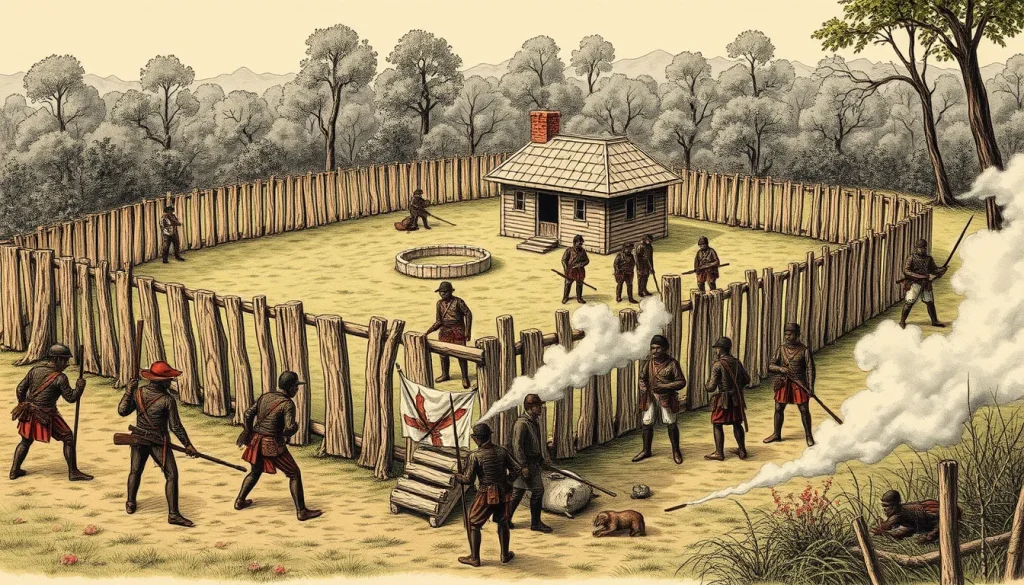
After Burnt Corn, American-allied Creeks and American settlers gathered for protection at Fort Mims, a hastily built stockade around the plantation of Samuel Mims in the Tensaw District. The garrison consisted of about 100 Mississippi Territorial Volunteers under Major Daniel Beasley. Roughly 400 civilians, including women, children, enslaved African Americans, and Creek allies, took refuge inside. On August 30, 1813, a Red Stick force of about 700 attacked at midday. Later accounts state that the stockade gate was open or poorly secured and that warnings of an attack had been ignored, though the details of these claims vary.

The attackers rushed through the gate and killed Beasley in the first minutes. Captain Dixon Bailey, a Creek officer allied with the United States, organized a defense that held for several hours. The Red Sticks then set the fort’s buildings on fire, probably with burning arrows or torches. As flames and smoke spread, resistance collapsed. Many occupants were killed, and at least 100 were taken captive. Modern estimates place the number of dead at about 250, though some accounts give higher figures. Red Stick losses are uncertain and no reliable count survives. The fort was destroyed.
Why It Matters
The immediate effect was outrage across the United States. Newspapers and officials called the event a massacre, and “Remember Fort Mims” became a rallying cry. In the absence of sufficient federal troops, Tennessee, Georgia, and Mississippi Territory volunteers mobilized against the Red Sticks. Andrew Jackson’s Tennessee militia campaign, along with Georgia and Mississippi forces and Cherokee and Lower Creek allies, defeated Red Stick armies and culminated at the Battle of Horseshoe Bend on March 27, 1814. The Treaty of Fort Jackson in August 1814 forced the Creek Nation to cede more than 20 million acres, including land belonging to Creek allies of the United States.
Historians interpret Fort Mims in several ways. It was a genuine Red Stick tactical victory and one of the most successful Indigenous assaults on a fortified position in the era. It was also a strategic disaster for the Red Sticks because it provoked a much larger United States intervention. Some scholars emphasize the massacre of civilians and the resulting American anger; others place it within the longer context of Creek civil war, United States land expansion, and the War of 1812’s southern theater. The term massacre reflects the killing of noncombatants and captives, but the event also included a pitched battle. These competing emphases explain why the event remains central to Creek and Gulf South history.
Prelude
The Battle of Burnt Corn on July 27, 1813, was the immediate precursor. United States militia attacked a Red Stick party led by Peter McQueen that was returning from Pensacola with arms and ammunition. The ambush failed to destroy the Red Stick force, and Red Stick leaders vowed revenge against the Tensaw settlements. Fort Mims became a target because it sheltered American militia and Creek families hostile to the Red Sticks. Contemporary and later accounts report warnings from allied Creeks and others, but the reliability of individual warnings is debated.
Forces and Commanders
The defenders included Major Daniel Beasley’s Mississippi Territorial Volunteers, Captain Dixon Bailey’s American and Creek militia, and civilians and enslaved people inside the stockade. The attacking Red Stick force numbered about 700 and was led by figures including William Weatherford, Far-off Warrior, and the prophet Paddy Walsh. Red Stick leadership was decentralized, and no single commander controlled every warrior. Beasley’s decision-making before the attack was criticized in later accounts, while Bailey’s defense was credited with prolonging resistance.
Battlefield and Map Context
Fort Mims stood near the Tensaw River in the Tensaw District of the Mississippi Territory, east of Mobile and north of Spanish Pensacola. The modern location is near Tensaw in Baldwin County, Alabama. The stockade enclosed about one acre around Samuel Mims’s plantation and was not a major military fortification. It lay between American settlements around Mobile and Creek towns to the north and east, making it a frontier refuge rather than a strategic strongpoint.
Battle Chronology
On August 30, 1813, the Red Stick force approached Fort Mims around midday. The attackers rushed through an open gate and overwhelmed the initial defense, killing Major Beasley. Captain Bailey rallied survivors, and the defenders held for several hours. In the afternoon the Red Sticks set fire to the buildings, causing the defense to collapse. The killing of many occupants and the taking of captives followed. Exact times and sequences vary among accounts, and no single contemporary narrative provides a complete timeline.
Casualties and Losses
The Encyclopedia of Alabama states that about 250 defenders were killed and at least 100 people were taken captive. Other accounts give higher death totals. The dead included militia, American settlers, Creek allies, women, children, and enslaved African Americans. Red Stick losses are uncertain and no reliable count survives. Captives included African Americans and Creeks, and their later fates varied.
Result
The attack destroyed Fort Mims and gave the Red Sticks a tactical victory. It did not deliver a strategic victory. Instead, it produced widespread alarm and a determination among United States officials and frontier settlers to crush the Red Stick movement. The event became a symbol of what many Americans saw as a threat to their settlements and to Creek allies.
Strategic Consequences
In late 1813 and 1814, United States and allied forces invaded Creek country. Andrew Jackson’s Tennessee army won victories at Tallushatchee, Talladega, and Horseshoe Bend, while Georgia and Mississippi forces operated elsewhere. The Treaty of Fort Jackson ended the Creek War on American terms and opened millions of acres to United States settlement. The conflict also merged with the War of 1812’s Gulf Coast campaign, where British forces and Red Stick refugees interacted. Jackson’s reputation, built partly on the Creek War, later carried him to the Battle of New Orleans and national political prominence. Longer term, the defeat of the Red Sticks contributed to the forced removal of Creeks and other southeastern Indigenous nations in the 1830s.
Primary Accounts
Most surviving written accounts are from United States officials, militia officers, settlers, and newspaper editors. They include military correspondence, territorial records, and newspaper reports that describe the attack and its aftermath. Their limitations include delay, rumor, defensiveness, and the desire to justify retaliation. Red Stick perspectives survive mainly through oral tradition, later ethnohistorical reconstruction, and the records of their adversaries. Later recollections by survivors and participants are valuable but shaped by memory, politics, and the passage of time. No complete contemporary Red Stick written narrative of the attack is known to survive in the sources consulted here.
Battlefield Today
The Fort Mims State Historic Site is near Tensaw, Alabama, and is managed by the Alabama Historical Commission. It was listed on the National Register of Historic Places in 1972. The site features a restored blockhouse, a well, and a reconstructed stockade. The National Park Service lists the site as not open to the public, so visitors should check current access with the Alabama Historical Commission before planning a visit.
Primary Sources
The key contemporary sources for Fort Mims fall into several groups. United States military and territorial correspondence, including reports from Mississippi Territory officials and volunteer officers, provides details about the garrison, warnings, and casualties, but these accounts often defend American decisions and emphasize Red Stick violence. Newspaper reports from 1813, such as those reprinted in national periodicals like Niles’ Weekly Register, spread the news and helped create the massacre narrative, though they relied on rumor and incomplete information. Survivor recollections and later interviews collected in the nineteenth century add human detail but are affected by memory and by the political needs of the Creek War’s aftermath. Creek and Red Stick perspectives are harder to document in written form; historians use oral traditions, archaeological evidence, and later Creek testimony to reconstruct them. The Treaty of Fort Jackson is a primary document for the war’s outcome rather than the attack itself.
Further Reading
- Gregory A. Waselkov, Conquering Spirit: Fort Mims and the Redstick War of 1813–14 (University of Alabama Press, 2006).
- Frank L. Owsley Jr., Struggle for the Gulf Borderlands: The Creek War and the Battle of New Orleans, 1812–1815 (University of Alabama Press, 1981).
- Henry S. Halbert and Timothy H. Ball, The Creek War of 1813 and 1814, edited by Frank L. Owsley Jr. (University of Alabama Press, 1995).
- Encyclopedia of Alabama, “Fort Mims Battle and Massacre,” by Gregory A. Waselkov.
- National Park Service, “Fort Mims State Historic Site.”
- Alabama Historical Commission, Fort Mims State Historic Site resources.
References
- National Park Service, “Fort Mims State Historic Site,” https://nps.gov/places/fort-mims.htm.
- Gregory A. Waselkov, “Fort Mims Battle and Massacre,” Encyclopedia of Alabama, https://encyclopediaofalabama.org/article/fort-mims-battle-and-massacre/.
- Gregory A. Waselkov, Conquering Spirit: Fort Mims and the Redstick War of 1813–14 (Tuscaloosa: University of Alabama Press, 2006).
- Frank L. Owsley Jr., Struggle for the Gulf Borderlands: The Creek War and the Battle of New Orleans, 1812–1815 (Tuscaloosa: University of Alabama Press, 1981).
- Henry S. Halbert and Timothy H. Ball, The Creek War of 1813 and 1814, ed. Frank L. Owsley Jr. (Tuscaloosa: University of Alabama Press, 1995).
FAQ
Did the Fort Mims Massacre start the Creek War?
It did not start the Creek War; the conflict had already begun as a Creek civil war and included the Battle of Burnt Corn in July 1813. Fort Mims transformed the conflict by provoking large-scale United States intervention.
Who was responsible for the Fort Mims Massacre?
Red Stick Creek leaders including William Weatherford, Far-off Warrior, and Paddy Walsh led the attacking force. Red Stick leadership was decentralized, so responsibility was not held by a single commander.
What happened at Fort Mims?
On August 30, 1813, about 700 Red Stick Creeks attacked the stockade, killed Major Daniel Beasley, overcame Captain Dixon Bailey's defense after several hours, burned the fort, and killed or captured most occupants. Modern estimates place the dead at about 250.
Leave a Reply