
Short Answer
The Battle of the Thames, fought on 5 October 1813 along the north bank of the Thames River near Moraviantown in Upper Canada (present-day Ontario), was a decisive American victory in the War of 1812. Led by Major General William Henry Harrison, American forces defeated a combined British and Indigenous army under Major General Henry Procter and the Shawnee war chief Tecumseh. The battle ended the Northwest Campaign, destroyed Tecumseh’s pan-Indigenous confederacy, and secured the Old Northwest for the United States.
Historical Context
Following the American naval victory at the Battle of Lake Erie on 10 September 1813, the British position in the western Great Lakes became untenable. Master Commandant Oliver Hazard Perry’s fleet gave the United States control of the lake, severing British supply lines to Fort Detroit and Fort Malden at Amherstburg. Major General Henry Procter, commanding British forces in the region, faced dwindling provisions and a powerful American army under Harrison advancing from the south. On 27 September, Procter ordered the evacuation of Fort Detroit and Amherstburg, initiating a retreat eastward up the Thames River. Tecumseh, who had forged an alliance with the British to protect Indigenous lands, strongly opposed the withdrawal, fearing it would expose their homes to American attack. After burning Fort Malden, Procter’s column of British regulars (largely the 41st Foot), Canadian militia, and about 500 Indigenous warriors moved slowly through difficult country, hampered by poor logistics and low morale.
What Happened
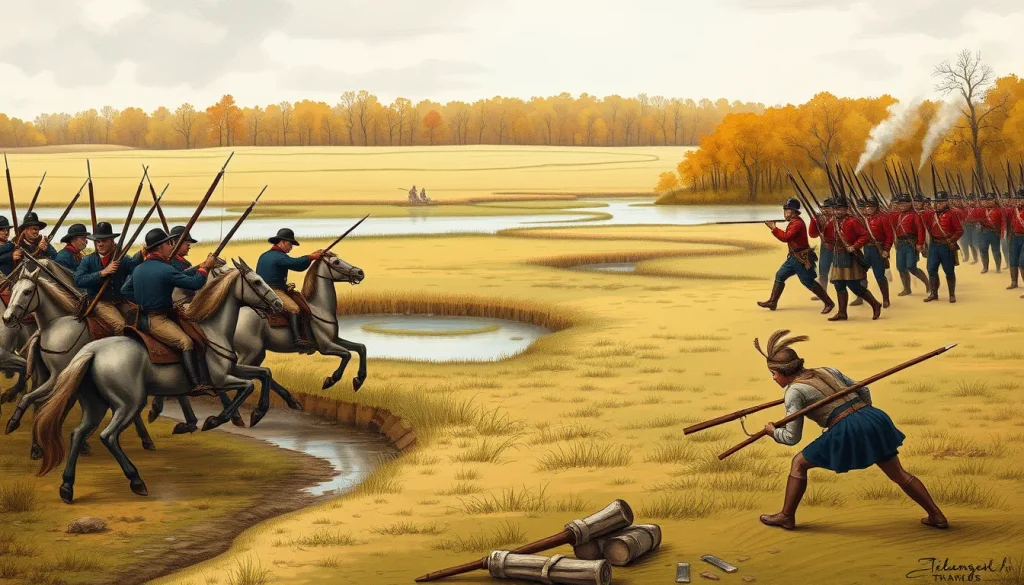
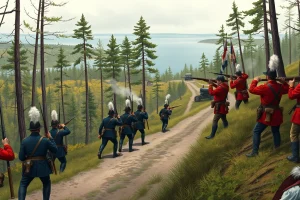
Harrison’s American force, numbering around 3,500–3,760 men, included Colonel Richard Mentor Johnson’s regiment of Kentucky mounted volunteers and regular infantry. After recapturing Detroit, Harrison pursued Procter’s retreating column, which halted near the Christian Lenape (Delaware) village of Moraviantown on the banks of the Thames. On the morning of 5 October, Procter deployed his regulars in a thin line along the road, with the river protecting his left flank and a swampy wooded area on his right, where Tecumseh’s warriors took position. The British had only one 6-pounder cannon without ammunition.
Harrison launched a charge with the Kentucky cavalry against the British regulars. The mounted riflemen broke through the line almost immediately; most of the British surrendered, while Procter and about 250 men fled the field. The American cavalry then turned toward the swamp, where Tecumseh’s warriors fought tenaciously. The fighting in the swamp was intense and close-quarters, with both sides taking casualties. During this phase, Tecumseh was killed; the precise circumstances of his death remain disputed, though Colonel Johnson later claimed to have shot him. Without their leader, the Indigenous warriors soon retreated, ending the battle by midday.

Why It Matters
The Battle of the Thames was the last major engagement in the Northwest and secured American control over Michigan Territory and the upper Ohio Valley. For Indigenous peoples, the death of Tecumseh was a catastrophe: his confederacy, painstakingly built through diplomacy and military skill, collapsed. It eliminated the most effective Native resistance to American western expansion. The battle also undermined British credibility among Indigenous nations and led to Procter’s court-martial for negligence. In the longer term, the victory removed the principal barrier to American westward expansion, contributing to the eventual removal of eastern Indigenous peoples in the 1820s and 1830s.
Prelude
After Perry’s victory on Lake Erie, Procter faced a strategic dilemma: without naval support, he could neither reinforce nor supply the garrison at Amherstburg. He decided to retreat east to Burlington Heights, but Tecumseh and his warriors protested, viewing the retreat as cowardice and betrayal. In a council, Tecumseh reportedly compared Procter to a fat animal that drops its tail and runs away when frightened. Procter eventually persuaded Tecumseh to retreat, promising to make a stand. The British began their withdrawal on 27 September, destroying fortifications and supplies. Harrison’s army, including over 1,000 Kentucky mounted riflemen, pursued vigorously. Procter’s retreat was slow and poorly managed, with bridges not destroyed and soldiers given half rations, further demoralizing the troops.
Forces and Commanders
American forces were commanded by Major General William Henry Harrison, with Colonel Richard Mentor Johnson leading the mounted Kentucky volunteers. The American force numbered about 3,500–3,760, including regulars and militia. British and Indigenous forces were led by Major General Henry Procter and Tecumseh. Procter’s force consisted of roughly 700–800 British regulars (mostly the 41st Foot) and about 500 Indigenous warriors from various nations, including Shawnee, Wyandot, Potawatomi, and others. The British were poorly supplied and exhausted.
Battlefield and Map Context
The battle occurred on the north bank of the Thames River, near the present-day village of Thamesville, Ontario. The site was adjacent to a Christian Lenape village known as Moraviantown. The terrain consisted of a narrow road bordered by a river on one side and a swampy, wooded area on the other. Procter positioned his regulars in the open along the road, with the swamp to their right where Tecumseh’s warriors were posted. The American cavalry charged down the road, breaking through the British line, while the fighting in the swamp proved more difficult due to the mire.
Battle Chronology
- Morning of 5 October: Harrison’s army catches up with Procter’s force. The British are caught while preparing breakfast.
- Early action: Harrison orders a mounted charge by Kentucky volunteers. The British line breaks with scattered fire, and many regulars surrender.
- Exposure: Procter and about 250 men flee the field, leaving Tecumseh and his warriors to fight alone.
- Swamp fighting: American cavalry dismount and engage Tecumseh’s warriors in the swamp. Fierce hand-to-hand fighting ensues.
- Death of Tecumseh: Tecumseh is killed; his body is never recovered. Without his leadership, the Indigenous fighters retreat.
- Aftermath: By midday, the battle ends with a complete American victory.
Casualties and Losses
Casualty figures vary among sources. American losses were relatively light: 7 killed and 22 wounded, according to the Canadian Encyclopedia and other accounts, though the American Battlefield Trust lists 27 killed and 57 wounded (84 total). British losses were heavier: about 12 killed, 22 wounded, and approximately 500–600 captured. Indigenous casualties are estimated at 33 killed, though some accounts report higher. Tecumseh’s death was the most significant loss.
Result
The Battle of the Thames ended in a decisive American victory. The British surrendered or fled, and the Indigenous force disintegrated after Tecumseh’s death. Harrison occupied the area, and the Americans regained full control of Detroit and the Michigan frontier.
Strategic Consequences
The victory secured American dominance in the Northwest, ending the threat of coordinated British-Indigenous attacks. For the British, the loss led to Procter’s court-martial and suspension. For Indigenous peoples, the battle marked the end of Tecumseh’s confederacy, which had aimed to create a pan-Indigenous buffer state. Subsequent peace agreements with individual tribes and American policy led to the removal of most eastern Indigenous peoples from their lands over the following decades.
Primary Accounts
Key contemporary sources include Harrison’s official dispatch to U.S. Secretary of War John Armstrong, written on October 9, 1813, which reported the victory and Tecumseh’s death. Colonel Richard Mentor Johnson and others later claimed credit for killing Tecumseh, giving rise to contradictory accounts. British reports, including Procter’s report and his court-martial testimony, describe the collapse of the British line and the subsequent retreat. Eyewitness accounts from Kentucky soldiers also survive, but they often exhibit bias and inconsistency regarding Tecumseh’s death.
Battlefield Today
The site of the battlefield, located near Thamesville, Ontario, is commemorated as a National Historic Site of Canada. A monument and interpretive panels mark the general location, though the exact spot of Tecumseh’s death remains unknown. The battlefield is part of the Thames River landscape, largely agricultural. The site is open to visitors, with a small park and signage.
Primary Sources
Harrison’s Official Dispatch (October 9, 1813): Written to Secretary of War John Armstrong, this report gives an American account of the battle, including casualty figures and claims about Tecumseh’s death. It is biased from a U.S. perspective and lacks Indigenous viewpoints.
British Court-Martial of Major General Procter (December 1814): The trial record includes testimony from British officers about the retreat and the battle, revealing the failures of command and the breakdown of discipline.
Tecumseh’s Council Speeches (as recorded by British officers): Although not verbatim, several officers recorded Tecumseh’s harsh criticisms of Procter, including the famous comparison to a fat animal. These accounts reflect British attempts to understand Indigenous frustrations.
Eyewitness Accounts from Kentucky Militia: Numerous veterans later wrote memoirs or gave statements, some claiming personal responsibility for killing Tecumseh. These are valuable but contradictory.
Further Reading
- Donald R. Hickey, The War of 1812: A Forgotten Conflict (University of Illinois Press, 1989).
- Alan Taylor, The Civil War of 1812: American Citizens, British Subjects, Irish Rebels, & Indian Allies (Knopf, 2010).
- Sandra L. Myres, The Northwest Campaign of 1813 (U.S. Army Military History Institute, 1977).
- John Sugden, Tecumseh: A Life (Henry Holt, 1997).
- Pierre Berton, The Invasion of Canada (McClelland & Stewart, 1980).
References
- American Battlefield Trust, “Battle of the Thames Battle Facts and Summary,” accessed October 2023, https://www.battlefields.org/learn/war-1812/battles/battle-thames.
- Carl A. Christie and Jason Ridler, “Battle of the Thames (Moraviantown),” The Canadian Encyclopedia, updated March 4, 2015, https://thecanadianencyclopedia.ca/en/article/battle-of-the-thames-moraviantown.
- “Battle of the Thames – War of 1812,” The War of 1812 Website, accessed October 2023, https://thewarof1812.org/battles/battle-of-the-thames/.
- “The Battle of the Thames Transcript,” Canada’s History, accessed October 2023, https://www.canadashistory.ca/explore/military-war/battle-of-the-thames/the-battle-of-the-thames-transcript.
- National Park Service, “Tecumseh page 4,” Perry’s Victory & International Peace Memorial, updated April 10, 2015, https://www.nps.gov/pevi/learn/historyculture/tecumseh-page-4.htm.
FAQ
Why were the British forced to evacuate Fort Detroit?
After the American victory on Lake Erie on 10 September 1813, the British lost naval control, making it impossible to supply Fort Detroit and Amherstburg. Major General Henry Procter chose to retreat eastward up the Thames River.
How did Tecumseh die?
Tecumseh was killed during the fighting in the swamp at the Battle of the Thames. The exact circumstances are disputed; several American soldiers claimed credit, including Colonel Richard Mentor Johnson, but no confirmed account exists. His body was never recovered.
What was the long-term impact of the Battle of the Thames?
The battle ended Tecumseh's confederacy and eliminated the last organized Indigenous resistance in the Northwest. This opened the door for American westward expansion and contributed to the later forced removal of Indigenous peoples from the region.
Leave a Reply