
Short Answer
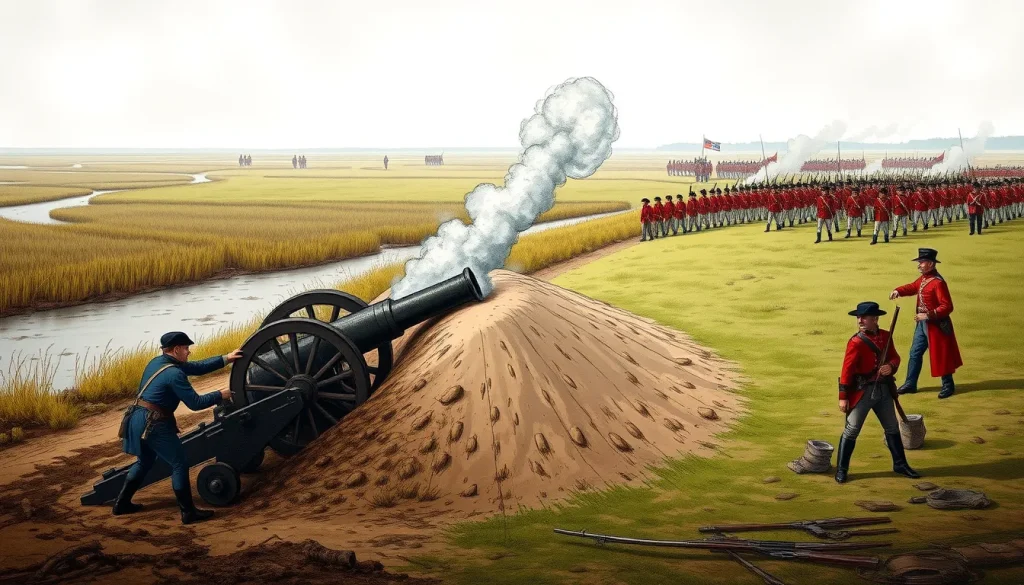
The Battle of New Orleans, fought on January 8, 1815, was the final major land engagement of the War of 1812, and it owed its outcome more to artillery than to any other single factor. Major General Andrew Jackson’s hastily assembled army, protected behind a fortified line along the Rodriguez Canal, used its cannons to devastating effect against a British force of battle-hardened regulars. The American artillery, numbering about twenty-four pieces, broke up the British assault columns at ranges of 400 yards or less, producing a casualty count that was one of the most disproportionate in the war. This article focuses on the organization, equipment, and tactical employment of Jackson’s artillery, and how it proved decisive in the battle of January 8, 1815.
Historical Context
By late 1814, the Napoleonic Wars in Europe had ended with Napoleon’s abdication, freeing large numbers of British regulars and naval resources for service in North America. The British government, eager to end the costly conflict with the United States on favorable terms, launched a multi-pronged campaign. One of the key objectives was the capture of New Orleans, the gateway to the Mississippi River and the interior of the American continent. Control of New Orleans would allow Britain to dominate trade and potentially annex Louisiana territory. British Admiral Sir Alexander Cochrane proposed the expedition in June 1814, and by December a fleet of some fifty ships carried a veteran army toward the Gulf Coast.
On the American side, Major General Andrew Jackson, fresh from his victory over the Creek Nation at the Battle of Horseshoe Bend, arrived in New Orleans on December 1, 1814. He found the city defensively weak and immediately proclaimed martial law, assembling a mixed force of regular U.S. infantry, Marines, sailors, Louisiana militia (including French and Spanish descendants), free men of color, Choctaw warriors, and even Jean Lafitte’s Baratarian pirates. Jackson’s first priority was to establish a defensive line south of the city to block the expected British advance. After a damaging night attack on the British camp on December 23, Jackson withdrew to the Rodriguez Canal, a millrace that ran from the Mississippi River eastward to an impassable swamp. Using slave labor, his men widened the canal and piled the earth into a seven-foot-high rampart, creating the line soon known as “Line Jackson.”
What Happened
The British, commanded by Lieutenant General Sir Edward Pakenham (the Duke of Wellington’s brother-in-law), arrived before Jackson’s line on December 28. After a probing attack that was repulsed, Pakenham decided to bring up his field artillery and bombard the American position. On New Year’s Day, 1815, the British opened a cannonade, but it was ineffective. American gunners, many of them experienced artillerymen, returned fire with greater accuracy and eventually silenced the British guns. The artillery duel demonstrated the superiority of the American defensive position and artillery handling.

Pakenham then planned a full frontal assault for January 8. He would send a diversionary force of about 700 men to cross the Mississippi and capture an American battery on the west bank, while the main attack would strike the east bank line with two columns of roughly 5,000 men each. The plan was to overwhelm the Americans with a quick bayonet charge.
At about 6:20 a.m., the British columns advanced into a heavy mist. As they emerged from the fog, they encountered the American line at a distance of about 400 yards. Jackson’s artillery, positioned in eight batteries along the rampart, opened fire with round shot and then switched to canister and grape when the British came within close range. The effect was devastating. The front ranks of the British were literally mowed down, and the columns faltered. Although the British right column managed to seize an advance redoubt on the American left, that success was soon neutralized by artillery fire from nearby batteries. Pakenham was killed while rallying his men, and his second-in-command was also wounded. Within about thirty minutes, the attack collapsed, with the British suffering over 2,000 casualties (killed, wounded, and taken prisoner) against fewer than a hundred American losses.
Why It Matters
The Battle of New Orleans was a stunning American victory that occurred after the Treaty of Ghent had been signed on December 24, 1814, though the news had not yet reached the combatants. The battle had no effect on the treaty, but it gave the United States a psychological triumph that fueled national pride. It also made Andrew Jackson a national hero, propelling him toward the presidency in 1828. For the British, the defeat was a humiliating end to a costly war, though they soon shifted attention to the final defeat of Napoleon at Waterloo in June 1815.
Historians have long argued about the degree to which the victory was due to American artillery, infantry rifle fire, or the sheer folly of the British frontal assault. Most agree that the artillery played the dominant role, as contemporary reports and later analyses emphasize the heavy concentrations of canister and grape that broke up the British formation. The battle also demonstrated the effectiveness of a well-anchored defensive line supported by artillery, a lesson that would influence military thinking for decades.
Definition
Artillery in the context of the Battle of New Orleans refers to the cannons, howitzers, and mortars used by both sides. The cannon (or gun) was a long-barreled, flat-trajectory weapon firing solid shot, grape, and canister. Howitzers were shorter-barreled pieces that fired explosive shells on an arcing trajectory. Mortars were extremely short-barreled weapons that lobbed shells at very high angles, useful for hitting troops behind fortifications, though they were not used in the battle. The American artillery consisted primarily of six- and twelve-pounder guns, along with a few howitzers, and was augmented by naval guns mounted on portable carriages.
Background
The artillery available to Andrew Jackson came from multiple sources: regular U.S. Army artillery companies, militia units from Tennessee and Kentucky that often brought small cannon, and naval guns from the U.S. schooners Carolina and Louisiana, which had been used to bombard the British during the night attack of December 23. The British, by contrast, had a well-trained artillery arm but were short of field pieces, relying largely on naval guns from Cochrane’s fleet. The American artillery was positioned in a series of batteries along the Rodriguez Canal, with each battery assigned to a specific sector. The center of the line was defended by Batteries 5 and 6, which were manned by U.S. regular artillerymen and proved especially deadly during the January 8 assault.
How It Worked
The American artillery was emplaced behind the earthen rampart, with the guns positioned to fire over the top or through embrasures. The artillerymen had measured the field of fire, and the flat, open ground between the canal and the British approach route provided a clear killing zone. During the British attack, the gunners initially fired solid shot to strike the massed columns at long range, then switched to canister—a tin cylinder filled with iron balls—and grape (smaller balls) as the enemy closed to within 300–400 yards. Canister acted like a giant shotgun, scything down entire ranks. The American line possessed a slight elevation advantage, allowing the gunners to depress their muzzles and sweep the ground effectively. The rapidity and accuracy of the American return fire during the New Year’s Day artillery duel also suppressed the British cannonade, leaving the British infantry without counter-battery support on January 8.
Competing Viewpoints
Historians differ on the relative importance of artillery versus small arms in the Battle of New Orleans. Some scholars argue that the massed volleys of Kentucky and Tennessee riflemen, who used long rifles to devastating effect, were equally culpable in the British casualties. Others contend that artillery was the primary killer, pointing to the close-packed British columns, which offered dense targets, and the fact that muskets and rifles had relatively slow rates of fire. Contemporary British officers reported that they were shot down “shoals” and that the American fire seemed to come from a “fortress.” The debate is not entirely settled, but most military historians assign at least half of the casualties to artillery fire. A further point of contention is whether the British, had they used mortars and howitzers more effectively, could have dislodged the Americans; the marker at Chalmette Battlefield notes that mortars were present but not used, suggesting a missed opportunity.
Role in the War of 1812
Artillery played a crucial role in several other campaigns of the War of 1812, notably at the battles of Plattsburgh and Baltimore, where American defenses repelled British attacks. However, the Battle of New Orleans is often cited as the most dramatic example of defensive artillery winning a battle against a superior infantry force. The engagement demonstrated that a well-served artillery line, anchored by terrain, could inflict catastrophic losses on an attacker, a lesson that would carry over to later wars. The success of Jackson’s artillery also enhanced the prestige of the fledgling U.S. Army’s artillery corps, which would become an integral part of American military doctrine.
Consequences and Historical Interpretation
The immediate consequence of the battle was the British withdrawal and the end of hostilities—though the treaty had already been signed. In the longer term, the victory at New Orleans instilled a lasting sense of American military pride and contributed to the rise of Andrew Jackson as a national figure. Historians have also viewed the battle as a classic example of the advantage of a prepared defensive position. The artillery’s performance has been romanticized in paintings and literature, sometimes exaggerating its numbers and effectiveness. Yet, on the basis of the casualty figures and the testimony of both sides, it is clear that Jackson’s guns were the decisive factor in stopping the British attack. Later scholarship has also noted that the battle’s fame overshadowed the fact that it had no bearing on the peace treaty, a point often raised to temper the celebration.
Primary Sources
The most important primary sources for the artillery’s role are the official reports and correspondence of the commanders. Andrew Jackson’s detailed report to the Secretary of War, dated January 9, 1815, describes the disposition of his batteries and praises his artillerymen. British accounts, such as the letters and memoirs of officers like Major General John Lambert, who succeeded Pakenham, provide a contrasting view; several British officers lamented the “destructive fire” of the American cannons. The diary of a British soldier, Private John A. Sutherland, who served in the 93rd Highlanders, gives a firsthand account of the slaughter. Additionally, the minutes of the British court of inquiry and the testimony of captured officers are housed in the National Archives (UK). These sources confirm the importance of artillery, though they also reveal the confusion and tactical errors that contributed to the disaster.
Further Reading
- Robert V. Remini, The Battle of New Orleans (New York: Viking, 1999) – A standard scholarly history.
- American Battlefield Trust, “Battle of New Orleans: The Last Battle of the War of 1812,” available at battlefields.org.
- Army Historical Foundation, “E Pluribus, Unum: The American Battle Line at New Orleans, 8 January 1815,” by Lt. Col. Edward B. Cummings.
- History.com Editors, “Battle of New Orleans,” History.com (2009, updated 2025).
- Historical Marker Database, “Batteries 5 and 6,” Chalmette Battlefield, Louisiana.
References
- American Battlefield Trust, “Battle of New Orleans: The Last Battle of the War of 1812,” https://www.battlefields.org/learn/articles/battle-new-orleans-last-battle-war-1812 (accessed 2025).
- Army Historical Foundation, “E Pluribus, Unum: The American Battle Line at New Orleans, 8 January 1815,” https://armyhistory.org/e-pluribus-unum-the-american-battle-line-at-new-orleans-8-january-1815/.
- Historical Marker Database, “Batteries 5 and 6,” https://www.hmdb.org/m.asp?m=6271.
- Military.com, “How a Rag-Tag Group of Soldiers, Marines, Choctaw, Militia and Pirates Saved New Orleans From the British,” https://www.military.com/daily-news/investigations-and-features/2025/11/13/how-rag-tag-group-of-soldiers-marines-choctaw-militia-and-pirates-saved-new-orleans-british.html.
- History.com Editors, “Battle of New Orleans,” https://www.history.com/articles/battle-of-new-orleans.
FAQ
Did the American artillery win the Battle of New Orleans?
Most historians agree that artillery was the decisive factor. The American batteries fired canister and grape at the British columns, causing more than half of the casualties. However, rifle fire from the infantry also contributed.
What types of cannons were used by Jackson?
Jackson's artillery consisted of long-barreled guns (mainly 6- and 12-pounders), a few howitzers, and mortars, though the mortars were not used. The guns fired solid shot, grape, and canister.
Why did the British suffer so many casualties?
The British advanced in dense columns across open ground without adequate artillery support. American artillery fired at short range with devastating effect, and the British lacked mortars or howitzers to suppress the American guns.
Leave a Reply