
Short Answer
The Treaty of Greenville, signed on August 3, 1795, at Fort Greenville in present-day Greenville, Ohio, ended the Northwest Indian War between the United States and a coalition of Indigenous nations known as the Western Confederacy. Negotiated by General Anthony Wayne after his victory at the Battle of Fallen Timbers in 1794, the treaty ceded a large portion of the Northwest Territory to the United States and established a boundary line intended to separate American settlement from Indigenous lands. Although the treaty predates the War of 1812 by more than a decade, it reshaped the political geography of the Great Lakes and created grievances, land pressures, and diplomatic precedents that helped set the stage for Indigenous participation in the War of 1812.
Historical Context
After the American Revolution, the United States claimed the Northwest Territory—lands north of the Ohio River and east of the Mississippi—under the 1783 Treaty of Paris. Many Indigenous nations in the region, including the Wyandot, Delaware, Shawnee, Miami, Ottawa, Chippewa, Potawatomi, and others, rejected the British cession of their lands and insisted that the United States had no legitimate claim west of the Ohio River. Between 1785 and 1795, these nations formed the Western Confederacy and fought the Northwest Indian War against American expansion.
The United States suffered early defeats. In 1790, General Josiah Harmar’s expedition was mauled. In 1791, General Arthur St. Clair’s army was routed near the Wabash River in one of the worst defeats in U.S. military history. Britain, which still occupied forts such as Detroit and Michilimackinac in violation of the Treaty of Paris, provided supplies and encouragement to Indigenous nations. The situation changed after President George Washington appointed General Anthony Wayne to command the new Legion of the United States. Wayne trained his troops and advanced into the Ohio Country. On August 20, 1794, he defeated the Western Confederacy at the Battle of Fallen Timbers near present-day Toledo, Ohio. British forces at nearby Fort Miami refused to aid the Indigenous warriors, exposing the limits of British support.
Wayne followed his victory with scorched-earth raids on Indigenous villages and fields, pressuring leaders to negotiate. Meanwhile, the Jay Treaty of 1794, ratified by the U.S. Senate in 1795, eased tensions with Britain and promised British evacuation of frontier posts. Wayne used the Jay Treaty as leverage at the negotiating table, arguing that Indigenous nations could no longer rely on British aid.

What Happened
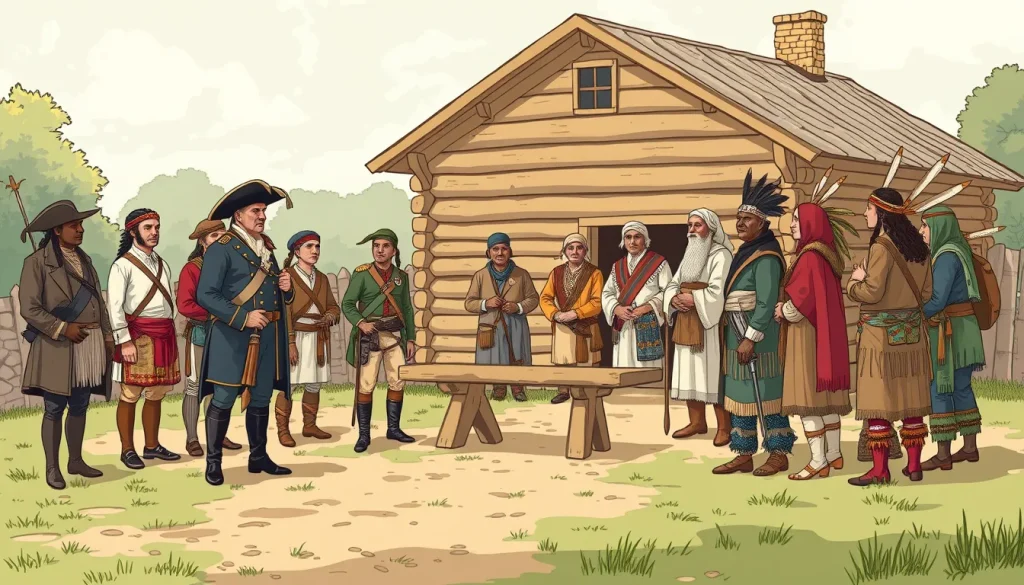
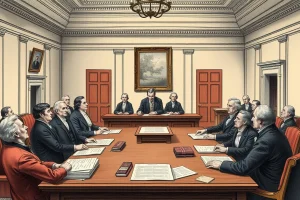
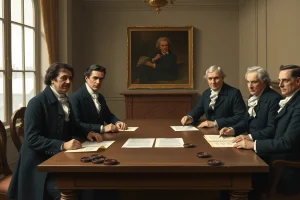
Wayne established Fort Greenville in western Ohio and summoned Indigenous leaders to negotiate. The U.S. delegation included Wayne, William Henry Harrison, William Clark, Meriwether Lewis, Caleb Swan, and William Wells, among others. Indigenous participants included Wyandot chiefs Tarhe, Roundhead, and Leatherlips; Delaware chief Buckongahelas; Shawnee chiefs Blue Jacket and Black Hoof; Ottawa leader Egushawa; Potawatomi leaders such as Gomo, Siggenauk, Black Partridge, Topinabee, and Five Medals; Miami leaders including Little Turtle, White Loon, and Jean Baptiste Richardville; and representatives of the Wea, Kickapoo, Piankeshaw, Kaskaskia, and other nations.
Wayne opened with terms based on earlier treaties—Fort McIntosh (1785), Fort Finney (1786), and Fort Harmar (1789)—that had ceded large tracts in Ohio. Little Turtle of the Miami objected that the Miami had not been parties to those agreements and that the chiefs who signed them had no right to sell Miami lands. For a week, Little Turtle resisted. Wayne revealed that the Jay Treaty would end British support and warned that the United States could take more land by force. Tarhe and other leaders urged acceptance, arguing that continued war would be disastrous. On August 3, 1795, the treaty was signed at Fort Greenville. The U.S. Senate ratified it on December 22, 1795.
The Treaty of Greenville ceded to the United States much of present-day southern and eastern Ohio, along with other lands in the Northwest Territory. It drew a boundary—the Greenville Treaty Line—that began at the mouth of the Cuyahoga River on Lake Erie, ran up the Cuyahoga to the portage, down the Tuscarawas branch of the Muskingum to Fort Laurens, west to Loramie’s Store, west to Fort Recovery, and southwest to the Ohio River opposite the mouth of the Kentucky River. Lands south and east of this line were open to American settlement; lands north and west were reserved as Indigenous territory, though the treaty also included reserved tracts for the United States and for certain Indigenous communities. The United States agreed to pay annual annuities in goods, supplies, and food, and to recognize the tribes as parties to the agreement.
Why It Matters
In the short term, the Treaty of Greenville ended the Northwest Indian War and brought a fragile peace to the Ohio Country. It opened much of Ohio to American settlement, accelerating migration into the Northwest Territory. Ohio became a state in 1803, and the treaty helped establish the legal framework for U.S. expansion across the Old Northwest. For Indigenous nations, the treaty was a severe loss. It ceded hunting grounds, forced communities onto smaller reserved areas, and made them increasingly dependent on federal annuities. Not all nations or leaders accepted the treaty, and many regarded it as invalid because it was signed under duress and did not represent the consensus of all Indigenous peoples.
The peace proved temporary. After 1800, American settlers crossed the Greenville Treaty Line in increasing numbers, often with little federal enforcement. Shawnee leaders Tecumseh and Tenskwatawa built a new confederacy in the early 1800s, rejecting land cessions made at Greenville and later treaties. Their movement led to the Battle of Tippecanoe in 1811 and then to alliances with Britain during the War of 1812. Many Indigenous nations in the Great Lakes region saw the war as an opportunity to halt American expansion and recover lands lost at Greenville. The Treaty of Ghent in 1814 ended the war but did not restore Indigenous sovereignty or lands; subsequent U.S. treaties forced further cessions.
Historians interpret the Treaty of Greenville in competing ways. Older American accounts often portray it as a necessary peace that secured the frontier and demonstrated U.S. authority. Modern historians, including Indigenous scholars, emphasize coercion, land theft, and the treaty’s role in settler colonialism. Some argue the treaty was a pragmatic compromise that delayed conflict; others contend it made later wars more likely by creating unresolved grievances and a boundary that the United States did not respect.
Document
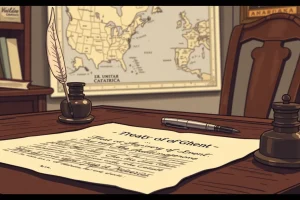
The Treaty of Greenville is formally titled ‘A treaty of peace between the United States of America, and the tribes of Indians called the Wyandots, Delawares, Shawanees, Ottawas, Chippewas, Pattawatimas, Miamis, Eel Rivers, Weas, Kickapoos, Piankeshaws, and Kaskaskias.’ It is also known as the Treaty with the Wyandots, etc. It is a diplomatic instrument signed at Fort Greenville and ratified by the U.S. Senate.
Date
The treaty was signed on August 3, 1795. The U.S. Senate ratified it on December 22, 1795.
Author
The treaty was not authored by a single person. It was negotiated by U.S. commissioners led by General Anthony Wayne, with assistance from William Henry Harrison, William Clark, Meriwether Lewis, Caleb Swan, and William Wells. Indigenous signatories included leaders from the Wyandot, Delaware, Shawnee, Ottawa, Chippewa, Potawatomi, Miami, Eel River, Wea, Kickapoo, Piankeshaw, and Kaskaskia nations.
Historical Context
The document emerged from the Northwest Indian War and the U.S. victory at Fallen Timbers. It reflected American military power, British withdrawal under the Jay Treaty, and deep divisions within the Western Confederacy. It also built on earlier treaties that the United States used to justify its claims to Indigenous lands.
Transcript
A complete verified transcript is not reproduced in this article. The official text is published in the U.S. Statutes at Large, 7 Stat. 49, and in Charles J. Kappler, ed., Indian Affairs: Laws and Treaties, Vol. II (Treaties). Researchers should consult those published editions or the original manuscript held in U.S. government records rather than relying on unverified transcriptions.
Modernized Transcript
Because a complete transcript is not reproduced here, a modernized transcript is also omitted. Modernization would require careful editorial comparison with the original manuscript and published treaty text. Readers seeking a modernized version should consult scholarly editions or the Kappler compilation and note any editorial changes.
What the Document Tells Us
The treaty documents the formal cession of Indigenous lands to the United States, the creation of the Greenville Treaty Line, the promise of annual annuities, and the U.S. assertion of sovereignty over the Northwest Territory. It shows that the United States treated Indigenous nations as parties capable of signing treaties, even as it denied their full sovereignty. It also reveals how U.S. negotiators used earlier treaties and the Jay Treaty to pressure leaders. The treaty records signatures from many nations, but it does not capture the dissent of those who opposed the agreement or the oral understandings that may have accompanied it.
Limitations and Bias of the Source
The Treaty of Greenville is a legal document written in English from the U.S. perspective. It records the terms the United States wanted enforced, not the full range of Indigenous viewpoints. It omits the voices of women, non-signatory warriors, and communities that rejected the treaty. The document also reflects the power imbalance of the negotiations: Wayne held military superiority and used threats and promises of annuities to secure signatures. Historians must read it alongside Indigenous oral histories, correspondence, and later testimony to understand its contested meanings.
Citation
Treaty of Greenville, August 3, 1795, 7 Stat. 49. Also in Charles J. Kappler, ed., Indian Affairs: Laws and Treaties, Vol. II (Treaties) (Washington, D.C.: Government Printing Office, 1904).
Primary Sources
Key contemporary sources include the treaty text itself, published in the U.S. Statutes at Large and Kappler’s compilation. The Anthony Wayne Papers at the Historical Society of Pennsylvania and the Library of Congress contain Wayne’s orders, letters, and reports from the campaign and negotiations. American State Papers: Indian Affairs, Vol. 1, includes correspondence, speeches, and minutes from the Greenville negotiations, including Little Turtle’s objections. William Henry Harrison’s papers and the records of the War Department also provide context. These sources are largely U.S. documents, often recorded through interpreters and American scribes, and they tend to minimize Indigenous agency and dissent. They should be balanced with Indigenous oral traditions and later scholarship.
Further Reading
- Colin G. Calloway, The Victory with No Name: The Native American Defeat of the First American Army (Oxford University Press, 2015).
- Richard White, The Middle Ground: Indians, Empires, and Republics in the Great Lakes Region, 1650–1815 (Cambridge University Press, 1991).
- Wiley Sword, President Washington’s Indian War: The Struggle for the Old Northwest, 1790–1795 (University of Oklahoma Press, 1985).
- John Sugden, Blue Jacket: Warrior of the Shawnees (University of Nebraska Press, 2000).
- David Andrew Nichols, Red Gentlemen and White Savages: Indians, Federalists, and the Search for Order on the American Frontier (University of Virginia Press, 2008).
- Eric Hemenway, ‘Summer 1795: The Treaty of Greenville creates an uneasy peace,’ National Park Service, March 6, 2015.
References
- Treaty of Greenville, August 3, 1795, 7 Stat. 49; Charles J. Kappler, ed., Indian Affairs: Laws and Treaties, Vol. II (Treaties) (Washington, D.C.: Government Printing Office, 1904).
- ‘Treaty of Greenville,’ Wikipedia, https://en.wikipedia.org/wiki/Treaty_of_Greenville.
- Eric Hemenway, ‘Summer 1795: The Treaty of Greenville creates an uneasy peace,’ National Park Service, March 6, 2015, https://www.nps.gov/articles/a-long-legacy.htm.
- Colin G. Calloway, The Victory with No Name: The Native American Defeat of the First American Army (Oxford University Press, 2015).
- Richard White, The Middle Ground: Indians, Empires, and Republics in the Great Lakes Region, 1650–1815 (Cambridge University Press, 1991).
- Wiley Sword, President Washington’s Indian War: The Struggle for the Old Northwest, 1790–1795 (University of Oklahoma Press, 1985).
FAQ
What was the Treaty of Greenville?
The Treaty of Greenville was a 1795 agreement between the United States and a coalition of Indigenous nations known as the Western Confederacy. Signed at Fort Greenville in present-day Ohio, it ended the Northwest Indian War and ceded large areas of the Northwest Territory to the United States.
How did the Treaty of Greenville affect the Northwest Territory?
It opened much of present-day southern and eastern Ohio to American settlement, established the Greenville Treaty Line, and created a system of annual annuities for Indigenous nations. It also accelerated U.S. expansion and set the stage for further conflicts.
How did the Treaty of Greenville contribute to the War of 1812?
The treaty created an uneasy peace that did not stop American expansion. Many Indigenous nations rejected its land cessions, and by the early 1800s Tecumseh and Tenskwatawa built a confederacy to resist U.S. encroachment. During the War of 1812, many Indigenous nations allied with Britain hoping to reverse the losses imposed at Greenville.
Leave a Reply