
Short Answer
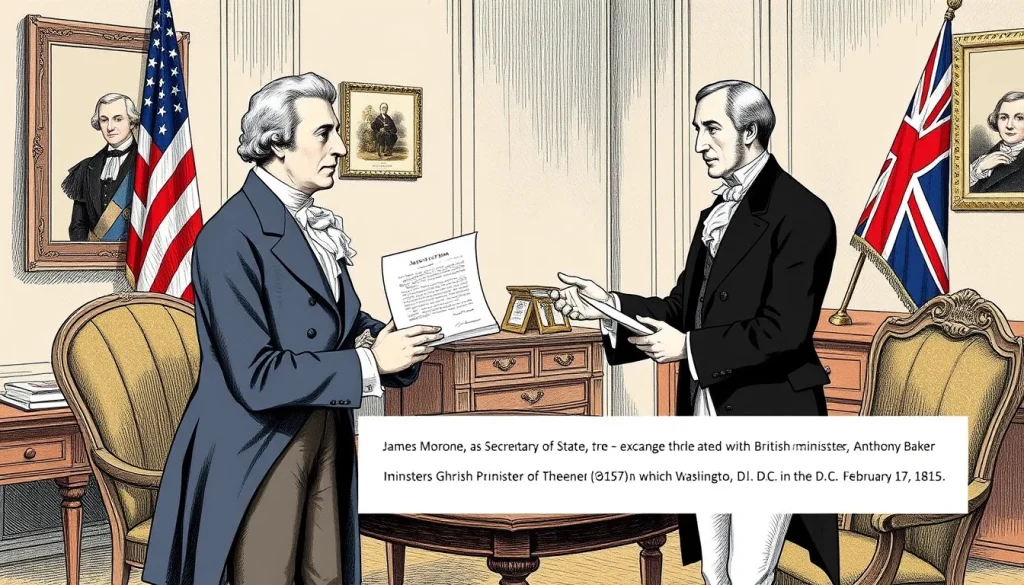
James Monroe, serving as U.S. Secretary of State throughout the War of 1812, played a central administrative role in the ratification of the Treaty of Ghent. Although he was not among the American peace commissioners at Ghent, Monroe managed the diplomatic correspondence, advised President James Madison, and executed the final steps that brought the war to a formal close. His actions on February 16–17, 1815, culminating in the exchange of ratifications with British minister Anthony Baker, marked the official end of the conflict and underscored the importance of executive leadership in treaty processes.
Historical Context
The War of 1812 had its origins in maritime disputes, British impressment of American sailors, and tensions along the U.S.–Canadian frontier. By late 1814, both nations were war-weary, and negotiations opened in Ghent, Belgium. American commissioners John Quincy Adams, Albert Gallatin, James A. Bayard, Henry Clay, and Jonathan Russell faced a demanding British delegation. The Treaty of Ghent, signed on December 24, 1814, did not address the original maritime grievances but restored prewar boundaries. Ratification under the U.S. Constitution required approval by a two-thirds Senate vote and the president’s signature, followed by an exchange of ratifications with the British government. The Senate’s role was complicated by the fact that the British had insisted the treaty be accepted without amendment.
What Happened
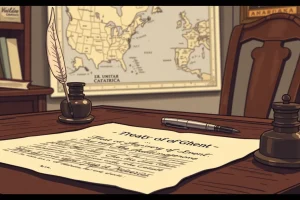
The treaty document arrived in Washington on February 14, 1815, after a six-week transatlantic voyage. Secretary of State James Monroe, as the president’s principal diplomatic adviser, immediately took charge of the ratification process. On February 16, President James Madison submitted the treaty to the Senate, which unanimously approved it by a vote of 35 to 0. Madison ratified the treaty later that day. Monroe then arranged for the formal exchange of ratifications with British representatives. On February 17, 1815, Monroe presented the signed treaty to British minister Anthony Baker, and the treaty became binding under international law. He also dispatched copies of the treaty to military commanders, including a letter to Colonel Thomas Miller dated February 14, 1815, informing him that “hostilities may immediately cease between our troops and those of Great Britain.” Monroe’s actions ensured that the armistice took effect as quickly as possible across all fronts.
Why It Matters
Monroe’s role was essential in translating the negotiated peace into an actual cessation of hostilities. His careful management of the ratification timeline allowed the United States to conclude the war promptly, despite the complicating factor of the Battle of New Orleans (January 8, 1815), which had been fought after the treaty was signed but before ratification. The unanimous Senate approval reflected both relief and the psychological boost of Jackson’s victory. Monroe’s diplomatic tact and administrative efficiency helped prevent any postwar disputes over procedural details. The exchange of ratifications on February 17, 1815, signaled the beginning of a long period of peaceful relations with Great Britain and contributed to the nationalist fervor of the “Era of Good Feelings.”

Definition
James Monroe’s role in the Treaty of Ghent ratification refers to his duties as Secretary of State from the treaty’s arrival in Washington until the exchange of ratifications. This included receiving the document, advising the president, coordinating with the Senate, preparing official copies, and executing the final diplomatic exchange that made the treaty legally effective.
Background
Monroe had extensive diplomatic experience before becoming Secretary of State in 1811, including service as minister to France and Britain. He was a close confidant of President Madison and had been a leading figure in shaping U.S. foreign policy during the war. Although he was not a commissioner at Ghent, he maintained ongoing correspondence with the American envoys and contributed to strategic guidance. His understanding of European diplomacy and his experience in executive governance made him well-suited to handle the ratification process.
How It Worked
The ratification process followed the steps laid out in the Constitution and customary international practice. After the treaty was signed, it was sent to Washington. Monroe, as Secretary of State, formally received the document and presented it to President Madison. Madison then sent it to the Senate with a message. The Senate debated and voted on February 16, 1815, approving without amendment. Madison signed the ratification instrument, and Monroe affixed the Great Seal and prepared the exchange copies. He then met with the British minister, Anthony Baker, to exchange ratifications, an act that finalized the treaty. Monroe also used his authority to distribute copies to military commands to ensure the cessation of hostilities was widely known.
Competing Viewpoints
Historians largely agree that Monroe’s administrative role was proficient, but interpretations differ on the extent of his personal influence over the treaty’s terms. Some emphasize that the American commissioners at Ghent deserve the credit for the treaty’s outcome, while others point to Monroe’s behind-the-scenes advice to Madison and the commissioners as crucial. A few scholars argue that Monroe’s role was merely ceremonial, given that the Senate vote was unanimous and Madison made the key decisions. However, Monroe’s handling of the exchange and his swift communication to the fronts demonstrate that his actions were important for implementing the peace.
Role in the War of 1812
Monroe’s actions brought the War of 1812 to a definitive close. His role in the ratification was the final step in a conflict that had seen the burning of Washington, the defense of Baltimore, and Andrew Jackson’s victory at New Orleans. By ensuring a prompt and orderly ratification, Monroe helped the United States end the war without further territorial losses and facilitated the transition to peacetime policies. His work also established precedents for how the executive branch could manage treaty ratifications, a legacy that influenced subsequent administrations.
Consequences and Historical Interpretation
The ratification of the Treaty of Ghent had immediate consequences: hostilities ceased, prisoners were exchanged, and occupied territories were restored. Over the long term, the treaty’s failure to address impressment was rendered moot by the end of the Napoleonic Wars. Monroe’s role in the ratification contributed to his reputation as a capable statesman, helping pave the way for his election to the presidency in 1816. Historical interpretation has generally cast Monroe’s actions as efficient and patriotic, though some have noted that the treaty itself was a compromise that left many American war aims unfulfilled. Yet the ratification process itself was a model of constitutional governance, and Monroe’s execution of it has been largely overlooked in favor of the dramatic events of the war.
Primary Sources
The most relevant primary sources include the Senate Executive Journal for February 16, 1815, which records the unanimous vote; President Madison’s message to the Senate transmitting the treaty; and Secretary of State Monroe’s official correspondence, including his letter of February 14, 1815, to Colonel Thomas Miller. This letter, held in the Gilder Lehrman Collection, explicitly states that hostilities should cease. The treaty itself, along with its ratification instruments, is preserved in the National Archives. Monroe’s personal papers also provide insight into his actions during this period.
Further Reading
- Stagg, J. C. A. The War of 1812: Conflict for a Continent. Cambridge University Press, 2012.
- Hickey, Donald R. The War of 1812: A Forgotten Conflict. University of Illinois Press, 1989.
- Ammon, Harry. James Monroe: The Quest for National Identity. University of Virginia Press, 1990.
- Taylor, Alan. The Civil War of 1812: American Citizens, British Subjects, Irish Rebels, & Indian Allies. Knopf, 2010.
- The Gilder Lehrman Institute of American History, for access to Monroe’s letter to Thomas Miller.
References
- “The Senate Approves for Ratification the Treaty of Ghent.” U.S. Senate. https://www.senate.gov/about/powers-procedures/treaties/senate-approves-treaty-of-ghent.htm.
- Palmer, Aaron J. “The United States Ratification of the Treaty of Ghent.” Varsity Tutors. https://www.varsitytutors.com/earlyamerica/early-america-review/volume-6/treaty-of-ghent.
- “James Monroe to Thomas Miller forwarding a copy of the Treaty of Ghent to the Northern Front.” American History 1493-1945, Adam Matthew Digital. https://www.americanhistory.amdigital.co.uk/Documents/Details/James-Monroe-to-Thomas-Miller-forwarding-a-copy-of-the-Treaty-of-Ghent-to-the-Northern-Front/GLC07980.
- “Treaty of Ghent, Summary, Facts, Significance.” American History Central. https://www.americanhistorycentral.com/entries/treaty-of-ghent/.
FAQ
What specifically did James Monroe do in the Treaty of Ghent ratification?
Monroe received the treaty, advised President Madison, coordinated with the Senate, and on February 17, 1815, exchanged ratified copies with the British minister, officially ending the war.
Why was Monroe's role significant if he was not a commissioner at Ghent?
Monroe handled the entire ratification process, ensuring the treaty was quickly approved and executed. His actions made the peace tangible and avoided delays in ceasing hostilities.
Did Monroe's involvement affect his later political career?
Yes, his efficient handling of the ratification contributed to his reputation as a statesman and likely aided his election to the presidency in 1816.
Leave a Reply