
Short Answer
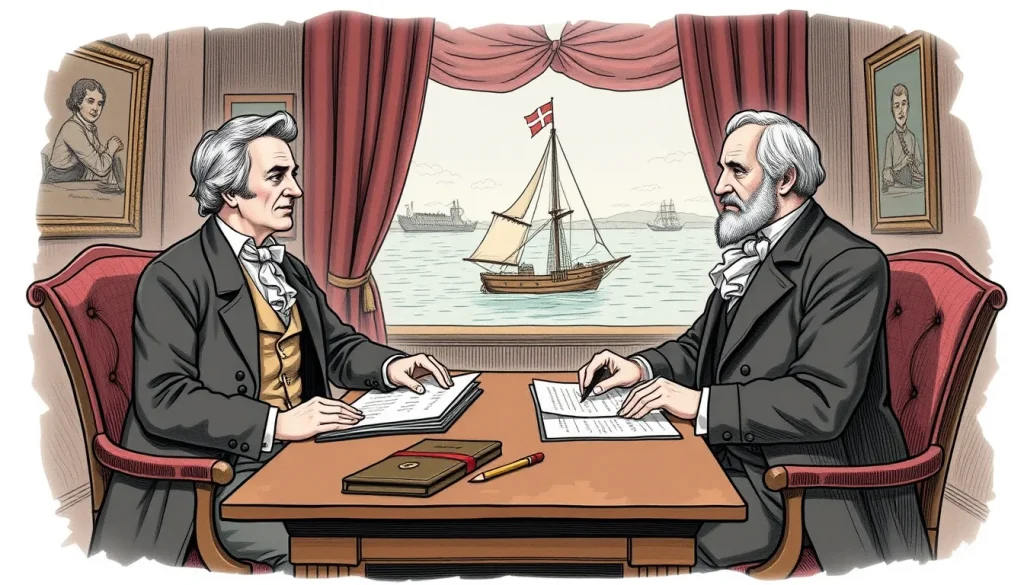
The Rush-Bagot Agreement, also known as the Rush-Bagot Pact or Treaty, was an exchange of diplomatic notes between the United States and Great Britain, concluded in 1817, that limited naval armaments on the Great Lakes and Lake Champlain. This agreement arose directly from the tensions and costs of the War of 1812 and is historically significant as a landmark disarmament measure that helped shape the long-term peaceful border between the United States and British North America (now Canada).
Historical Context
During the War of 1812, both the United States and Great Britain built substantial naval fleets on the Great Lakes, engaging in battles such as the Battle of Lake Erie (1813) and the Battle of Plattsburgh (1814). These fleets were costly to maintain and had become a source of tension even after the war ended. The Treaty of Ghent, signed in December 1814, restored pre-war boundaries but contained no provisions for disarmament. Consequently, both nations continued a naval shipbuilding race on the lakes throughout 1815 and 1816. At the same time, postwar trade between the United States and Britain rebounded, and British leaders began to see the United States as a valuable partner. British North America was expensive to defend, and another war seemed undesirable. This diplomatic climate opened the door for negotiations on limiting naval forces.
What Happened
In the summer of 1815, U.S. Secretary of State James Monroe proposed to British Foreign Secretary Lord Castlereagh that the two countries limit their naval forces on the Great Lakes. Monroe suggested one vessel on Lake Ontario and two on the upper lakes—a proposal that was initially overlooked. In late 1816, Sir Charles Bagot, the British minister to the United States, received instructions to pursue an improved relationship. After informal talks with Monroe and later with Acting Secretary of State Richard Rush, the exchange of notes took place on April 28–29, 1817. The notes specified that each side could maintain one vessel not exceeding 100 tons burden and armed with one 18-pounder cannon on Lake Ontario, two similar vessels on the Upper Lakes, and one on Lake Champlain. All other armed vessels were to be dismantled, and no new warships could be built on those waters. The agreement also included a six-month termination notice clause. The U.S. Senate ratified the agreement on April 28, 1818, while Britain considered the exchange of notes sufficient.
Why It Matters
The Rush-Bagot Agreement effectively ended the naval race on the Great Lakes, reducing the risk of accidental conflict and the financial burden of maintaining large fleets. It is often cited as the diplomatic origin of the demilitarized and peaceful Canada–U.S. border. However, the agreement applied only to naval vessels; both countries continued to build and maintain land fortifications for decades. Its symbolism grew over time, especially in the 20th century, when it was invoked as a model for arms control and a testament to the enduring friendship between the two nations.
Definition
The Rush-Bagot Agreement is a formal exchange of diplomatic notes between Richard Rush, acting Secretary of State of the United States, and Sir Charles Bagot, British minister to Washington. It is an executive agreement rather than a treaty under U.S. law, though it has often been referred to as a treaty. The agreement restricted military naval vessels on the Great Lakes and Lake Champlain to small, lightly armed patrol craft and prohibited the construction of new warships there.
Background
Proposals to disarm the Great Lakes had been floated even before the War of 1812. During negotiations for the 1794 Jay Treaty, American envoys suggested limiting naval forces on the lakes, but the British declined. The war itself demonstrated the strategic importance of these inland seas, and both sides invested heavily in shipbuilding. After the war, financial constraints and a growing desire for normalized relations pushed both governments toward a compromise. The exchange of notes in 1817 built on earlier correspondence, including Monroe’s note of August 2, 1816, and was shaped by the broader diplomatic context of the postwar period.
How It Worked
The agreement set specific limits: one vessel on Lake Ontario, two on the Upper Lakes (Lake Erie, Lake Huron, Lake Michigan, and Lake Superior), and one on Lake Champlain. Each vessel was limited to 100 tons burden and armed with a single 18-pounder cannon. All other armed vessels were to be dismantled. The agreement allowed either party to give six months’ notice to annul it. Over time, both sides interpreted the limits flexibly to accommodate changing needs, such as training naval reserves, but they consistently sought to preserve the agreement’s spirit.
Competing Viewpoints
Historians and legal scholars have debated the agreement’s scope and effectiveness. Some view it as a groundbreaking disarmament accord that established a precedent for arms control and set the stage for the peaceful border. Others note that it was limited to naval forces and did not address land fortifications, which continued to be built along the border for decades. Additionally, both nations occasionally deviated from its strict terms, especially during the First and Second World Wars, when they needed naval forces on the lakes for training and transport. Nevertheless, most scholars concur that the agreement’s primary significance lies in its symbolic value and its role in fostering mutual trust.
Role in the War of 1812
The Rush-Bagot Agreement was a direct consequence of the War of 1812, stemming from the military buildup and the subsequent desire to avoid a costly arms race. The war had demonstrated the destructiveness of naval conflict on the Great Lakes, and the agreement was an explicit attempt to prevent a recurrence. It did not affect the causes of the war but rather addressed one of its key theaters and helped to normalize Anglo-American relations in the postwar period.
Consequences and Historical Interpretation
Immediately, the agreement led to the dismantling of warships and a reduction in military spending. Over the long term, it contributed to the demilitarization of the Canada–U.S. border, which remains largely unfortified today. Historians have interpreted the agreement as a turning point in Anglo-American relations, marking a shift from confrontation to cooperation. However, they also caution against overstating its practical impact, as land fortifications continued and the agreement was occasionally violated in spirit. The agreement has become a powerful symbol, frequently cited in diplomatic rhetoric and arms control discussions.
Primary Sources
The primary sources for the Rush-Bagot Agreement are the two diplomatic notes exchanged on April 28 and April 29, 1817. The first note, from Sir Charles Bagot to Richard Rush, conveyed the Prince Regent’s acceptance of the U.S. proposal. The second, from Rush to Bagot, recorded the U.S. agreement to the terms. These notes are housed in the U.S. National Archives and are reproduced on the website of Global Affairs Canada. They are invaluable for understanding the precise wording and limitations of the agreement. A limitation is that they are diplomatic correspondence, reflecting the formal positions of the two governments rather than the internal debates or later interpretations.
Further Reading
- Office of the Historian, U.S. Department of State, “Rush-Bagot Pact, 1817 and Convention of 1818,” https://history.state.gov/milestones/1801-1829/rush-bagot.
- “Rush-Bagot Agreement,” The Canadian Encyclopedia, https://thecanadianencyclopedia.ca/en/article/rush-bagot-agreement.
- Exchange of Notes Between the United Kingdom and the United States Concerning the Naval Forces to Be Maintained on the Great Lakes (Rush-Bagot Agreement), https://www.treaty-accord.gc.ca/text-texte.aspx?id=101662.
- Exchange of Notes Relating to the Application and Interpretation of the Rush-Bagot Agreement, 1939, https://www.treaty-accord.gc.ca/text-texte.aspx?id=101663.
References
- Office of the Historian, U.S. Department of State, “Rush-Bagot Pact, 1817 and Convention of 1818,” https://history.state.gov/milestones/1801-1829/rush-bagot.
- The Canadian Encyclopedia, “Rush-Bagot Agreement,” https://thecanadianencyclopedia.ca/en/article/rush-bagot-agreement.
- Global Affairs Canada, “Exchange of Notes … (Rush-Bagot Agreement), 1817,” https://www.treaty-accord.gc.ca/text-texte.aspx?id=101662.
- Global Affairs Canada, “Exchange of Notes Relating to the Application … (1939),” https://www.treaty-accord.gc.ca/text-texte.aspx?id=101663.
FAQ
What did the Rush-Bagot Agreement specifically ban?
It limited each side to one or two small patrol vessels on each of the Great Lakes and Lake Champlain, and banned the construction of new warships on those waters.
Is the Rush-Bagot Agreement still in effect today?
Yes, the agreement remains in force, though both countries have occasionally interpreted it flexibly and have updated its application through mutual consent.
Why was the agreement named 'Rush-Bagot'?
It is named after the two diplomats who exchanged the notes: Richard Rush of the United States and Sir Charles Bagot of Great Britain.



Leave a Reply