
Short Answer
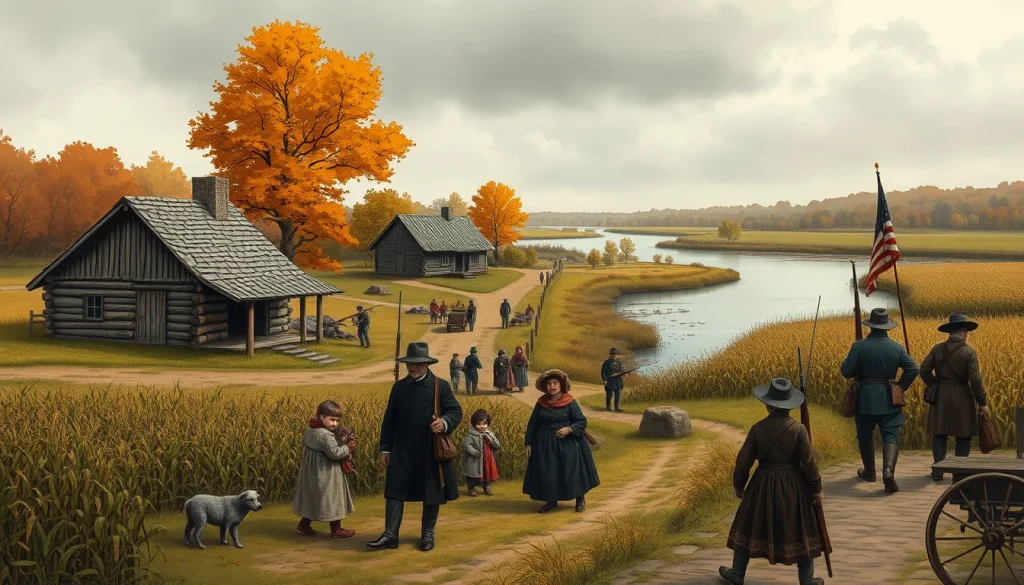
The Moravian community at Moraviantown—also known as Fairfield—was a settlement of Christian Delaware (Lenape) people and Moravian missionaries on the north bank of the Thames River in Upper Canada. During the War of 1812, its location placed it directly in the path of the British retreat and the Battle of the Thames on October 5, 1813. Two days later, American forces burned the village, displacing civilians and destroying homes, farms, and mission buildings. The episode is historically significant because it shows how a pacifist Indigenous community experienced the war as civilians rather than combatants.
Historical Context
The Moravian Church, a Protestant denomination with roots in central Europe, conducted extensive missionary work among Indigenous nations in colonial North America. In the Ohio country, Moravian missionaries gathered Delaware (Lenape) converts into settled communities. Their pacifism made them suspect during the American Revolution. In March 1782, American militia killed about one hundred Christian Delaware at Gnadenhutten, Ohio. Survivors fled to Michigan, then returned to Ohio, and eventually sought refuge in British territory.
In April 1792, a group of roughly 150 Christian Delaware and several Moravian missionaries, led by David Zeisberger, settled on the Thames River in Upper Canada. Lieutenant-Governor John Graves Simcoe promised them land. They named the settlement Fairfield. Located on the north bank of the Thames between the present-day communities of Bothwell and Thamesville, Ontario, Fairfield became a self-sufficient agricultural village with log houses, a meeting house, a school, and cultivated fields. The Moravian Delaware were loyal to the British Crown but tried to remain neutral in the mounting conflict between Britain and the United States.
The Thames River was a strategic corridor linking the Detroit frontier to the interior of Upper Canada. When the United States declared war on Britain in June 1812, the western Great Lakes region became a major theatre. British forces relied heavily on Indigenous allies, including Tecumseh’s confederacy. American invasions threatened Detroit and Amherstburg. By September 1813, after the Battle of Lake Erie, American naval control forced the British to abandon Detroit and retreat up the Thames. That retreat led directly through Moraviantown.
What Happened
For the first year of the war, Fairfield was not directly attacked, but civilian life was disrupted. Military traffic, shortages, and fear of invasion affected the community. Moravian diaries from the period record anxiety and uncertainty. In September 1813, British General Henry Procter withdrew his army and Indigenous allies from the Detroit frontier. They moved up the Thames River, passing through Moraviantown. American General William Henry Harrison pursued with a larger force.
On October 5, 1813, the two armies met near Moraviantown in the Battle of the Thames. The British line quickly collapsed. Tecumseh was killed, and his Indigenous confederacy suffered a severe blow. Harrison’s army occupied the area. Two days later, on October 7, 1813, American forces burned Fairfield. According to the Ohio History Journal account by Frederick Coyne Hamil, the destruction of the Moravian village was a sequel to the battle that American histories often omitted. The Americans plundered and destroyed the settlement, including mission buildings, homes, and stored food. Civilians had largely fled before the burning, but they lost their homes, livestock, and personal property. The community was scattered, and the mission was devastated.
After the American withdrawal, some Moravian Delaware returned to the region. They eventually re-established a settlement that continues today as the Moravian of the Thames First Nation. The original village of Fairfield, however, was never rebuilt on the same site. The events of October 1813 marked a sharp rupture in the community’s history.
Why It Matters
The destruction of Fairfield illustrates the civilian cost of the War of 1812, particularly for Indigenous noncombatants. The Moravian Delaware had adopted Christianity and pacifism, and they did not take up arms. Yet their location on a strategic river and their association with the British made them vulnerable. The burning of the village destroyed not only shelter and food but also the records and institutions of a mission community. The immediate effects included displacement, exposure, and loss of livelihood as winter approached.
In the longer term, the war accelerated changes already underway in the Great Lakes region. Indigenous nations faced increasing pressure from American expansion and shifting British policies. The Moravian community’s experience complicates traditional military narratives that focus on battles and commanders. It raises questions about British protection of Indigenous allies and about American military policy toward civilian property. Historians disagree about whether the burning of Fairfield was a deliberate strategic decision to deny British supplies or an act of plunder by soldiers. The lack of detailed American records, alongside the religious focus of Moravian diaries, leaves uncertainties.
Historical memory of the event is preserved at the Fairfield Museum and National Historic Site, which interprets the Moravian mission and the War of 1812. The site serves as a reminder that the war affected civilians—especially Indigenous civilians—in ways that are often overlooked in accounts centered on military engagements.
Definition
The Moravian community at Moraviantown refers to the Christian Delaware settlement of Fairfield and its Moravian missionaries. The central historical question is how the War of 1812 affected civilian life in this community: its safety, food supply, housing, religious practice, and social cohesion.
Background
The community was founded in 1792 by Delaware converts and Moravian missionaries fleeing violence in the United States. They received land from the British authorities in Upper Canada and built Fairfield as a planned village. The residents practiced a communal form of Christianity shaped by Moravian discipline. They farmed corn, wheat, and vegetables, raised livestock, and traded with British settlers and other Indigenous nations. Their pacifism set them apart from the warrior societies around them, but it did not shield them from the war.
How Civilian Life Was Organized
Before the war, daily life at Fairfield revolved around agriculture, worship, and education. The village had log houses, a meeting house, and a school. Moravian missionaries kept detailed diaries that recorded weather, crops, religious services, births, deaths, and visits. Delaware leaders managed community affairs alongside the missionaries. The community was largely self-sufficient, though it depended on trade for tools, cloth, and some foodstuffs. When war came, this routine was disrupted by troop movements, requisitions, and the threat of violence. Civilians faced difficult choices: stay and risk destruction, or flee and abandon their homes and crops.
Competing Viewpoints
Interpretations of the destruction of Fairfield vary. Some historians and local accounts emphasize that American forces deliberately targeted British property, including the Moravian mission, as part of a broader strategy to weaken British and Indigenous resistance. Others argue that the burning was more chaotic—an act of plunder and retaliation by soldiers after a hard-fought battle. Moravian records portray the community as peaceful and innocent, highlighting the tragedy of civilian suffering. American military reports tend to focus on the battle’s outcome and may not mention the village’s destruction in detail. British accounts sometimes criticize Procter’s leadership and the failure to protect Indigenous allies. These differing perspectives reflect the fragmented nature of the evidence and the different purposes of the sources.
Role in the War of 1812
The Moravian community was not a military participant. However, its location on the Thames River made it strategically significant. The British retreat passed through Moraviantown, and the Battle of the Thames was fought nearby. After the battle, the destruction of Fairfield formed part of American operations in the region. The community’s experience demonstrates how Indigenous civilians could be drawn into the war despite their neutrality. It also shows the limits of British protection for Indigenous allies.
Consequences and Historical Interpretation
The immediate consequences for the Moravian Delaware were severe: loss of homes, food stores, livestock, and mission property. Many civilians became refugees. The community’s religious and educational institutions were disrupted. Some Moravian Delaware eventually returned and re-established a settlement, but the original Fairfield was gone. Historians interpret the event as a case study in the war’s impact on noncombatants and on Indigenous mission communities. It also contributes to debates about American military conduct and British-Indigenous relations. The site is now commemorated as a National Historic Site, and the Moravian of the Thames First Nation continues to maintain its heritage.
Primary Sources
The most important contemporary sources are the Moravian diaries and congregation records from Fairfield, which cover the years before and during the War of 1812. These records were kept by missionaries and provide details about daily life, war anxiety, and the destruction of the village. They are held in Moravian archives and were used by Frederick Coyne Hamil in his 1939 article “Fairfield on the River Thames.” American military reports, such as William Henry Harrison’s official report after the Battle of the Thames, describe the battle but generally do not focus on civilian suffering. British reports by Henry Procter offer a military perspective and are often defensive. These sources have limitations: Moravian diaries are religious in focus, American reports may justify destruction, and British accounts may shift blame. No verified transcript of a specific diary entry is reproduced here; readers should consult the Moravian Archives or published editions for exact wording.
Further Reading
- Frederick Coyne Hamil, “Fairfield on the River Thames,” Ohio Archaeological and Historical Quarterly 48 (1939).
- Fairfield Museum and National Historic Site, Parks Canada.
- Moravian Archives, Bethlehem, Pennsylvania.
- Alan Taylor, The Civil War of 1812: American Citizens, British Subjects, Irish Rebels, & Indian Allies (2010).
- Donald R. Hickey, The War of 1812: A Forgotten Conflict (1989).
- C. A. Weslager, The Delaware Indians: A History (1972).
References
- Frederick Coyne Hamil, “Fairfield on the River Thames,” Ohio Archaeological and Historical Quarterly 48 (1939). https://resources.ohiohistory.org/ohj/search/display.php?ipp=20&page=3&pages=1-19&searchterm=Array&vol=48
- Community Stories, “Fairfield Mission.” https://www.communitystories.ca/v1/pm_v2.php?ex=810&fl=0&id=story_line_child&lg=English&pos=1&sl=8855
- Alan Taylor, The Civil War of 1812: American Citizens, British Subjects, Irish Rebels, & Indian Allies (New York: Alfred A. Knopf, 2010).
- Donald R. Hickey, The War of 1812: A Forgotten Conflict (Urbana: University of Illinois Press, 1989).
- C. A. Weslager, The Delaware Indians: A History (New Brunswick, NJ: Rutgers University Press, 1972).
FAQ
Where was the Moravian community at Moraviantown?
It was on the north bank of the Thames River in Upper Canada, near the present-day communities of Bothwell and Thamesville, Ontario.
What happened to Fairfield during the War of 1812?
American forces burned the village on October 7, 1813, two days after the Battle of the Thames, destroying homes, farms, and mission buildings.
How did civilians experience the war?
The pacifist Moravian Delaware faced displacement, loss of homes, food, and livestock. Many fled before the burning, and the community was scattered.
Leave a Reply