
Short Answer
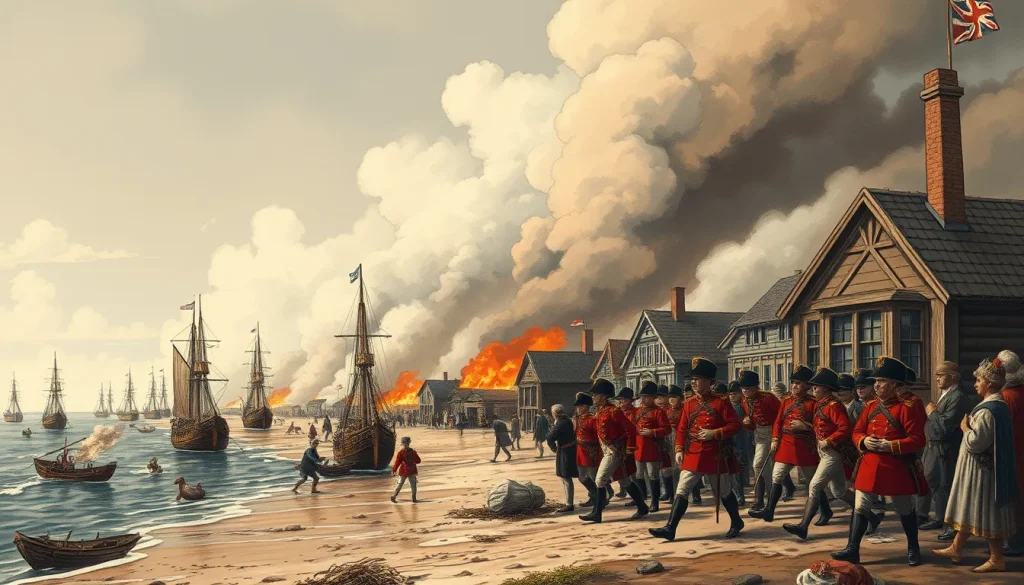
Looting and property destruction were widespread features of the War of 1812 (1812–1815), a conflict between the United States and Great Britain that also involved Indigenous peoples across North America. Both regular military forces and militia units seized private property, burned public buildings, and devastated farms, towns, and naval stores from the Canadian border to the Chesapeake Bay. These acts had immediate effects on civilians and became enduring symbols of the war’s brutality and contested meanings.
Historical Context
The War of 1812 grew out of disputes over maritime rights, impressment, restrictions on neutral trade, and American ambitions to expand into Canada. Military operations took place along a vast frontier that stretched from the Great Lakes to the Gulf of Mexico. Supply lines were long and unreliable, and armies often depended on local resources, which encouraged requisitioning and looting. Naval powers used blockade and raiding to disrupt enemy trade and morale, while inland forces launched cross-border incursions into Upper Canada (now Ontario) and the Northwestern United States.
In 1813 and 1814, the British Royal Navy extended its blockade of the American coast and conducted amphibious raids on ports, naval yards, and coastal towns. American forces, in turn, penetrated Canadian territory and sought to destroy British military stores and infrastructure. Civilians on both sides experienced forced contributions, confiscation of property, and the burning of their homes and businesses. The legal and moral justifications for such conduct were contested at the time and remain a topic of historical debate.
What Happened
The most dramatic episodes of looting and property destruction occurred in 1813 and 1814. On 27 April 1813, American troops under Major General Henry Dearborn captured the provincial capital of York (present-day Toronto). During the occupation, soldiers burned the Parliament buildings of Upper Canada and carried off military supplies, naval stores, and personal property, including a quantity of government stores and a mace. The destruction of York, though partly ordered to deny resources, was widely seen in British and Canadian accounts as an act of vandalism.
In retaliation and as part of broader strategy, British forces mounted a series of raids in the Chesapeake Bay region. Under Rear Admiral George Cockburn and later Major General Robert Ross, British troops and marines plundered and burned plantations, towns, and merchant vessels along the Patuxent and Potomac rivers. The raid on Alexandria, Virginia, on 28–29 August 1814 resulted in the seizure of thousands of dollars worth of merchandise and military stores. The most notorious event was the burning of Washington, D.C., on 24–25 August 1814, following the Battle of Bladensburg. British troops set fire to the Capitol, the White House, the Library of Congress, the Treasury, and other federal buildings, causing extensive damage to official property. While private residences were generally spared, the conflagration was deliberate and devastating.
Property destruction also occurred on the Canadian border. American forces under Major General Jacob Brown and other commanders burned villages in Upper Canada, including St. Davids in July 1814, after clashes in the Niagara Peninsula. British forces and their Indigenous allies, in turn, destroyed American frontier towns. On 30 December 1813, British troops under General Phineas Riall burned the villages of Buffalo and Black Rock, New York, leaving thousands homeless. Similar patterns of seizure, burning, and looting marked other frontier operations, such as the American attacks on Fort George and the British counter-raids.
Why It Matters
The destruction of property during the War of 1812 had immediate and long-term consequences. It intensified civilian suffering, fueled calls for retaliation, and shaped national memories. The burning of Washington became a powerful symbol of British aggression in American identity and a justification for postwar coastal fortifications. In Canada, the destruction of York and Niagara villages contributed to a sense of persecution and solidarity across the border. These events also influenced the development of the laws of war, as governments and legal scholars sought to limit such destruction in later conflicts.
Historians disagree about the proportionality and legality of these acts. Some view them as legitimate military operations to disrupt enemy resources, while others see them as wanton violations of customary rules. The treatment of private property—whether it was seized for military use or destroyed solely as punishment—remains a central point of debate. Contemporary accounts, often patriotic or jingoistic, need to be balanced against archival evidence of orders, reports, and civilian claims.
Definition
Looting is the unauthorized seizure of property—movable goods, livestock, or valuables—from private persons or public institutions. Property destruction involves the deliberate burning, demolition, or damaging of buildings, infrastructure, agricultural resources, and other material assets. In the War of 1812 context, these acts ranged from soldiers taking food and clothing to wholesale razing of public buildings and entire villages.
Background
During the early nineteenth century, customary international law permitted armies to forage for supplies and to requisition property needed for military operations, but prohibited wanton pillage of private property. Treaties and military manuals, such as those drafted by European jurists, recognized a distinction between legitimate military necessity and cruel destruction. However, enforcement was weak, and in practice commanders often tolerated or ordered destruction as reprisal or to deny resources to the enemy. The War of 1812 occurred at a time when these norms were being redefined, and the conduct of both sides reflected that uncertainty.
How It Worked
On land, invading armies depended heavily on local resources. Foragers would seize crops, cattle, and horses, and soldiers would occasionally break into homes to obtain food or valuables. When an army captured a town or fort, it might carry away military stores, public records, and goods as legitimate booty. In some cases, as at York, property was deliberately burned to prevent its use by the enemy. Naval raids employed landing parties that would seize or destroy ships, warehouses, and military installations. Discipline often broke down, leading to private looting, especially during prolonged occupations or chaotic retreats.
Competing Viewpoints
British and Canadian observers condemned American destruction of York and villages in Upper Canada as unnecessary vandalism. American leaders and citizens, in turn, decried British burning of Washington and its Chesapeake raids as barbaric acts unbecoming a civilized nation. Historians have interpreted these events along a spectrum: some emphasize the brutality and civilian suffering; others highlight the strategic rationale, such as denying enemy depots, cutting supply lines, and demoralizing the population. The role of Indigenous allies, who had their own practices of plunder and retaliation, further complicates the picture, as Native peoples were neither simply victims nor agents of European orders.
Role in the War of 1812
Looting and property destruction were integral to the war effort, functioning as tools of economic warfare, reprisal, and psychological pressure. The American raid on York aimed to cripple Upper Canada’s governance and military capacity. The British capture of Washington targeted the symbolic and material heart of the American federal government. Raids on Alexandria and the Chesapeake shore deprived American merchants of commerce and naval supplies. On the Niagara and Detroit frontiers, destruction of farms and towns aimed to strip support from local forces. These acts also escalated the war’s violence, as each side sought to outdo the other in retaliation.
Consequences and Historical Interpretation
The physical and economic damage of the conflict was extensive. Citizens on both sides filed property claims with national governments and treaty commissions, some of which continued for years after the war. The burning of Washington spurred American efforts to improve coastal defenses and relocate federal archives. The destruction in Upper Canada contributed to a collective memory in Canada of American invasion. Later historians have read these events as evidence of the war’s brutal, totalizing character, while also situating them within evolving legal and moral frameworks of warfare. Modern law, such as the 1949 Geneva Convention, explicitly prohibits destruction of civilian property not justified by military necessity, a principle that resonates with the controversies of 1812.
Primary Sources
Several contemporary documents and accounts survive to illuminate the events described. George Robert Gleig, a British officer, published A Narrative of the Campaigns of the British Army at Washington and New Orleans (1821), which provides an eyewitness description of the burning of Washington. On the American side, Dolley Madison’s letter to her sister Lucy Todd (24 August 1814) recounts her escape from the White House and the rescue of the Gilbert Stuart portrait of George Washington. British naval dispatches, including those of Admiral John Borlase Warren and Rear Admiral George Cockburn, contain orders and reports detailing Chesapeake raids and property destruction. American claims proceedings, such as those under the Treaty of Ghent, documented civilian property losses. These sources are shaped by rank, nationality, and purpose, so they must be read critically alongside official orders and letters.
Further Reading
- Hickey, Donald R. The War of 1812: A Forgotten Conflict. University of Illinois Press, 1989.
- Taylor, Alan. The Civil War of 1812. Alfred A. Knopf, 2010.
- Pitch, Anthony S. The Burning of Washington: The British Invasion of 1814. White House Historical Association, 2000.
- Stagg, J. C. A. The War of 1812: Conflict for a Continent. Cambridge University Press, 2012.
References
- Gleig, George Robert. A Narrative of the Campaigns of the British Army at Washington and New Orleans. London, 1821.
- Hickey, Donald R. The War of 1812: A Forgotten Conflict. University of Illinois Press, 1989.
- Taylor, Alan. The Civil War of 1812. Alfred A. Knopf, 2010.
- Pitch, Anthony S. The Burning of Washington: The British Invasion of 1814. White House Historical Association, 2000.
- Stagg, J. C. A. The War of 1812: Conflict for a Continent. Cambridge University Press, 2012.
FAQ
Which side destroyed more property in the War of 1812?
Both sides engaged in substantial property destruction. American forces destroyed York and several Canadian villages, while British forces burned Washington, raided Chesapeake towns, and destroyed American frontier settlements such as Buffalo. The total extent is difficult to compare due to differing documentation.
Why was Washington, D.C., burned in 1814?
British leaders justified the burning as retaliation for American destruction of York and other Canadian towns, and also to disrupt the American government’s capacity to wage war. The raid was ordered by Rear Admiral Cockburn and Major General Ross after the Battle of Bladensburg.
Were private homes spared during the burning of Washington?
British troops mainly targeted public buildings—the Capitol, White House, Treasury, and Library of Congress—and generally left private residences intact, although some damage and looting did occur. Eyewitness accounts emphasize the focus on official structures.
Leave a Reply