
Short Answer
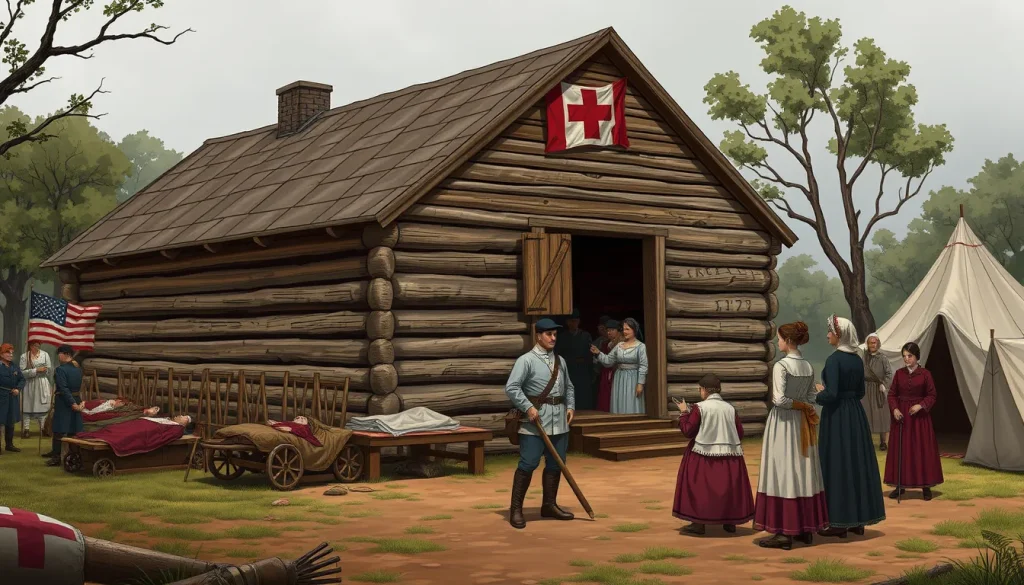
The War of 1812, fought between the United States and Great Britain with Canadian and Indigenous allies, forced both armies to develop systems of care for the sick and wounded. Military hospitals during this conflict were often little more than converted buildings, tents, or private homes, and they struggled against the era’s limited medical knowledge, widespread disease, and chronic shortage of supplies. These institutions nevertheless represent a formative stage in the evolution of military medicine, as doctors attempted to organize treatments on a scale unprecedented in North America.
Historical Context
The War of 1812 erupted in June 1812 after years of tension over trade restrictions, impressment, and territorial expansion. Both the United States and Great Britain maintained small professional armies, but the conflict forced rapid mobilization of militia and regular troops. In 1812, military medicine was still largely a craft, not a science. The cause of most diseases was unknown, and surgical techniques remained primitive. Armies routinely lost far more soldiers to disease than to enemy action; historically, about 80% of war-related deaths resulted from infection, disease, and poor sanitary conditions. In this context, hospitals—military or otherwise—were feared as places of high mortality, but they were also central to any army’s ability to remain in the field.
What Happened
As American forces invaded Canada and British forces launched counterattacks along the Atlantic coast and Great Lakes, each side established a network of temporary hospitals. These were often located in churches, schoolhouses, vacant barracks, or private residences near the front lines. In the U.S. Army, the Medical Department was small and poorly funded; Congress authorized only a few surgeons and surgeon’s mates in 1812, and the army often relied on acting civilian doctors. The British Army had a more established military medical organization, but it too faced challenges in North America, with hospitals set up at strategic sites like York (Toronto), Kingston, Halifax, and Quebec City.
Field hospitals, established near battle sites, provided basic first aid—such as amputation, wound dressing, and stabilization—before patients were evacuated to general hospitals farther from combat. Ambulances were often carts or wagons, and patients endured long, bumpy journeys. After battles like the Battle of Lundy’s Lane (1814) or the Battle of Baltimore (1814), the wounded were packed into any available structure. Disease, however, posed the greater threat. Typhus, dysentery, malaria, and respiratory infections flourished in crowded, unsanitary hospitals, making them dangerous places. By 1813 and 1814, both sides began establishing more systematic hospital systems, especially after catastrophic disease outbreaks, such as those during the American camp at Buffalo, New York, in 1812.
Key figures in military medicine included Dr. William Beaumont, an American army surgeon who conducted his famous digestion experiments on a patient after a gunshot wound at Fort Mackinac, and British military surgeons like Dr. John Revere (son of Paul Revere) who served in Canada. Women, such as enlisted men’s wives and camp followers, often served as nurses, and Indigenous peoples provided medical knowledge and assistance. The hospitals themselves were crowded and frequently lacked proper food, water, and ventilation, leading to appalling mortality rates; for example, during the American siege of Fort George in 1813, disease in nearby field hospitals claimed many more lives than British bullets.
Why It Matters
Military hospitals during the War of 1812 mattered because they directly affected the armies’ combat effectiveness and set precedents for later conflicts. The high rates of disease-related death prompted military and political leaders to call for reforms, including better sanitation, more extensive medical staff, and improved hospital design. Although many lessons were forgotten after the war, the experience contributed to the establishment of the U.S. Army’s permanent Medical Department and informed later medical procedures used in the Mexican-American and Civil Wars. For the British, the Canadian war experience shaped similar reforms in colonial military medicine. Socially, hospitals brought together volunteers, enslaved persons hired as nurses, and military surgeons, and they exposed civilians to wartime realities, thereby influencing public attitudes toward medical professionalism.
Definition
Military hospitals during the War of 1812 were facilities, either temporary or semi-permanent, established by the armed forces to provide medical care for soldiers and sailors. They ranged from regimental field hospitals stationed near battlefields to larger general hospitals that received evacuated patients.
Background
Before the war, regular armies had only rudimentary hospital systems, often based on European models. In the U.S. Army, a medical department existed but was tiny. In Britain, the Royal Army Medical Corps had developed during the Napoleonic Wars, but its presence in North America was limited. Canada, as a British colony, relied on garrison hospitals and Indian Department support. When the war broke out, neither side was prepared for a long conflict.
How It Worked
A soldier wounded in battle was first treated in a field hospital, usually a surgeon’s tent or a nearby building. He received immediate surgical care—often amputation or wound probing—and then was evacuated by wagon or ship to a general hospital. These general hospitals were larger, often established in vacant warehouses or public buildings. Each was run by a surgeon, with assistant surgeons, steward, and nurses. Patients were grouped by type of illness or injury, and a rough system of record-keeping was used, although it varied widely. Sanitation was primitive: no germ theory, limited antiseptics, and reliance on bleeding, purging, and questionable drugs. Ventilation was improved by letting fresh air in, but overcrowding remained a problem.
Competing Viewpoints
Historians disagree about the quality of military hospitals in the War of 1812. Some emphasize that American hospital care was exceptionally poor due to governmental neglect and the poor condition of militia, while others point out that British hospitals were better organized but still plagued by similar disease rates. There is also debate over the role of civilian aid and the degree to which Indigenous medical practices influenced military medicine. The scarcity of official medical records from 1812 makes direct comparisons difficult, leading historians to rely on anecdotal accounts.
Role in the War of 1812
Military hospitals directly influenced the course of the war. Outbreaks of typhus and dysentery repeatedly decimated armies, forcing commanders to delay campaigns or retreat. For example, the American invasion of Canada in 1812 collapsed partly due to disease in frontier hospitals. Conversely, effective hospital care, such as British naval hospitals at Halifax, allowed the Royal Navy to maintain its blockade despite outbreaks of scurvy and other ailments. Hospitals also functioned as nodes of communication and supply, and their failures fueled recruitment shortages and public dissatisfaction.
Consequences and Historical Interpretation
The War of 1812’s military hospitals left a mixed legacy. They demonstrate both the limits and the necessity of organized medical care in war. Postwar reforms in the U.S. Army included increasing the number of surgeons, standardizing supplies, and establishing a more robust hospital system, though these changes took decades to implement. For the British, the conflict reinforced the need for permanent hospitals in North America. Modern historians view these institutions as key to understanding the human cost of the conflict, particularly the high death toll from disease, which outnumbered battlefield deaths by a wide margin. The hospitals also helped to normalize professional nursing and medical education for both men and women, setting a precedent for the larger hospital systems of the mid-nineteenth century.
Primary Sources
The most relevant primary sources for military hospitals during the War of 1812 include military medical returns, surgeons’ journals and letters, and official reports. For the United States, the National Archives holds records of the Office of the Surgeon General, including hospital returns and invoices from 1812–1815. Key first-person accounts include the writings of Dr. William Beaumont, who served as an army surgeon and later published his observations. British sources are found in the National Archives (UK) under War Office records, including hospital muster rolls and inspector-general reports. Canadian sources are located in Library and Archives Canada, particularly in the military records of garrisons at York, Kingston, and Quebec. These documents are biased by the perspectives of their authors, often medical officers with limited training, and they sometimes exaggerate or minimize casualty figures. Nevertheless, they provide vital evidence on hospital conditions, treatments, and patient outcomes.
Further Reading
- Hickey, Donald R. The War of 1812: A Forgotten Conflict. University of Illinois Press, 1989.
- Malcomson, Robert. Historical Dictionary of the War of 1812. Scarecrow Press, 2006.
- Beaumont, William. Experiments and Observations on the Gastric Juice. Plattsburgh, 1833. (Primary account by an army surgeon.)
- Library and Archives Canada. War of 1812 Collection. https://library-archives.canada.ca.
- National Archives of the United States. Records of the Office of the Surgeon General (Army), 1775–1927. Record Group 112.
References
- Hickey, Donald R. The War of 1812: A Forgotten Conflict. University of Illinois Press, 1989.
- Malcomson, Robert. Historical Dictionary of the War of 1812. Scarecrow Press, 2006.
- Beaumont, William. Experiments and Observations on the Gastric Juice. Plattsburgh, 1833.
- National Archives and Records Administration. “Records of the Office of the Surgeon General (Army).” Accessed 2025.
- Library and Archives Canada. “War of 1812: Military Medical Records.” Accessed 2025.
FAQ
What were military hospitals like during the War of 1812?
They were often improvised in existing buildings like churches, homes, and barracks. They were crowded, lacked proper sanitation and supplies, and many patients died from diseases rather than wounds.
Why did disease kill more soldiers than combat in the War of 1812?
Medical knowledge was limited, with no germ theory or effective vaccines. Crowded conditions, poor hygiene, and inadequate nutrition spread typhus, dysentery, and other infections.
Did the War of 1812 lead to improvements in military medicine?
Yes, the high death rate from disease prompted reforms in the U.S. Army's medical department, including more surgeons, better supplies, and attention to sanitation, though progress was gradual.


Leave a Reply