
Short Answer
From 1812 to 1815, the pay and allowances of soldiers in the United States Army shaped who enlisted, how they lived, and how well the service retained its troops. This article examines the cash wages, bounties, and non-cash allowances granted to American regulars and officers, while noting that the payments were frequently delayed and sometimes never reached the soldier. The subject is central to understanding the everyday realities of the War of 1812 and the persistent administrative challenges that undermined the army.
Historical Context
At the declaration of war on June 18, 1812, the U.S. Regular Army numbered about 10,000 men, half of whom were raw recruits. Congress moved quickly to expand the army: the act of June 26, 1812 authorized 25 infantry regiments, 4 artillery regiments, 2 dragoon regiments, 1 rifle regiment, plus engineers and artificers, totaling roughly 36,700 men. A further act of January 29, 1813 added more regiments. This dramatic wartime expansion made recruiting imperative, and Congress used both high cash bounties and promises of monthly pay to attract volunteers. The pay scale that emerged became a critical element of the war effort, as did the government’s failure to disburse that pay on time.
What Happened
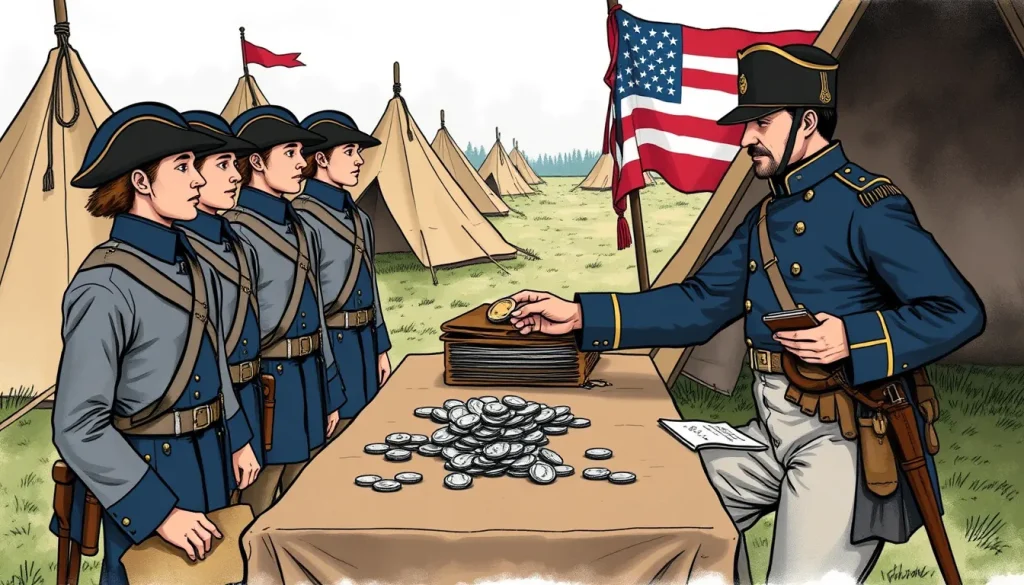
At the start of the war, the monthly pay for enlisted men was modest. A private received $5, while noncommissioned officers—sergeants and corporals—received between $7 and $9. Officers were paid according to rank, from $20 for a junior lieutenant to $200 for a major general, and their allowances of subsistence, forage, and servants’ hire often more than doubled their cash incomes. For example, a major general’s pay of $200 per month could be supplemented by about $193 in allowances, bringing the total to roughly $393.
To stimulate enlistments and retain men, Congress passed the Act of December 12, 1812, raising the monthly pay of all enlisted men effective December 31, 1812. The new rates were: $12 for sergeants major and quartermaster sergeants; $11 for sergeants and principal musicians; $10 for corporals; $9 for musicians; $8 for privates, drivers, bombardiers, matrosses, sappers, and miners; and $13 for artificers, saddlers, farriers, and blacksmiths not attached to the quartermaster general’s or ordnance departments. This was the most significant wartime pay increase for the U.S. Army.
The enlistment bounty rose even more dramatically. Initially, recruits were promised a cash bounty of $31 and 160 acres of land. Because the quota was not being met, Congress gradually increased the bounty to $124 and 320 acres. The cash bounty alone equaled many unskilled laborers’ annual wages, and the land bounty could be sold, making the total compensation for a five-year enlistment substantial when the government actually paid it.
But the payment system broke down from the beginning. By law, army pay was not supposed to be more than two months in arrears “unless the circumstances of the case should render it unavoidable.” In October 1812, men who had enlisted five months earlier absolutely refused to march until they had received their pay, and other units mutinied for want of pay. Conditions worsened as the war progressed. By the fall of 1814, army pay was frequently six to twelve months in arrears, sometimes longer. Discharge certificates from the period show that many soldiers were still owed large sums when they left the service. For instance, a private named John Warring, discharged in March 1815, received his back pay dating from October 31, 1813, plus three months’ advance pay and subsistence to travel home.
Why It Matters
Pay and allowances directly affected recruitment, desertion, and morale. The high bounty and improved pay helped fill the ranks, especially in the later years of the war, when the U.S. Army finally became a more effective fighting force. Yet chronic arrears often negated these inducements and made life unbearable for soldiers who could not feed themselves or their families at home. The contrast between the generous paper value of a soldier’s contract and the reality of delayed payment is one of the forgotten administrative failures of the war. Historians also note that the economic value of a soldier’s pay must be judged relative to civilian wages and the cost of living; an $8 monthly wage for a private was less than the $10–$12 commonly earned by unskilled laborers, but the bounty and land grants could make enlisting economically attractive despite the risks.
Definition
In the context of the War of 1812, “pay” meant the monthly cash salary established by law for each rank in the regular army. “Allowances” were additional benefits provided to soldiers and officers, including subsistence (food), forage (for horses), servants’ hire for higher officers, clothing, and sometimes payment for travel at discharge. Enlistment bounties—money and land grants—were one-time inducements offered at the moment of signing up.
Background
The U.S. Army’s pay system evolved from the Continental Army of the Revolutionary War and was fixed by Congress through a series of statutes. In 1812, the basic pay scales were those inherited from the 1790s, with minor adjustments. The wartime expansion to a force of more than 36,000 authorized regulars required a new recruiting structure, and the initial bounty and pay rates were set low, causing enlistments to lag. Congress responded by raising the monetary pay and increasing the bounty. The December 1812 act also permitted recruits to choose to serve for the duration of the war rather than a fixed five-year term, further adjusting the terms of service.
How It Worked
Soldiers received monthly pay on paper, but actual disbursement was handled by Army paymasters, who were often far from the regiments and were burdened by poor communications. Congress established that pay should not be more than two months in arrears unless unavoidable, but this rule was routinely ignored. Allowances were typically not paid in cash. Subsistence was issued as rations or a ration allowance, which for officers was a fixed dollar amount based on the price of food; forage was similarly paid to officers who kept horses. Clothing was distributed in kind, and at discharge, men received a certificate showing what they were owed, including any back pay and travel subsistence. Officers’ allowances were more generous, sometimes exceeding the base pay itself.
Competing Viewpoints
Historians have debated whether U.S. soldiers in the War of 1812 were well paid or poorly paid relative to the civilian economy. On one side, Donald R. Hickey has argued that the total compensation—monthly pay plus the cash bounty and land warrant—was so high that it exceeded what most unskilled laborers earned in a year, making the incentive to enlist “a princely sum.” He also noted that the army’s pay was higher than many European armies. On the other side, critics point out that a private’s monthly cash wage of $8 was still less than the average laborer’s pay, and that the bounty was a one-time payment that did not address the chronic arrears. Many soldiers experienced months without any remuneration, leading to mutinies and desertion. A balanced interpretation acknowledges both the relatively generous paper terms and the systemic failure to deliver those terms in a timely manner.
Role in the War of 1812
Pay and allowances were crucial to mobilizing the American war effort. The early recruiting shortfalls led directly to the increased bounties and pay raises, which did help fill the ranks. By 1814 the regular army had grown enough to fight effectively, particularly on the Niagara frontier, although many of those troops were still owed substantial amounts. For British and Canadian forces, pay structures differed; British regulars followed an older scale, but their conditions were often no better. The American pay system’s failure to keep up with its own promises contributed to desertion, poor morale, and the early defeats of 1812. Later in the war, as paymaster services improved and bounties attracted more men, the army became a more reliable force. The financial burden of the pay and bounty system also affected the U.S. treasury, which was already strained by wartime borrowing.
Consequences and Historical Interpretation
The pay and allowances of the War of 1812 left a mixed legacy. The generous bounties set a precedent for American recruiting for decades, while the arrears exposed the administrative weakness of the War Department. Veterans often spent years seeking the money they had been promised, and land warrants were sometimes sold at a discount to speculators. Historians use discharge certificates and pay accounts to reconstruct not only individual service records but also the broader social history of the army. The contrast between official rates and actual disbursements remains a central theme in scholarship on the period, illustrating the gap between legislation and life for the common soldier.
Primary Sources
The most important contemporary evidence for U.S. soldier pay is found in the discharge certificates and military service records in the National Archives. The discharge certificates (reproduced in NARA microfilm publication M1856) list the soldier’s length of service, the dates for which he was paid, and any additional travel pay and subsistence owed at discharge. A detailed example is the certificate of John Warring, which shows back pay and three months’ travel allowance.
Another primary source is the Act of December 12, 1812, “An Act increasing the pay of the non-commissioned officers, musicians, privates, and others of the Army, and for other purposes,” printed in the United States Statutes at Large. This statute gives the exact new monthly pay rates and the option to enlist for the war’s duration.
Also valuable is the 1846 Senate Document “Statement of the allowance for pay, subsistence, forage, and servants’ hire…” prepared by the Paymaster General, which compared officer pay and allowances in 1812, 1824, 1838, and 1846. The document is available online through GovInfo and provides the detailed officer compensation tables.
Finally, the National Archives’ Prologue article “Leaving the Army During Mr. Madison’s War” explains how discharge certificates were used and includes the example of John Warring, offering valuable context on how soldiers were paid out at the end of their service.
Further Reading
- Donald R. Hickey, The War of 1812: A Forgotten Conflict (University of Illinois Press, 1989).
- John P. Deeben and Claire Prechtel-Kluskens, “Leaving the Army During Mr. Madison’s War,” Prologue, National Archives, Fall 2011.
- National Archives and Records Administration, “War of 1812 Discharge Certificates,” available online at archives.gov.
- U.S. Senate, “Document showing the pay and allowances to officers in the army during the years 1812, 1824, 1838, and the present time,” 1846, GovInfo.
References
- Hickey, Donald R. The War of 1812: A Forgotten Conflict. Urbana: University of Illinois Press, 1989, pp. 76–77.
- National Archives and Records Administration. “War of 1812 Discharge Certificates.” Accessed from archives.gov/research/military/war-of-1812/1812-discharge-certificates.
- U.S. Congress. “An Act increasing the pay of the non-commissioned officers, musicians, privates, and others of the Army, and for other purposes,” December 12, 1812. In United States Statutes at Large, vol. 2.
- U.S. Senate. “Document showing the pay and allowances to officers in the army during the years 1812, 1824, 1838, and the present time.” Senate Document 246, 29th Congress, 1st Session, 1846. Available via GovInfo.
- Deeben, John P., and Claire Prechtel-Kluskens. “Leaving the Army During Mr. Madison’s War.” Prologue 43, no. 3 (Fall 2011). National Archives.
FAQ
How much did a private soldier earn per month during the War of 1812?
A private in the U.S. Army initially earned $5 a month. In December 1812, Congress raised the monthly pay of privates to $8, a rate that remained in effect for the rest of the war.
What allowances did soldiers receive besides monthly pay?
Soldiers and officers received allowances for subsistence (food), forage (for horses), clothing, and, for officers, servants’ hire. At discharge, they could also receive travel subsistence and a settlement of any back pay owed.
Were soldiers in the War of 1812 paid on time?
Often not. The payment system broke down, and by fall 1814 army pay was frequently six to twelve months in arrears. That failure caused mutinies and forced many men to serve without regular income.


Leave a Reply