
Short Answer
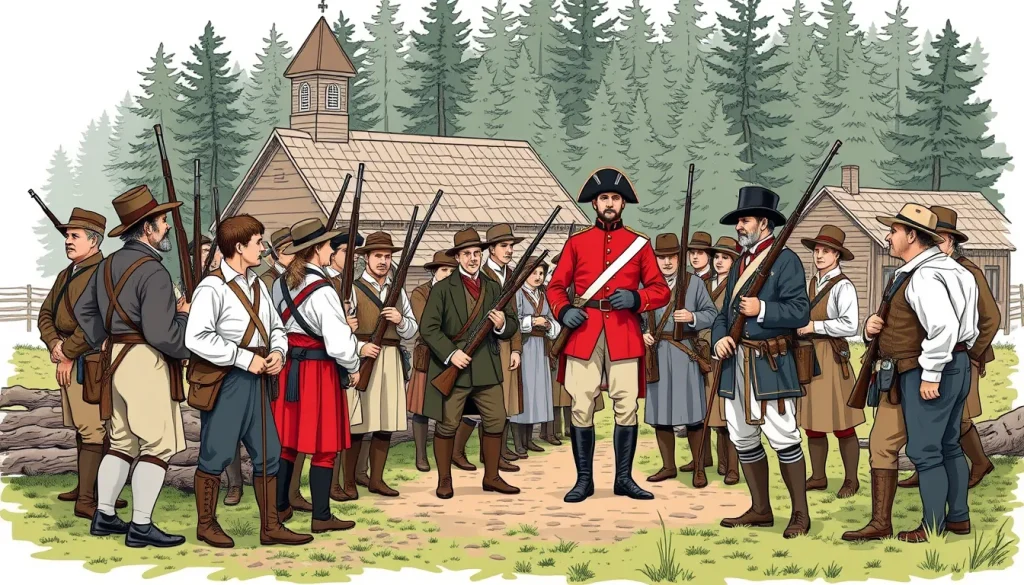
The Canadian militia in Upper Canada during the War of 1812 was a system of part-time, locally raised citizen soldiers who were legally obligated to defend the colony. Composed largely of farmers, artisans, and tradesmen, these sedentary and embodied units served alongside British regulars and Indigenous allies against American invasion between 1812 and 1815. Their uneven but often crucial service became the foundation of a powerful post-war mythology that shaped Canadian identity and continues to provoke debate among historians about who really defended Upper Canada.
Historical Context
Upper Canada, established in 1791 as a separate British colony (roughly present-day Ontario), was sparsely populated and strategically vulnerable. Its population included many American-born settlers—Late Loyalists and others—whose loyalty Britain viewed with suspicion. The colony’s defense rested on a small number of British regulars, alliances with Indigenous nations such as the Six Nations and Ojibwe, and a compulsory militia system inherited from French and earlier British practices. The Upper Canadian Militia Act of 1793 and a more comprehensive act in 1808 required able-bodied males aged 16 to 60 to enroll in county-based regiments. These sedentary militia units mustered annually, often with limited weapons and training. As war with the United States loomed, British commanders like Major-General Isaac Brock worried that many militiamen might refuse to fight or even sympathize with the invaders. The declaration of war in June 1812 turned these anxieties into immediate practical problems.
What Happened
When the United States declared war, Upper Canada’s militia was called out to supplement British regulars. In August 1812, militia flank companies accompanied Brock to Detroit, where the American garrison surrendered without a fight. At the Battle of Queenston Heights in October 1812, militia units fought on the Canadian side; some refused to cross the Niagara River into New York, but others engaged in the battle that cost Brock his life. During 1813, American forces captured York (now Toronto) and Fort George, and militia participated in the British counterattacks at Stoney Creek and Beaver Dams. Later that year, militia served at the Thames (Moraviantown) and in the defense of Montreal, including the Battle of Chateauguay. In 1814, Upper Canadian militia fought at Chippawa, Lundy’s Lane, and the Siege of Fort Erie. Throughout the war, sedentary militia also performed essential non-combat duties: guarding prisoners, transporting supplies, building fortifications, and policing local populations. Many served only short terms; some deserted, sought exemptions, or refused orders, while others volunteered for repeated service.
Why It Matters
The militia’s contributions helped prevent the conquest of Upper Canada, but they came at a cost. Requisitions, plundering, and the strain of supporting both regulars and militia created deep resentments among civilians. After the war, prominent Upper Canadians—many of them militia officers—promoted what historians call the “Militia Myth”: the idea that citizen soldiers had been the decisive force in saving the colony. This narrative elevated the militia’s role while minimizing that of British regulars and Indigenous warriors, and it served to build a British-Canadian identity and to justify the social and political power of the province’s elite. Later historians have challenged this myth, arguing that militia service was uneven, that many avoided service, and that the war’s outcome depended heavily on British and Indigenous forces. The debate over the militia’s true significance remains central to how Canadians remember the War of 1812.
Definition
In the context of Upper Canada during the War of 1812, the “Canadian militia” refers to a colonial institution of part-time soldiers rather than a professional standing army. It had two main components. The sedentary militia included virtually all able-bodied men aged 16 to 60, who were enrolled by law but typically trained only once or twice a year. The embodied militia, also called flank companies or incorporated militia, consisted of volunteers or selected men who served for longer periods, often in active combat roles. The term “Canadian Militia” later referred to regular forces established in the 1850s, but this article uses the term specifically for the Upper Canadian colonial militia between 1812 and 1815.
Background
The militia tradition in Canada predates British rule, originating in New France, where parish-based companies defended the colony. After Britain conquered New France in 1763, the militia system continued in Quebec and later in Upper Canada. Upper Canada’s first militia law in 1793 established a sedentary militia; the Militia Act of 1808 refined the system, specifying age limits, exemptions, and the governor’s power to call out units. Regiments were organized by county and led by local officers, often prominent landowners or merchants. Equipment was scarce, and many men trained with little more than personal firearms or farm tools. The militia was intended primarily for local defense, but wartime demands pushed it into active campaigning alongside British regulars.
How It Worked
Enrolment was compulsory, though exemptions existed for certain religious groups (such as Quakers and Mennonites), government officials, and those who provided substitutes or paid fines. When the war began, the governor or military commander could call out flank companies for immediate service and later embodied militia for fixed terms, usually several months. Militiamen were paid, fed, and clothed—sometimes inadequately—by the colonial government or British army. Discipline was enforced under colonial militia law, which could include fines, imprisonment, or corporal punishment. In battle, militia units often fought as light infantry or skirmishers, while sedentary militia provided labour, transport, and garrison duty. The system was designed to be cheap and locally controlled, but it struggled to meet the manpower and logistical demands of a sustained war.
Competing Viewpoints
Contemporary views of the militia were sharply divided. British commanders like Isaac Brock praised some flank companies but doubted the reliability of the sedentary militia, fearing mass refusal to serve or outright disloyalty. American officials and newspapers often predicted that Canadians would welcome invasion, a claim that proved largely false. Upper Canadian leaders after the war celebrated the militia as heroic defenders. Modern historians offer competing interpretations. George Sheppard, in Plunder, Profit, and Paroles, argues that militia service was not universal, that many men avoided duty, and that the war exposed social divisions rather than unity. Scholars such as those writing in The General (Brock University) contend that the Militia Myth was deliberately constructed by elites to serve their interests. Other historians emphasize the militia’s genuine contributions in specific battles, while noting that Indigenous warriors and British regulars bore the heaviest fighting. No single perspective captures the full complexity of the militia’s role.
Role in the War of 1812
Upper Canadian militia participated in most major engagements on the Niagara and Detroit frontiers. In 1812, flank companies fought at Detroit and Queenston Heights. In 1813, militia helped delay American advances at Stoney Creek and Beaver Dams, and they served at the Thames and Chateauguay. In 1814, they were present at Chippawa, Lundy’s Lane, and Fort Erie. Their roles ranged from front-line skirmishing to guard duty, convoy escort, and construction. Some units, such as the 1st and 2nd Lincoln Militia, saw repeated action. However, not all service was voluntary or effective: local militias occasionally refused orders, particularly when asked to cross into American territory, and desertion was a persistent problem. The militia’s greatest contribution may have been its sheer numbers, which allowed British commanders to concentrate regulars at key points while relying on citizen soldiers for local defense and support.
Consequences and Historical Interpretation
The militia’s immediate impact was to help preserve Upper Canada from American conquest, but the war also left a legacy of debt, property destruction, and social tension. After 1815, the Militia Myth became a cornerstone of Canadian identity, especially in Ontario, where militia service was celebrated in monuments, histories, and political rhetoric. This myth served to legitimize the power of local elites and to promote a British-oriented nationalism. Historians have since reassessed the militia’s record. Sheppard’s social history reveals widespread avoidance of service and bitter disputes over plunder and compensation. The Brock University journal article argues that the myth deliberately obscured the roles of British regulars and Indigenous nations. In modern Canada, the Army Reserve traces its lineage to the militia, but scholarly consensus holds that the militia was one of several forces—never the sole or even the primary one—that defended Upper Canada.
Primary Sources
Several contemporary documents illuminate the militia’s experience. The Upper Canada Militia Act of 1808 (and its 1793 predecessor) established the legal framework; it is a legislative text, not a record of practice. The correspondence of Sir Isaac Brock, published in E. Cruikshank’s The Documentary History of the Campaign upon the Niagara Frontier (1896–1908), includes Brock’s assessments of militia reliability—valuable but filtered through a British commander’s perspective. Muster rolls and pay lists, held by Library and Archives Canada, list names, units, and service periods; they are incomplete and rarely record those who evaded service. Petitions for war losses, preserved in Ontario archives, describe plundering and destruction from civilians’ viewpoints, though claimants had financial incentives to exaggerate. Journals of the Legislative Assembly of Upper Canada record debates over militia bills. Indigenous perspectives on the war are less represented in written colonial records, though oral traditions and later testimonies exist; their absence from militia-focused documents is itself a limitation. No verbatim quotations are reproduced here because exact wording requires verification against archival originals or published editions.
Further Reading
- Gray, W. M. Soldiers of the King: The Upper Canadian Militia, 1812–1815: A Reference Guide. Erin, Ont.: Boston Mills Press, 1995.
- Sheppard, George. Plunder, Profit, and Paroles: A Social History of the War of 1812 in Upper Canada. Montreal: McGill-Queen’s University Press, 1994.
- “Upper Canada Preserved: The Long Shadow of the Militia Myth of 1812.” The General: Brock University Undergraduate Journal of History (2020).
- Cruikshank, E., ed. The Documentary History of the Campaign upon the Niagara Frontier. Welland, Ont.: Tribune Press, 1896–1908.
- Library and Archives Canada, War of 1812 records (militia muster rolls, pay lists, and correspondence).
- Ontario Heritage Trust, War of 1812 historic sites (Queenston Heights, Stoney Creek, Lundy’s Lane).
References
- Wikipedia contributors. “Canadian Militia.” Wikipedia. https://en.wikipedia.org/wiki/Canadian_militia
- Wikipedia contributors. “Colonial militia in Canada.” Wikipedia. https://en.wikipedia.org/wiki/Upper_Canadian_Militia
- Gray, W. M. Soldiers of the King: The Upper Canadian Militia, 1812–1815: A Reference Guide. Erin, Ont.: Boston Mills Press, 1995. Internet Archive record: https://archive.org/details/soldiersofkingup0000gray
- “Upper Canada Preserved: The Long Shadow of the Militia Myth of 1812.” The General: Brock University Undergraduate Journal of History (2020). https://journals.library.brocku.ca/index.php/bujh/article/view/2386
- Sheppard, George. Plunder, Profit, and Paroles: A Social History of the War of 1812 in Upper Canada. Montreal: McGill-Queen’s University Press, 1994. DOI: 10.1515/9780773564428
FAQ
What was the Canadian militia in Upper Canada?
It was a compulsory part-time military system of citizen soldiers, aged 16–60, organized in county regiments for local defense. During the War of 1812, some served in combat while others performed support roles.
Did the militia win the War of 1812 for Britain?
Historians agree the militia contributed but was not the decisive force. British regulars and Indigenous allies played crucial roles. The 'Militia Myth' overstates the militia's importance.
What is the Militia Myth?
A post-war narrative promoted by Upper Canadian elites that claimed citizen soldiers saved the colony. It served to build Canadian identity and legitimize elite power, but modern historians have challenged its accuracy.
Leave a Reply