
Short Answer
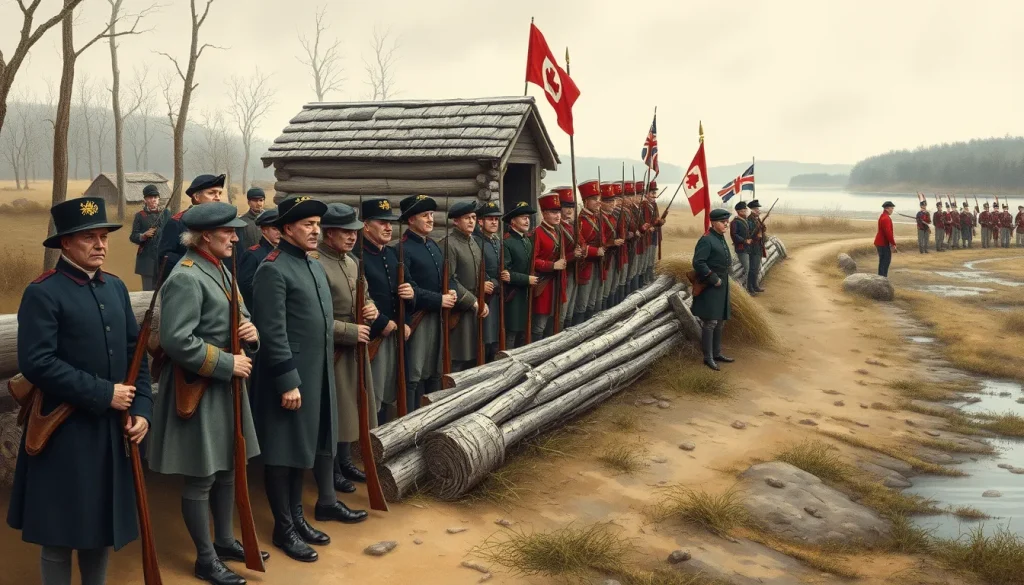
Canadian militia — the part-time, locally raised citizen soldiers of Upper Canada, Lower Canada, and the Atlantic colonies — served in the War of 1812 (1812–1815) as garrisons, labourers, boatmen, and, in flank companies and embodied battalions, as combat troops beside British regulars, fencible regiments, and Indigenous allies. Their service helped check repeated American invasions of the Canadas and became central to later Canadian memory of the war, though historians continue to dispute how much of the outcome they actually determined.
Historical Context
In 1812 the British colonies in northern North America were administered separately: Upper Canada (broadly the southern portion of present-day Ontario), Lower Canada (roughly southern present-day Quebec), and the Atlantic colonies of New Brunswick, Nova Scotia, Prince Edward Island, Cape Breton, and Newfoundland. Each had its own governor, legislature, and militia law, and each depended for defence on a small British regular garrison, since the greater part of the British Army was engaged in the Napoleonic Wars in Europe and the Iberian Peninsula. In this article, Canadian militia refers to the part-time forces of all these colonies, not only those of the two Canadas.
Upper Canada’s population was roughly 75,000 to 95,000, including many recent immigrants from the United States drawn by free land grants, alongside Loyalist families and settlers from Britain and Scotland. Lower Canada’s population was considerably larger and overwhelmingly French-speaking Canadien, organized in seigneurial parishes under the influence of the Catholic Church. American planners assumed Upper Canada would be easy to seize and might even welcome invasion, which made the loyalty of its inhabitants a persistent anxiety for British commanders.
Militia service was a long-established obligation of manhood in British North America, tied to local government, landholding, and social standing. Officer commissions generally went to prominent landowners, merchants, magistrates, and seigneurial families, while the rank and file were farmers, artisans, labourers, and tradesmen. British North American militia laws required periodic musters, imposed fines for absence, and exempted certain religious groups — notably Quakers, Mennonites, and Tunkers — from personal service. In Lower Canada, control of the militia was also entangled in the running dispute between the governor and the elected assembly over taxation and local authority.
Any assessment of the militia must also account for two other forces. British regulars, thin on the ground but professionally trained, formed the core of most field forces. Indigenous nations — Anishinaabe, Haudenosaunee, Wyandot, and others — provided intelligence, skirmishers, and warriors whose presence shaped the outcome of several early campaigns, particularly in the west.
What Happened
The United States declared war on 18 June 1812. American strategy centred on invading Canada from Detroit, across the Niagara River, and along the Lake Champlain corridor, with the expectation that Upper Canada would fall quickly.
In July 1812 Brigadier-General William Hull crossed into Upper Canada from Detroit. Major-General Isaac Brock, the British commander in Upper Canada, called out militia flank companies, mustered local militia, and advanced with a mixed force of British regulars, about 400 Upper Canadian militia, and roughly 600 Indigenous warriors. Hull surrendered Detroit on 16 August 1812, a victory in which militia presence formed part of a much larger regular and Indigenous effort.
On 13 October 1812 at Queenston Heights on the Niagara frontier, American regulars and militia crossed the river and seized the heights. Upper Canadian militia flank companies, including the 2nd Lincoln Militia and a small Black militia unit known as Runchey’s Company of Coloured Men, fought in the engagement; Brock was killed leading a counterattack, and Major-General Roger Hale Sheaffe retook the position with reinforcements that included militia. American losses were roughly 300 killed and wounded with about 900 taken prisoner, while British and Canadian losses included about 100 dead.
Through 1813 the pattern of militia service broadened. Militiamen formed part of the defences at York (present-day Toronto) in April and at Fort George in May, joined the retreat to Burlington Heights, and took part in the night attack at Stoney Creek on 6 June 1813. At Beaver Dams on 24 June 1813, Lieutenant James FitzGibbon’s small detachment of regulars and militia operated with a large body of Indigenous warriors in the capture of an American column, an episode later associated with Laura Secord’s warning.
In Lower Canada, the campaign of autumn 1813 produced two of the war’s clearest examples of colonial military service. At the Châteauguay River on 26 October 1813, Lieutenant-Colonel Charles-Michel de Salaberry commanded roughly 1,500 to 1,800 defenders — Canadian Fencibles, Canadian Voltigeurs, embodied militia, and Indigenous allies — who stopped Major-General Wade Hampton’s advance of about 4,000 American troops. Defending losses were fewer than thirty; American casualties were somewhat higher. On 11 November 1813 at Crysler’s Farm on the St. Lawrence, British regulars, Canadian Fencibles, and local militia companies from Stormont and Dundas helped defeat Major-General James Wilkinson’s column advancing toward Montreal.
The 1814 campaign on the Niagara peninsula again drew heavily on militia. The Incorporated Militia of Upper Canada, a full-time embodied force raised from the provincial militia, fought at Lundy’s Lane on 25 July 1814, the bloodiest engagement on Canadian soil, where each side suffered roughly 800 killed, wounded, and missing. Militia also served during the siege of Fort Erie and in the small actions along the border, while Lower Canadian embodied militia and voltigeurs helped repel another American thrust at Lacolle Mills in March 1814. In the Atlantic colonies, militia were embodied chiefly for garrison duty, coastal defence, and internal security, and New Brunswick and Nova Scotia units supported British operations, including the occupation of eastern Maine in 1814.
The Treaty of Ghent, signed on 24 December 1814, ended the fighting on terms that largely restored the pre-war situation. Militia units were stood down, paid off, and disbanded, though many veterans pursued pay arrears, war-loss claims, pensions, and land grants for years afterward.
Why It Matters
In immediate military terms, militia service mattered most as depth rather than as a strike force. Militiamen garrisoned forts and blockhouses, escorted prisoners, repaired roads and bridges, crewed bateaux and supply boats, moved stores, and freed regulars for the field. Flank companies and embodied battalions added usable numbers at Queenston Heights, Stoney Creek, Châteauguay, Crysler’s Farm, and Lundy’s Lane.
In the longer term, the war became a founding episode in Canadian memory. Nineteenth-century writers, clergymen, and veterans’ organizations promoted the idea that Canadian citizen-soldiers had saved the colonies from conquest, a narrative often called the militia myth. It fed a growing sense of a distinct British North American identity, shaped monument-building such as Brock’s Monument at Queenston, and influenced later thinking about self-defence and, eventually, Confederation.
Historians now qualify that narrative in two directions. First, British regulars and fencible regiments supplied the trained core of nearly every serious engagement, and Indigenous allies were indispensable in the west and decisive in several actions. Second, the militia was never uniformly loyal or eager: some men evaded service, some deserted, and a small number of Upper Canadians, notably Joseph Willcocks’s Canadian Volunteers, took up arms for the United States and participated in the burning of Newark (present-day Niagara-on-the-Lake) in December 1813.
Definition
Canadian militia in the War of 1812 means the part-time, locally recruited forces raised under the militia laws of Upper Canada, Lower Canada, New Brunswick, Nova Scotia, Prince Edward Island, Cape Breton, and Newfoundland. It does not include British regular regiments, fencible regiments on the regular establishment but liable for service only in North America, the Provincial Marine, or Indigenous war parties, although all of these fought alongside militia and are essential to explaining militia actions.
Background
Two tiers existed almost everywhere. The sedentary militia was the mass enrolment of adult males for local defence, musters, and emergencies; its members generally served unwillingly, briefly, and without proper arms or clothing. The flank companies, drawn disproportionately from younger volunteers, were better equipped, drilled more often, and could be called out for full-time service. In Lower Canada the governor also had the Select Embodied Militia battalions and provincial corps such as the Canadian Voltigeurs and the Frontier Light Infantry, and a corps of voyageurs was raised for transport work.
How It Worked
Enrolment was compulsory for men within a broad age band, commonly sixteen to fifty and later extended. Absence from muster brought fines, and when volunteer quotas fell short, men could be selected by ballot for embodied service. Exemptions covered the aged and infirm, certain religious pacifists, and some officeholders and tradesmen. Once called out, militiamen were entitled to pay, rations, and in some cases clothing; in practice, pay was often late and equipment improvised.
Command ran through local hierarchies. Colonels and captains were usually landowners, merchants, or seigneurial figures who knew their men, which could strengthen local cohesion but also protect the well-connected from service. In Upper Canada, the Incorporated Militia, raised from 1812–1813, offered a full-time route for those willing to serve for the duration, and it became the most consistently effective militia formation in the province.
Competing Viewpoints
Interpretation turns on three arguments. The traditional view holds that Canadian militia, fighting on their own soil, saved the colonies and that their service was the seed of Canadian nationhood. The revisionist view, associated especially with the Canadian historian C. P. Stacey and developed by later military historians, argues that this exaggerates the militia’s battlefield weight and understates the role of British regulars and fencibles.
A second debate concerns reliability. British officers in Upper Canada initially doubted the loyalty of American-born settlers, and some militia units performed poorly or refused duties; yet many militia units fought steadily. A third debate concerns Lower Canada, where some British officials questioned Canadien loyalty, while the fighting at Châteauguay has long been central to French-Canadian memories of the war. Historians of Indigenous participation argue that the militia myth has also obscured the scale of Indigenous contribution and loss.
Role in the War of 1812
Taken together, the militia’s role was substantial but uneven. It provided the bulk of manpower for garrisons and logistics, the local knowledge that regulars lacked, and enough armed bodies to hold positions while regular and Indigenous forces concentrated. It supplied the flank companies that fought at Queenston Heights, Stoney Creek, Beaver Dams, Crysler’s Farm, and Lundy’s Lane, and the embodied battalions that formed part of the defences of Lower Canada in 1813 and 1814. It did not, however, win the war on its own, and it was least effective in open-field battle against trained troops.
Consequences and Historical Interpretation
After 1815, militia service translated into claims rather than glory. Upper Canada and Lower Canada legislated pensions for disabled militiamen and widows, and veterans received land grants, often after long delay. Disputes over pay, land, and recognition fed a broader discontent that some historians connect to later reform politics in the provinces.
The institutional legacy is visible in the modern Canadian Army Reserve, whose units trace lineages and battle honours to 1812 formations, including the Royal Newfoundland Regiment, the Royal New Brunswick Regiment, and the Royal 22e Régiment. The memory of the war was publicly renewed during the bicentennial of 2012–2015, which also prompted more explicit acknowledgement of Indigenous roles and of the war’s divided loyalties among Canadians themselves.
Primary Sources
The most useful contemporary records of Canadian militia service are administrative rather than narrative. Muster rolls, pay lists, and casualty returns for provincial militia and embodied battalions are held in Library and Archives Canada within the militia and defence records, and they document who was enrolled, where units served, and what they were paid. Their limitation is that they record presence rather than experience and rarely explain motivation or dissent.
Official correspondence is the second major category. General Isaac Brock’s letters and proclamations, and Sir George Prevost’s dispatches, are printed in William Wood’s Select British Documents of the Canadian War of 1812 and in nineteenth-century biographies of Brock; these are valuable but written by senior officers defending their own decisions. Charles-Michel de Salaberry’s dispatch after the Battle of Châteauguay, dated 26 October 1813, is a key account of that action written by the commander himself.
Memoirs and petitions fill some gaps. James FitzGibbon’s reminiscences of 1812–1814, published long after the events, describe small-unit service in Upper Canada but reflect later memory and self-justification. Laura Secord’s petition for recognition, written in 1860, is the earliest substantial source for her warning before Beaver Dams, and it was composed decades after the fact. Ordinary militiamen left few written accounts, so most evidence about their service comes from the records of those who commanded them, a persistent bias in the surviving documentation.
Further Reading
- George F. G. Stanley, The War of 1812: Land Operations (Macmillan of Canada, 1983).
- J. Mackay Hitsman, The Incredible War of 1812: A Military History (University of Toronto Press, 1965; revised editions thereafter).
- Alan Taylor, The Civil War of 1812: American Citizens, British Subjects, Irish Rebels, and Indian Allies (Alfred A. Knopf, 2010).
- Carl Benn, The Iroquois in the War of 1812 (University of Toronto Press, 1998).
- Donald E. Graves, Where Right and Glory Lead! The Battle of Lundy’s Lane, 1814 (Robin Brass Studio, 1997).
- William Wood, ed., Select British Documents of the Canadian War of 1812, 3 vols. (Champlain Society, 1920–1928).
- Library and Archives Canada, militia and defence records (RG 9), Ottawa.
- Canadian War Museum, online resources on the War of 1812.
- The Canadian Encyclopedia, entries on the War of 1812 and Canadian militia.
References
- The Canadian Encyclopedia, “War of 1812,” https://thecanadianencyclopedia.ca/en/article/war-of-1812
- Wikipedia, “Canadian units of the War of 1812,” https://en.wikipedia.org/wiki/Canadian_Units_of_the_War_of_1812
- William Wood, ed., Select British Documents of the Canadian War of 1812, 3 vols. (Champlain Society, 1920–1928).
- George F. G. Stanley, The War of 1812: Land Operations (Macmillan of Canada, 1983).
- J. Mackay Hitsman, The Incredible War of 1812: A Military History (University of Toronto Press, 1965).
- Alan Taylor, The Civil War of 1812 (Alfred A. Knopf, 2010).
- Carl Benn, The Iroquois in the War of 1812 (University of Toronto Press, 1998).
- Library and Archives Canada, militia and defence records (RG 9).
FAQ
Did the Canadian militia fight as front-line troops in the War of 1812?
In some actions, yes. Flank companies and embodied battalions fought at Queenston Heights, Stoney Creek, Châteauguay, Crysler's Farm, and Lundy's Lane. Most militiamen, however, served in garrisons, transport, and labour duties rather than in pitched battle.
How important was the militia compared with British regulars and Indigenous allies?
Historians generally treat the trained British regulars and fencible regiments as the core of most field forces, with Indigenous allies decisive in several campaigns. The militia added essential numbers, local knowledge, and logistical support, but the claim that militia alone saved Canada is a later mythologized view.
Was militia service in Canada compulsory or voluntary?
Enrolment in the sedentary militia was legally compulsory for most adult males within a broad age range, with fines for absence and exemptions for certain groups. Full-time field service often depended on volunteers, and men could also be selected by ballot when quotas fell short.
Leave a Reply