
Short Answer
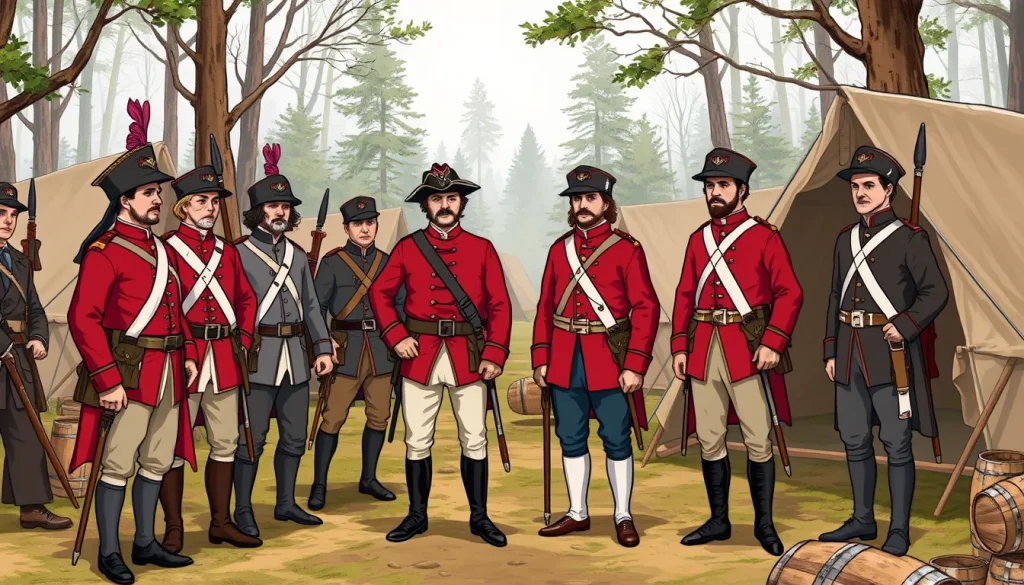
During the War of 1812, the Canadian militia—comprising diverse embodied, sedentary, and volunteer units—wore uniforms ranging from British-issue red coats to civilian clothing with only a coloured cockade or belt to signify military service. The uniforms were rarely standardized and depended on the availability of British supplies, the wealth of individual officers, and the administrative priorities of the colonial governments. Understanding these uniforms reveals much about the militia’s practical role, its social composition, and the logistical challenges that shaped the war in British North America.
Historical Context
The War of 1812 was fought between the United States and the United Kingdom, with British North America (present-day Canada) as a primary theatre. The defence of the colonies relied heavily on the Canadian militia, which was organized under the provincial governments of Upper and Lower Canada. In 1812, the militia consisted of two broad categories: the “sedentary” militia, which was a paper force of all able-bodied men liable for service, and the “embodied” or “active” militia, which was composed of men actually called out for duty. There were also volunteer units, such as the Glengarry Light Infantry and the Canadian Voltigeurs, raised for specific campaigns. The British regular army provided the professional core, but militia units were essential for garrison duty and local defence, especially in the early years of the war when British troops were scarce.
The colonial supply system had limited manufacturing capability. Most cloth, buttons, and accoutrements had to be imported from Britain or the United States. The British military authorities, through the Ordnance department and the Commissariat, issued uniforms to some units, but the quantity was often insufficient for large numbers of embodied militia. Additionally, the colonial governments held differing views on the importance of uniforms for the militia. Many believed that a uniformed militia would enhance discipline and esprit de corps, but others saw uniforms as an unnecessary expense, preferring to spend funds on arms and provisions.
What Happened
At the outbreak of the war, most Canadian militia units were poorly clothed. The sedentary militia had no uniforms at all; when called out, they might be given a simple regimental jacket or a pair of trousers, but often they appeared in civilian dress. The embodied militia, however, were more likely to receive military clothing. In Upper Canada, the government contracted with local tailors to produce jackets, trousers, and caps, while the British army supplied red coats, white crossbelts, and black shakos to some units. The quality and consistency of these items varied widely.
One notable formation, the Canadian Fencibles, a regular British unit raised for service in North America, wore the standard red coat with yellow facings, similar to British line infantry. The Glengarry Light Infantry, a unit of Scottish Highlanders, originally wore a dark green jacket with black facings, but later received red coats. The Canadian Voltigeurs, a French-Canadian light infantry unit, wore grey coat with green facings and a distinctive tuque-style cap. The York Volunteers, a militia unit from York (Toronto), were issued red coats with white facings, which were typical of British provincial units.
Despite these attempts at uniformity, many militia men fought in their own civilian clothes. In the heat of battle, identification became a serious issue. At the Battle of Queenston Heights in October 1812, American and British forces were similarly dressed in red or blue, and confusion sometimes occurred. To mitigate this, militia officers often ordered their men to wear a piece of white cloth on their hats as a distinguishing mark. Later, as the war progressed, the British issued standard “militia clothing” which included a short grey coat, blue trousers, and a round hat, but this was not universal.
The winter of 1813-14 saw a severe shortage of clothing, particularly for militia units. The British naval blockade of the American coast did not affect inland supply routes, but the Atlantic convoy system was risky. A number of British supply ships were captured by American privateers, and by 1814 the British were forced to rely more heavily on local resources. This led to a further deterioration of uniform quality, with some militia units wearing mismatched jackets and trousers.
Why It Matters
The state of Canadian militia uniforms had immediate practical effects on the war. Proper uniforms provided protection from the elements, but more importantly, they influenced the morale and esprit de corps of the troops. A uniformed soldier was more likely to be seen as a legitimate combatant by both the enemy and the civilian population, and it enhanced the military image of the militia. The lack of uniforms could also lead to inefficiency, as men without uniforms were often mistaken for civilians and subject to harsher treatment if captured.
Beyond the battlefield, uniforms symbolized the connection between the colonies and the British Empire. The red coat, in particular, was a powerful imperial symbol, and its use by militia units reinforced the loyalty of the colonists. At the same time, the distinctive colours of Canadian units, such as the green of the Voltigeurs or the grey of other militia, reflected a growing sense of Canadian identity. After the war, the memory of the militia as patriotic defenders was cultivated, and the uniforms became part of the narrative of national survival.
Historians have debated the military effectiveness of the Canadian militia. Some argue that their lack of training and uniforms made them unreliable, while others emphasise their importance in guerrilla-style operations and in freeing up British regulars for other tasks. The uniform issue is a proxy for these larger debates, as it reflects the broader logistical and political constraints of the war.
Definition
In the context of the War of 1812, a “Canadian militia uniform” was any clothing officially or semi-officially issued to, or adopted by, the militia forces of British North America. It could range from the full red coat and shako of a British provincial regiment to a simple civilian coat with a coloured sash or badge. The term encompasses both the garments themselves and the broader concept of military dress as a marker of identity and function.
Background
The Canadian militia system evolved from French colonial era seigneurial responsibilities and British colonial legislation. The 1793 Militia Act of Upper Canada required all able-bodied men aged 16 to 60 to serve in the sedentary militia, but it did not provide uniforms. Uniforms were only provided when the government activated men for active service. The British military authorities influenced the design, issuing regulations for provincial units, but colonial governments had discretion on clothing allowances. The financial strain of the war meant that uniforms were often a luxury.
How It Worked
The process of acquiring a uniform for a Canadian militiaman in the War of 1812 varied by unit and period. Embodied militia were usually issued clothing from government stores upon enrolment, but the issuance was often incomplete. Officers typically purchased their own uniforms, which were made to regulation pattern by civilian tailors. The rank and file received whatever was available: in some cases, a complete suit; in others, only a coat or a pair of trousers. The clothing was often of poor quality, especially when local contractors underbid for government contracts and used inferior cloth. The British army occasionally supplied surplus jackets and accoutrements, but these were not always suitable for the Canadian climate.
Unit identity was expressed through facing colours—the colour of collar and cuffs—and by badges or buttons. For example, the Glengarry Light Infantry had green facings with black lace, while the Canadian Fencibles had yellow facings. The Canadian Voltigeurs used green facings. The sedentary militia, when called out for local defence, often wore their own farmers’ clothing with a leather belt and a musket. In 1813, the British colonial authorities attempted to standardize using a grey jacket for militia units, but this was only partially successful.
Competing Viewpoints
Contemporary British officers often expressed frustration with the appearance of the Canadian militia. Major-General Isaac Brock, for example, noted in his letters the need to clothe the militia properly to prevent desertion and to ensure they were not mistaken for civilians. Some American observers dismissed the militia as “embodied farmers” with no military bearing. On the other hand, many colonial administrators argued that the militia’s effectiveness did not depend on uniforms, and that the money could be better spent on provisions or pay. There was also a cultural view that the militia represented a citizen-soldier ideal, and that their civilian dress was a symbol of their defence of home and hearth.
Modern historians have similarly debated the importance of uniforms. Military historians often emphasize discipline and uniformity as essential to combat effectiveness, while social historians note that the militia’s real value lay in its local knowledge and motivation, not in its appearance. The debate is tied to the larger question of whether the militia was a reliable force or merely a stopgap.
Role in the War of 1812
Uniforms played several roles in the war. Practically, they helped commanders identify their troops on the battlefield, which was critical in the confusion of engagements like the Battle of York and the Battle of Crysler’s Farm. Uniforms also affected the prisoners-of-war status: soldiers in uniform were entitled to treatment under the laws of war, whereas civilian-clothed fighters were sometimes treated as spies or brigands. Symbolically, the red coat represented the British Empire, and the militia’s adoption of it reinforced the colonial connection. For the Canadian units with distinctive uniforms, such as the Voltigeurs or Glengarry Light Infantry, the uniform served to build a regimental spirit and to win recognition from the British commander.
The lack of uniforms also had negative consequences. In the American invasion of 1813, several militia units surrendered with minimal resistance, some historians argue because they lacked the esprit de corps that uniforms might have fostered. The uniform, or lack thereof, thus became a proxy for the broader morale and discipline of the militia.
Consequences and Historical Interpretation
The immediate consequence of the uniform situation was that the Canadian militia were often perceived as an irregular force, which influenced American military planning. The British, for their part, learned that they needed to invest in local clothing production but were unable to fully do so before the war ended. After the conflict, the British government adopted a more formal system for provincial forces, though it was never fully standardized.
Historians interpret the uniforms as evidence of the limited resources of the British colonies and the resilience of the civilian population. The narrative of the “backwoods militia” who fought in homespun clothes while saving Canada is central to Canadian national mythology, despite the fact that many units did receive proper uniforms. Scholarly works, such as René Chartrand’s study of Canadian military heritage, have catalogued these uniforms and corrected some myths. The legacy of the militia uniform in Canada is thus a mix of colonial reliance and nascent national identity.
Primary Sources
Contemporary accounts of Canadian militia uniforms are scattered across military correspondence, personal diaries, and official reports. Important primary sources include the letters and orderly books of British officers, such as those of Major-General Isaac Brock and Major-General Roger Sheaffe, which sometimes mention clothing issues. The Provincial Secretary’s records in the Archives of Ontario contain contracts for militia clothing and correspondence regarding supplies. The British National Archives hold the quarterly clothing returns from the Canadian provinces, detailing the quantities of coats, trousers, and shoes issued. These documents are biased toward administrative views and may not reflect the actual wear of the men. Personal diaries, such as that of Sergeant James Fitzgibbon, provide anecdotal evidence of the poor state of the militia’s attire. However, no comprehensive visual record exists for the early period, so historians rely on reconstructions from documentation.
Further Reading
- René Chartrand, Canadian Military Heritage: Volume 2 (1755-1871) (Montreal: Art Global, 1993).
- Donald E. Graves, Field of Glory: The Battle of Crysler’s Farm, 1813 (Toronto: Robin Brass Studio, 1999).
- J. Mackay Hitsman, The Incredible War of 1812: A Military History (Toronto: University of Toronto Press, 1965).
- Carl Benn, Historic Fort York, 1793-1993 (Toronto: Natural Heritage/Natural History, 1993).
- George F.G. Stanley, Canada’s Soldiers, 1604-1954: The Military History of an Unmilitary People (Toronto: Macmillan, 1954).
References
- Benn, Carl. Historic Fort York, 1793-1993. Toronto: Natural Heritage/Natural History, 1993.
- Chartrand, René. Canadian Military Heritage: Volume 2 (1755-1871). Montreal: Art Global, 1993.
- Graves, Donald E. Field of Glory: The Battle of Crysler’s Farm, 1813. Toronto: Robin Brass Studio, 1999.
- Hitsman, J. Mackay. The Incredible War of 1812: A Military History. Toronto: University of Toronto Press, 1965.
- Stanley, George F.G. Canada’s Soldiers, 1604-1954: The Military History of an Unmilitary People. Toronto: Macmillan, 1954.
FAQ
Did all Canadian militia members wear red coats during the War of 1812?
No. While some embodied militia units received British-issue red coats, many others wore grey or green jackets, and many sedentary militia members wore their own civilian clothes. Uniform issuance was inconsistent and depended on the unit and the availability of supplies.
Why were Canadian militia uniforms so varied?
The colonies had limited manufacturing capacity and relied on British imports, which were often delayed or captured. Local contracts were also of inconsistent quality. Moreover, the British army prioritized clothing for regular troops, leaving militia units to receive whatever was left over or was locally produced.
How did the lack of uniforms affect the militia's performance?
Lack of uniforms could hurt morale and make identification on the battlefield difficult, sometimes leading to friendly-fire incidents. It also affected the status of captured militia, who might be treated as civilians rather than lawful combatants. However, motivation and local knowledge were often more important than appearance in determining combat effectiveness.
Leave a Reply