
Short Answer
Discipline in the U.S. Army during the War of 1812 (1812–1815) encompassed the legal codes, punishments, and training practices by which the regular army and wartime volunteers were controlled. The United States entered the war with a tiny professional force and relied heavily on militia and short-term volunteers, creating persistent challenges in obedience, morale, and combat effectiveness. This article examines how the army defined and enforced discipline, the difficulties it faced, and the lasting consequences for American military practice.
Historical Context
The U.S. Army on the eve of the War of 1812 was woefully understrength—fewer than 10,000 regulars—and had a mixed record of training and leadership. The militia system, inherited from colonial practice, placed primary military obligation on state-controlled citizen-soldiers who were often poorly trained, ill-equipped, and reluctant to serve beyond short terms. Congress authorized expansions of the regular army during the war, but enlistment remained short, and many volunteers joined for bounties rather than patriotic commitment. The legal framework for discipline was the Articles of War, a code inherited from British practice and revised in 1806, which defined offenses and prescribed punishments ranging from extra duty to flogging and execution. Commanders also issued general orders to regulate camp hygiene, drill, and conduct. The War of 1812 thus became a test of whether a republican citizenry could match the professional discipline of the British regulars and their Canadian and Indigenous allies.
What Happened
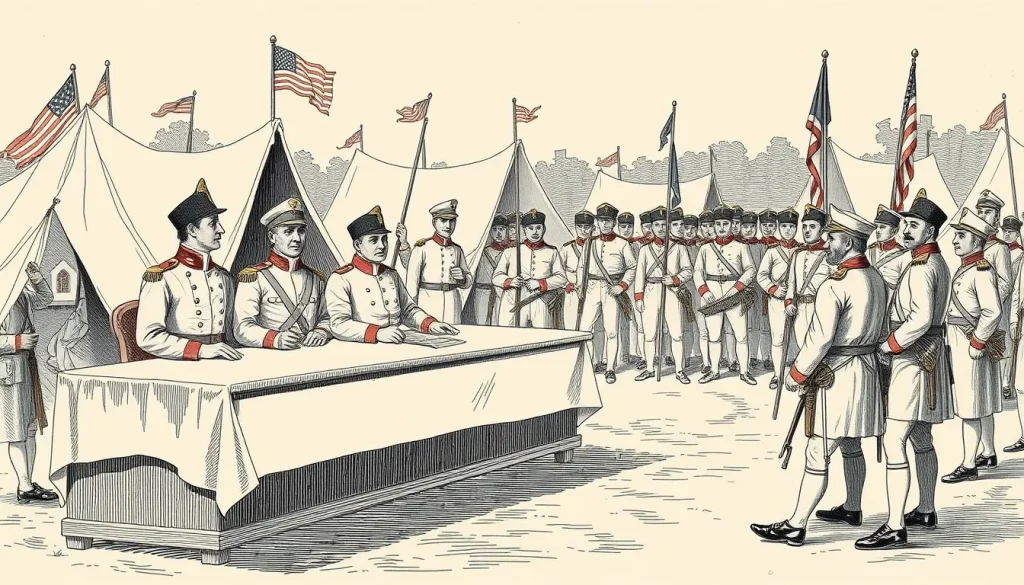
Throughout the war, U.S. armies struggled with desertion, insubordination, drunkenness, and neglect of duty. Early defeats—such as the surrender of Detroit in August 1812 and the failed invasion of Canada at Queenston Heights in October—were partly attributed to poor discipline and lack of training among militia and raw regulars. Desertion was rampant; by some estimates, the regular army lost a significant portion of its enlistments to desertion each year. Courts-martial were common, and sentences often included flogging (up to 100 lashes), imprisonment, hard labor, or, for desertion in the face of the enemy, death. In 1814, as the army expanded, reformers like Major General Winfield Scott worked to instill professionalism. Scott’s training camp at Buffalo in the spring of 1814 imposed strict drill, hygiene, and obedience, resulting in the disciplined brigades that fought well at Chippawa and Lundy’s Lane. However, such standards were not universal; state militias often resisted federal control, and discipline varied widely across campaigns. The war’s end in 1815 left the regular army small but with renewed attention to professional standards.
Why It Matters
The handling of discipline directly influenced the war’s outcome. The U.S. Army’s poor discipline contributed to early setbacks and prolonged the conflict, while improved discipline under Scott and others allowed American forces to hold their own in key battles. The war exposed fundamental flaws in the militia system and the ad-hoc expansion of the regular army, spurring post-war reforms such as a larger standing army and better training. For historians, discipline during the war reveals broader tensions between republican ideals of individual liberty and the necessities of military order. The legacy of this period shaped American military thought for decades, including the professionalization movements that culminated in the establishment of West Point as a primary source of officers.
Definition
In the context of the U.S. Army during the War of 1812, discipline referred to the system of regulations, training, and punishment designed to produce obedient, efficient soldiers. It encompassed both self-discipline—a soldier’s internalization of duty—and institutional discipline, enforced through courts-martial and summary punishments. The Army’s Articles of War (1806) were the legal foundation, specifying crimes, procedures, and penalties.
Background
The peacetime U.S. Army had inherited many British practices, including flogging and harsh punishment, but republican ideology fostered resentment against such measures. The militia tradition emphasized the citizen-soldier who voluntarily defended his community, making strict hierarchy and coercion unpopular. As war loomed, the regular army expanded quickly, bringing in large numbers of immigrants and unemployed laborers who had little stake in the cause, while state militias often operated under their own rules and governors. This patchwork created disciplinary confusion and conflict between federal and state authorities.
How It Worked
Discipline was enforced through a combination of drill, inspection, and legal procedures. Officers, many of them without formal training, were expected to enforce orders and maintain order. Courts-martial tried serious offenses—desertion, mutiny, striking an officer, theft—while commanders imposed minor punishments such as extra guard duty or forfeiture of pay. Flogging remained legal but was controversial; some officers used it liberally, others avoided it. Execution was reserved for egregious cases, often by firing squad. Regular soldiers were more frequently subjected to harsh discipline than militia, who could often escape to civilian life. The effectiveness of discipline varied with the quality of officers; West Point graduates, though few, tended to uphold higher standards.
Competing Viewpoints
Contemporaries disagreed about the proper balance between severity and republican principles. Some officers, like Winfield Scott, advocated rigorous training and uncompromising discipline, arguing that a professional army required it. Others, including many militia commanders and politicians, believed that too much coercion undermined the citizen-soldier ideal and turned soldiers into automatons. Soldiers themselves often resented harsh punishments; mutinies and resistance to flogging were recorded. Historians have interpreted these tensions as reflecting deep American ambivalence about standing armies and military authority. Some scholars argue that the war proved the need for a professional force, while others contend that the volunteer spirit, though undisciplined, was ultimately effective in defending the nation.
Role in the War of 1812
Discipline (or its lack) shaped campaigns from Canada to the Chesapeake. The failed invasion of Canada in 1812–1813 was hampered by militia refusing to cross borders and by undisciplined regulars who surrendered or fled. In contrast, the 1814 Niagara campaign demonstrated what disciplined troops could achieve: Scott’s brigade, trained to European standards, stood against British regulars at Chippawa and fought them to a standstill at Lundy’s Lane. On the lakes, naval discipline differed but also faced challenges. Desertion weakened garrisons and delayed operations. The burning of Washington in August 1814 was partly due to poor discipline and panic among American defenders. Conversely, disciplined forces at the Battle of New Orleans in January 1815, though under Andrew Jackson’s iron hand, showed that even mixed forces could perform well when effectively led.
Consequences and Historical Interpretation
The war’s disciplinary failures prompted post-war reforms: Congress increased the size of the regular army, improved pay and conditions, and emphasized professional training. West Point’s curriculum was strengthened. The war also fostered a lasting debate over the role of militia versus regulars. Historians like Donald Hickey argue that the war revealed the inadequacy of the militia system, while others, such as J.C.A. Stagg, emphasize the political constraints on raising a disciplined army. Long-term, the U.S. Army moved toward a more professional, less punitive model by the Mexican-American War, but many disciplinary practices, including flogging, persisted until after the Civil War. The War of 1812 thus stands as a pivotal moment in the development of American military discipline, marked by painful lessons and gradual improvement.
Primary Sources
Contemporary documents provide direct insight into discipline. General Orders issued by commanders like Winfield Scott and Jacob Brown specify drills and punishments. Courts-martial records, held in the National Archives, detail procedural and sentencing practices. Soldiers’ letters and memoirs—such as the journals of Private Abner B. Cushman or the memoirs of Winfield Scott—offer personal perspectives on harshness and morale. These sources are valuable but must be interpreted critically; official records may understate abuses, while individual accounts reflect personal bias. No single document covers the topic comprehensively, but together they allow reconstruction of disciplinary trends.
Further Reading
- Hickey, Donald R. The War of 1812: A Forgotten Conflict. University of Illinois Press, 1989.
- Quimby, Robert S. The U.S. Army in the War of 1812: An Operational and Command Study. Michigan State University Press, 1997.
- Stagg, J.C.A. Mr. Madison’s War: Politics, Diplomacy, and Warfare in the Early American Republic, 1783–1830. Princeton University Press, 1983.
- Scott, Winfield. Memoirs of Lieut.-General Winfield Scott. Sheldon & Company, 1864.
- Whitehorne, Joseph W.A. The Battle for Baltimore, 1814. Nautical & Aviation Publishing, 1997.
References
- Hickey, Donald R. The War of 1812: A Forgotten Conflict. University of Illinois Press, 1989.
- Quimby, Robert S. The U.S. Army in the War of 1812: An Operational and Command Study. Michigan State University Press, 1997.
- Stagg, J.C.A. Mr. Madison’s War. Princeton University Press, 1983.
- Scott, Winfield. Memoirs of Lieut.-General Winfield Scott. Sheldon & Company, 1864.
FAQ
What were the most common offenses in the U.S. Army during the War of 1812?
Desertion, drunkenness, insubordination, neglect of duty, and theft were common. Desertion was particularly severe, sometimes leading to execution.
How did Winfield Scott improve discipline in 1814?
Scott established a rigorous training camp at Buffalo, emphasizing drill, hygiene, and obedience. He punished infractions strictly while rewarding proficiency, creating a disciplined brigade that performed well at Chippawa and Lundy’s Lane.
What is the historical significance of U.S. Army discipline in the War of 1812?
The war revealed the weaknesses of the militia system and the need for a professional standing army, leading to post-war reforms in training and military policy.


Leave a Reply