
Short Answer
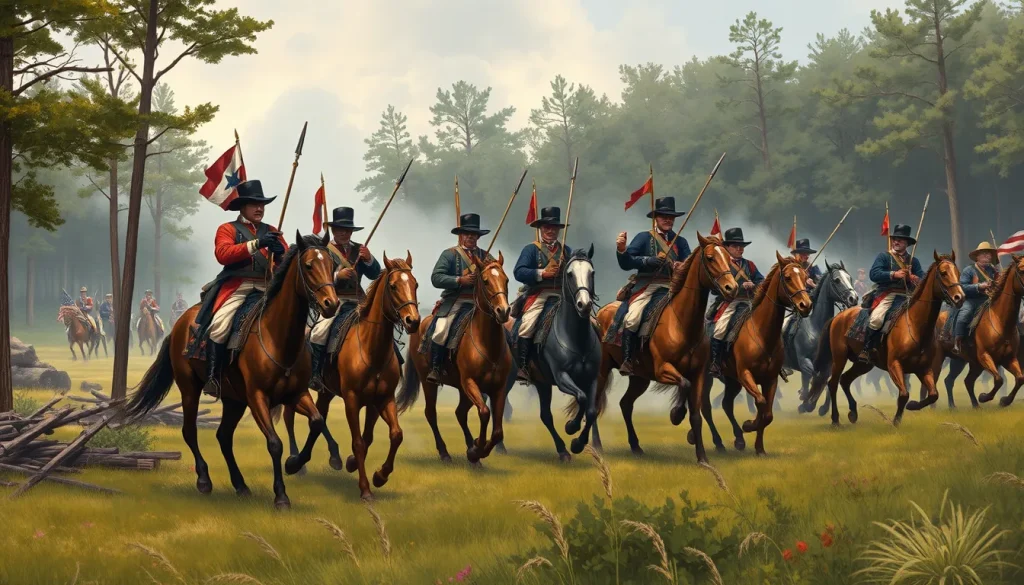
The War of 1812 saw cavalry used in a limited but important way by American, British, Canadian, and Indigenous forces. Though often overshadowed by infantry and naval actions, mounted troops performed essential duties such as reconnaissance, raiding, pursuit, and occasional shock action. The conflict revealed both the potential and the limitations of cavalry in North American terrain and set the stage for later mounted tactics.
Historical Context
By the outbreak of the War of 1812, the United States had a small regular army with only one regiment of light dragoons, authorized in 1808; a second regiment was added in 1812. These regular units were never at full strength because of recruiting difficulties, high costs, and the expense of maintaining horses and equipment. State militias and volunteer units, including mounted riflemen and independent cavalry companies, supplemented the regulars. In contrast, the British Army in North America had few regular cavalry units; they relied instead on Canadian militia, Indigenous allies, and a small number of horse artillery. Both armies used horses for transport and dispatch riders, but formal cavalry as a dedicated combat arm was scarce. Dense forests, poor roads, and the high cost of supplies limited the effectiveness of mounted troops, yet commanders on both sides recognized the need for mobility, especially on the frontier and along the border.
What Happened
During 1812 and 1813, American cavalry was largely confined to small-scale actions on the western frontier and along the Niagara River. In December 1812, a detachment of the 1st and 2nd U.S. Light Dragoons participated in the raid on the Mississinewa River in Indiana Territory, attacking Miami villages to disrupt supply lines. The next spring, another detachment helped defend Fort Meigs in Ohio against a British siege. The most notable cavalry action came in October 1813 at the Battle of the Thames in Upper Canada, where Colonel Richard Johnson’s Kentucky Mounted Riflemen launched a mounted charge that broke the British line and resulted in the death of Tecumseh. In the Creek War in the South, Colonel John Coffee’s Tennessee Mounted Riflemen fought as mounted infantry at battles like Tallushatchee and Horseshoe Bend. On the Atlantic coast, a squadron of regular dragoons helped repel a British attack at Sackett’s Harbor in May 1813. By 1814, the two dragoon regiments were consolidated into a single Regiment of Light Dragoons, which saw action at Bladensburg (August 1814) and at Lundy’s Lane (July 1814) before being disbanded in June 1815.
Why It Matters
The use of cavalry in the War of 1812 demonstrated both its value and its limitations. The mounted volunteer units, particularly those from Kentucky and Tennessee, proved effective in the frontier environment, where their mobility allowed rapid raids and pursuit. However, the regular dragoons were too few and too poorly supplied to have a decisive impact on most battlefields. The war reinforced the lesson that cavalry required substantial investment and training to be effective, and the post-war disbandment of the dragoon regiment reflected the nation’s aversion to military spending. The experience also influenced later debates about the need for a permanent mounted force, leading to the formation of the United States Dragoons in 1833. Historians generally agree that cavalry in this war was a secondary arm, but its contributions in reconnaissance, raids, and occasional charges helped shape American military thinking.
Definition
In the War of 1812, cavalry referred to soldiers who fought on horseback, encompassing regular dragoons, mounted militia, and volunteer mounted riflemen. Unlike true heavy cavalry, most American troops were dragoons—mounts used for mobility but with the intent to fight dismounted—or mounted infantry who used horses for transport. True cavalry charges, as practiced in Europe, were rare, but mounted troops could engage effectively when terrain and opportunity allowed.
Background
Before the war, the United States had almost no standing cavalry. The 1808 authorization for a light dragoon regiment was part of a general expansion of the army in response to international tensions. In 1812, a second regiment was raised. However, the army lacked trained horses, saddles, and experienced officers. British forces in Canada also had little cavalry, relying on Canadian militia and Indigenous warriors who were skilled in irregular mounted raiding. The terrain of the northern frontier—dense forests, muddy roads, and river crossings—made large-scale cavalry operations difficult, while the open woodlands of the South offered more opportunities for mounted action.
How It Worked
Cavalry in the War of 1812 performed several distinct roles. Reconnaissance and screening were the most common tasks. Mounted troops could move quickly ahead of an army to gather intelligence and protect flanks. Raiding was also important, as demonstrated by attacks on enemy supply lines and villages. Pursuit after a battle could turn a retreat into a rout, as seen at the Thames, where Johnson’s charge broke the British line and led to the capture of prisoners and supplies. However, most American mounted troops were trained to fight dismounted as infantry, using their horses for transport. This made them effective in rough terrain where horses could not charge. The quality of these troops varied; regular dragoons were better disciplined but few in number, while volunteers were more numerous but loosely organized.
Competing Viewpoints
Contemporary opinions on cavalry were divided. Some American commanders, like Andrew Jackson, valued mounted riflemen for their speed and marksmanship, using them as versatile light infantry. Others, following European doctrine, argued that true cavalry should be able to charge with sabers and shock the enemy. The British and Canadian forces had a different perspective: they regarded mounted troops as less essential, preferring to use Indigenous allies for irregular mounted warfare. Historians have since debated whether the heavy reliance on mounted volunteers was a sign of pragmatism or of the lack of a professional cavalry. Some argue that the war proved the value of mounted infantry on the frontier, while others contend that the limited training and discipline of these units prevented them from being decisive in more conventional battles.
Role in the War of 1812
Cavalry participated in nearly every theater of the war. In the Northwest, mounted units supported Harrison’s campaigns, including the defense of Fort Meigs and the victory at the Thames. In the South, Coffee’s mounted militia played a crucial role in the Creek War and at the Battle of New Orleans. On the Niagara frontier, regular dragoons were present at Chippawa and Lundy’s Lane, but their impact was limited. At Bladensburg in 1814, a small force of American dragoons was routed along with the rest of the militia, demonstrating the vulnerability of poorly supported cavalry. British and Canadian forces also used mounted troops for raiding, such as the attack on American outposts along the St. Lawrence, but they never fielded a large cavalry force.
Consequences and Historical Interpretation
After the war, the United States disbanded its dragoon regiment in 1815, and for seventeen years the regular army had no cavalry. The war’s experience was interpreted in different ways: some saw the success of mounted volunteers as evidence that militia could suffice, while others pointed to the need for professional mounted troops. The latter view eventually won out, leading to the creation of the United States Dragoons in 1833. Historians today note that the War of 1812 accelerated the transition from European-style cavalry to more flexible, mobile mounted infantry suited to North American conditions. The war also demonstrated that cavalry could be decisive in raiding and pursuit when properly led, but that its effectiveness depended on logistics and training.
Primary Sources
Key primary sources include the official reports of American commanders such as William Henry Harrison at the Battle of the Thames, Andrew Jackson’s orders and correspondence during the Creek War, and Colonel Richard Johnson’s account of his charge. British perspectives appear in the official dispatches of General Isaac Brock and later commanders. The National Archives of the United States and the Library and Archives of Canada hold these records. The Center of Military History’s campaign pamphlet “The Campaign of 1812” provides a modern synthesis based on these sources. Limitations include the tendency of after-action reports to exaggerate enemy numbers and underestimate own casualties.
Further Reading
- Hickey, Donald R. The War of 1812: A Forgotten Conflict. University of Illinois Press, 1989.
- Rauch, Steven J. The Campaign of 1812. United States Army Center of Military History, 2013.
- Elting, John R. Amateurs to Arms! A Military History of the War of 1812. Da Capo Press, 1995.
- Starobin, Paul. Fighting the War of 1812: The Mounted Arm. Journal of the Early Republic, 2008.
References
- Rauch, Steven J. The Campaign of 1812. United States Army Center of Military History, 2013. Accessed from history.army.mil.
- American Battlefield Trust. “Here Comes the Cavalry.” Accessed 2025. https://staging.battlefields.org/learn/articles/here-comes-cavalry.
- Wikisource. “ARMOR-CAVALRY: Part 1; Regular Army and Army Reserve/War of 1812 to Civil War.” Accessed 2025.
- Cameron, Robert C. “The Horse Cavalry Heritage.” ARMOR, March-May 2010.
FAQ
Did cavalry charges play a decisive role in any major battle of the War of 1812?
The most notable charge was Colonel Richard Johnson's mounted assault at the Battle of the Thames in 1813, which helped break the British line. However, most cavalry actions were raids and scouting, not large-scale shock charges.
Why was the American cavalry so small during the war?
The high cost of horses and equipment, recruitment difficulties, and a general distrust of standing armies led to a small regular cavalry. Additionally, the terrain and logistics made large mounted forces impractical.
How did British and Indigenous forces use cavalry?
British forces in Canada had few regular cavalry, relying on Canadian militia and Indigenous allies who used horses for raiding and mobility. Indigenous warriors were especially effective in irregular mounted warfare.


Leave a Reply