
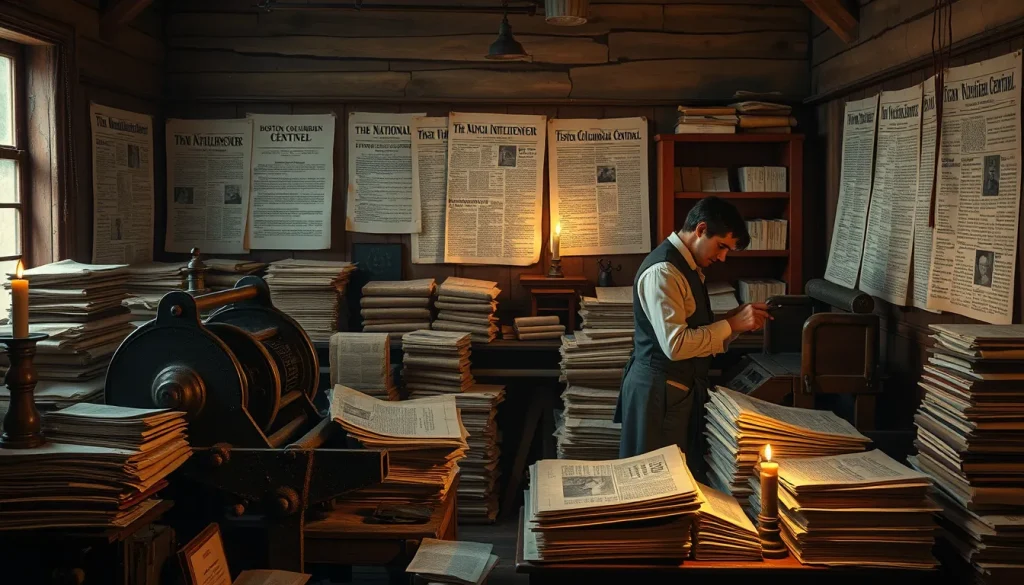
Short Answer
During the War of 1812 (1812–1815), American newspapers were the principal means by which citizens learned of events and debated the conflict. As a largely partisan press, they split along Federalist and Democratic-Republican lines, offering sharply contrasting interpretations of the war’s causes and conduct. These newspapers are historically significant both as records of wartime opinion and as active participants in the political struggles of the early republic.
Historical Context
The American newspaper industry in the early 19th century was small but growing, with most papers printed weekly and explicitly tied to political parties. The Federalist party, centered in New England, generally opposed war with Britain, fearing it would ruin commerce and favor revolutionary France. The Democratic-Republicans, dominant in the South and West, saw war as necessary to defend neutral rights and national honor. Papers often received patronage from political parties, and editors frequently held partisan loyalties. Communication was slow: news traveled by post riders and sailing ships, and editors relied on reprinting items from exchanges with other papers. This environment fostered an intensely partisan and opinionated press, which became a central forum for the debates that preceded and accompanied the war.
What Happened
From the declaration of war on June 18, 1812, newspapers throughout the United States responded with editorials, reprints of government documents, and reports of military engagements. The National Intelligencer in Washington, D.C., acted as the semi-official voice of the Madison administration, publishing the message asking for war and the subsequent declaration. Federalist papers such as the Boston Columbian Centinel and the New York Evening Post condemned the conflict as “Mr. Madison’s War” and predicted disaster. As the war progressed, newspapers provided accounts of major battles—including the invasions of Canada, the naval victories on the Great Lakes, and the burning of Washington in 1814—often relying on letters from officers and reprinted British reports when official information was scarce. Editors faced practical problems: obtaining reliable intelligence, keeping presses running during shortages of paper and ink, and defending themselves against accusations of treason when they criticized the government. Some Federalist editors, such as William Coleman of the New York Evening Post, were attacked by mobs, and a few were arrested under wartime suspensions of habeas corpus. Despite these pressures, the press remained vibrant, and by war’s end newspapers had both reported the conflict and helped shape the political landscape that produced the Treaty of Ghent.
Why It Matters
The wartime press had immediate and lasting effects. At the time, newspapers influenced public opinion, affected military recruiting, and contributed to the sharp partisan divisions that threatened to fragment the union. Federalist opposition in New England reached its peak at the Hartford Convention in 1814–15, and newspapers both stimulated and reported that dissent. In the longer term, the war spurred the growth of more professional journalism; the demand for timely news led to improved distribution and the beginnings of the penny press in the following decade. Historians have used wartime newspapers extensively to reconstruct the political debates and public sentiment of the era. Scholarly interpretations range from viewing the press as a mouthpiece of party elites to recognizing it as a force for democracy, and the study of wartime journalism illuminates the limits and pressures of free expression in the early republic.
Definition
American newspapers during the War of 1812 were printed periodicals, mostly weeklies, that served as the primary means of mass communication in the United States. They contained political commentary, military news, government proclamations, advertisements, and letters from readers, and they were typically aligned with one of the two major political parties: Federalists or Democratic-Republicans.
Background
By 1812, the United States had hundreds of newspapers, with most published in the eastern seaboard states. The press was partisan by tradition; many papers were founded by party supporters and relied on party patronage for subscriptions and government printing contracts. The development of the postal system and the practice of exchanging papers between editors allowed news to circulate, but at a slow pace. This background meant that newspapers were integral to the political debates that led to the war, particularly over issues like impressment, trade restrictions, and the rights of neutrals.
How It Worked
Newspapers were produced on hand-operated presses, often in small offices. Editors gathered news from a variety of sources: official government communications, letters from military officers and civilian correspondents, reports from other newspapers (often reprinted without attribution), and even captured British newspapers. Reports of battles could take weeks to arrive and were often embellished with rumor. Editors wrote editorial columns expressing their political opinions, and they published letters from readers to show public support. Subscription was the main revenue source, though advertising also helped. Many papers had a regional readership, and some, like Niles’ Weekly Register in Baltimore, gained national influence by compiling and digesting news from around the country.
Competing Viewpoints
The most significant divide was between Federalist and Democratic-Republican newspapers. Federalist papers, concentrated in New England and the mid-Atlantic, generally opposed the war as a dangerous and unnecessary conflict that would ruin American commerce and strengthen France. They attacked President James Madison’s leadership and sometimes advocated peace negotiations or even secession. Democratic-Republican papers, such as the National Intelligencer and the Richmond Enquirer, supported the war as a necessary defense of American sovereignty and national honor. They celebrated military victories and sought to rally public backing. Both sides used emotionally charged language, and accusations of corruption, cowardice, and treason were common. There were also regional variations, with western and southern papers generally more supportive of the war, while coastal commercial papers often opposed it.
Role in the War of 1812
Newspapers played several crucial roles: they communicated government announcements, such as the declaration of war and the peace treaty; they shaped public opinion through editorials and letters; they reported military events and casualties, which influenced recruiting and morale; they served as forums for the debate over the war’s legitimacy. They also acted as watchdogs, exposing scandals and inefficiencies in the war effort. At times, the government attempted to suppress opposition by prosecuting editors under sedition laws or by using military force, but these actions were controversial. The press was thus both a mirror and a participant in the conflict.
Consequences and Historical Interpretation
Historians have examined the wartime press from multiple perspectives. Some view it as an extension of party politics, showing how elite factions manipulated public opinion. Others emphasize the press’s role in fostering a national identity and democratic participation. The war also revealed the limits of press freedom in wartime: editors were harassed, paper shortages threatened publication, and the need to attract readers led to sensationalism and bias. After the war, the experience contributed to a shift toward more independent and news-focused journalism, culminating in the penny press of the 1830s. The press’s coverage of the war remains a vital source for understanding the period, but it must be used with caution due to its partisan nature.
Primary Sources
The most significant primary sources are the newspapers themselves. The National Intelligencer (Washington, D.C.) provides official government documents and pro-administration commentary. Niles’ Weekly Register (Baltimore) compiles news from across the country and offers a moderate Democratic-Republican viewpoint. Federalist perspectives appear in the Boston Columbian Centinel and the New York Evening Post. These papers contain editorials, letters, and reprinted items that document the partisan arguments of the era. Additionally, the British press and Canadian papers offer external perspectives, but they are not the focus of this article. Researchers should be aware that all American papers were partisan and that wartime censorship or self-censorship may have limited some reporting. Original issues are available in archives such as the Library of Congress and the American Antiquarian Society, and many have been digitized in databases like America’s Historical Newspapers.
Further Reading
- Hickey, Donald R. The War of 1812: A Forgotten Conflict. University of Illinois Press, 1989.
- Humphrey, Carol Sue. The Press of the Young Republic, 1783–1833. Greenwood Press, 1996.
- Sloan, Wm. David, and James D. Startt. The Media in America: A History. Vision Press, 2008.
- Smith, Jeffrey A. Printers and Press Freedom: The Ideology of Early American Journalism. Oxford University Press, 1988.
References
- Hickey, Donald R. The War of 1812: A Forgotten Conflict. University of Illinois Press, 1989.
- Humphrey, Carol Sue. The Press of the Young Republic, 1783–1833. Greenwood Press, 1996.
- Sloan, Wm. David, and James D. Startt. The Media in America: A History. Vision Press, 2008.
- Smith, Jeffrey A. Printers and Press Freedom: The Ideology of Early American Journalism. Oxford University Press, 1988.
FAQ
How did newspapers learn about the war?
They relied on letters from officers, official government communications, and reprints from other papers; news could take weeks to arrive.
Did the government censor newspapers?
There was no formal censorship, but some Federalist editors were prosecuted or threatened for opposing the war.
Why were newspapers important during the War of 1812?
They were the main way citizens learned about events and debated policy, influencing public opinion and shaping the political response to the conflict.


Leave a Reply