
Short Answer
War of 1812 newspapers are primary sources that require specialized reading techniques due to their format, distribution, and political context. This article explains how to approach these periodicals to extract accurate historical information, covering their geographic organizing principle, reprinting practices, partisan bias, and typographic conventions.
Historical Context
During the early nineteenth century, newspapers were the primary mass medium in North America and Britain. Most papers were small, four-page weeklies produced on hand-operated presses. Editors obtained news through exchanged subscriptions, mail deliveries, and reports from ship captains and travelers. Because information traveled slowly, newspapers often printed items weeks or months old. The political climate of the War of 1812 was intensely partisan: the Federalist Party opposed the conflict, while the Democratic-Republican Party supported it. Consequently, most newspapers had explicit political loyalties and used their columns to advocate for their side. Understanding this context is essential for interpreting any single issue.
What Happened
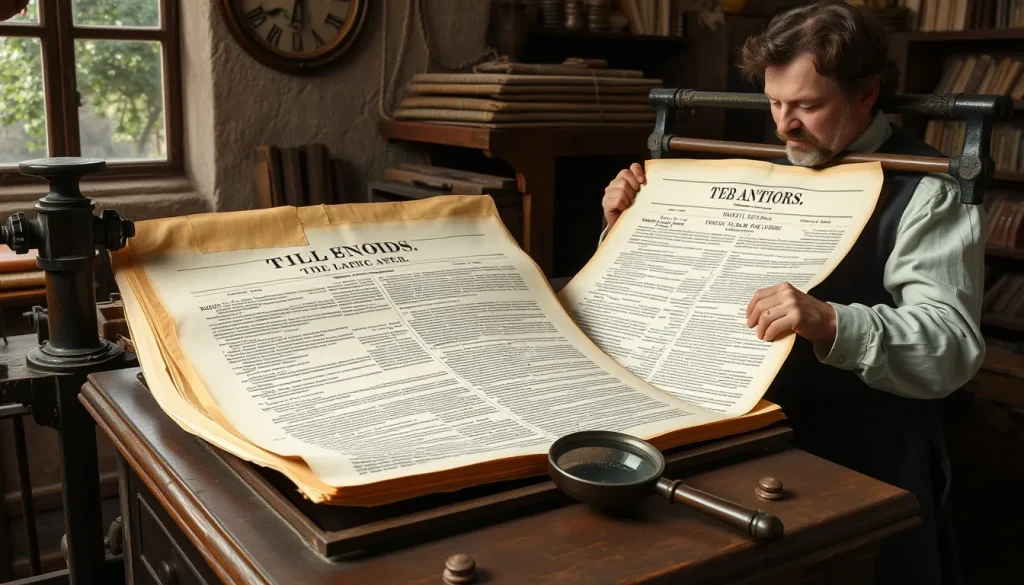
War of 1812-era newspapers typically opened with sections of foreign news, often copied from London journals, followed by national and local news. Each issue was a collage of paragraphs taken from other papers, with the editor adding occasional original items or editorial commentary. The basic unit was the paragraph, not the modern story, and there were no headlines or bylines. Reports were arranged geographically: the most distant news came first, and local news appeared later. This system reflected the way information flowed along shipping and postal routes. Advertisements, legal notices, ship arrivals, and legislative proceedings filled much of the page. Editors also used abbreviations such as “inst.” (this month), “ult.” (last month), and “prox.” (next month) to denote time. Typography included the long “s” (ſ), which resembled a lowercase “f” and can mislead modern readers and optical character recognition software.
Why It Matters
These newspapers are indispensable for reconstructing the War of 1812 from the perspective of those who lived through it. They reveal what the public knew and when they knew it, how editors shaped stories to suit political agendas, and how rumors and speculation spread. However, they also present challenges: many articles are inaccurate, biased, or based on unreliable reports. Historians must cross-reference newspaper accounts with official documents, letters, and later scholarship. The ability to read these papers critically is a core skill for any student of the period.

Definition
“How to read War of 1812 newspapers” refers to a set of interpretive skills used to extract historical evidence from periodicals published between 1812 and 1815. These skills include recognizing the geographic organization of news, decoding archaic abbreviations and typography, identifying political bias, and evaluating the reliability of reprinted reports.
Background
The War of 1812 occurred during what historians call the “partisan press” era. Newspapers were usually sponsored by political factions or individual editors and did not strive for objectivity. They were produced on small presses and distributed primarily through the post office. Many editors exchanged their papers with counterparts in other cities, which is why the same article often appears in multiple papers with slight changes. This practice made reprinting a central feature of early American journalism.
How It Worked
To read a War of 1812 paper effectively, follow these steps. First, note the masthead: the title, place, date, and issue number. This tells you the paper’s origin and its political leaning (if discernible). Second, scan the page for section headers, which usually indicate a city and date, such as “LONDON, August 16.” The material beneath that header was copied from a London paper or from an account that reached London by that date. The farther away the dateline, the older the news. Third, treat each paragraph as a separate report; do not assume that all items in a section relate to a single event. Fourth, check for the source of each item if it is mentioned (e.g., “We learn from the Halifax Journal…”). Fifth, be aware that the editor may have abridged, reordered, or misprinted the original text. Sixth, decode time abbreviations using the masthead date: “inst.” means the current month, “ult.” the previous month, and “prox.” the next month. Seventh, watch for the long “s” (ſ) and other period-specific spellings—when searching digital archives, account for OCR errors due to this letterform. Finally, always ask who benefited from the story as printed. A Federalist paper might portray British victories in detail, while a Republican paper might emphasize American heroism.
Competing Viewpoints
Historians disagree about how much trust to place in newspaper accounts. Some argue that because papers were close to the events and often relied on eyewitness reports, they provide a valuable record of public sentiment. Others point out that partisan editors frequently exaggerated, suppressed, or invented stories to support their cause. Moreover, the practice of reprinting meant that an error made in one paper could be repeated across many publications. Scholars also debate whether newspapers influenced public opinion or merely reflected it. These debates underscore the need for careful source criticism.
Role in the War of 1812
Newspapers played a crucial role in shaping perceptions of the war. They announced declarations of war, reported naval victories and defeats, published casualty lists, and printed speeches and proclamations. Editors on both sides of the Atlantic used inflammatory language to rally support. The British and American presses traded accusations, and each side’s reports often contradicted the other. Newspapers also served as a channel for official communication; for example, the British naval officer Admiral Sir John Borlase Warren’s proclamations were published in American papers to threaten and intimidate. At the same time, papers were a source of military intelligence, as both sides monitored each other’s press.
Consequences and Historical Interpretation
The historical interpretation of the War of 1812 has been shaped by the newspapers that survived. They are among the most abundant primary sources from the period, and modern historians use them to study home-front morale, the economic impact of blockades, and daily life. With the digitization of collections such as the Library of Congress’s Chronicling America and the Maryland State Archives’ newspapers, researchers can now search thousands of issues. However, interpreting these sources still requires the skills described above. As a result, “how to read” these newspapers remains a fundamental part of training in early American history.
Primary Sources
The most useful War of 1812 newspapers for research include Niles’ Weekly Register (Baltimore), which compiled news from various papers; The War (New York), a weekly devoted entirely to the conflict; and many local papers such as the Maryland Gazette and the Baltimore Patriot. These are available in original and microfilm formats at archives and in digitized form through the Library of Congress’s Chronicling America project. The Lilly Library at Indiana University provides access to The War online. When using any of these sources, note the publication date and place, the editor’s known political affiliation, and the original source of each article.
Further Reading
For further guidance, consult the following: “7 Tips for Reading the Virginia Gazette” from Colonial Williamsburg (website); “Glorious News! How Maryland newspapers reported the War of 1812” from the Maryland State Archives (PDF); the “How To: Research with Historic Newspapers” guide from Hobart and William Smith Colleges (webpage); and the “Guide to the War of 1812 Resources” from the Maryland Center for History and Culture (PDF). These resources provide detailed examples and practical advice for working with early nineteenth-century periodicals.
References
- Colonial Williamsburg Foundation, “7 Tips for Reading the Virginia Gazette,” https://www.colonialwilliamsburg.org/learn/deep-dives/7-tips-for-reading-the-virginia-gazette/
- Maryland State Archives, “Glorious News!: How Maryland newspapers reported the War of 1812,” https://msa.maryland.gov/msa/speccol/sc5500/sc5572/000001/000000/000191/html/t191.html
- Hobart and William Smith Colleges Libraries, “How To: Research With Historic Newspapers,” https://library.hws.edu/c.php?g=1093638&p=8177807
- Mike’s History Blog, “Digital Online Newspapers for Researching the War of 1812,” https://www.dixonhistory.com/news/digital-online-newspapers-for-researching-the-war-of-1812/
- Maryland Center for History and Culture, “Guide to the War of 1812 Resources,” https://www.mdhistory.org/wp-content/uploads/2023/10/GuideToWarOf1812Resources_2020.pdf
FAQ
How can I tell if a War of 1812 newspaper article is reliable?
Compare the same event reported in papers from different political leanings, check the dateline and source, and cross-reference with official government documents, diaries, and later scholarship. Be aware that reprints may contain errors and that partisan editors often exaggerated.
Why does a War of 1812 newspaper contain so much old news?
News traveled slowly; foreign reports could take weeks to cross the Atlantic. Editors arranged sections by geography, so distant items were older. Readers were accustomed to this delay and expected to see the latest local news at the end of the paper.
What are the best free online resources for War of 1812 newspapers?
The Library of Congress's Chronicling America provides free access to digitized American papers, including many from 1812–1815. The Lilly Library at Indiana University hosts The War newspaper. State archives, such as the Maryland State Archives, also offer online guides and digitized issues.



Leave a Reply