
Short Answer
The British naval blockade of the United States during the War of 1812 was a systematic effort by the Royal Navy to close American ports to both foreign and coastal commerce. Initiated in late 1812 and expanded to the entire coast by 1814, the blockade drastically reduced American trade, crippled government revenue, and became a central factor in U.S. financial distress. This article traces how the blockade was implemented, its direct effects on American trade, and historians’ differing interpretations of its role in the war’s outcome.
Historical Context
Before the war, the United States had prospered as a neutral carrier during the Napoleonic Wars, but British and French restrictions had already damaged its commerce. The Embargo Act of 1807 and subsequent non-importation acts aimed to protect American interests but failed to avert war. The federal government depended heavily on customs duties for revenue—about 80 percent of its income. When Congress declared war on Britain in June 1812, the Royal Navy controlled the Atlantic. Britain’s North America Station, with bases at Halifax, Nova Scotia, and Bermuda, provided the force to enforce a blockade. Strategists in London viewed cutting American trade as a way to pressure the republic without large land operations, exploiting regional divisions and economic self-interest.
What Happened
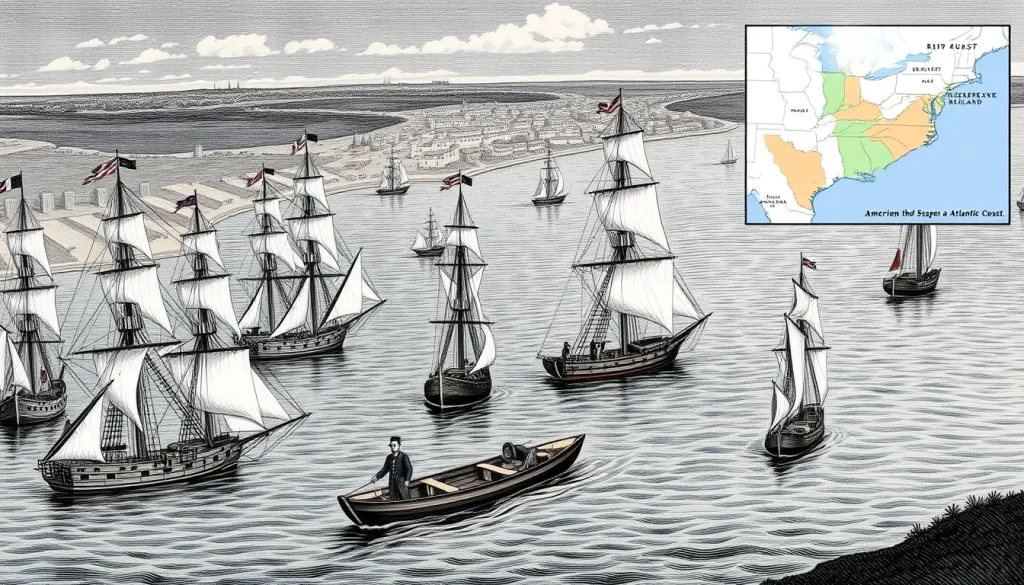
The blockade evolved in stages rather than as a single proclamation. In December 1812, Admiral Sir John Borlase Warren, commander of the North American station, issued a directive to blockade the Chesapeake and Delaware Bays, two vital commercial waterways. Over 1813, the blockade extended to other Atlantic ports, including New York, Charleston, and Savannah, as vessels patrolled the coast, stopped merchantmen, and seized cargoes. New England, however, was deliberately excluded from the early restrictions, a decision designed to minimize opposition in that strongly Federalist region and to encourage smuggling that profited British forces.
When Vice Admiral Alexander Cochrane succeeded Warren in 1814, he issued a proclamation on April 25, 1814, extending the blockade northward to the border with New Brunswick, covering effectively every American port. The enforcement involved dozens of ships, from large frigates to small tenders, which monitored harbors and chased blockade runners. The effect on trade was catastrophic. According to official records, American exports fell from about $61 million in 1811 to under $7 million in 1814—a decline of nearly 89 percent. Imports similarly collapsed, and customs receipts dropped by roughly 80 percent. The coastal trade, which moved goods between American ports by sea, was almost wiped out, as local vessels became easy prizes.

Why It Matters
The blockade’s economic effects were immediate and profound. The collapse of customs revenue left the federal government unable to finance the war, forcing it to rely on loans and to impose internal taxes, which proved unpopular. By late 1814, the Treasury faced near-insolvency; banks outside New England suspended specie payments, and the government’s paper notes depreciated. The blockade also isolated New England’s trade, which continued to some degree, and inflamed regional tensions that culminated in the Hartford Convention. The economic pressure contributed to the willingness of American commissioners to sign the Treaty of Ghent in December 1814. Historians debate whether the blockade alone forced this outcome or was one of several pressures, but its significance is undisputed.
Definition
A blockade is a military operation by which a belligerent uses naval forces to prevent ships from entering or leaving an enemy’s ports, thereby cutting off commerce and supplies. In the War of 1812, the British blockade was a form of economic warfare aimed at strangling American trade and federal revenue, rather than a mere tactical maneuver.
Background
The United States had a large and growing merchant marine, with its trade serving as a vital source of income and government income. British naval supremacy made a blockade feasible. The decision to blockade American ports was part of Britain’s broader strategy to defeat Napoleon—after the repeal of the Orders in Council, the blockade of the American coast became the main instrument of economic pressure. The U.S. had also employed trade restrictions, such as the Embargo of 1807, but these failed to coerce Britain and France. The war began with American naval successes, but the Royal Navy quickly tightened its grip on American commerce.
How It Worked
The Royal Navy stationed squadrons off major American harbors, with orders to intercept all vessels attempting to enter or leave. Blockade proclamations gave legal notice, and captured ships and cargoes were condemned in admiralty courts. Enforcement varied by location and time; some ports faced near-total closure, while others saw sporadic captures. Neutral ships, such as those from Sweden or Denmark, were often allowed through with licenses, but American ships were treated as prizes. The blockade also relied on intelligence from local agents and on the threat of seizure to deter merchantmen from sailing. Coastal trade was equally affected, as British cruisers patrolled coastal routes and even entered bays and inlets.
Competing Viewpoints
Historians disagree over the blockade’s strategic decisive-ness. Brian Arthur, in How Britain Won the War of 1812, argues that the blockade was the preeminent factor in Britain’s success, because it destroyed American trade and finances, making the war unsustainable. Donald Hickey, in The War of 1812: A Forgotten Conflict, and Wade Dudley, in Splintering the Wooden Wall, maintain that the blockade was one of several pressures, including military stalemate, the defeat of Napoleon, and internal American opposition. They emphasize that the blockade’s effects were uneven and that the U.S. government remained able to function, albeit with great strain. The question of whether the blockade alone compelled the Treaty of Ghent remains contested, as American negotiators also faced demands from the West and the Gulf.
Role in the War of 1812
The blockade played a central role in shaping the war’s course. It denied the United States the revenue and goods needed to sustain a prolonged conflict, limited American naval movements, and facilitated British amphibious raids along the coast. The early exclusion of New England allowed British forces to procure food and supplies from that region, undermining the American war effort. After Cochrane extended the blockade to New England in April 1814, the entire coastline was closed, and trade with the enemy—though diminished—continued only through smuggling. The blockade also affected neutral trade and the U.S. carrying trade, contributing to a shift toward domestic manufacturing as import competition disappeared. However, as Douglas Irwin and Joseph Davis have shown, the trade disruptions did not decisively accelerate industrialization; rather, they caused a limited reallocation of resources from shipping to textile and other infant industries.
Consequences and Historical Interpretation
The blockade’s effects extended beyond the war. The near-total collapse of federal revenues forced a restructuring of American finance after 1815 and contributed to the creation of the Second Bank of the United States. The economic hardship influenced political divisions and the decline of the Federalist Party. Later historians have used the blockade to illustrate the power of economic warfare, but they also caution against seeing it as an isolated cause. The blockade was effective because it exploited America’s dependence on maritime trade, but its success was conditional on the broader strategic context, including the fall of Napoleon and the war-weariness of all parties. The debate over its significance reflects broader questions about the importance of naval power versus land campaigns and about the causes of the war’s outcome. Ultimately, the blockade stands as a clear example of how economic pressure can shape military and political outcomes, even when it produces few dramatic battles.
Primary Sources
Admiral Warren’s directive of December 1812 and Admiral Cochrane’s proclamation of April 25, 1814 are the foundational documents of the blockade. They are reproduced in the U.S. Naval History and Heritage Command’s The Naval War of 1812: A Documentary History, Volumes II and III. These proclamations define the boundaries and legal basis of the blockade. Also valuable are American treasury reports, such as the annual reports of Secretary of the Treasury Albert Gallatin and his successor Alexander Dallas, which document the decline in customs revenue. Letters from British captains and American merchants, collected in published document sets, provide insight into enforcement and evasion. A notable limitation is that British documents often overstate the blockade’s effect, while American sources may understate it due to smuggling; both must be read with caution.
Further Reading
– Brian Arthur, How Britain Won the War of 1812: The Royal Navy’s Blockades of the United States, 1812-1815 (Woodbridge, UK: Boydell Press, 2011).
– Donald R. Hickey, The War of 1812: A Forgotten Conflict (Urbana: University of Illinois Press, 1989).
– Wade G. Dudley, Splintering the Wooden Wall: The British Blockade of the United States, 1812-1815 (Annapolis, MD: Naval Institute Press, 2003).
– Andrew Lambert, The Challenge: Britain Against America in the Naval War of 1812 (London: Faber and Faber, 2012).
– U.S. Naval History and Heritage Command, The Naval War of 1812: A Documentary History (Washington, DC: Government Printing Office, 1985-2016).
References
1. Brian Arthur, “The Royal Navy and Economic Warfare in North America, 1812-1815,” PhD diss., University of Greenwich, 2009, URL: https://doi.org/10.1016/j.jaad.2009.11.691.
2. Donald R. Hickey, review of How Britain Won the War of 1812, by Brian Arthur, The Napoleon Series, 2012, URL: https://www.napoleon-series.org/military-info/Warof1812/2012/Issue19/BritBlockade.pdf.
3. James J. Tennant, “British blockade of the United States during the War of 1812 (1812-1815),” The Encyclopedia of Economic Statecraft, 2026, URL: https://jamesjtennant.com/entries/british-blockade-of-the-united-states-war-of-1812-1812-1815/.
4. Douglas A. Irwin and Joseph H. Davis, “Trade Disruptions and America’s Early Industrialization,” NBER Working Paper 9944, 2003, URL: https://doi.org/10.3386/w9944.
5. “The British Blockade of the American Coast,” War of 1812.org, accessed 2025, URL: https://thewarof1812.org/battles/the-british-blockade-of-the-american-coast/.
FAQ
Why did Britain blockade American ports?
Britain sought to cut off American trade, which was vital to the U.S. economy and government revenue, thereby pressuring the republic to abandon the war. The blockade also limited American naval operations and supplies to British forces.
How did the blockade affect American trade?
It nearly eliminated American exports and imports. Exports fell from about $61 million in 1811 to under $7 million in 1814, and coastal trade was destroyed, crippling the economy and federal revenue.
Was the blockade the decisive factor in the war's outcome?
Historians disagree. Brian Arthur argues it was decisive, while Donald Hickey and others see it as one of several pressures, including military stalemate and Napoleon's defeat. The debate reflects differing assessments of economic versus military factors.

Leave a Reply