
Short Answer
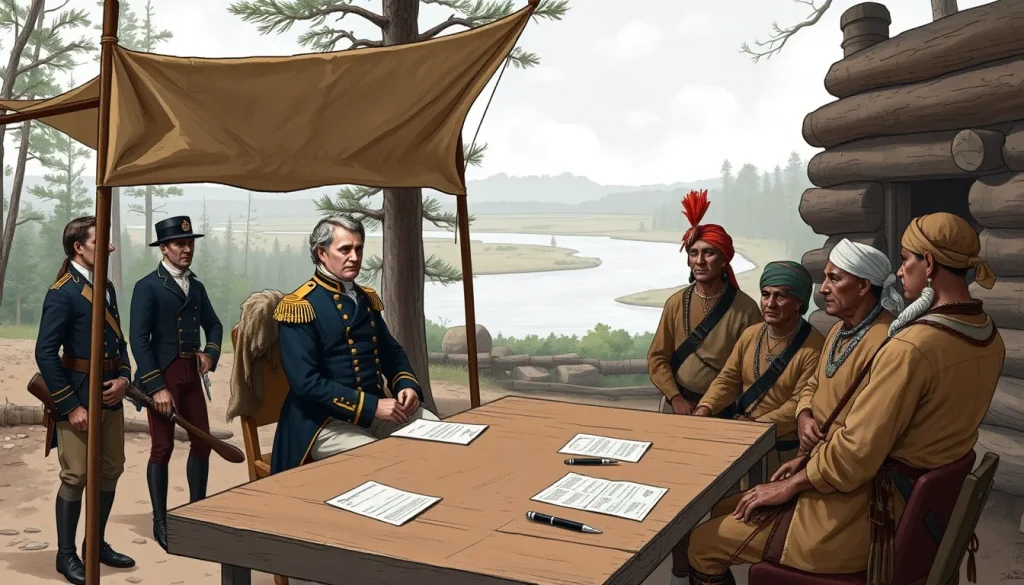
The Treaty of Fort Jackson, signed on August 9, 1814 at an American stockade near the confluence of the Coosa and Tallapoosa Rivers in the Mississippi Territory, ended the Creek War and obliged the Creek Nation to cede more than 20 million acres of its territory to the United States. Major General Andrew Jackson, acting as sole United States commissioner, dictated the terms while the United States was still at war with Great Britain, justifying the seizure as compensation for the expense of a war he described as begun by a hostile Creek faction. The cession — usually given as roughly 20 to 23 million acres depending on how the boundary and the accounting are measured — stripped the Creeks of much of present-day central and southern Alabama and part of southern Georgia, and it became a legal precedent for later removals of southeastern Indigenous nations. This article treats the treaty itself, the campaign that produced it, and the land loss commonly summarized as “20 million acres.”
Historical Context
The Creek Confederacy of the early nineteenth century was not a centralized state but a network of largely autonomous towns grouped into Upper Towns along the Coosa, Tallapoosa, and Alabama rivers and Lower Towns along the Chattahoochee, Flint, and Ocmulgee rivers. Town councils and a national council managed collective decisions, while the Creek economy combined farming, hunting, cattle raising, and trade with British, Spanish, and American merchants. That economy and the confederacy’s land base had already been narrowed by treaty before 1812, including the 1790 Treaty of New York with the United States.
American pressure on Creek land intensified after 1800. Settlers moved into the Mississippi Territory, the War Department pushed the Federal Road across Creek country toward Mobile, and Georgia politicians demanded that the federal government extinguish Creek title within Georgia’s claimed borders, a commitment associated with the 1802 Georgia compact. Accommodationist Creek leaders who accepted roads, trading houses, and private property faced growing opposition from towns that rejected further cessions.
That opposition crystallized into the Red Stick movement, a nativist and revivalist current influenced by the message of the Shawnee leaders Tecumseh and Tenskwatawa and by resentment of American encroachment and of Creek chiefs who profited from accommodation. Violence escalated in 1813: fighting at Burnt Corn Creek in July was followed on August 30, 1813 by the Red Stick assault on Fort Mims north of Mobile, where hundreds of settlers, militia, and allied Creeks were killed. American officials in Tennessee, Georgia, and the Mississippi Territory treated Fort Mims as evidence that the Creek war and the British war were linked.

That link was real enough on the Gulf Coast. Because the United States had been at war with Britain since June 1812, British and Spanish authorities in Florida were viewed by American officials as suppliers of arms and encouragement to hostile Creeks, and Pensacola became a particular object of suspicion. American strategy therefore combined the defeat of the Red Sticks with preparation for a British attack on Mobile, New Orleans, and the Gulf coast. Tennessee militia under Jackson, Georgia militia, the 39th United States Infantry, and Cherokee, Chickasaw, Choctaw, and Lower Creek allies fought the Red Stick towns through 1813 and early 1814, culminating in the destruction of the Red Stick stronghold at Tohopeka, or Horseshoe Bend, on March 27, 1814.
What Happened
After Horseshoe Bend, Jackson moved his force southward to the confluence of the Coosa and Tallapoosa rivers, where in April 1814 he built a stockade on the site of the former French post of Fort Toulouse and named it Fort Jackson. The new fort, near the present-day city of Wetumpka, Alabama, became the base for operations against the Red Stick remnant and against any future British or Spanish move into the Mississippi Territory.
Washington had already decided to convert military victory into land. Secretary of War John Armstrong instructed Major General Thomas Pinckney and the long-serving Creek agent Benjamin Hawkins to seek a treaty that included an undefined cession to pay the costs of the war, the surrender of Creek leaders who had urged resistance, an end to Creek communication with Spanish posts, and American access to roads and posts. Jackson, recently promoted to major general, was ultimately designated the sole commissioner for the United States and worked from those broad instructions while imposing far harsher terms than they required. Hawkins was directed to summon the chiefs to Fort Jackson in early August 1814; Red Stick leader William Weatherford, learning that Jackson had ordered his arrest, surrendered himself in July 1814 and was not made a party to the treaty.
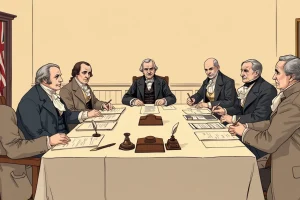
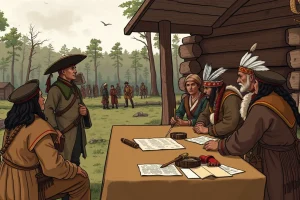
Negotiations opened on August 9, 1814. Jackson presented the terms as a capitulation. Allied Creek headmen, including Lower Creek leader William McIntosh Jr., the Tuckabatchee headman Big Warrior, and the Yuchi chief Timpoochee Barnard, argued that towns that had remained friendly to the United States should not be punished for Red Stick attacks. Jackson answered that the Creek Nation as a whole was responsible for failing to prevent those attacks, and the treaty’s preamble asserted that more than two-thirds of the Creek chiefs and warriors had been drawn into the war by men calling themselves prophets and by the misrepresentation of foreign emissaries. Sources differ slightly on the number of signatories: the National Park Service states that the proceedings represented 28 Creek towns, while the Encyclopedia of Alabama reports that approximately 36 Creeks signed.
The articles required the Creek Nation to cede all territory belonging to it within the United States lying west, south, and southeast of a survey line beginning on the eastern bank of the Coosa River. The ceded tract covered most of the Creeks’ remaining land in Georgia and much of central and southern Alabama, while the territory east and north of the line remained under a United States guarantee. Allied headmen whose improvements fell inside the cession could claim a reservation of one square mile. The treaty also required the Creeks to abandon all communication with British or Spanish posts and to admit only traders licensed by the United States; acknowledged the American right to build military posts, trading houses, and roads on Creek land and to navigate its waters freely; demanded the return of persons and property taken during the war; and obliged the United States to supply food rations to the displaced and starving Upper Creek towns.
The acreage is reported differently because the boundary, the methods of measurement, and the inclusion of disputed tracts are matters of interpretation. Contemporary summaries and modern references commonly give “more than 20 million acres,” “nearly 22 million acres,” or “23 million acres.” The National Park Service states that the Creek Nation ceded nearly 22 million acres; the Encyclopedia of Alabama gives more than 21 million acres; the Office of the Historian of the U.S. Department of State uses “over twenty-million acres,” about half of present-day Alabama and one-fifth of Georgia. The round phrase “20 million acres” is therefore a widely used approximation rather than a precisely audited total. The treaty was proclaimed on February 16, 1815.
Why It Matters
At the time, the cession was understood in the United States as both punishment and payment. It opened a vast fertile region to settlement, secured the road corridor between Tennessee and Mobile, created a buffer between the Creek Nation and Spanish Florida, and separated the Creeks from British and Spanish influence on the Gulf. For the Creek Nation the treaty was catastrophic: it removed hunting grounds on which much of the Upper Town economy depended, deepened divisions between those who had fought the United States and those who had allied with it, and left allied towns largely uncompensated for property destroyed in the war.
The months after the signing tested the treaty’s meaning. The Treaty of Ghent, signed December 24, 1814, included Article IX, which required the United States to restore to its Indigenous allies the property, rights, and privileges they had held in 1811. Historians writing for the Encyclopedia of Alabama describe Article IX as effectively nullifying the Fort Jackson cession, but the United States did not implement it, and Jackson argued that restoring the land would endanger American security. A separate Cherokee protest over land west of the Coosa River was partly addressed by a treaty of March 22, 1816 that returned about four million acres. The secretary of war ultimately approved Creek claims for wartime property losses totaling more than $300,000, but the Creeks were never paid the full amount, and Red Stick families received nothing. In 1962 the Indian Claims Commission authorized a payment of nearly four million dollars for a disputed tract of nearly nine million acres along the Florida border that had been taken to create the buffer zone.
The longer consequences were structural. The ceded land fed the cotton and enslaved-labor plantation economy of the emerging state of Alabama, admitted to the Union in 1819, and it helped make Andrew Jackson a national figure whose popularity rested partly on his Creek campaign and later victory at New Orleans. Dispossession continued: the Indian Removal Act of 1830, the Second Creek War of 1836, and the subsequent forced removal of most remaining Creeks to Indian Territory followed from the land regime the 1814 treaty established.
Historians disagree less about the facts than about how to characterize them. Some emphasize that the treaty was negotiated with an allied national council rather than a defeated enemy, making the land cession a punishment of friends; Kathryn Braund’s account for the National Park Service develops this point and traces the Creek Nation’s generations-long pursuit of compensation. Others stress the strategic logic of the moment — American fear of a British, Spanish, and Indigenous front on the Gulf in 1814 — and read the treaty as a security measure as much as a land grab. Still others treat it as the first major federal land transfer in the Southeast and the template for the removal treaties of the 1820s and 1830s, when Jackson’s administration built on the precedents set at Fort Jackson.
Document
The instrument signed at Fort Jackson is styled “Articles of agreement and capitulation” and is also cited as the Treaty with the Creeks, 1814, or the Treaty of Fort Jackson. It consists of a preamble and a series of numbered articles defining the cession, the guarantee of the remaining Creek territory, the prohibition on intercourse with British and Spanish posts, American rights to posts, roads, and navigation, and the surrender of captured persons and property.
Date
Signed August 9, 1814, at Fort Jackson, Mississippi Territory, near present-day Wetumpka, Alabama. Proclaimed by the United States on February 16, 1815.
Author
The text was drafted on the American side. Jackson signed on behalf of the President of the United States as sole commissioner, assisted by Benjamin Hawkins, the federal agent to the Creeks. The Creek signatories were chiefs, deputies, and warriors of the Creek Nation, among them allied headmen such as William McIntosh Jr., Big Warrior of Tuckabatchee, and the Yuchi chief Timpoochee Barnard. Secretary of War John Armstrong had issued the general instructions under which Jackson acted.
Historical Context of the Document
The treaty was written immediately after the American victory at Horseshoe Bend and in the middle of the War of 1812, when the United States expected a British offensive on the Gulf Coast. Its preamble recasts the Creek War as an unprovoked attack on the United States and invokes the 1790 Treaty of New York; its first article converts the cost of the war into a demand for land. The wider setting is described above under Historical Context.
Transcript
The full text comprises a preamble and numbered articles, printed in the official treaty series. What follows is a short excerpt from the opening of the document as reproduced in standard treaty compilations; the complete text should be consulted in a published edition or in the original at the National Archives.
“Articles of agreement and capitulation, made and concluded this ninth day of August, one thousand eight hundred and fourteen, between major general Andrew Jackson, on behalf of the President of the United States of America, and the chiefs, deputies, and warriors of the Creek Nation.”
“The United States demand an equivalent for all expenses incurred in prosecuting the war to its termination, by a cession of all the territory belonging to the Creek nation within the territories of the United States, lying west, south, and south-eastwardly, of a line to be run and described by persons duly authorized and appointed by the President of the United States.”
Modernized Transcript
The following modernization changes spelling, capitalization, and punctuation only; the wording is unchanged.
“Articles of agreement and capitulation, made and concluded this ninth day of August, 1814, between Major General Andrew Jackson, on behalf of the President of the United States of America, and the chiefs, deputies, and warriors of the Creek Nation.”
“The United States demand an equivalent for all expenses incurred in prosecuting the war to its termination, by a cession of all the territory belonging to the Creek Nation within the territories of the United States, lying west, south, and southeast of a line to be surveyed and described by persons duly authorized and appointed by the President of the United States.”
What the Document Tells Us
Read closely, the text records a demand rather than a bargain. The United States “demand[s]” each provision, and the cession is framed as an equivalent for war expenses rather than as a negotiated exchange of benefits. The document also reveals what American officials feared in 1814: references to foreign emissaries, the ban on intercourse with British and Spanish posts, and the requirement of licensed traders all address the Gulf Coast war with Britain and the influence of Spanish Florida. Finally, the reservation clause for friendly Creek headmen shows that American negotiators understood the cession would fall partly on communities that had fought alongside the United States.
Limitations and Bias of the Source
The treaty is a one-sided record. It was written by the American party, in English, with no Creek-language text, and its preamble presents the American account of the war’s origins, including the claim about the number of Creek warriors who supported the Red Sticks. It records signatures but not the debate, the pressure, or the dissent at Fort Jackson, and it does not describe the practical effect of the boundary on specific towns. Sources differ on the number of signatories and towns represented, and some popular summaries place the signing near Alexander City, Alabama — the Horseshoe Bend battlefield — rather than at Fort Jackson near Wetumpka, where standard references locate it. Creek perspectives on the treaty survive mainly through later testimony, petitions, and claims litigation rather than in the document itself.
Citation
“Articles of agreement and capitulation” (Treaty with the Creeks, 1814), August 9, 1814, United States–Creek Nation, 7 Stat. 120; proclaimed February 16, 1815. Printed in Charles J. Kappler, ed., Indian Affairs: Laws and Treaties, vol. 2 (Washington: Government Printing Office, 1904), and in the Oklahoma State University Libraries Tribal Treaties Database. The ratified original is held by the National Archives and Records Administration in its series of ratified Indian treaties, Record Group 11.
Primary Sources
- The treaty text itself (7 Stat. 120), the primary record of the cession, its boundary description, and its conditions. Limitation: it is an American drafting with no Creek-language version.
- Andrew Jackson’s official correspondence and reports, published in John Spencer Bassett, ed., Correspondence of Andrew Jackson, and in the ongoing Papers of Andrew Jackson. These show Jackson’s reasoning and his instructions; they reflect his own justification for the terms.
- Benjamin Hawkins’s letters and reports as federal agent, collected in American State Papers: Indian Affairs, vol. 1. Hawkins supplied the administrative detail of the negotiations and privately considered the terms too harsh.
- The Treaty of Ghent, Article IX, December 24, 1814, which addressed the rights of Indigenous allies and was not carried out with respect to the Fort Jackson cession.
- Contemporary newspaper reporting in Tennessee, Georgia, and the Mississippi Territory, which circulated the terms to the American public. These accounts are dispersed and should be checked against the treaty text.
- Creek petitions and testimony in later compensation proceedings, including those before the Indian Claims Commission in the twentieth century, which preserve Creek memory of the disputed southern tract.
Further Reading
- Braund, Kathryn. “Summer 1814: The Treaty of Ft. Jackson ends the Creek War.” National Park Service.
- Braund, Kathryn E. Holland. Deerskins and Duffels: Creek Indian Trade with Anglo-America, 1685–1815. University of Nebraska Press.
- Bunn, Mike, and Clay Williams. Battle for the Southern Frontier: The Creek War and the War of 1812. Charleston: History Press, 2008.
- Halbert, Henry S., and Timothy H. Ball. The Creek War of 1813 and 1814. 1895.
- Owsley, Frank Lawrence, Jr. Struggle for the Gulf Borderlands: The Creek War and the Battle of New Orleans, 1812–1815. University Press of Florida, 1981.
- Saunt, Claudio. A New Order of Things: Property, Power, and the Transformation of the Creek Indians, 1733–1816. Cambridge University Press, 1999.
- “Treaty of Fort Jackson.” Encyclopedia of Alabama.
- Fort Toulouse–Fort Jackson Park, Wetumpka, Alabama (state historic site interpreting the fort and treaty site).
References
- Braund, Kathryn. “Summer 1814: The Treaty of Ft. Jackson ends the Creek War.” National Park Service. https://www.nps.gov/articles/treaty-of-fort-jackson.htm
- “Treaty of Fort Jackson.” Encyclopedia of Alabama. https://encyclopediaofalabama.org/article/treaty-of-fort-jackson/
- “Treaty with the Creeks, 1814.” Tribal Treaties Database, Oklahoma State University Libraries. https://treaties.okstate.edu/treaties/treaty-with-the-creeks-1814-0107
- “Indian Treaties and the Removal Act of 1830.” Office of the Historian, U.S. Department of State. https://history.state.gov/milestones/1830-1860/indian-treaties
- “Treaty of Fort Jackson.” Wikipedia. https://en.wikipedia.org/wiki/Treaty_of_Fort_Jackson
- Kappler, Charles J., ed. Indian Affairs: Laws and Treaties, vol. 2. Washington: Government Printing Office, 1904.
FAQ
How much land did the Creek Nation actually lose in the Treaty of Fort Jackson?
Published figures differ because the boundary and the accounting are interpreted differently. The National Park Service states that nearly 22 million acres were ceded, the Encyclopedia of Alabama gives more than 21 million acres, and the U.S. Department of State uses more than 20 million acres. The frequently used phrase “20 million acres” is a round approximation of a cession of roughly 20 to 23 million acres.
Why did Andrew Jackson seize so much Creek land?
Jackson justified the cession as an equivalent for the expenses of a war he called unprovoked, and the treaty's first article states that demand in those terms. He also argued that the Creek Nation as a whole was responsible for failing to prevent Red Stick attacks. American officials additionally wanted a buffer between the Creeks and Spanish Florida and an end to Creek contact with British and Spanish posts during the War of 1812.
Was the treaty made with a defeated enemy or an American ally?
It was concluded with the Creek National Council, whose towns had largely supported the United States against the Red Sticks. Allied headmen protested that they were being punished for offenses committed by a hostile faction, and Jackson rejected the argument. Historians such as Kathryn Braund stress this aspect, which shapes how the treaty is interpreted today.
Did the Treaty of Ghent undo the Fort Jackson land cession?
Article IX of the Treaty of Ghent required the United States to restore to its Indigenous allies the rights and property they had held in 1811, and historians writing for the Encyclopedia of Alabama describe it as effectively nullifying the cession. The United States did not implement the provision, and Jackson opposed it on security grounds, so the land remained in American hands.

Leave a Reply