
Short Answer
The Treaty of Greenville, concluded on August 3, 1795, at Fort Greenville in present-day Ohio, ended the Northwest Indian War between the United States and a coalition of Indigenous nations often called the Western Confederacy. This article concerns the 1795 treaty, not the separate 1814 agreement sometimes called the Treaty of Greenville. Negotiated by U.S. General Anthony Wayne after the Battle of Fallen Timbers, it ceded large parts of present-day Ohio and strategic posts to the United States while creating an annuity system of goods and payments. Its legacy is inseparable from the War of 1812: unresolved land grievances, contested boundaries, and dependency on annuities fueled Indigenous resistance and alliances with Britain in the following decades.
Historical Context
After the 1783 Treaty of Paris, Britain transferred its claims to the Northwest Territory—lands north of the Ohio River and east of the Mississippi—to the United States without consulting the Indigenous nations who lived there. The new republic treated much of the region as public domain, but the Shawnee, Miami, Delaware, Wyandot, Ottawa, Ojibwe, Potawatomi, and others rejected U.S. sovereignty and formed the Western Confederacy. U.S. military expeditions under Josiah Harmar in 1790 and Arthur St. Clair in 1791 suffered severe defeats, especially St. Clair’s defeat near the Wabash River, which encouraged Indigenous unity and alarmed the Washington administration. In 1792 President George Washington appointed Anthony Wayne to command the Legion of the United States. Wayne trained a more disciplined force, advanced into the Ohio Country, and defeated the Western Confederacy at the Battle of Fallen Timbers on August 20, 1794. The Jay Treaty of 1794–1795, ratified by the U.S. Senate in 1795, reduced the likelihood of British support for the confederacy by arranging British withdrawal from posts on American soil. These military and diplomatic developments set the conditions for negotiations at Fort Greenville.
What Happened
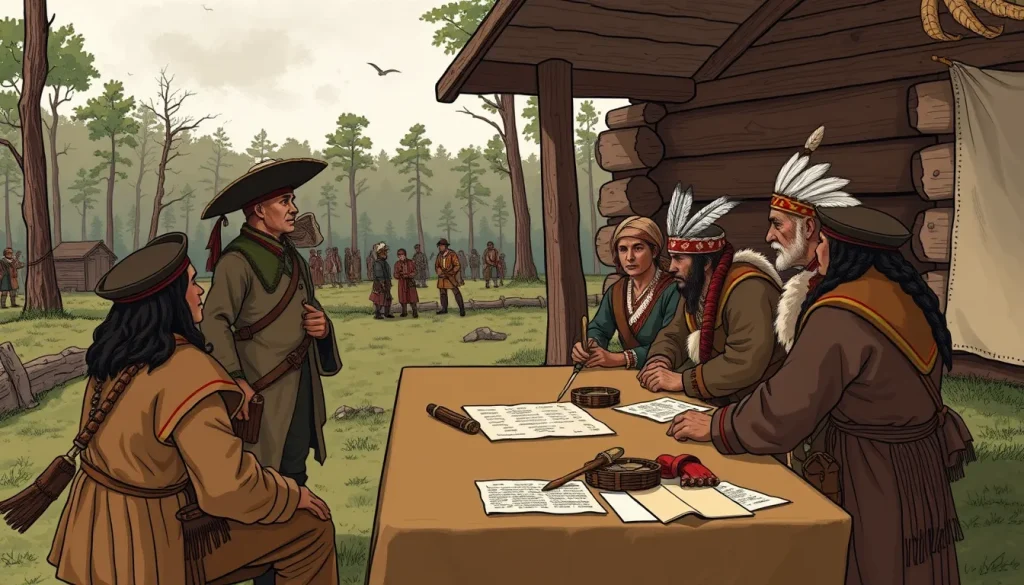
After Fallen Timbers, Wayne established a chain of forts, including Fort Recovery, Fort Defiance, and Fort Wayne, and invited Indigenous delegations to treat at Fort Greenville. Negotiations continued from late 1794 into the summer of 1795. On August 3, 1795, U.S. commissioners and representatives of the Wyandot, Delaware, Shawnee, Ottawa, Chippewa, Potawatomi, Miami, Eel River, Wea, Kickapoo, Piankeshaw, and Kaskaskia nations signed the Treaty of Greenville. Wayne served as the sole U.S. commissioner, and other American participants included William Henry Harrison, William Clark, Meriwether Lewis, Caleb Swan, and interpreter William Wells. Indigenous leaders associated with the treaty included Little Turtle, Blue Jacket, Tarhe, Buckongahelas, Black Hoof, Egushawa, and Jean Baptiste Richardville, among many others.
The treaty declared perpetual peace, required the return of prisoners and the surrender of hostages until captives were delivered, and fixed a general boundary line between U.S. and Indigenous lands. The line ran from the mouth of the Cuyahoga River through the Tuscarawas and Great Miami country to Fort Recovery and then southwest to the Ohio River opposite the mouth of the Kentucky River. The signatory nations ceded lands east and south of that line—most of present-day Ohio—and also granted numerous specific tracts at or near forts, trading posts, and settlements, including Detroit, Michilimackinac, Fort Wayne, Fort Defiance, Sandusky, the Chicago area, and Vincennes. In return, the United States promised goods, payments, and annual deliveries. The treaty also barred Indigenous nations from selling land to private parties or to any government other than the United States. The U.S. Senate ratified it on December 22, 1795. Miami leader Little Turtle objected that the Miami had not consented to earlier treaties and that land sales by other nations were invalid, although his name was recorded among the signatories. Some nations and bands refused to accept the agreement, and the treaty did not end competition over land.
Why It Matters
In the short term, the Treaty of Greenville ended the Northwest Indian War, opened much of Ohio to American settlement, and accelerated Ohio’s path to statehood in 1803. It also created an annuity system that tied many Indigenous communities to annual U.S. goods and payments, giving American officials leverage and creating dependencies that later treaty negotiations exploited. The treaty did not stop settlers from encroaching on Indigenous lands or U.S. officials from demanding further cessions. In the Indiana Territory, Governor William Henry Harrison negotiated additional treaties at Fort Wayne in 1803, Grouseland in 1805, and Fort Wayne in 1809, each intensifying Indigenous opposition.
The Greenville settlement became a central grievance for a new generation of Indigenous leaders. Tenskwatawa and Tecumseh argued that no single nation could sell common lands without collective consent, a position that directly challenged the treaty system. Their confederacy at Prophetstown drew support from nations across the Great Lakes and Ohio Valley. When the War of 1812 began, many Indigenous nations allied with Britain, hoping to restore lands, halt American expansion, and reverse the Greenville cessions. Battles and killings such as Fort Dearborn and the River Raisin were shaped by these unresolved grievances. After the war, the United States did not restore Greenville boundaries; instead, it imposed new treaties and removals that pushed many nations west. Historians disagree about how to characterize the treaty. Some emphasize its role as a foundational U.S. diplomatic and legal document; others stress coercion, settler colonialism, and the limited consent of Indigenous signatories. Many Indigenous nations remember it as one episode in a longer struggle for sovereignty and land that continued long after 1795.
Document
The document is formally titled A treaty of peace between the United States of America, and the tribes of Indians called the Wyandots, Delawares, Shawanees, Ottawas, Chippewas, Pattawatimas, Miamis, Eel Rivers, Weas, Kickapoos, Piankeshaws, and Kaskaskias. Americans often called it the Treaty with the Wyandots, etc., while it is commonly known as the Treaty of Greenville.
Date
Concluded August 3, 1795, at Fort Greenville; ratified by the U.S. Senate on December 22, 1795.
Author
The treaty was negotiated by Major General Anthony Wayne as sole commissioner for the United States, with U.S. officials, interpreters, and clerks recording the text in English. It was signed by Wayne and by sachems, chiefs, and warriors of the participating Indigenous nations. The surviving certified copies and published texts reflect U.S. recordkeeping practices rather than a complete Indigenous-authored record.
Historical Context
The treaty followed the Battle of Fallen Timbers and the Jay Treaty. It was intended to end the Northwest Indian War, confirm U.S. authority in the Ohio Country, and secure land cessions and strategic posts. It emerged from a military imbalance, but it also depended on Indigenous diplomacy, interpreters, and the willingness of some leaders to negotiate rather than continue fighting.
Transcript
A complete verified transcript is available through the Avalon Project at Yale Law School and in published documentary editions. A short excerpt from Article 1 reads:
Henceforth all hostilities shall cease; peace is hereby established, and shall be perpetual; and a friendly intercourse shall take place between the said United States and Indian tribes.
Article 3 describes the boundary line and states that the tribes cede and relinquish forever all claims to lands lying eastwardly and southwardly of that line. It also lists specific ceded tracts and provides for goods and annual deliveries.
Modernized Transcript
No complete modernized transcript is reproduced here. In modern English, Article 1 established perpetual peace and friendly relations. Article 3 created a boundary between U.S. and Indigenous lands, ceded lands east and south of the line plus designated tracts, and exchanged those cessions for goods, payments, and yearly deliveries. Other articles addressed prisoners, hostages, trade, and the return of captives. Readers should consult the Avalon Project text for exact wording.
What the Document Tells Us
The treaty shows that the United States and Indigenous nations negotiated as parties with distinct claims, but it also reveals a stark power imbalance after Fallen Timbers. U.S. language of permanent cession, boundary making, and annuity payments translated Indigenous land into American legal categories. The treaty established a framework for future land takings, created a system of annual payments that could be withheld or manipulated, and left many nations and bands outside the agreement. It also records the names of Indigenous leaders and interpreters, offering evidence of diplomacy that is often absent from military accounts.
Limitations and Bias of the Source
The surviving text is in English and follows U.S. legal conventions. It does not provide a full record of Indigenous council debates, dissent, or oral understandings. Interpreters and recorders mediated meaning, and signatures did not necessarily represent unanimous consent from every nation or band. The treaty describes cessions of lands that some Indigenous nations continued to contest. These limitations mean the document must be read alongside Indigenous oral histories, later treaties, and U.S. and British correspondence.
Citation
Treaty of Greenville, August 3, 1795, Avalon Project: Documents in Law, History and Diplomacy, Yale Law School, https://avalon.law.yale.edu/18th_century/greenvil.asp. A certified copy is cataloged in Papers of the War Department, item 51022, https://www.wardepartmentpapers.org/s/home/item/51022.
Primary Sources
The most important primary source is the treaty text itself, including the Avalon Project transcription and the certified copy in the Papers of the War Department. Anthony Wayne’s correspondence with Henry Knox, Timothy Pickering, and other officials, found in the Anthony Wayne Papers and Papers of the War Department, documents U.S. negotiating aims but rarely records Indigenous council perspectives. The American State Papers: Indian Affairs contains related official correspondence and treaty communications. These sources are valuable but biased toward U.S. administrative and military viewpoints; they should be balanced with Indigenous historical traditions and later testimony.
Further Reading
- Calloway, Colin G. The Shawnees and the War for America. New York: Viking, 2007.
- Dowd, Gregory Evans. A Spirited Resistance: The North American Indian Struggle for Unity, 1745–1815. Baltimore: Johns Hopkins University Press, 1992.
- Edmunds, R. David. The Shawnee Prophet. Lincoln: University of Nebraska Press, 1983.
- Prucha, Francis Paul. American Indian Treaties: The History of a Political Anomaly. Berkeley: University of California Press, 1994.
- Sword, Wiley. President Washington’s Indian War: The Struggle for the Old Northwest, 1790–1795. Norman: University of Oklahoma Press, 1985.
- White, Richard. The Middle Ground: Indians, Empires, and Republics in the Great Lakes Region, 1650–1815. Cambridge: Cambridge University Press, 1991.
- National Park Service, Summer 1795: The Treaty of Greenville creates an uneasy peace, https://www.nps.gov/articles/a-long-legacy.htm.
- Yale Law School, Avalon Project, The Treaty of Greenville 1795, https://avalon.law.yale.edu/18th_century/greenvil.asp.
References
- Treaty of Greenville, August 3, 1795, Avalon Project, Yale Law School, https://avalon.law.yale.edu/18th_century/greenvil.asp.
- Papers of the War Department, Treaty of Greenville, item 51022, https://www.wardepartmentpapers.org/s/home/item/51022.
- Hemenway, Eric. Summer 1795: The Treaty of Greenville creates an uneasy peace. National Park Service, March 6, 2015, https://www.nps.gov/articles/a-long-legacy.htm.
- Haehner, Alex. The Treaty of Greenville, 1795. Discover Indiana, https://www.discoverindianahistory.org/items/show/673.
- Calloway, Colin G. The Shawnees and the War for America. New York: Viking, 2007.
- Dowd, Gregory Evans. A Spirited Resistance: The North American Indian Struggle for Unity, 1745–1815. Baltimore: Johns Hopkins University Press, 1992.
- Prucha, Francis Paul. American Indian Treaties: The History of a Political Anomaly. Berkeley: University of California Press, 1994.
- Sword, Wiley. President Washington’s Indian War: The Struggle for the Old Northwest, 1790–1795. Norman: University of Oklahoma Press, 1985.
- White, Richard. The Middle Ground: Indians, Empires, and Republics in the Great Lakes Region, 1650–1815. Cambridge: Cambridge University Press, 1991.
FAQ
What did the Treaty of Greenville do?
Signed on August 3, 1795, it ended the Northwest Indian War, ceded most of present-day Ohio and strategic posts to the United States, required prisoner returns, and established annual annuity payments to the signatory Indigenous nations.
How did the Treaty of Greenville lead to the War of 1812?
It did not cause the war by itself, but it created unresolved grievances over land cessions and annuity dependency. Many Indigenous nations rejected its boundaries, and leaders such as Tecumseh and Tenskwatawa built a confederacy that opposed further U.S. expansion, later allying with Britain during the War of 1812.
Did all Indigenous nations agree to the Treaty of Greenville?
No. Several nations and bands did not sign or refused its terms. Even among signatories, consent was not unanimous, and Miami leader Little Turtle raised objections about earlier treaties and land sales.
Where is the Treaty of Greenville document today?
The original treaty materials are dispersed. A certified copy is cataloged in the Papers of the War Department, item 51022, and a verified transcription is published by the Avalon Project at Yale Law School.



Leave a Reply