
Short Answer
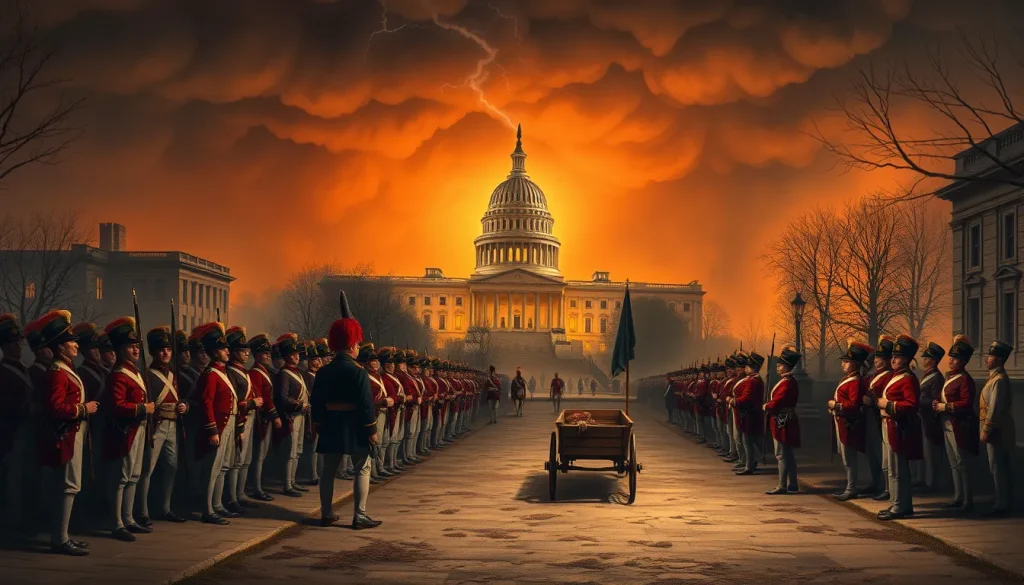
How British soldiers described the burning of Washington is known chiefly from a small body of letters, official dispatches and retrospective memoirs left by officers of the Chesapeake expedition of August 1814. The fullest and most frequently quoted is George Robert Gleig, an eighteen-year-old officer of the 85th Regiment of Foot, whose A Narrative of the Campaigns of the British Army at Washington and New Orleans (1821) recounts the rout of the American militia at Bladensburg on 24 August 1814, the destruction of the Capitol and the President’s House, and the violent storm that broke over the city. These accounts remain the principal British testimony for the episode and continue to shape how it is remembered.
Historical Context
Britain and the United States had been at war since June 1812, but the defeat of Napoleon in the spring of 1814 released regular British and allied troops for service in North America. The strategy adopted in Chesapeake Bay was not conquest but pressure: raids along the bay would tie down American forces, disrupt commerce and shipping, and retaliate for American operations against Upper Canada, where United States forces had burned the town of Newark (modern Niagara-on-the-Lake) in December 1813 and destroyed other settlements along the Niagara frontier. Vice Admiral Sir Alexander Cochrane took command of the North American station in 1814, and Rear Admiral George Cockburn, who had spent more than a year raiding the Chesapeake, argued for striking the American capital.
The land force, roughly 4,000 strong and including the 4th, 21st and 44th Regiments of Foot, the 85th Light Infantry, Royal Marines, sailors and artillery, was commanded by Major General Robert Ross. Washington in 1814 was a partly built city of about 8,000 people. It had no substantial fortifications, its public buildings were unfinished, and its defence rested on militia, a small number of regulars, and a hastily organised command under Brigadier General William H. Winder. British officers who wrote about the campaign knew they were attacking a political symbol rather than a fortress.
What Happened
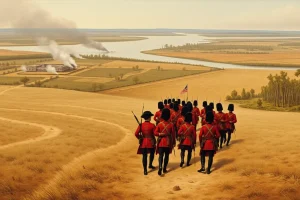
British troops landed at Benedict on the Patuxent River in Maryland on 19–20 August 1814 and advanced north. On 24 August they met an American force at Bladensburg, where a mixed body of militia, regulars and sailors — larger than the British column — was broken in a short engagement. The American retreat was later mocked as the Bladensburg races. British officers, Gleig among them, wrote that the militia appeared untrained and badly posted.

Later that day a British party entered Washington under a flag of truce and, according to British accounts, was fired on from a private house; British officers cited this in justifying the destruction that followed. That evening and the next day British troops burned the Capitol, the President’s House, the Treasury, the War Office and other public buildings. The Navy Yard was set alight by the Americans themselves, under Commodore Thomas Tingey, to keep its stores and ships out of British hands. President James Madison had left the city, and his wife Dolley Madison had evacuated the President’s House the previous day.
On 25 August a violent thunderstorm swept over the city, killing and injuring soldiers and civilians. Gleig placed it toward morning; later reconstructions generally locate the worst of the weather on the afternoon and evening of 25 August, and note that his chronology is imprecise. The British withdrew that night, marched back to Benedict and re-embarked by 30 August, moving next against Baltimore. There Major General Ross was killed on 12 September and the attack on the city failed.
Why It Matters
The burning of Washington was a humiliation rather than a conquest. The British held the city for roughly a day and a half and never intended to keep it; the operation destroyed public buildings and at least one private property, the office of the National Intelligencer, but left the government able to reconvene. The episode stiffened American resistance, contributed to the mobilisation that saved Baltimore in September 1814, and influenced the negotiations that produced the Treaty of Ghent in December 1814.
British soldiers’ descriptions matter for a second reason: they are the fullest surviving record of how the destruction looked from the attacking side. They show that the burning was selective in intention — public buildings were marked for destruction, and officers claimed private property was generally spared — but also that the execution was hurried, improvised and in places indiscriminate. Historians have used these accounts to argue about whether the burning was retaliation, military necessity or deliberate political theatre, and they illustrate the gap between the terse language of official dispatches and the vivid reconstructions published years later.
Definition: What Counts as a British Soldier’s Description
The phrase refers to the body of testimony left by British army and naval personnel who took part in the Chesapeake expedition of August 1814. It falls into three broad groups. The first is official: dispatches and reports by Ross, Cochrane and Cockburn, which are brief, formal and written to justify the operation to superiors. The second is private and immediate: letters and journals written during or shortly after the campaign, often reprinted in British newspapers. The third is retrospective and literary: memoirs published years afterwards, above all Gleig’s narrative of 1821. The three genres differ sharply in detail, tone and purpose, and the passages most often quoted come from the last and most literary of them.
Background: Why So Few British Voices Survive
British officers of the Napoleonic period wrote on an unusual scale. Regimental officers kept journals, sent letters home, and after 1815 found a ready market for campaign memoirs; the Peninsular War had made military autobiography a popular genre. Gleig, born in Stirling in 1796 and educated at Glasgow and Oxford, served with the 85th Foot in the Peninsula and then in America, being present at Bladensburg and Washington in 1814 and later at New Orleans in January 1815. He was eighteen during the Chesapeake campaign.
Only a handful of British participants in the Washington raid published anything. Ross was killed the following month; Cockburn’s surviving papers are largely official; Cochrane’s correspondence is administrative. As a result, the ordinary soldier’s view of the burning survives almost entirely in a few memoirs, of which Gleig’s is the most frequently reprinted. That imbalance shapes the historiography: when modern histories describe a British soldier’s impression of the burning, they are usually quoting Gleig, or quoting later writers who quoted him.
How It Worked: The Shape of Gleig’s Account
Gleig’s narrative follows the campaign in sequence: the landing, the march, the battle, the entry into the city, the burning, the storm and the withdrawal. Its set pieces became the standard British images of the event. Describing the night of the burning, he wrote that the consternation of the inhabitants was complete and that for them it was a night of terror, and pictured the streets crowded with soldiers and senators, men, women and children fleeing toward the bridge over the Potomac. The next morning, he wrote, nothing remained of the Capitol, the President’s House, the barracks and the dockyard but heaps of smoking ruins.
Two episodes are especially revealing. The first is the storm, which he treated not as a disaster but as spectacle: lightning seemed to compete with the flames, and a scene he called superlatively sublime seemed to him to require the thunder to be complete. The second is the dinner said to have been laid at the President’s House for forty guests, which a British detachment ate before burning the building; Gleig presents it as evidence of American overconfidence. Crucially, he flags the fragility of the accompanying story about Madison, writing that he would not answer for the truth of those details and elsewhere attributing information to what he had been credibly informed. His narrative therefore mixes eyewitness observation, camp rumour and later literary shaping.
Competing Viewpoints: Eyewitness Testimony and Its Limits
Historians differ over how much weight to place on these texts. One position treats Gleig and his fellow memoirists as valuable eyewitnesses whose details — the storm, the food taken from the President’s House, the conduct of the light infantry — are corroborated by other testimony and by physical evidence. Another cautions that Gleig wrote seven years after the event for a British readership that expected adventure and moral commentary, and that he revised his text in later editions. His unfavourable comparison of the American militia at Bladensburg to men better suited to agricultural occupations reflects professional contempt as much as observation.
The extent of British restraint is also disputed. Officers maintained that only public buildings were destroyed, but the deliberate burning of the offices of the National Intelligencer, a private newspaper that had attacked Cockburn, shows that the rule had exceptions; that incident is recorded largely in American and later sources rather than in Gleig. An often repeated anecdote in which Cockburn calls for a vote on burning what he allegedly called a harbour of Yankee democracy from the Speaker’s chair is poorly documented in contemporary sources and is treated sceptically by modern historians. The story of the dinner for forty rests largely on Gleig’s chain of hearsay. Modern accounts of the burning, including those by Anthony S. Pitch and Steve Vogel, accordingly rely on a wide range of British and American testimony rather than on any single memoir.
Role in the War of 1812
Within the wider war, the British descriptions document a raid rather than an occupation. They record the speed of the operation, the absence of any plan to hold Washington, and the rapid withdrawal to the transports — a pattern repeated throughout the Chesapeake campaign, which combined amphibious mobility with a refusal to become tied to fixed positions. They also record the campaign’s punitive logic: the burning of public buildings was presented by British commanders as retaliation for American destruction in Upper Canada, and Ross’s dispatch framed the operation in those terms.
The accounts are equally revealing about other theatres. Gleig, who went on to fight at New Orleans, wrote about both campaigns in a single volume, and his book helped fix in British memory an image of the American war as an exotic and frustrating sideshow after the decisive struggle against France. Read alongside American sources such as Dolley Madison’s letters, they show a war in which both sides destroyed civilian property and both presented their own restraint as exemplary.
Consequences and Historical Interpretation
The burning of Washington entered American memory as the war’s defining humiliation and later as evidence of British ruthlessness; in Britain it was remembered chiefly as a successful raid in an inconclusive and unpopular war. The soldiers’ accounts had a long afterlife: Gleig’s storm passage and his description of the ruined Capitol are quoted in almost every modern treatment of the episode. They have also shaped scholarly interpretation by supplying physical details — smoke, heat, collapsing roofs, chaos in the streets — that official dispatches omit.
Modern historians treat these texts cautiously. They are used as evidence of what British participants saw and believed, of the discipline and indiscipline of the expedition, and of how a professional army understood a politically symbolic target. They are not treated as neutral records, since they were written to entertain, to justify and sometimes to moralise. The result is a body of testimony that is indispensable for the history of August 1814 and unavoidably partial in both senses of the word.
Primary Sources
- George Robert Gleig, A Narrative of the Campaigns of the British Army at Washington and New Orleans (London, 1821; later revised editions). The most detailed British account of the burning, by an officer of the 85th Foot who was present. Vivid and informative, but composed years afterwards and containing hearsay that the author himself flags.
- Major General Robert Ross’s dispatch to the Secretary of State for War, August 1814, published in the London Gazette. The official army report on Bladensburg and the destruction of public buildings. Concise and self-justifying, written from a command perspective.
- Naval correspondence of Vice Admiral Sir Alexander Cochrane and Rear Admiral George Cockburn. Letters and reports documenting the planning and conduct of the expedition. Official rather than reflective, and concerned with justifying the operation and its targets.
- Dolley Madison’s letters to her sister Lucy Payne Todd, August 1814 (Library of Congress). An American counterpart to the British accounts, describing the evacuation of the President’s House. Valuable, but written in haste and shaped by concern for reputation and possessions.
Where transcripts are used, the wording above follows published nineteenth-century editions of Gleig; readers seeking verified text should consult the 1821 first edition or a modern documentary anthology rather than undated internet extracts.
Further Reading
- George Robert Gleig, A Narrative of the Campaigns of the British Army at Washington and New Orleans (1821; several later editions).
- Anthony S. Pitch, The Burning of Washington: The British Invasion of 1814 (Naval Institute Press, 1998; later editions).
- Steve Vogel, Through the Perilous Fight: Six Weeks That Saved the Nation (Random House, 2013).
- Donald R. Hickey, The War of 1812: A Forgotten Conflict (University of Illinois Press, 1989; revised edition 2012).
- Jon Latimer, 1812: War with America (Harvard University Press, 2007).
- Donald R. Hickey, ed., The War of 1812: Writings from America’s Second War of Independence (Library of America, 2013).
- U.S. National Park Service, Star-Spangled Banner National Historic Trail and Bladensburg Battlefield resources.
- White House Historical Association, resources on the President’s House in 1814.
References
- George Robert Gleig, A Narrative of the Campaigns of the British Army at Washington and New Orleans, under Generals Ross, Pakenham and Lambert, in the Years 1814 and 1815 (London: John Murray, 1821).
- Major General Robert Ross, dispatch to the Secretary of State for War, August 1814, printed in the London Gazette.
- The National Center, “A British Account of the Burning of Washington – 1814” (extract from Gleig’s narrative), https://nationalcenter.org/ncppr/2001/11/03/a-british-account-of-the-burning-of-washington-1814/
- Library of America, “Storming the Capital,” Story of the Week, 22 August 2014, https://storyoftheweek.loa.org/2014/08/storming-capital.html
- Donald R. Hickey, The War of 1812: A Forgotten Conflict (Urbana: University of Illinois Press, 1989; revised edition 2012).
- Anthony S. Pitch, The Burning of Washington: The British Invasion of 1814 (Annapolis: Naval Institute Press, 1998).
- Steve Vogel, Through the Perilous Fight: Six Weeks That Saved the Nation (New York: Random House, 2013).
FAQ
Did British soldiers admit to burning Washington?
Yes. British officers and memoirists described the destruction of the Capitol, the President's House, the Treasury and other public buildings as an ordered act and generally justified it as retaliation for American destruction in Upper Canada. They were less forthcoming about the burning of private property such as the National Intelligencer press, which is documented mainly in other sources.
Who was George Robert Gleig?
Gleig (1796–1888) was a Scottish-born officer of the 85th Regiment of Foot who served in the Peninsula and then in America in 1814–15, taking part in the Bladensburg and Washington operations and later at New Orleans. He published a widely read narrative of the campaigns in 1821 and later became a chaplain in the British Army.
Why are British accounts of the burning considered unreliable in places?
The most quoted account was written years after the event for a British reading public, and it mixes personal observation with camp rumour. Gleig himself declined to vouch for some details, including the story of the dinner laid at the President's House, and his chronology of the great storm of 25 August 1814 is imprecise.
How long did the British occupy Washington?
Roughly a day and a half. British troops entered the city on the evening of 24 August 1814, burned public buildings during the night and the following day, and withdrew on the night of 25 August, marching back to Benedict on the Patuxent and re-embarking by 30 August.
Leave a Reply