Short Answer
In 1812, British strategy in Upper Canada was shaped by the broader Napoleonic conflict: a defensive war to preserve the Canadas until victory in Europe freed reinforcements. With only about 1,600 regulars and a thinly spread population, British commanders relied on the Provincial Marine, fortified posts, and Indigenous alliances to counter American invasion attempts. Major-General Isaac Brock’s aggressive raids against Detroit and Fort Michilimackinac were the most striking tactical expressions of this defensive strategy.
Historical Context
After the Chesapeake-Leopard affair of 1807, Anglo-American relations deteriorated. The United States declared war on Britain on 18 June 1812, in part due to impressment and trade restrictions, but also because of American expansionist desires regarding Canada. In London, the war was a sideshow; most troops and ships were committed to the Peninsular War in Spain. Lieutenant-General Sir George Prevost, commander of British North America, therefore received clear instructions to avoid offensive operations that risked losing the colonies. The defence of Upper Canada, a province of about 80,000 people, was deemed vital because it lay between the lower St. Lawrence and the western Great Lakes, protecting the crucial fur trade and the route to Quebec. The province was bordered by the United States to the south and had a large American-born population, making its loyalty uncertain.
What Happened
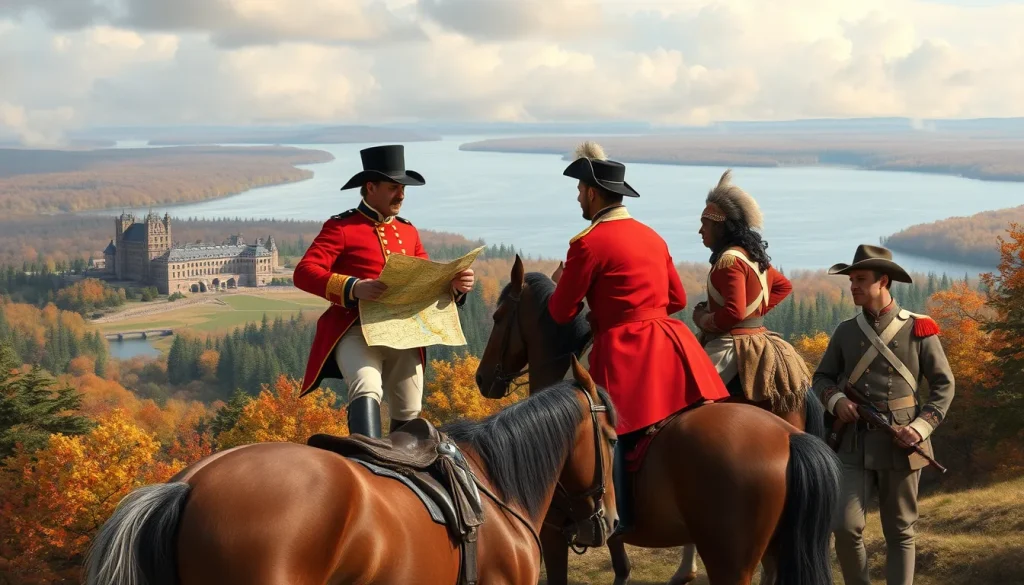
When war broke out, Prevost ordered a halt to offensive action, but Brock, then administrator and military commander of Upper Canada, seized the initiative. On 17 July 1812, Captain Charles Roberts, with British regulars, fur traders, and Indigenous warriors from Fort St. Joseph, captured American Fort Michilimackinac. This secured British control of the upper Great Lakes and encouraged Indigenous support. On 16 August, Brock, with a small force of regulars, militia, and Indigenous allies, accepted General William Hull’s surrender of Detroit. These victories bolstered British morale and convinced many Indigenous nations that Britain had the means to protect them. In October, American attempts to invade at Queenston Heights were repulsed, though Brock was killed during the battle. The year ended with the British still holding all major posts in Upper Canada, though the naval race on Lake Ontario and Lake Erie was beginning.
Why It Matters
The defensive strategy of 1812 laid the foundation for the British (and Canadian) success in later years. It preserved Upper Canada as a base for operations and maintained allied Indigenous support until the crisis in Europe passed. Contemporary observers recognized that a loss of Upper Canada would have exposed Lower Canada to invasion and possibly led to the collapse of British North America. Historians have debated whether Brock’s aggression exceeded his instructions and whether Prevost’s caution was too great. The campaign showed that even a small British force, combined with Indigenous allies and naval superiority on the upper lakes, could frustrate a larger American army.
Definition
British strategy in Upper Canada in 1812 was the overall plan to defend the province against an American invasion. It was defensive and economy-of-force oriented, aiming to hold territory without expending resources critical to the larger war against Napoleon.
Background
From 1808 onward, Prevost had prepared reports to London outlining the vulnerable frontier. He recognized that the colony’s defence hinged on controlling the Great Lakes and the St. Lawrence River. The Provincial Marine, a transport service, was converted to a naval force to support operations. Prewar planning also identified the need to cultivate Indigenous alliances, particularly around Amherstburg and Michilimackinac.
How It Worked
The strategy operated on several levels. Prevost’s directive was to avoid defeat, but local commanders like Brock used offensive strikes to secure the frontier and rally support. The capture of Michilimackinac and Detroit were defensive measures that removed American bases and deterred invasions. The British relied on a chain of posts: Kingston, York, Fort George, Fort Erie, and Fort Amherstburg. The Provincial Marine moved troops and supplies; on land, militia and Indigenous warriors patrolled. The strategy worked as long as Britain maintained control of the upper lakes and the Americans could not coordinate their forces.
Competing Viewpoints
Historians differ on whether Brock’s forays were strategically sound. Some argue that they were necessary to compensate for British weakness and to keep Indigenous allies loyal. Others claim they invited retaliation and violated Prevost’s defensive policy. There is also debate over the role of the militia; contemporary myths of the ‘Canadian militia saving the colony’ overshadow the reality that British regulars and Indigenous allies carried the main burden.
Role in the War of 1812
The strategy of 1812 shaped the entire war. It demonstrated that the United States would not easily overrun Canada. It also set the pattern for the naval arms race on the lakes, leading to the decisive Battle of Lake Erie in 1813. The alliances with Tecumseh’s confederacy and other Indigenous nations were central to British hopes, but the death of Tecumseh and the loss of Lake Erie in 1813 undermined those plans. The successful defence in 1812 ensured that the war would continue until 1814, when reinforcements finally arrived from Europe.
Consequences and Historical Interpretation
In the short term, the strategy preserved Upper Canada. Its success contributed to a sense of Canadian identity and the belief that local troops had defended the colony. For Indigenous peoples, the results were tragic: they lost a key ally in Tecumseh, and their territorial rights were largely ignored at the Treaty of Ghent. Later historians have emphasised the fragility of the British position and the importance of naval control and allied Indigenous nations. The war also exposed serious weaknesses in American military leadership and logistical planning.
Primary Sources
– Brock’s correspondence with Prevost (1812) reveals his desire to take aggressive action. Many letters are printed in W. H. Kingsford’s The History of Canada, Volume 10.
– Prevost’s report “Upon the Military Position of His Majesty’s North American Provinces” (May 1812) outlines the defensive plan. It is held in the British National Archives.
– The diary of John Strachan, a York resident, provides civilian perspective on the war’s conduct.
– American intelligence reports and letters of General Hull also illuminate British strategy from the enemy side.
These sources are biased by the authors’ perspectives, but together they illustrate the planning and execution of British strategy in 1812.
Further Reading
- Grodzinski, John R. Defender of Canada: Sir George Prevost and the War of 1812. Norman: University of Oklahoma Press, 2013.
- Benn, Carl. The War of 1812. Oxford: Osprey Publishing, 2002.
- Stagg, J. C. A. The War of 1812: Conflict for a Continent. Cambridge: Cambridge University Press, 2012.
- “War on the Lakes in the War of 1812.” The Canadian Encyclopedia, edited by Barry M. Gough.
References
- Grodzinski, John R. “Planning and Preparing for War in North America, 1808-1812.” The Napoleon Series, 2012. Read online.
- Gough, Barry M. “War on the Lakes in the War of 1812.” The Canadian Encyclopedia. Read online.
- Marsh, James H., and Pierre Berton. “War of 1812.” The Canadian Encyclopedia. Read online.
- U.S. Army Center of Military History. “Chapter 6: The War of 1812.” American Military History. Read online.
- Grodzinski, John R. “Command Structure and Appointments in Upper Canada, 1812 to 1814.” Napoleon Series, 2006. Read online.
FAQ
Why did Britain adopt a defensive strategy in Upper Canada in 1812?
Britain was focused on defeating Napoleon in Europe and could spare only limited troops for North America. Prevost was ordered to hold the colonies without risking them in offensive campaigns.
What role did Indigenous nations play in the British strategy?
Indigenous allies were essential for early warning, intelligence, and as fighting forces. They also helped capture Michilimackinac and Detroit. Their support was crucial for the defence of Upper Canada.
Did the British strategy in 1812 succeed?
Yes, the strategy succeeded in preserving Upper Canada. The capture of Detroit and Michilimackinac eliminated immediate American threats, and the British retained control of all major posts by the end of the year.

Leave a Reply