
Short Answer
The Battle of Chippawa, fought on 5 July 1814 along the Niagara River in Upper Canada, was a significant American tactical victory in the War of 1812. Brigadier General Winfield Scott, commanding the U.S. Army’s 1st Brigade, led his newly trained regulars against British regular forces under Major General Phineas Riall. Scott’s success validated his rigorous training methods and demonstrated that American regulars could stand toe-to-toe with British professionals in open battle.
Historical Context
By 1814, the War of 1812 had reached a critical phase. The British, having defeated Napoleon in Europe, began transferring veteran regiments to North America. American strategic planners feared these battle-hardened troops and sought to seize the initiative in the Niagara Peninsula before they arrived. The U.S. War Department, under Secretary John Armstrong Jr., authorized an invasion of Upper Canada, concentrating on the Niagara front. Major General Jacob Brown commanded the American Left Division, which included two regular brigades—one led by Winfield Scott and the other by Eleazar Ripley. Recognizing the poor performance of American troops in the war’s first two years, Scott had established camps of instruction near Buffalo during the winter and spring of 1814. He drilled his soldiers relentlessly, using French tactical manuals, emphasizing discipline, formations, and musketry. By summer, his brigade was arguably the best-trained American force of the war.
What Happened
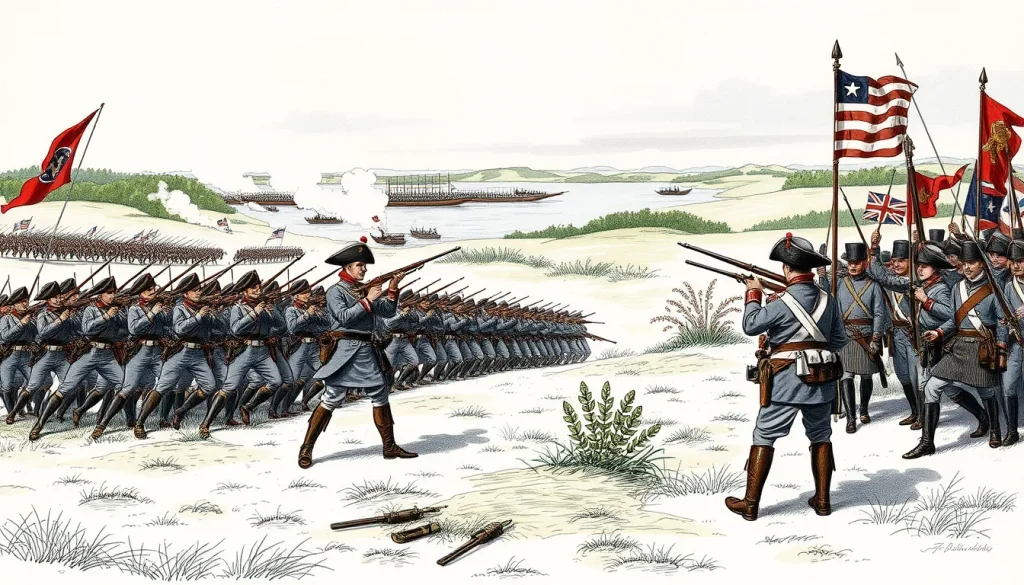
On 3 July 1814, Brown’s division crossed the Niagara River and captured Fort Erie without significant resistance. The next day, Scott’s brigade advanced northward along the river road, skirmishing with British light infantry and reaching the south bank of the Chippawa River by evening. The British, commanded by Major General Phineas Riall, held a defensive line behind the Chippawa. On the morning of 5 July, Riall, believing the Americans were largely militia, crossed the river and attacked. Scott, initially almost captured while eating breakfast, rushed his brigade into battle formation on an open plain bordered by woods and the Niagara River. As the British advanced, they mistook Scott’s grey-uniformed soldiers for militia. The Americans, however, stood steady under artillery fire and delivered disciplined volley fire. After about thirty minutes of intense musketry, the British line wavered and retreated back across the Chippawa. Scott’s forces, supported by a flanking movement through the woods, forced the British to withdraw. The battle was a clear American victory, with remarkably low casualties compared to the British.
Why It Matters
Chippawa was a milestone in American military history. It proved that well-trained regulars could defeat British regulars on equal terms, contradicting earlier American failures at Queenston Heights, Detroit, and elsewhere. The battle boosted American morale and demonstrated the value of professional officer education, later influencing the development of West Point. For Scott personally, it cemented his reputation as a brilliant trainer and tactician. Strategically, however, the victory did not break the deadlock in the Niagara campaign; the Americans lacked the strength to exploit their success, and the campaign culminated in the bloody draw at Lundy’s Lane on 25 July. Nevertheless, Chippawa remains a symbol of the American regular’s maturation and is remembered by the U.S. Army’s 6th Infantry Regiment, whose motto is “Regulars, by God.”
Prelude
The American invasion of Upper Canada in July 1814 was intended to seize control of the Niagara Peninsula and potentially advance toward York or Kingston. Scott’s brigade, after crossing the river, moved north on 4 July. They encountered British delaying forces under Lieutenant Colonel Thomas Pearson, who skirmished and fell back to the Chippawa River. Scott’s men camped near Street’s Creek, roughly two miles south of the Chippawa, awaiting the arrival of the rest of Brown’s division.
Forces and Commanders
American forces under Brigadier General Winfield Scott comprised the 9th, 11th, 22nd, and 25th Infantry Regiments, totaling about 2,000 regulars, plus artillery and some Pennsylvania militia and Indigenous allies. British forces under Major General Phineas Riall included the 1st (Royal Scots), 8th, and 100th Regiments of Foot, Canadian militia, and Indigenous warriors, roughly similar in number. Riall commanded about 2,000 men, though some sources place the British strength at 1,500 or 1,800.
Battlefield and Map Context
The battle took place on a large open plain between the Chippawa River to the north and Street’s Creek to the south, bounded by woods on the west and the Niagara River on the east. The ground was relatively flat, allowing both sides to deploy in line. The Niagara River ran to the east, and the road toward Fort George passed through the area. Modern location: near present-day Niagara Falls, Ontario, just south of the Welland River.
Battle Chronology
The battle began in the morning when British and Indigenous skirmishers probed American pickets. Brown ordered Pennsylvania militia and warriors to clear the woods, leading to a skirmish that triggered the main engagement. By early afternoon, Riall’s main force crossed the repaired bridge over the Chippawa and formed in line. Scott’s brigade deployed and advanced. The British opened artillery fire, and an exchange of volleys lasted approximately thirty minutes. American flanking maneuvers and superior artillery eventually forced Riall to order a withdrawal around 6:30 p.m. The British crossed back over the Chippawa and destroyed the bridge.
Casualties and Losses
British casualties were officially reported as 148 killed, 321 wounded, and 46 missing, roughly one-third of the engaged force. American casualties were significantly lighter: 58 killed, 241 wounded, and 19 missing, with Scott’s brigade bearing most of the losses. Some sources give slightly different American figures (61 killed, 255 wounded), but the totals are similar.
Result
The Battle of Chippawa was a clear American tactical victory. Scott’s regulars held the field and forced the British to retreat. The Americans captured the Chippawa bridgehead, but did not immediately pursue, allowing the British to fall back toward Fort George.
Strategic Consequences
Despite the victory, the American offensive stalled. Brown’s division remained near Chippawa for two days, awaiting naval support that never came. The British regrouped at Fort George, and the campaign culminated at Lundy’s Lane on 25 July, where heavy losses forced the Americans to withdraw to Fort Erie. Chippawa did not alter the strategic balance in the Niagara theater, but it enhanced American confidence and demonstrated improved professionalism.
Primary Accounts
Official reports from Major General Jacob Brown and Brigadier General Winfield Scott describe the battle and American tactics. British dispatches by General Riall acknowledge the discipline of the American troops. Scott later recounted the battle in his memoirs. The famous phrase “Regulars, by God” is attributed to Riall, but its exact wording and timing are uncertain, appearing in later accounts rather than contemporary documents.
Battlefield Today
The battlefield is located within the Niagara Parks Commission area in Ontario, Canada. A monument commemorates the engagement, and a plaque describes the battle. The site is open to the public, with walking trails and interpretive markers. It is part of the heritage tourism related to the War of 1812.
Primary Sources
Key primary sources include: (1) Official after-action reports from Maj. Gen. Jacob Brown and Brig. Gen. Winfield Scott to the U.S. War Department, dated July 1814, detailing the battle and casualties; (2) British dispatches from Major General Phineas Riall, acknowledging the defeat and praising American discipline; (3) the memoir of Winfield Scott, Memoirs of Lieut.-General Scott, LL.D. (1864), which provides a retrospective account; (4) contemporary newspaper accounts, such as those in Niles’ Weekly Register. Important limitation: Scott’s memoir, written decades later, may embellish events.
Further Reading
- John R. Grodzinski, The War of 1812: An Annotated Bibliography (2010)
- J. Mackay Hitsman, The Incredible War of 1812 (1965, revised 1999)
- Alan Taylor, The Civil War of 1812 (2010)
- Harry L. Coles, The War of 1812 (1965)
- National Park Service, “Battle of Chippawa” (article)
- American Battlefield Trust, “Chippawa Battle Facts” (web resource)
References
- National Park Service, “Summer 1814: American regular troops perform superbly at the Battle of Chippawa,” https://www.nps.gov/articles/battle-of-chippawa.htm
- American Battlefield Trust, “Chippawa Battle Facts and Summary,” https://www.battlefields.org/learn/war-1812/battles/chippawa
- John R. Grodzinski, “Battle of Chippawa,” The Canadian Encyclopedia, https://thecanadianencyclopedia.ca/en/article/battle-of-chippawa
- The War of 1812 website, “Battle of Chippawa,” https://thewarof1812.org/battles/battle-of-chippawa/
- J. Rickard, “Battle of Chippewa, 5 July 1814,” History of War, https://www.historyofwar.org/articles/battles_chippewa_river.html
- Winfield Scott, Memoirs of Lieut.-General Scott, LL.D. (New York: Sheldon & Company, 1864)
FAQ
What was Winfield Scott's role at the Battle of Chippawa?
Scott commanded the American 1st Brigade, which bore the main brunt of the British assault. His troops' disciplined volleys and steady conduct secured the American victory.
Why did the American soldiers wear grey uniforms at Chippawa?
Due to shortages of regulation blue cloth, many of Scott's regiments were issued grey uniforms. This led British commander Riall to mistake them for militia, contributing to his decision to attack.
Did the Battle of Chippawa change the outcome of the War of 1812?
No, it was a tactical American victory but did not alter the strategic stalemate in the Niagara theater. The campaign continued and culminated in the bloody draw at Lundy's Lane.



Leave a Reply