
Short Answer
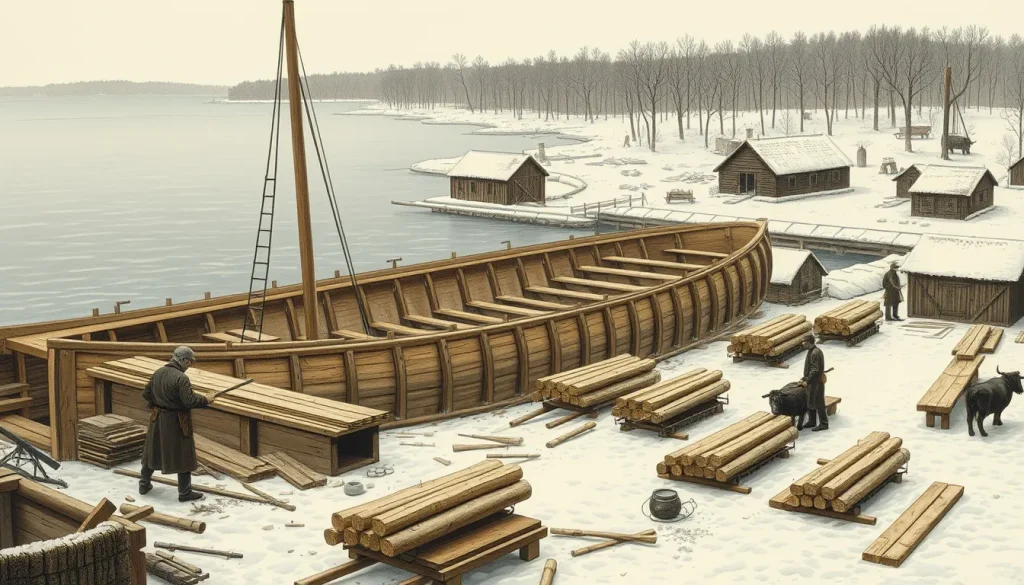
Building warships with green timber meant using unseasoned, freshly felled wood that still held its sap, and during the War of 1812 it became the ordinary method of construction in the freshwater yards of the Great Lakes and Lake Champlain. This article uses the phrase in its early nineteenth-century sense — unseasoned timber worked into hulls in wartime yards — rather than in later industrial or archaeological senses. Between 1812 and 1815, American, British, and Canadian shipwrights at places such as Sackets Harbor, Presque Isle, Vergennes, Kingston, Amherstburg, and Île aux Noix launched squadrons in months rather than years, cutting timber from nearby forests and working it before it had dried. The practice shaped how quickly the fleets appeared, how well they sailed and fought, how long they survived, and in several campaigns which side controlled the lakes.
Historical Context
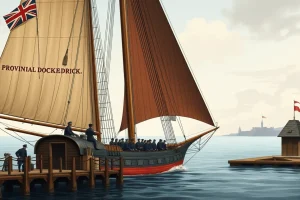
The lakes and Lake Champlain were the supply arteries of the war in the interior. At the outbreak of war in June 1812 the United States had essentially one naval vessel on the lakes, the brig USS Oneida on Lake Ontario, while Britain relied on the Provincial Marine, a small transport and patrol service based at Kingston, York, Fort Erie, and Amherstburg. Whoever controlled the water could move troops, stores, and artillery; whoever lost it could not hold the frontier.
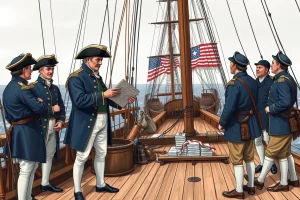
Neither side had seasoned naval timber, established dockyards, or large stocks of iron, cordage, and cannon in the interior. In the United States guns, anchors, and naval stores had to be hauled over difficult roads from the seaboard; Britain could move them up the St. Lawrence from Quebec and Montreal, a considerable logistical advantage. Both governments appointed energetic commanders — Isaac Chauncey for the United States in 1812 and James Lucas Yeo for Britain in 1813 — and hired civilian shipwrights, among them Henry Eckford at Sackets Harbor and Noah Brown at Presque Isle and later Vergennes. Timber itself was abundant, and the winter freeze largely defined the building season.
What Happened
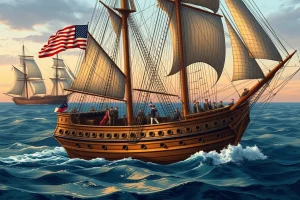
The first year of the war was improvised: both sides purchased and armed merchant schooners, and the early lake actions were fought by converted traders. From 1813 the contest became one of construction. At Presque Isle on Lake Erie, Noah Brown’s yard laid down the brigs Lawrence and Niagara in the winter and spring of 1813, launched them, and moved the squadron over the harbour bar using floating camels in early August; Oliver Hazard Perry’s victory on 10 September 1813 followed.

On Lake Ontario, Chauncey’s yard at Sackets Harbor and the British yard at Kingston expanded continuously. In 1814 the British launched HMS St. Lawrence, a 102-gun ship of the line, at Kingston; the United States responded by laying down 74-gun ships at Sackets Harbor, including USS New Orleans, which was never launched. On Lake Champlain the British built HMS Confiance at Île aux Noix and launched her in late August 1814, while the Americans under Thomas Macdonough completed USS Saratoga and consorts at Vergennes. Macdonough’s squadron defeated the British at Plattsburgh Bay on 11 September 1814, and the Treaty of Ghent followed in December.
Why It Matters
Green timber made the naval race possible. Because unseasoned wood is far easier to hew, split, and bend with axes, adzes, and simple saws, hulls could be assembled in weeks or months rather than the years required for a properly seasoned warship. The same property created chronic problems: as the wood dried after launching, planks shrank, seams opened, and hulls worked in a seaway or in a chop, requiring constant pumping and frequent repairs.
The consequences were strategic as well as technical. Squadrons built from green timber decided the campaigns of 1813 and 1814, and after 1815 most of the ships were laid up, sold, or left to rot. Historians have treated the episode both as an example of rapid wartime improvisation and as a cautionary case of expensive ships with very short useful lives.
Definition
Green timber is wood that has not been seasoned — that is, not slowly dried to reduce its moisture content before working. It is softer and more pliable than dried wood, takes an edge from an axe or adze crisply rather than tearing, splits and bends with less resistance, and is correspondingly more prone to shrinkage, warping, fungal decay, and insect attack once in service. A freshwater warship in this period was a vessel designed for lakes and rivers: relatively shallow in draft for constricted harbours and river mouths, and normally uncoppered, since the marine borers that destroy wooden hulls in salt water do not thrive in fresh water.
Background
Early nineteenth-century warship construction in European practice was frame-first: the keel, stem, and sternposts were erected, the frames raised, and planking fastened to the frame, then caulked with oakum and pitched. Ocean-going navies customarily stored and seasoned oak for years before use, and the long lead times this implied were part of the reason a ship of the line could take years to complete.
Archaeological and experimental evidence from earlier European shipbuilding shows that working timber soon after felling was common, and that fresh wood was generally preferred for hull planking because it was easier to work and bend. Wartime conditions on the lakes removed any choice in the matter: the timber stood in the forests beside the yards, and the political and military demand was for ships within a single season.
How It Worked
Timber was felled, usually in winter when hauling over snow and ice was easiest, then squared and roughly shaped at or near the stump and dragged or floated to the yard. Planking was hewn or pit-sawn from green logs. Curved pieces for knees and frames came from natural crooks and root sections of oak and tamarack (hackmatack), which were prized because grown curves were stronger than joints.
In the yard, shipwrights raised the keel and frames and fastened green plank with treenails — wooden pegs — and iron spikes and bolts. Planks were caulked as work progressed and the hull was launched and then fitted out with masts, rigging, and guns, often while still unfinished. Guns, anchors, and cordage arrived slowly and irregularly, so many lake warships were armed only shortly before action.
The material’s behaviour governed the result. A green hull was easier to build but less watertight, and its seams tended to open as the timber dried under sun and wind. Officers repeatedly recorded leaking, hogging, and the need for pumping and repair; vessels that survived the war were often rebuilt or recaulked with better material, and several were judged unfit within a few years of launching.
Competing Viewpoints
One interpretation treats green timber as a rational necessity. Given the absence of seasoned stocks in the interior and the fact that control of the lakes turned on which side could float a squadron first, using local unseasoned timber was the only practical course, and the material evidence from historic shipbuilding supports the view that fresh wood was a normal choice when time pressed.
A second view is more critical. Contemporaries on both sides complained about the quality of the ships they received, and some later historians have read the same evidence as a symptom of mismanagement — over-large programmes, insufficient skilled labour, and hulls that consumed enormous sums and never justified their cost. Much of this testimony, however, comes from officers defending their own conduct in dispatches or at court-martial, and the physical evidence is fragmentary, so the debate is only partly resolvable.
A third line of argument, associated especially with the naval historian Robert Malcomson, treats the Lake Ontario building race as an escalating contest in which both sides produced ever-larger ships that never fought a decisive action, and whose strategic value was largely negated by the peace of 1814 and the subsequent demilitarisation of the lakes.
Role in the War of 1812
Freshwater warships built from local timber carried almost every major inland campaign. Perry’s squadron on Lake Erie secured the lake, cut British supply to the western First Nations, and forced the British retreat up the Thames in the autumn of 1813. On Lake Ontario, Chauncey’s and Yeo’s squadrons escorted and sometimes fought over troop convoys, though neither achieved a decisive victory. On Lake Champlain, Macdonough’s ships helped compel the British army to withdraw from the Plattsburgh campaign in September 1814. Smaller craft built and maintained at Amherstburg, Detroit, and on Lake Huron supported operations on the Detroit frontier, where Indigenous nations were central to the fighting and to the supply networks that the ships protected or threatened.
Consequences and Historical Interpretation
After the Treaty of Ghent, the lake navies became a liability. Ships were laid up, disarmed, sold, or left to decay; USS New Orleans remained unfinished on the stocks at Sackets Harbor for decades. The Rush–Bagot Agreement of 1817 sharply limited naval armament on the Great Lakes, an early example of arms control and a direct outcome of the building race. The material remains of the contest — including the wrecks of USS Hamilton and USS Scourge, which sank in a squall on Lake Ontario on 8 August 1813 — are now archaeological resources.
Nineteenth-century accounts, notably Theodore Roosevelt’s The Naval War of 1812 (1882) and Alfred Thayer Mahan’s Sea Power in Its Relations to the War of 1812 (1905), emphasised command decisions and naval heroism. Later scholarship has given more attention to logistics, materials, labour, and the social history of the yards and crews, and to the Indigenous peoples whose fortunes depended on the fleets. Modern historians generally agree that the ships built of green timber mattered enormously in the short term and very little in the long run.
Primary Sources
The richest contemporary record is official naval correspondence. The letters and dispatches of Commodores Isaac Chauncey and Oliver Hazard Perry, and of the British commodore James Lucas Yeo, document the shortage of skilled labour, iron, cordage, and cannon, the pace of construction, and the condition of the ships. Much of this material is printed in William S. Dudley’s documentary edition The Naval War of 1812: A Documentary History; the British side is represented in William Wood’s Select British Documents of the Canadian War of 1812.
The court-martial record of Captain Robert Heriot Barclay, tried at Halifax after the loss of the British squadron on Lake Erie, preserves an extended contemporary defence of how those ships were built and manned; like all such records, it is shaped by the need to justify the defendant’s conduct. Shipwrights’ contracts, navy agents’ accounts, and yard returns surviving in national archives show costs, materials, and timetables. Newspapers such as the Kingston Gazette and Niles’ Weekly Register reported launches and launch ceremonies and are useful for dates and public framing, but they are promotional rather than technical. Paraphrase is used throughout this article; no direct quotations are offered, because the exact wording of these documents should be checked against the published editions or the holding institutions.
Further Reading
- William S. Dudley, ed., The Naval War of 1812: A Documentary History, 3 vols. (Naval Historical Center, 1985–2002).
- Robert Malcomson, Lords of the Lake: The Naval War on Lake Ontario, 1812–1814 (Robin Brass Studio, 1998).
- Robert Malcomson, Warships of the Great Lakes, 1754–1834 (Chatham Publishing, 2001).
- David Curtis Skaggs and Gerard T. Altoff, A Signal Victory: The Lake Erie Campaign, 1812–1813 (Naval Institute Press, 1997).
- Gerard T. Altoff, Amongst My Best Men: African-Americans and the War of 1812 (The Perry Group, 1996).
- David Fitz-Enz, The Final Invasion: Plattsburgh, the War of 1812’s Most Decisive Battle (Cooper Square Press, 2001).
- William Wood, ed., Select British Documents of the Canadian War of 1812, 3 vols. (Champlain Society, 1920–1928).
- Erie Maritime Museum and USS Niagara, Erie, Pennsylvania; Sackets Harbor Battlefield State Historic Site, New York.
References
- William S. Dudley, ed., The Naval War of 1812: A Documentary History, 3 vols. (Washington, DC: Naval Historical Center, 1985–2002).
- Robert Malcomson, Lords of the Lake: The Naval War on Lake Ontario, 1812–1814 (Toronto: Robin Brass Studio, 1998).
- Robert Malcomson, Warships of the Great Lakes, 1754–1834 (London: Chatham Publishing, 2001).
- David Curtis Skaggs and Gerard T. Altoff, A Signal Victory: The Lake Erie Campaign, 1812–1813 (Annapolis: Naval Institute Press, 1997).
- Gerard T. Altoff, Amongst My Best Men: African-Americans and the War of 1812 (Put-in-Bay, OH: The Perry Group, 1996).
- David Fitz-Enz, The Final Invasion: Plattsburgh, the War of 1812’s Most Decisive Battle (New York: Cooper Square Press, 2001).
- William Wood, ed., Select British Documents of the Canadian War of 1812, 3 vols. (Toronto: Champlain Society, 1920–1928).
- Damian Goodburn, “Why are we using green oak to build the Ship?”, The Sutton Hoo Ship’s Company, https://saxonship.org/why-are-we-using-green-oak-to-build-the-ship/ (used for the working properties of unseasoned oak and evidence for the use of green timber in historic shipbuilding).
- W. Ossowski, “Medieval large river crafts from the Vistula River, Poland”, in K. Brandt and H. J. Kuhn, eds., Der Prahm aus dem Hafen von Haithabu (Schleswig: Archäologisches Landesmuseum, 2004), 83–96, https://www.academia.edu/2348107/ (used for the observation that historic boatbuilders preferred fresh timber because it was easier to work and bend).
- “A Viking ship built from 200 year old fleet oak”, Viking Ship Museum, Roskilde, https://www.vikingeskibsmuseet.dk/en/professions/boatyard/building-projects/showing/a-viking-ship-built-from-200-year-old-fleet-oak (used for the contrast between long-term timber seasoning programmes and short-term construction).
FAQ
Why was green timber used to build War of 1812 warships on the lakes?
Neither Britain nor the United States had seasoned naval timber, established dockyards, or large stocks of naval stores in the interior. Because unseasoned wood is much easier to hew, split, and bend with hand tools, using timber cut from forests beside the yards was the fastest way to float a squadron within a single building season.
What problems did green-timber construction cause?
As the wood dried after launching, planks shrank and seams opened, hulls worked and leaked, and constant pumping and repair were needed. Green timber is also more vulnerable to fungal decay and insects, and many lake warships were judged unfit or laid up within a few years of completion.
Did green timber ships decide the outcome of the War of 1812?
They mattered greatly in the short term. Perry's Lake Erie squadron of 1813 and Macdonough's Lake Champlain squadron of 1814 helped secure decisive campaigns in the interior. In the longer term their influence was limited: after the Treaty of Ghent most were laid up or decayed, and the Rush–Bagot Agreement of 1817 ended the naval competition on the lakes.
Leave a Reply