
Short Answer
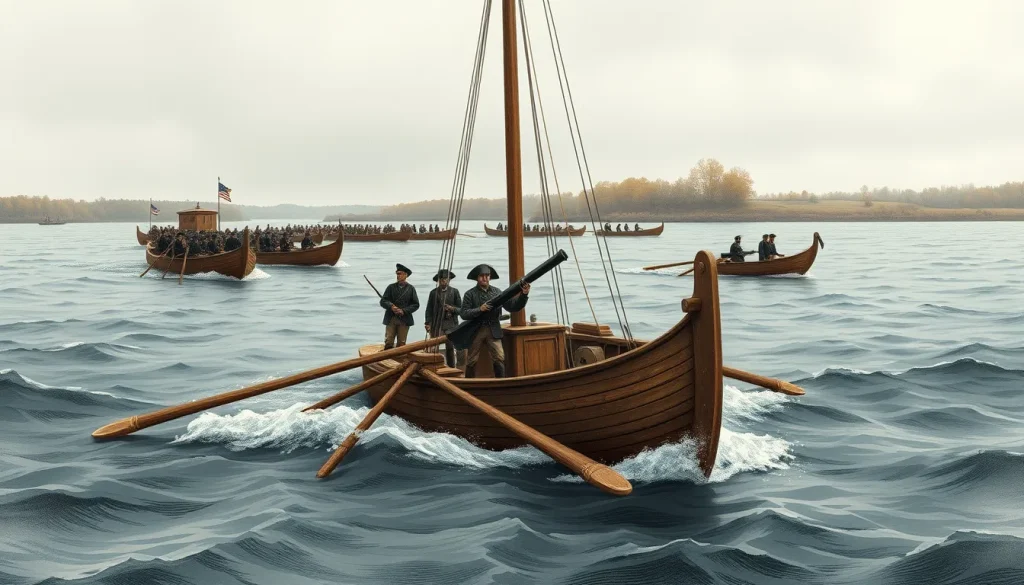
Gunboats — shallow-draft, oar-and-sail craft mounting one or two heavy cannon — provided the principal naval firepower of the American flotilla that descended the St. Lawrence River in the autumn of 1813 during the War of 1812. As part of the two-pronged American offensive against Montreal, several hundred bateaux, Durham boats, and gunboats carried Major General James Wilkinson’s army downriver from Sackets Harbor, New York, until the advance collapsed after the Battle of Crysler’s Farm on 11 November 1813. The campaign is the war’s clearest test of the gunboat in an offensive role rather than a defensive one, and its failure shaped the subsequent naval building race on Lake Ontario. This article treats “gunboat” in its War of 1812 naval sense and takes the St. Lawrence River Campaign to mean the American expedition against Montreal in the autumn of 1813.
Historical Context
By 1813 the American war effort against British North America had stalled on the Niagara frontier and along Lake Champlain. Secretary of War John Armstrong therefore revived a plan for a two-pronged advance on Montreal, the commercial and military hub of Lower Canada and the key junction in the British supply chain that ran up the St. Lawrence River to Kingston, Prescott, and the Upper Canadian interior. Control of that river was the object of the campaign: an army that could move downstream faster than the British could reinforce along the banks might isolate Upper Canada from Quebec.
The St. Lawrence below Lake Ontario was a difficult military corridor. Rowed craft could drift and row downstream, but the current ran hard, and stretches such as the rapids near Prescott and the Long Sault required experienced boatmen. The northern bank was British territory, settled in places by militia, and the towns of Prescott and Cornwall gave the defenders fixed points from which shore batteries and small craft could harass anything passing. In earlier North American wars the same chain of waterways — linking the Hudson River, Lake Champlain, the Mohawk Valley, and Lake Ontario — had served as a corridor for forts, bateaux, and gunboats, as the shallow-draft gunboat Philadelphia, sunk at Valcour Island in 1776 and later recovered, illustrates.
Both belligerents maintained small fleets on Lake Ontario. Commodore Isaac Chauncey commanded the United States squadron at Sackets Harbor; Commodore James Lucas Yeo commanded the Royal Navy and Provincial Marine force at Kingston. Both depended heavily on gunboats and row galleys for shallow-water work, convoy escort, and inshore fire support. On the American side the gunboat had been a central and much-criticised element of naval policy since the administration of Thomas Jefferson, which had built well over a hundred of them for harbour defence rather than for oceanic fleets.

What Happened
Armstrong’s plan required Major General Wade Hampton’s division to advance north from Plattsburgh along the Châteauguay River while Wilkinson’s Lake Ontario army moved down the St. Lawrence in boats. The two forces were to meet at St. Regis, on Lake St. Francis, and move together on Montreal. Wilkinson’s command, commonly estimated at 7,000 to 8,000 men, was embarked in several hundred bateaux and Durham boats with a naval escort that included gunboats, supported by a handful of small schooners and sloops.
The flotilla began leaving Sackets Harbor in mid-October 1813 and, after gales scattered and delayed it at Grenadier Island near Cape Vincent, entered the St. Lawrence. Chauncey’s squadron covered the passage as far as the head of the river and then returned to Sackets Harbor; Chauncey declined to take his ships into the St. Lawrence, where the rapids and the batteries at Prescott would expose them. From that point the expedition’s gunboats were the flotilla’s only naval protection.
Moving into the river in early November, the Americans ran the rapids past Prescott, and American accounts describe an exchange of fire with British batteries and gunboats on the north bank as the bateaux were steered through the narrow channels. On 10 November a force under Brigadier General Jacob Brown clashed with Canadian militia and British regulars at Hoople’s Creek. The next day Wilkinson put a brigade ashore on the north bank near the farm of John Crysler, where Lieutenant Colonel Joseph Wanton Morrison’s pursuing corps — built around the 89th Foot, flank companies of the 49th Foot, the Canadian Voltigeurs, and local militia, with gunboats on the river — attacked the American force under Brigadier General John Parker Boyd. The flotilla’s gunboats fired into the British line and the naval craft engaged their opposite numbers, but the American force was repulsed and re-embarked. Commonly cited casualty figures are roughly 100 Americans killed and about 230 wounded, with about 100 taken prisoner, against British and Canadian losses of about 30 killed and 150 wounded.
Wilkinson had already learned that Hampton had been defeated on the Châteauguay River on 26 October 1813 (some accounts give 25 October) by a much smaller force of Canadian militia and Indigenous warriors, and had withdrawn to Plattsburgh. Without Hampton, the Montreal operation was impossible. The flotilla continued downstream to the Salmon River at French Mills, now Fort Covington, New York, where the army went into winter quarters. In February 1814, as the Americans withdrew to Plattsburgh and Sackets Harbor, the boats of the flotilla were burned and scuttled to keep them from capture.
Why It Matters
The campaign ended the last serious American threat to Montreal in 1813 and left the St. Lawrence supply line intact, which helped the British sustain Upper Canada through the winter and into 1814. It also exposed the limits of the gunboat as an offensive instrument: gunboats could escort a river column and trade fire with shore batteries, but they could not create naval superiority, could not silence Prescott’s batteries, and could not by themselves prevent a determined land pursuit. Contemporaries drew different lessons. Chauncey and Wilkinson blamed each other for the failure, and American officers publicly questioned Wilkinson’s competence and sobriety. Later historians have generally located the failure in the plan and its divided command rather than in any single class of vessel, while noting that a gunboat-heavy flotilla was poorly suited to a contested river passage. The consequences included Hampton’s resignation in 1814, Wilkinson’s court-martial in 1815 — at which he was acquitted — and an intensified shipbuilding race on Lake Ontario in 1814, in which both sides laid down ships of the line and gunboats became auxiliaries rather than the main strength.
In Upper Canadian memory the repulse at Crysler’s Farm became one of the defining events of the war, and the battlefield later became a site of commemoration — with the complication that the original ground was partly inundated in the 1950s by the St. Lawrence Seaway.
Definition
“Gunboat” in this period was not a single class but a family of small armed craft. The typical United States Navy gunboat was a shallow-draft vessel roughly 45 to 60 feet long, rigged with one or two masts and fitted with oars, carrying one or two heavy long guns — commonly 18-, 24-, or 32-pounders — on pivot mounts, sometimes supplemented by smaller carronades or howitzers. In practice the term also covered row galleys, armed bateaux, and small armed schooners doing the same work. On inland waters a “gunboat” might be anything from a purpose-built naval craft to a converted cargo boat carrying a single cannon.
Background
The gunboat was the signature vessel of the Jeffersonian naval establishment. Between 1803 and 1812 the United States built well over a hundred of them for harbour and coastal defence, on the theory that cheap, numerous, shallow-draft craft could protect American ports against a far larger Royal Navy. Critics, including many naval officers, considered them of little use except in the calmest conditions and unfit for extended service. When war came, both belligerents found them valuable on the lakes and rivers, where deep-draft frigates could not operate and where convoys needed close escort. American gunboats and row galleys were built at Sackets Harbor, New York, while the Royal Navy and the Provincial Marine built and armed comparable craft at Kingston and Prescott.
How It Worked
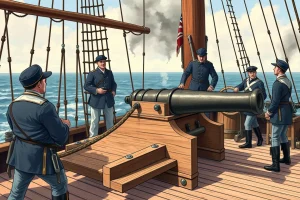
In the 1813 St. Lawrence expedition the gunboats functioned as the flotilla’s escort, its mobile artillery, and its rearguard. They were interspersed among, or stationed on the flanks of, the column of bateaux and Durham boats that carried the infantry, stores, and artillery. When the column passed a British battery or was engaged by British gunboats, the American gunboats and row galleys formed a line to return fire while the transports ran past. In landings they provided covering fire; at Crysler’s Farm they fired into the British line on the north bank while the army re-embarked. Their weaknesses were structural. Rowing against the current exhausted crews; in the rapids the boats had to be warped or kedged through, which made them slow, bunched, and vulnerable; a single heavy gun with limited ammunition could not sustain a long bombardment; and a low-freeboard craft was exposed to musketry and field artillery from the bank, and to boarding.
Competing Viewpoints
American accounts divide sharply. Wilkinson, in Memoirs of My Own Times, and Chauncey, in his letters to the Navy Department, each placed responsibility for the campaign’s failure on the other’s service. Wilkinson complained that the navy had abandoned the flotilla by refusing to enter the river; Chauncey argued that the army’s plan was unsound and that his squadron could not be risked in a confined waterway under enemy batteries. Hampton, for his part, claimed that Châteauguay had been a diversion in Wilkinson’s favour. British reports, including Morrison’s and Major General Francis de Rottenburg’s despatches, treated the American gunboat flotilla as a serious but manageable threat that could be countered by shore batteries, gunboats, and light infantry moving along the bank. Modern historians differ on how much weight to place on the gunboat programme itself: some emphasise the institutional weaknesses of the gunboat navy, while others argue that the flotilla performed its escort function competently and that the campaign failed for reasons of strategy, coordination, and weather.
Role in the War of 1812
The St. Lawrence campaign was the war’s largest attempt to use gunboats offensively, as the escort of an army in an amphibious advance rather than as harbour defenders. It was also the moment when the limits of the type became politically visible. Gunboats remained essential on the lakes and rivers for the rest of the war — escorting supply convoys, patrolling, raiding, and supporting landings — but they were increasingly seen as auxiliaries to the large squadrons both sides built at Kingston and Sackets Harbor in 1814. British supply convoys between Kingston and Montreal, which were the strategic object of the American campaign, continued to move under gunboat and armed-bateau escort.
Consequences and Historical Interpretation
No gunboats from Wilkinson’s flotilla are known to survive; the craft that were not abandoned were burned at French Mills in 1814. The researcher Dana William Ashdown has argued that remains of some of the flotilla’s boats may lie in the Salmon River near Fort Covington, New York, though this remains an open research question rather than an established find. The battlefield at Crysler’s Farm was partly flooded by the St. Lawrence Seaway in the 1950s, and the memorial and commemorative interpretation were relocated near Upper Canada Village, outside Morrisburg, Ontario. In Canadian memory the battle is recalled as a defensive victory won largely by British regulars, Canadian militia, and Indigenous allies; in American military history the campaign is usually treated as a case study in failed joint planning and divided command.
Primary Sources
- Memoirs of My Own Times by Major General James Wilkinson (Philadelphia: Abraham Small, 1816, three volumes). Wilkinson’s third volume is largely a defence of his conduct in the Canadian campaigns of 1813 and 1814 and reproduces documents from his 1815 court-martial, making it the fullest surviving American narrative of the flotilla. It is also a self-serving account written to answer his critics, and its claims about the navy and about his own health and conduct must be read with that in mind. Statements here are paraphrased, not quoted word for word.
- The correspondence of Commodore Isaac Chauncey with Secretary of the Navy William Jones, October and November 1813, printed in The Naval War of 1812: A Documentary History, volume 2, edited by William S. Dudley (Washington, DC: Naval Historical Center, 1992). These letters set out the navy’s reasons for keeping the Lake Ontario squadron out of the St. Lawrence. They are official self-justification as much as report, and they represent the naval view rather than the army’s.
- British despatches of November 1813, notably Lieutenant Colonel Joseph Wanton Morrison’s report of the action at Crysler’s Farm to Major General Francis de Rottenburg, and de Rottenburg’s report to Governor General Sir George Prevost. They describe the pursuit along the north bank and the role of gunboats and shore forces, but were written quickly, from the victors’ vantage point, with imperfect knowledge of American intentions.
- American State Papers: Military Affairs, volume 1 (Washington: Gales and Seaton, 1832), which prints official returns and correspondence bearing on the campaign. Returns from the autumn 1813 operations are incomplete and sometimes inconsistent.
- The published correspondence and justifications of Major General Wade Hampton concerning his withdrawal from Lower Canada in 1813, which explain his decision to abandon the rendezvous. Hampton wrote in defence of his own reputation after disputes with Wilkinson and with his own officers.
No verbatim transcript of a gunboat officer’s log or journal from the campaign has been verified for this article; readers seeking such material should consult the Lake Ontario naval correspondence in the Dudley documentary volumes and the holdings of Library and Archives Canada and the United States National Archives.
Further Reading
- Donald E. Graves, Field of Glory: The Battle of Crysler’s Farm, 1813 (Toronto: Robin Brass Studio, 1999).
- Robert Malcomson, Lords of the Lake: The Naval War on Lake Ontario, 1812–1814 (Annapolis: Naval Institute Press, 1998).
- Robert Malcomson, Warships of the Great Lakes, 1754–1834 (London: Chatham, 2001).
- Spencer C. Tucker, The Jeffersonian Gunboat Navy (Columbia: University of South Carolina Press, 1993).
- Donald R. Hickey, The War of 1812: A Forgotten Conflict, bicentennial edition (Urbana: University of Illinois Press, 2012).
- J. C. A. Stagg, Mr. Madison’s War: Politics, Diplomacy, and Warfare in the Early American Republic, 1783–1830 (Princeton: Princeton University Press, 1983).
- George F. G. Stanley, The War of 1812: Land Operations (Toronto: Macmillan, 1983).
- William S. Dudley and Michael J. Crawford, editors, The Naval War of 1812: A Documentary History, 3 volumes (Washington, DC: Naval Historical Center, 1985–2002).
- Dana William Ashdown, “Wilkinson’s Invasion Flotilla of 1813,” The Napoleon Series.
- Crysler Farm Battlefield and Upper Canada Village, St. Lawrence Parks Commission, Ontario.
- H. Lee White Maritime Museum, Oswego, New York, “Path Through Maritime History: Waterways of War.”
References
- James Wilkinson, Memoirs of My Own Times, 3 vols. (Philadelphia: Abraham Small, 1816).
- William S. Dudley, ed., The Naval War of 1812: A Documentary History, vol. 2 (Washington, DC: Naval Historical Center, 1992).
- American State Papers: Military Affairs, vol. 1 (Washington: Gales and Seaton, 1832).
- Donald E. Graves, Field of Glory: The Battle of Crysler’s Farm, 1813 (Toronto: Robin Brass Studio, 1999).
- Robert Malcomson, Lords of the Lake: The Naval War on Lake Ontario, 1812–1814 (Annapolis: Naval Institute Press, 1998).
- Spencer C. Tucker, The Jeffersonian Gunboat Navy (Columbia: University of South Carolina Press, 1993).
- Donald R. Hickey, The War of 1812: A Forgotten Conflict, bicentennial ed. (Urbana: University of Illinois Press, 2012).
- J. C. A. Stagg, Mr. Madison’s War (Princeton: Princeton University Press, 1983).
- Dana William Ashdown, “Wilkinson’s Invasion Flotilla of 1813: A paper examining the American flotilla of Major-General James Wilkinson,” The Napoleon Series.
- H. Lee White Maritime Museum at Oswego, “Path Through Maritime History: Waterways of War.”
FAQ
What did gunboats actually do in the St. Lawrence River campaign of 1813?
They served as the flotilla's escort, mobile artillery, and rearguard. Gunboats and row galleys screened the column of bateaux and Durham boats carrying Wilkinson's army, returned fire when the flotilla passed British batteries at Prescott, and fired into the British line at Crysler's Farm on 11 November 1813 while the army re-embarked.
Did the gunboats cause the American defeat in the St. Lawrence campaign?
Most modern accounts do not single out the gunboats. The campaign failed because the two-pronged plan collapsed when Wade Hampton was defeated at the Châteauguay River on 26 October 1813 and withdrew, because command was divided between Wilkinson and Hampton, and because the army was beaten in a land action at Crysler's Farm. The gunboats' limitations — slow progress against the current and in the rapids, limited firepower, and vulnerability to shore batteries — contributed to the flotilla's difficulty but were not the decisive factor.
What happened to the gunboats of Wilkinson's flotilla?
After the campaign the flotilla wintered at French Mills (Fort Covington), New York, on the Salmon River. When the army withdrew to Plattsburgh and Sackets Harbor in February 1814, the boats were burned and scuttled to prevent their capture. No gunboat from the expedition is known to survive.
Leave a Reply