
Short Answer
Carronades were short-barreled, light naval guns developed in Britain in the 1770s that traded long-range accuracy for immense close-range hitting power. By the War of 1812 (1812–1815), they were standard armament on many British and United States warships, especially frigates, sloops, and brigs. They changed naval warfare less by replacing long guns than by reshaping tactics: commanders who carried them sought to close to point-blank range, where a few heavy carronade balls could dismast or shatter an opponent. Their limitations—short range and vulnerability to long guns—also shaped the war’s single-ship duels and later assessments of naval power.
Historical Context
Naval warfare in the Age of Sail depended on smoothbore cannon. The standard long gun threw a solid iron shot with considerable range and accuracy, but it was heavy, required a large crew, and produced a powerful recoil that demanded a wheeled carriage and strong ship timbers. A 32-pounder long gun could weigh more than two tons, and a ship’s broadside weight—the total weight of shot fired from one side—was a key measure of fighting power. Larger ships of the line carried dozens of such guns, but frigates, sloops, and brigs needed lighter armament to remain fast and seaworthy.
The carronade emerged from a specific problem: how to give small or lightly built vessels defensive firepower against privateers and pirates. In the 1750s, British artillery officer Robert Melville began investigating a shorter, lighter gun. Working with Charles Gascoigne, manager of the Carron Company ironworks at Falkirk, Scotland, Melville finalized the design in 1776. The weapon was called a smasher by Melville, but it took the name carronade from the foundry that produced it.
By the early 19th century, the Royal Navy had adopted carronades widely, and other navies followed. The United States Navy began using them at the beginning of the century; Henry Foxall, superintendent of the Eagle Foundry on the Schuylkill River at Philadelphia, probably cast the first American versions in 1799. When the United States declared war on Britain in June 1812, both navies therefore entered the conflict with carronades already integrated into their armaments.
What Happened
The carronade first demonstrated its potential in September 1782, when HMS Rainbow, commanded by Captain Henry Trollope, encountered the French frigate Hébé off the Brittany coast. Rainbow had been experimentally armed with 68-pounder and 42-pounder carronades instead of her usual long guns. Trollope closed the range and fired a broadside that brought down Hébé’s foremast and wounded her captain, prompting surrender. The action showed that a ship armed with carronades could deliver far greater weight of metal at close quarters than a conventionally armed opponent of similar size.
During the War of 1812, carronades figured in many of the war’s most famous single-ship actions. On 13 August 1812, the U.S. frigate Essex, commanded by Captain David Porter, captured HMS Alert after only eight minutes. Essex carried 40 32-pounder carronades and only 6 12-pounder long guns; Alert mounted 6 9-pounder long guns and 16 18-pounder carronades. The American ship’s heavier close-range broadside proved decisive. Alert was the first British warship captured by the United States in the war.
On 19 August 1812, USS Constitution, under Captain Isaac Hull, engaged HMS Guerriere. Constitution carried 30 24-pounder long guns, 1 18-pounder long gun, and 24 32-pounder carronades. Guerriere, a 38-gun British frigate, was smaller and more lightly armed. After a chase and maneuvering, Constitution closed to within half pistol-shot and fired heavy broadsides that dismasted Guerriere. The British ship surrendered. Similar patterns appeared on 25 October 1812, when USS United States captured HMS Macedonian, and on 29 December 1812, when USS Constitution captured HMS Java.
Not every action favored carronade-armed ships. On 1 June 1813, HMS Shannon, under Captain Philip Broke, captured USS Chesapeake, under Captain James Lawrence, in a brief and bloody engagement. Shannon also carried carronades, but the British crew’s long practice in gunnery and the ship’s mixed battery helped decide the fight. The war thus showed both the power and the limits of the carronade.
Why It Matters
Carronades mattered immediately because they allowed smaller warships to carry a heavier close-range broadside than their size would otherwise permit. They required fewer men to operate, took up less deck space, and could be mounted on slides that permitted a wider field of fire. For American frigates and sloops, they helped offset the Royal Navy’s enormous numerical superiority in a single-ship duel. For British captains, they added smashing power to ships already expected to fight at close range.
The longer-term significance lay in the tactical trade-off they exposed. A ship armed largely with carronades had to close with an enemy to be effective; if it could not, long guns could stand off and batter it from beyond carronade range. The War of 1812 demonstrated that a balanced battery of long guns and carronades was often preferable to an all-carronade armament. Later naval architects and ordnance specialists continued to seek guns that combined range, accuracy, and hitting power, a search that eventually led to shell guns and rifled artillery.
Historians disagree about how much credit carronades deserve for the war’s famous American victories. Some emphasize the heavier American frigates and their mixed batteries; others stress crew training, ship construction, British overconfidence, or luck. The carronade was a significant factor, but rarely the only one.
Definition
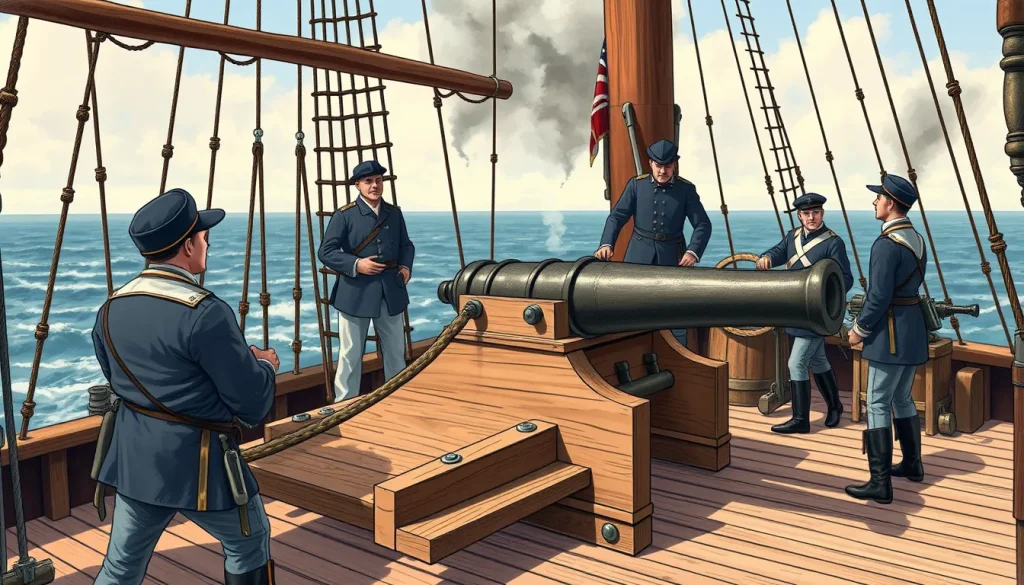
A carronade is a short-barreled, low-velocity naval gun that was designed for close-range action. It was cast with thinner walls than a long gun, used a smaller powder charge, and was mounted on a slide rather than a wheeled carriage. The weapon’s heavy shot and lighter construction gave it great destructive power at short range, but it could not match the range of conventional long guns. Its nickname, smasher, reflected the damage it caused to an enemy’s hull and crew.
Background
The carronade was developed by Robert Melville and Charles Gascoigne at the Carron Company in Scotland. Melville wanted a weapon that merchant ships could use against privateers and pirates without the weight, space, and crew requirements of a standard long gun. The first production models appeared in 1776. Early demand came from merchantmen sailing in dangerous waters, but the Royal Navy soon recognized the weapon’s value for its own close-range tactics. The Admiralty ordered trials, and after HMS Rainbow’s success in 1782, carronades spread across the fleet. The U.S. Navy adopted them in the late 1790s and early 1800s, with Henry Foxall’s Eagle Foundry casting most American carronades.
How It Worked
A carronade was relatively light for its caliber. It weighed about 50 to 70 pounds of metal for every pound of shot, compared with as much as 150 to 200 pounds per pound of shot for a long gun. Its barrel was roughly seven calibers long—seven times the diameter of its bore. A 42-pounder carronade was therefore shorter than a 3-pounder long gun and weighed less than a 12-pounder long gun. Because it used about one-third the powder charge of a comparable long gun, the recoil was gentler, although still powerful. The reduced charge also meant less windage, which could improve accuracy at close range.
Unlike a long gun, a carronade had no trunnions. Instead, a bolt through a loop cast on the underside of the barrel secured it to a wooden slide. The slide rested on a larger skid, attached by a fighting bolt that allowed the gun to recoil about two feet. Side tackles were used to run the gun out again, and a pivot pin and small rollers allowed it to traverse. A 42-pounder carronade needed only about four men to work, roughly half the crew of a comparable long gun. At close range, its heavy, relatively slow-moving shot tore large irregular holes in an enemy’s hull and created deadly splinters; such damage was difficult for ships’ carpenters to repair. The chief drawbacks were excessive recoil, the risk of burning powder igniting the ship’s side or rigging, and above all, short range.
Competing Viewpoints
One interpretation holds that carronades were a decisive technological edge for the United States in the War of 1812. According to this view, American 44-gun frigates such as Constitution and United States used heavy carronades and long guns to outgun British 38-gun frigates at close range, producing a string of victories that shocked the Royal Navy and British public. Another interpretation argues that the American ships were simply larger and more heavily built, and that their crews had trained hard in gunnery. In this view, carronades were important but not unique; the Royal Navy also used them extensively.
A third viewpoint emphasizes the carronade’s limitations. It was not a wonder weapon. It could not win a long-range fight, and its short range forced captains to take risks in closing. The British capture of USS Chesapeake by HMS Shannon in June 1813 is often cited to show that carronades alone did not determine victory. Modern naval historians, following the lead of Alfred Thayer Mahan, also argue that single-ship duels had limited strategic effect on the war’s outcome, which was shaped more by blockade, commerce raiding, and logistics than by frigate victories.
Role in the War of 1812
Carronades were carried by many types of warship in the War of 1812. The largest British ships of the line mounted 68-pounder carronades, while American frigates typically carried 32-pounder or 42-pounder carronades alongside 24-pounder long guns. Smaller vessels such as brigs and sloops often relied on carronades as their principal armament. For example, USS Hornet was rebuilt before the war and armed with 2 12-pounder long guns and 18 32-pounder carronades, giving it a broadside weight of 300 pounds compared with 72 pounds before the change.
In practice, carronades shaped the tactics of single-ship combat. American captains often sought to close quickly and deliver a heavy broadside before an enemy could use superior long-range gunnery. British captains, aware of their advantage in long guns, sometimes tried to keep the range open. The results were mixed. Essex’s quick capture of Alert and Constitution’s victories over Guerriere and Java showed the carronade’s close-range power. Shannon’s defeat of Chesapeake showed that a well-trained British crew with a mixed battery could still win. On the Great Lakes, carronades also formed part of the armament of the improvised squadrons that fought for control of the waterways, though the lakes campaigns had their own logistical and tactical conditions.
Consequences and Historical Interpretation
After the War of 1812, carronades remained in naval service for decades, but their limitations became increasingly clear. Navies continued to value heavy close-range firepower, yet the trend in the 19th century moved toward guns that could fire accurately at longer range. The development of shell guns, such as the Paixhans gun, and later rifled artillery eventually reduced the carronade’s importance. In the shorter term, the war’s frigate victories became central to American naval memory, and carronades were part of that story. The nickname Old Ironsides for USS Constitution and the fame of the 1812 frigate duels owed much to the close-range hammering delivered by carronades and long guns together.
Historians now treat the carronade as an important but not solitary cause of tactical change. It increased the stakes of close combat, encouraged mixed batteries, and demonstrated the need for fast, well-handled ships that could choose the range of engagement. At the same time, it exposed the dangers of relying on any single weapon type. The War of 1812 was a laboratory for these lessons, and the carronade’s performance—both its smashing successes and its vulnerabilities—helped shape naval thinking in the decades that followed.
Primary Sources
- USS Constitution logbook, 1812. The logbook records sightings, maneuvers, and times around the 19 August 1812 action with HMS Guerriere. It is terse and sometimes differs from other accounts in timekeeping, so it is best read alongside officers’ letters and British reports.
- Isaac Hull to Paul Hamilton, 28 August 1812. Hull’s official letter to the U.S. secretary of the navy describes the Constitution-Guerriere battle from the American commander’s perspective. It is a valuable but self-justifying official report.
- Richard Dacres’s report on the loss of HMS Guerriere, 1812. Dacres’s account gives the British perspective on the battle and helps balance American narratives. As a defeated commander’s report, it may emphasize unfavorable circumstances or minimize British errors.
- Royal Navy Admiralty records, especially correspondence and orders concerning carronade trials and deployment. These administrative documents show how the Royal Navy adopted and distributed carronades, but they rarely describe combat in detail.
- Contemporary newspapers, including the London Times and Niles’ Weekly Register. They show how the war’s naval actions were reported and remembered, but they often reflected national pride, incomplete information, and propaganda.
- William S. Dudley, ed., The Naval War of 1812: A Documentary History, 3 vols. This documentary edition reprints many official letters, reports, and other primary materials and is a standard starting point for research.
Paraphrases above are drawn from these sources; no direct quotation is reconstructed where the wording is uncertain.
Further Reading
- Philip K. Allan, Carronades: The Smashers, Naval History Magazine, December 2023.
- Spencer C. Tucker, The U.S. Navy’s Smashers, Naval History Magazine, December 2014.
- Margherita M. Desy, America’s Frigate Triumphs, Naval History Magazine, June 2012.
- American Battlefield Trust, Naval Engagements in the War of 1812.
- Michael J. Crawford, The Lasting Influence of Theodore Roosevelt’s Naval War of 1812, International Journal of Naval History 1, no. 1 (April 2002).
- Theodore Roosevelt, The Naval War of 1812 (New York: G. P. Putnam’s Sons, 1882).
- Alfred Thayer Mahan, Sea Power in Its Relations to the War of 1812, 2 vols. (Boston: Little, Brown, 1905).
- William S. Dudley, ed., The Naval War of 1812: A Documentary History, 3 vols. (Washington, DC: Naval Historical Center, 1985–2002).
- USS Constitution Museum, Charlestown, Massachusetts, and the National Museum of the Royal Navy, Portsmouth, for artifact and exhibit-based interpretation.
References
- Allan, Philip K. “Carronades: The Smashers.” Naval History Magazine 37, no. 6 (December 2023). https://www.usni.org/magazines/naval-history-magazine/2023/december/carronades-smashers.
- Tucker, Spencer C. “The U.S. Navy’s ‘Smashers’.” Naval History Magazine 28, no. 6 (December 2014). https://www.usni.org/magazines/naval-history-magazine/2014/december/armaments-and-innovations-us-navys-smashers.
- Desy, Margherita M. “America’s Frigate Triumphs.” Naval History Magazine 26, no. 3 (June 2012). https://www.usni.org/magazines/naval-history-magazine/2012/may/americas-frigate-triumphs.
- American Battlefield Trust. “Naval Engagements in the War of 1812.” https://www.battlefields.org/learn/articles/naval-engagements-war-1812.
- Crawford, Michael J. “The Lasting Influence of Theodore Roosevelt’s Naval War of 1812.” International Journal of Naval History 1, no. 1 (April 2002). https://ijnh.seahistory.org/wp-content/uploads/sites/2/2012/01/pdf_crawford.pdf.
- Roosevelt, Theodore. The Naval War of 1812. New York: G. P. Putnam’s Sons, 1882.
- Mahan, Alfred Thayer. Sea Power in Its Relations to the War of 1812. 2 vols. Boston: Little, Brown, 1905.
- Dudley, William S., ed. The Naval War of 1812: A Documentary History. 3 vols. Washington, DC: Naval Historical Center, 1985–2002.
FAQ
What was a carronade?
A carronade was a short-barreled, low-velocity naval gun designed for close-range combat. It used a smaller powder charge and a slide mounting, allowing a heavy shot to be fired from a relatively light gun with a small crew.
How did carronades affect the War of 1812?
They increased the close-range broadside power of many British and American warships, especially frigates, sloops, and brigs. This encouraged commanders to close to point-blank range, contributing to notable single-ship victories such as USS Constitution versus HMS Guerriere and USS Essex versus HMS Alert.
Were carronades decisive in the War of 1812?
Historians generally treat carronades as important but not solely decisive. They gave ships heavy short-range firepower, but long guns could outrange them, and other factors such as ship size, crew training, and tactics also shaped outcomes.

Leave a Reply