Short Answer
The Rush-Bagot Agreement of 1817 was a diplomatic arrangement between the United States and Great Britain that restricted each country’s military naval forces on the Great Lakes and Lake Champlain to a few small patrol vessels. Concluded as an exchange of notes on April 28–29, 1817, it arose directly from the aftermath of the War of 1812, when both powers sought to avoid a costly naval arms race along the frontier. The agreement is historically significant as a major step toward the peaceful and largely undefended border between the United States and Canada that exists today.
Historical Context
During the War of 1812, both the United States and Great Britain built substantial naval squadrons on the Great Lakes, engaging in fierce ship-to-ship combat at places like Lake Erie (1813) and Lake Ontario. These fleets were costly to construct and maintain, and by the war’s end in 1815, the United States had gained a strategic edge on most of the upper lakes. However, the Treaty of Ghent, which ended the war, contained no specific provisions for naval disarmament, leaving both nations free to continue building.
After peace, tensions remained high along the frontier. Each side feared the other might use naval power to launch a surprise attack or to support territorial claims. At the same time, both governments faced heavy postwar debts and wished to reduce military expenditures. The idea of limiting naval forces on the lakes had been raised earlier—American leaders had proposed it during the negotiation of the Jay Treaty in 1794—but the British had rejected it then. The changed diplomatic climate after 1815 made the idea more attractive.
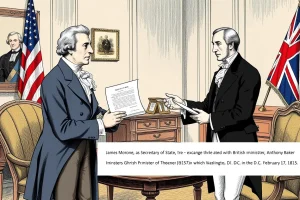
In January 1816, U.S. Minister to Britain John Quincy Adams proposed mutual disarmament to British Foreign Secretary Viscount Castlereagh. The British government responded favorably and dispatched Sir Charles Bagot as minister to Washington with instructions to improve relations. Secretary of State James Monroe initially handled the discussions, and his successor, Acting Secretary Richard Rush, eventually concluded the agreement with Bagot.

What Happened
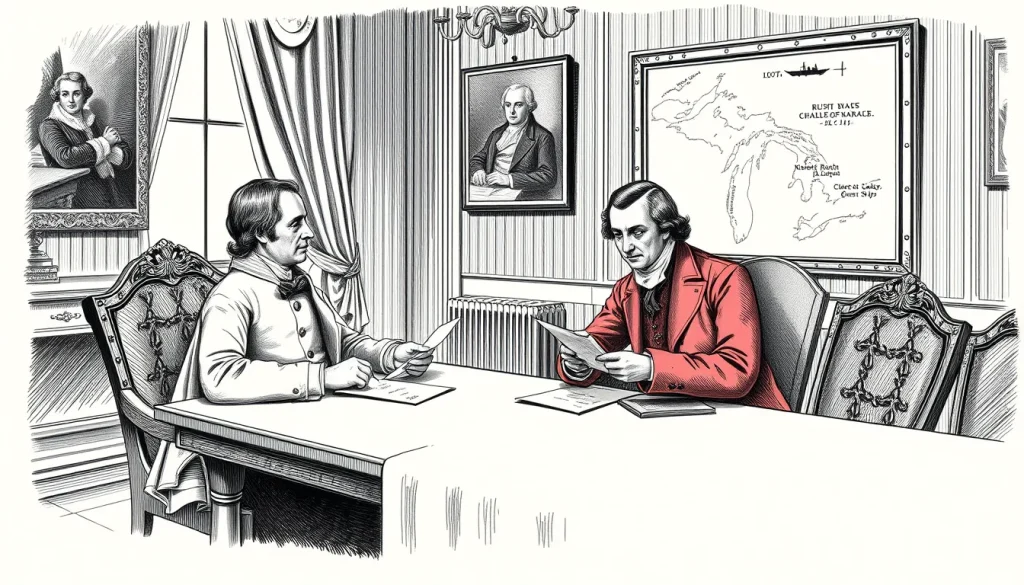
On April 28, 1817, Sir Charles Bagot delivered a note to Acting Secretary of State Richard Rush, stating that the British government, acting on behalf of the Prince Regent, accepted the American proposal of August 1816. The note specified the exact limitations on naval forces: on Lake Ontario, one vessel not exceeding one hundred tons burden and armed with one eighteen-pound cannon; on the Upper Lakes (all other Great Lakes), two vessels of similar size and armament; and on Lake Champlain, one vessel of similar size and armament. All other armed vessels were to be dismantled, and no new warships were to be built. The agreement included a six-month notice clause allowing either side to withdraw.
Rush replied on April 29, 1817, formally agreeing to the terms on behalf of the U.S. government. The notes were exchanged without a formal treaty, but the arrangement was considered binding. President James Monroe submitted the agreement to the U.S. Senate, which approved it on April 16, 1818. Monroe then issued a proclamation on April 28, 1818, declaring the arrangement in full force. The British government, for its part, treated the exchange of notes as sufficient, so the agreement became effective for both parties.
The agreement did not address land fortifications; both countries continued to build and maintain forts along the border for decades. It also did not resolve broader boundary issues, which were partially handled by the separate Convention of 1818 that fixed the boundary from the Lake of the Woods to the Rocky Mountains at the forty-ninth parallel.
Why It Matters
The immediate effect of the Rush-Bagot Agreement was to halt the naval arms race on the Great Lakes. The dismantling of warships and the prohibition on new construction reduced tensions and saved money. It also set a precedent for arms control through diplomatic negotiation.
Longer term, the agreement is often cited as the origin of the peaceful and largely demilitarized border between the United States and Canada. Although both nations continued to fortify land positions, the lakes became a zone of mutual restraint. The agreement was later reinforced by the Treaty of Washington (1871), which completed disarmament of the lakes, and by a 1946 exchange of notes permitting naval vessels for training purposes with advance notice.
Historians generally view the Rush-Bagot Agreement as an important turning point in Anglo-American relations. It reflected a shift from post-revolutionary hostility to a growing recognition of shared economic interests and the impracticality of defending the vast frontier. Some scholars emphasize that the agreement’s success was due to its narrow scope—it avoided complex territorial disputes and focused solely on naval forces. Others point out that it did not eliminate all military readiness, as both sides retained land forces and forts.
Definition
The Rush-Bagot Agreement is a diplomatic accord between the United States and Great Britain that limited each country’s armed naval vessels on the Great Lakes and Lake Champlain to one or two small patrol craft per lake, none exceeding 100 tons burden or armed with more than an 18-pounder cannon. It was achieved through an exchange of notes rather than a signed treaty.
Background
The agreement emerged from the aftermath of the War of 1812. The war had seen both sides build large fleets on the inland lakes, and after peace, both governments wanted to avoid a ruinous naval race. Early proposals for disarmament had been made in 1794, but were rejected. In 1815–1816, U.S. diplomats, including John Quincy Adams and James Monroe, pushed the idea again. The British, facing financial strain and a desire for good relations with the United States, agreed to negotiate.
How It Worked
The arrangement allowed each side a strictly limited naval presence on the waters it controlled: one vessel on Lake Ontario, two on the Upper Lakes (Huron, Michigan, Erie, and Superior), and one on Lake Champlain. Each vessel was limited to 100 tons and one 18-pounder cannon. All other warships were to be dismantled, and no new ones built. The agreement included a six-month withdrawal clause, so either party could terminate it on notice.
Competing Viewpoints
Historians generally agree on the basic facts, but they differ on its significance. Some see it as a decisive move toward disarmament and peace, while others note that it applied only to naval forces and did not stop land fortifications. Some argue that the agreement’s effectiveness depended on the mutual interest in avoiding war, rather than on the technical limitations alone. Others emphasize that it was not a formal treaty and question its long-term legal status, though both nations treated it as binding.
Role in the War of 1812
The Rush-Bagot Agreement was not part of the war itself but was directly caused by it. The war demonstrated the cost and destructiveness of naval contests on the lakes, and the difficulty of defending a long frontier. The agreement addressed the root of that problem by eliminating the largest military vessels, thus reducing the risk of accidental clashes and the incentive for a new arms race. It helped transform the Great Lakes from a zone of conflict into a shared commercial waterway.
Consequences and Historical Interpretation
The immediate consequence was the dismantling of the fleets at the end of the war, with the British storing some dismantled ships in the Stone Frigate at Kingston, Ontario. The longer-term consequence was a gradually demilitarized border, which contributed to the development of peaceful relations between the United States and Canada. Most historians interpret the Rush-Bagot Agreement as a landmark in arms control and in the evolution of the U.S.-Canadian relationship, though they often note that it was only one of several steps, including the Convention of 1818 and the Treaty of Washington, that shaped the modern border.
Primary Sources
The primary sources for the Rush-Bagot Agreement are the diplomatic notes exchanged between Richard Rush and Charles Bagot in April 1817. These notes, held in the U.S. National Archives and published in collections such as Treaties and Other International Acts of the United States of America (edited by Hunter Miller), provide the exact terms. President James Monroe’s proclamation of April 28, 1818, which announced that the Senate had approved the arrangement and that it was in force, is another key document. The Avalon Project at Yale Law School provides a modern transcription of the proclamation and the notes. These sources are reliable for the wording, though they reflect the official government view and do not capture dissenting opinions of the era.
Further Reading
- Office of the Historian, U.S. Department of State, “Milestones: 1801–1829 – Rush-Bagot Pact, 1817 and Convention of 1818,” available at history.state.gov.
- The Canadian Encyclopedia, “Rush-Bagot Agreement,” available at thecanadianencyclopedia.ca.
- Avalon Project, “British-American Diplomacy: Exchange of Notes 1817 : Proclamation,” available at avalon.law.yale.edu.
- Hunter Miller, ed., Treaties and Other International Acts of the United States of America, vol. 2, Washington: Government Printing Office, 1931.
References
- Office of the Historian, U.S. Department of State, “Milestones: 1801–1829 – Rush-Bagot Pact, 1817 and Convention of 1818,” accessed 2025, https://history.state.gov/milestones/1801-1829/rush-bagot.
- Avalon Project, “British-American Diplomacy: Exchange of Notes 1817 : Proclamation,” accessed 2025, https://avalon.law.yale.edu/19th_century/br1817p.asp.
- D.N. Sprague, “Rush-Bagot Agreement,” updated by Michelle Filice, The Canadian Encyclopedia, accessed 2025, https://thecanadianencyclopedia.ca/en/article/rush-bagot-agreement.
- Wikipedia, “Rush–Bagot Treaty,” accessed 2025, https://en.wikipedia.org/wiki/Rush-Bagot_Treaty.
FAQ
Was the Rush-Bagot Agreement a formal treaty?
No, it was an exchange of diplomatic notes between the U.S. Acting Secretary of State and the British Minister. However, it was treated as binding by both governments, and the U.S. Senate approved it, after which President Monroe proclaimed it in force.
What restrictions did the Rush-Bagot Agreement place on naval forces?
It allowed each country one vessel (max 100 tons, one 18-pounder) on Lake Ontario and Lake Champlain, and two such vessels on the upper Great Lakes. All other armed vessels were to be dismantled and no new ones built.
Why is the Rush-Bagot Agreement important for the U.S.-Canada border?
It is widely credited as the first step toward demilitarizing the Great Lakes, which helped create a peaceful and largely undefended border between the U.S. and Canada, despite continued land fortifications.



Leave a Reply