
Short Answer
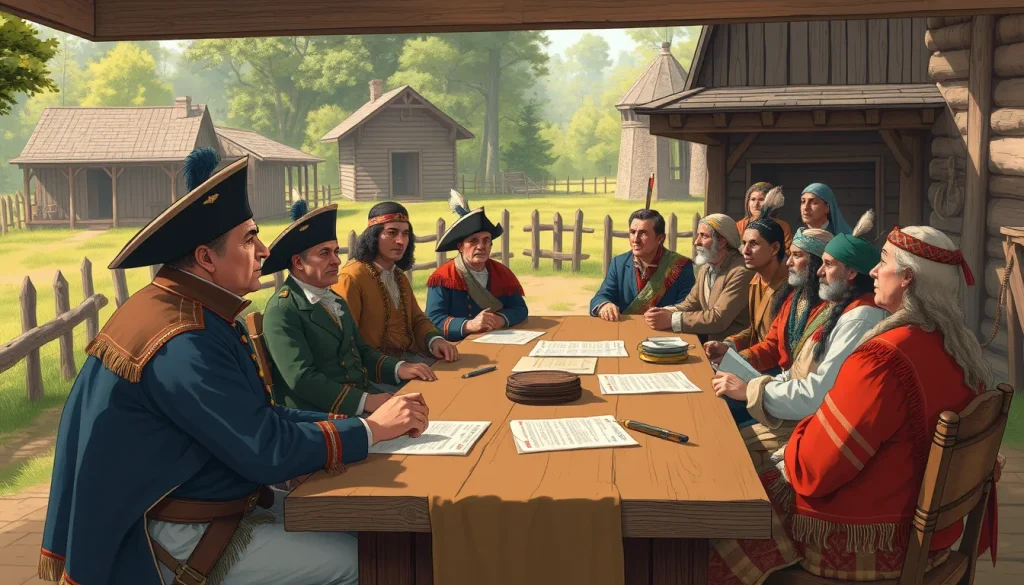
The Treaty of Greenville, signed on August 3, 1795, at Fort Greenville in the Northwest Territory (present-day Greenville, Ohio), ended the Northwest Indian War between the United States and a coalition of Native nations known as the Western Confederacy. Negotiated after the U.S. victory at the Battle of Fallen Timbers, it ceded large areas of Native land in what is now Ohio and parts of the surrounding region, established a boundary between U.S. settlement and Native territory, and created an annuity system. The treaty brought a temporary peace, but its land cessions and the displacement that followed became central grievances that helped draw Native nations into the War of 1812.
Historical Context
After the American Revolution, the United States claimed the Northwest Territory under the 1783 Treaty of Paris, but the British cession did not consult or include the Native nations who lived there. The U.S. government treated the lands as open for settlement and tried to impose treaties at Fort McIntosh (1785), Fort Finney (1786), and Fort Harmar (1789). Many Native nations rejected these agreements, arguing that the leaders who signed them had no authority to sell lands they did not own. In response to American expansion, nations including the Wyandot, Delaware, Shawnee, Miami, Ottawa, Chippewa, Potawatomi, and others formed the Western Confederacy.
The Northwest Indian War (1785–1795) followed. U.S. forces suffered major defeats under General Josiah Harmar in 1790 and General Arthur St. Clair in 1791; St. Clair’s defeat was one of the worst in U.S. Army history. President George Washington then appointed General Anthony Wayne to command the Legion of the United States. Wayne trained his troops, built a chain of forts, and advanced into the Ohio Country. On August 20, 1794, his army defeated the Western Confederacy at the Battle of Fallen Timbers near present-day Toledo, Ohio. Wayne then destroyed Native villages and crops in the region, increasing pressure on the confederacy.
Diplomatically, the 1794 Jay Treaty between the United States and Britain changed the strategic situation. Britain agreed to evacuate its posts on U.S. territory and reduced its material support for Native nations, though British traders and officials in Canada retained influence. With the Western Confederacy weakened and without reliable British backing, Wayne was able to negotiate from a position of strength at Fort Greenville in 1795.

What Happened
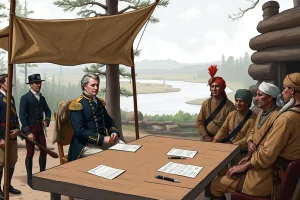
Wayne convened councils at Fort Greenville in the summer of 1795. He provided food, supplies, and promises of future goods to encourage attendance and agreement. The negotiations were not a meeting of equals: the United States had defeated the Western Confederacy militarily, and Wayne made clear that he could take more land if the Native nations refused. The U.S. delegation included Wayne, William Henry Harrison, William Clark, Meriwether Lewis, Caleb Swan, and William Wells. Native leaders present included Tarhe and other Wyandot chiefs, Blue Jacket and Black Hoof of the Shawnee, Buckongahelas of the Delaware, Little Turtle of the Miami, and representatives of the Ottawa, Chippewa, Potawatomi, Wea, Kickapoo, Piankeshaw, and Kaskaskia.
Little Turtle initially opposed the terms. He argued that the Miami were not parties to earlier treaties and that those agreements were invalid because the signers had no right to sell Miami lands. Other leaders, including Blue Jacket, urged acceptance as the only way to avoid further destruction. Tarhe reportedly warned that Wayne had the power to take all Native lands if they did not negotiate. On August 3, 1795, the treaty was signed at Fort Greenville. The U.S. Senate ratified it on December 22, 1795.
The treaty’s terms were extensive. Native nations ceded lands in eastern and southern Ohio and specific tracts around U.S. posts and settlements, including areas near Fort Detroit, Fort Miami, Fort Defiance, Fort Wayne, Ouiatenon, Vincennes, and Kaskaskia. A boundary known as the Greenville Treaty Line separated ceded land from lands reserved for Native nations. The United States agreed to pay annual annuities in goods and supplies and to respect Native lands beyond the line, while Native nations agreed to return captives and recognize U.S. authority. The agreement did not include all Native nations, and many communities and leaders rejected or contested it. Even among signatories, acceptance often reflected military necessity rather than consent to permanent dispossession.
Why It Matters
In the short term, the Treaty of Greenville ended the Northwest Indian War and brought an uneasy peace to the Ohio Country. It opened much of present-day Ohio to American settlement and established a framework of annuities and land cessions that the United States would use repeatedly in the following decades. For the U.S. government, it confirmed federal authority in the Northwest Territory and reduced British-backed Native resistance. For Native nations, it meant the loss of hunting grounds, villages, and political autonomy, and it forced many communities to relocate or adapt to new boundaries.
Over the longer term, the treaty accelerated displacement. American settlers often ignored the Greenville line, and state and federal officials pressured Native nations into further cessions. By 1800, tribes from the eastern United States were being pushed west, and the Shawnee, Delaware, Miami, Wea, Wyandot, and others faced continuing encroachment. In 1809, the Treaty of Fort Wayne forced additional land cessions in Indiana, prompting renewed resistance. The Shawnee leader Tecumseh and his brother Tenskwatawa built a confederacy that rejected the right of any single leader to sell communal lands. Their movement led to the Battle of Tippecanoe in 1811 and, during the War of 1812, to alliances with Britain and Canadian forces.
Historians interpret the Treaty of Greenville in different ways. Some emphasize U.S. expansion and military power, seeing the treaty as one stage in the inevitable dispossession of Native nations. Others stress Native agency, diplomacy, and survival, noting that leaders negotiated, resisted, and adapted under extreme pressure. Many scholars argue that the treaty’s promises were never fully honored and that its legacy is less a lasting peace than a prelude to further conflict. The treaty remains a central document in the history of U.S.–Native relations and the causes of the War of 1812 in the Old Northwest.
Document
The Treaty of Greenville is a formal peace treaty between the United States and a coalition of Native nations. Its full formal title is A treaty of peace between the United States of America, and the tribes of Indians called the Wyandots, Delawares, Shawanees, Ottawas, Chippewas, Pattawatimas, Miamis, Eel Rivers, Weas, Kickapoos, Piankeshaws, and Kaskaskias. It is also known as the Treaty with the Wyandots, etc.
Date
Signed August 3, 1795, at Fort Greenville, Northwest Territory (present-day Greenville, Ohio). Ratified by the U.S. Senate on December 22, 1795.
Author
The treaty was negotiated by U.S. commissioners led by General Anthony Wayne and by representatives of the Native nations listed in the title. It was drafted by U.S. officials; no single author is identified. The document reflects U.S. legal and diplomatic language, with Native leaders’ marks and signatures appended.
Historical Context
The treaty followed the Battle of Fallen Timbers (1794) and the Jay Treaty (1794), which reduced British support for the Western Confederacy. It was part of a broader U.S. effort to secure the Northwest Territory and open it to settlement, and it responded to years of violent conflict and Native displacement.
Transcript
A full verified transcript is not reproduced here. The treaty’s formal title, as recorded, reads: “A treaty of peace between the United States of America, and the tribes of Indians called the Wyandots, Delawares, Shawanees, Ottawas, Chippewas, Pattawatimas, Miamis, Eel Rivers, Weas, Kickapoos, Piankeshaws, and Kaskaskias.” The complete text is available in the U.S. Statutes at Large, vol. 7, p. 49, and in published documentary editions held by the National Archives and Records Administration.
Modernized Transcript
No modernized full transcript is provided here. A modernized edition would require editorial decisions about spelling, punctuation, and translation, and this article does not reconstruct missing or uncertain text. Researchers should consult the original published text in the U.S. Statutes at Large or archival holdings at the National Archives and Records Administration.
What the Document Tells Us
The treaty records the terms imposed after U.S. military victory: land cessions, a defined boundary, annuities, return of captives, and recognition of U.S. authority. It shows the unequal diplomatic position of the Native nations, the U.S. desire for legal title and settlement space, and the creation of an annuity system that tied Native communities to federal payments. It also reveals that the agreement was made with specific leaders and nations, not with all Native peoples, and that dissent existed even among those who signed.
Limitations and Bias of the Source
The treaty text is a U.S. government document written in English and framed from the U.S. perspective. It does not record Native oral histories, the coercive context of negotiations, or the meanings that Native communities attached to the land. Signatures by individual leaders did not represent all factions or nations. Translation and mediation shaped the final wording. For these reasons, the treaty must be read alongside Native accounts, archaeological evidence, and later scholarship.
Citation
Treaty of Greenville, August 3, 1795, U.S. Statutes at Large, vol. 7, p. 49. Ratified December 22, 1795.
Primary Sources
- Treaty of Greenville (1795). The official treaty text, signed by U.S. and Native representatives. It provides the legal terms of land cession, boundary, and annuities. Limitation: it reflects U.S. diplomatic language and does not capture Native dissent or oral understandings.
- U.S. military correspondence from Anthony Wayne’s campaign (1794–1795). Letters and reports by Wayne and his officers describe the campaign, councils, and treaty negotiations. They are valuable for U.S. decision-making but are biased toward American military perspectives.
- Jay Treaty (1794). The British–U.S. agreement helped isolate the Western Confederacy by promising British evacuation of frontier posts. It is relevant context but does not directly address Native land claims.
- Native oral traditions and later speeches. Accounts passed down by Wyandot, Shawnee, Miami, Delaware, and other nations preserve memories of displacement and resistance. They are essential but often recorded later and not contemporaneous written documents.
Further Reading
- Richard White, The Middle Ground: Indians, Empires, and Republics in the Great Lakes Region, 1650–1815 (1991).
- Colin G. Calloway, The Shawnees and the War for America (2007).
- Gregory Evans Dowd, A Spirited Resistance: The North American Indian Struggle for Unity, 1745–1815 (1992).
- John Sugden, Tecumseh: A Life (1997).
- Alan Taylor, The Civil War of 1812: American Citizens, British Subjects, Irish Rebels, and Indian Allies (2010).
- U.S. National Park Service, “Summer 1795: The Treaty of Greenville creates an uneasy peace.”
- U.S. Statutes at Large, vol. 7, p. 49 (Treaty of Greenville).
References
- U.S. National Park Service, “Summer 1795: The Treaty of Greenville creates an uneasy peace,” by Eric Hemenway, Little Traverse Bay Bands of Odawa Indians. https://www.nps.gov/articles/a-long-legacy.htm
- Wikipedia, “Treaty of Greenville.” https://en.wikipedia.org/wiki/Treaty_of_Greenville
- Treaty of Greenville, August 3, 1795, U.S. Statutes at Large, vol. 7, p. 49.
FAQ
What did the Treaty of Greenville do?
It ended the Northwest Indian War, ceded large areas of Native land in the Ohio Country to the United States, established the Greenville Treaty Line, and created an annuity system of annual goods payments.
Did all Native nations agree to the Treaty of Greenville?
No. The treaty was signed by representatives of several nations, but many leaders and communities rejected or contested it. Little Turtle of the Miami initially opposed the terms, and the agreement did not represent all Native peoples.
How did the Treaty of Greenville lead to the War of 1812?
The treaty opened Native lands to American settlement and led to further displacement and land cessions. Resistance to these pressures produced Tecumseh’s Confederacy and the Battle of Tippecanoe, and many Native nations allied with Britain during the War of 1812.
Leave a Reply