
Short Answer
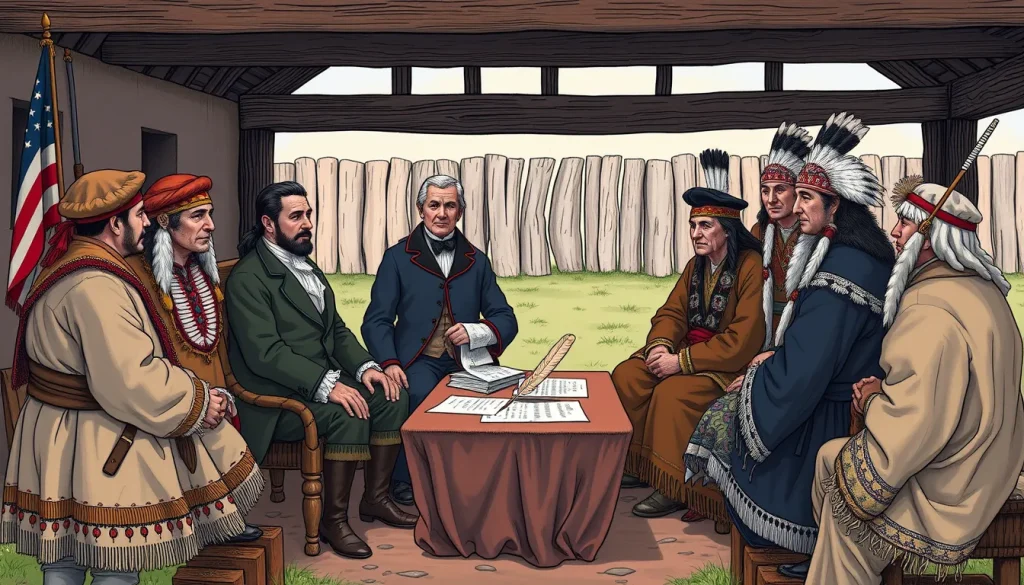
The Treaty of Fort Wayne (1809), also known as the Ten O’clock Line Treaty or Twelve Mile Line Treaty, was signed on September 30, 1809, at Fort Wayne in present-day Indiana. Negotiated by William Henry Harrison, governor of Indiana Territory, it transferred roughly 2.5 to 3 million acres of Indigenous land along the Wabash River to the United States. Because it excluded the Shawnee and was rejected by Tecumseh as illegitimate, the treaty became a direct catalyst for Tecumseh’s resistance, helping to set the stage for Tecumseh’s War and the War of 1812 in the Old Northwest.
Historical Context
After American independence, the United States sought to consolidate control over the Old Northwest. The Treaty of Greenville (1795) ended the Northwest Indian War and established a boundary between U.S. settlement and Indigenous lands, but it left the Wabash River valley largely in the hands of the Miami, Wea, Kickapoo, and other nations. Thomas Jefferson’s administration encouraged federal officials to acquire land through treaties and to promote assimilation. William Henry Harrison, appointed governor of Indiana Territory in 1801, negotiated numerous treaties between 1803 and 1808 that transferred tens of millions of acres. By 1809, settlement pressure and debt among some Indigenous communities had made further cessions possible, but many leaders in the Wabash region opposed selling any more land. Meanwhile, Tenskwatawa (the Prophet) and his brother Tecumseh had established Prophetstown on the Tippecanoe River, where they preached pan-Indian revival and resistance to land cessions. Their position was that land was held in common and could not be sold by any single tribe without the consent of all.
What Happened
In 1809 Harrison began to push for a new treaty to open more land for settlement. He invited Delaware, Potawatomi, Miami, and Eel River Miami leaders to Fort Wayne in September. The Miami, who claimed ownership of much of the Wabash region, opposed the sale and presented the Treaty of Greenville as proof of their rights. Harrison offered subsidies, direct payments, and annuities. After two weeks, Potawatomi leaders persuaded the Miami to accept as an act of reciprocity. The treaty was signed on September 30, 1809, though some accounts give September 29. It ceded a tract north of Vincennes along the Wabash and its tributaries, covering about 2.5 to 3 million acres in present-day Indiana, Illinois, and adjacent areas. The agreement provided annuities: Delaware and Miami $500 each, Potawatomi $500, Eel River Miami $250, and contingent sums for the Wea and Kickapoo. The treaty was contingent on later acceptance by the Wea and Kickapoo, who had not agreed at Fort Wayne. Harrison obtained Wea consent in the winter of 1809 by offering a larger subsidy, and Kickapoo acceptance by March 1810. Tecumseh and the Shawnee were not consulted. In August 1810, Tecumseh led about 400 armed warriors to Vincennes to confront Harrison. He demanded the treaty be nullified and warned that Americans should not settle the ceded lands. Harrison refused, arguing that the Miami owned the land and could sell it. Tecumseh then traveled south to seek support among other Indigenous nations. In November 1811, while Tecumseh was away, Tenskwatawa’s followers fought Harrison’s army at the Battle of Tippecanoe. The battle and subsequent American destruction of Prophetstown intensified the conflict, and by 1812 Tecumseh had allied with Britain.
Why It Matters
The Treaty of Fort Wayne mattered immediately because it opened a large bloc of land to American settlement and sharply escalated tensions in the Wabash region. Tecumseh and other dissenting leaders treated the cession as proof that U.S. treaty-making was a tool of dispossession rather than a fair exchange. The treaty therefore helped transform Tecumseh’s message of pan-Indian unity from a warning into an armed movement. Its longer-term consequences reached well beyond Indiana. The fighting that followed at Tippecanoe and the wider conflict known as Tecumseh’s War merged into the War of 1812, when Tecumseh allied with Britain and fought alongside British and Canadian forces in the Old Northwest. His death at the Battle of the Thames in 1813 weakened the Indigenous confederacy and Britain’s position in the region.

Historians disagree about how to characterize the treaty. Some emphasize that it followed the diplomatic forms of the era: U.S. commissioners negotiated with recognized leaders, offered annuities, and obtained signatures. Others stress that the agreement was secured through pressure, unequal bargaining power, and a divide-and-conquer approach that exploited divisions among tribes. Indigenous critics at the time and since have argued that no single tribe could alienate common lands without broader consent. The treaty also illustrates a fundamental cultural conflict: U.S. officials treated land as a commodity to be bought and sold, while many Indigenous nations understood it as a shared inheritance and a source of life. The original manuscript is held by the U.S. National Archives and has been displayed in the National Museum of the American Indian’s Nation to Nation exhibition, where it is presented as both a legal document and a record of dispossession.
Document
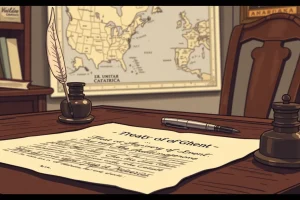
The Treaty of Fort Wayne is a formal land-cession treaty between the United States and several Indigenous nations of the Old Northwest. It is sometimes called the Ten O’clock Line Treaty or the Twelve Mile Line Treaty. The document consists of articles that describe the boundaries of the ceded land, the payments and annuities to be made, and the conditions under which the cession would become final. It is a primary source for U.S. treaty-making, Indigenous diplomacy, and the origins of Tecumseh’s resistance.
Date
The treaty was signed on September 30, 1809, at Fort Wayne, Indiana Territory. Some accounts record the signing on September 29. The agreement was not fully complete until the Wea accepted it later in 1809 and the Kickapoo accepted it by March 1810, because the original text made their consent a condition of the cession.
Author
No single individual authored the treaty. It was drafted and negotiated by U.S. officials under William Henry Harrison, governor of Indiana Territory and federal commissioner. Indigenous signatories included leaders of the Delaware, Potawatomi, Miami, and Eel River Miami, with later assent from Wea and Kickapoo leaders. The official English text was recorded by U.S. treaty commissioners, so the surviving document reflects American legal language and translation choices.
Historical Context
The treaty grew out of the U.S. treaty system established after the Treaty of Greenville and expanded under Harrison’s governorship. At the same time, Prophetstown had become a center of Indigenous resistance and revival, and its leaders rejected the idea that any one tribe could sell land held in common. The Fort Wayne treaty was therefore both a continuation of American expansion and a direct provocation to the emerging Tecumseh confederacy.
Transcript
A complete verbatim transcript is not reproduced in this article. The official text is published in Charles J. Kappler, comp., Indian Affairs: Laws and Treaties, vol. 2, and the original enrolled treaty is held by the U.S. National Archives, Record Group 11. Readers seeking exact wording should consult those sources rather than rely on paraphrases.
Modernized Transcript
No modernized or simplified transcript is provided here because altering the language risks introducing errors in boundary descriptions, annuity amounts, and conditional clauses. A faithful modernization would need to preserve the treaty’s articles and signatories while explaining terms such as annuity and cession. The Kappler edition remains the standard printed text for reference.
What the Document Tells Us
The treaty tells us that the United States claimed the right to acquire Indigenous land through written agreements with selected leaders. It identifies the ceded tract, the payments promised, and the requirement that the Wea and Kickapoo later agree. It also reveals sharp divisions among Indigenous nations, since some leaders accepted the treaty while others, especially the Shawnee under Tecumseh, rejected it. The document shows how annuities were used to secure assent and how U.S. officials treated land as a commodity that could be measured, bounded, and sold.
Limitations and Bias of the Source
The treaty is an English-language U.S. record, not a neutral transcript of the negotiations. It does not capture oral understandings, translation difficulties, pressure, or the threat of force that may have shaped decisions. Signatures were sometimes made with marks, and not all affected nations were present. The treaty’s contingent clauses and later assents complicate any simple reading of who agreed and what they believed they were doing. Historians therefore read it alongside Indigenous oral histories, Harrison’s correspondence, and newspaper accounts.
Citation
Treaty of Fort Wayne, September 30, 1809, U.S. National Archives, Record Group 11; printed in Charles J. Kappler, comp., Indian Affairs: Laws and Treaties, vol. 2 (Washington, D.C.: Government Printing Office, 1904).
Primary Sources
The most important primary source is the enrolled Treaty of Fort Wayne itself, held by the U.S. National Archives and printed in Kappler’s Indian Affairs: Laws and Treaties. William Henry Harrison’s letters and reports from 1809 to 1810, collected in Logan Esarey’s Messages and Letters of William Henry Harrison, document his negotiation strategy and his account of the treaty’s acceptance. The American State Papers: Indian Affairs contains official correspondence and reports on the treaty and subsequent tensions. Contemporary newspaper accounts describe Tecumseh’s August 1810 meeting with Harrison at Vincennes, though they are not verbatim transcripts and vary in detail. These sources are valuable but limited: they are mostly American, often written after the fact, and rarely preserve Indigenous voices directly.
Further Reading
- John Sugden, Tecumseh: A Life (1998).
- R. David Edmunds, The Shawnee Prophet (1983).
- Robert M. Owens, Mr. Jefferson’s Hammer: William Henry Harrison and the Origins of American Indian Policy (2007).
- Alan Taylor, The Civil War of 1812: American Citizens, British Subjects, Irish Rebels, and Indian Allies (2010).
- Charles J. Kappler, comp., Indian Affairs: Laws and Treaties, vol. 2 (1904).
- National Museum of the American Indian, Nation to Nation: Treaties Between the United States and American Indian Nations, exhibition and online resources.
- Alicia Ault, A Territorial Land Grab That Pushed Native Americans to the Breaking Point, Smithsonian Magazine, October 9, 2017.
References
- Treaty of Fort Wayne, September 30, 1809, U.S. National Archives, Record Group 11; printed in Charles J. Kappler, comp., Indian Affairs: Laws and Treaties, vol. 2 (Washington, D.C.: Government Printing Office, 1904).
- William Henry Harrison to James Madison and related correspondence, 1809-1810, in Logan Esarey, ed., Messages and Letters of William Henry Harrison, vol. 1 (Indianapolis: Indiana Historical Commission, 1922).
- Alicia Ault, A Territorial Land Grab That Pushed Native Americans to the Breaking Point, Smithsonian Magazine, October 9, 2017, https://www.smithsonianmag.com/smithsonian-institution/territorial-grab-pushed-native-americans-breaking-point-180965142/.
- Treaty of Fort Wayne (1809), Wikipedia, https://en.wikipedia.org/wiki/Treaty_of_Fort_Wayne_(1809).
- John Sugden, Tecumseh: A Life (New York: Henry Holt, 1998).
- Robert M. Owens, Mr. Jefferson’s Hammer: William Henry Harrison and the Origins of American Indian Policy (Norman: University of Oklahoma Press, 2007).
- National Museum of the American Indian, Nation to Nation: Treaties Between the United States and American Indian Nations, exhibition and online resources.
FAQ
What was the Treaty of Fort Wayne?
The Treaty of Fort Wayne was a land-cession agreement signed on September 30, 1809, at Fort Wayne in Indiana Territory. Negotiated by William Henry Harrison, it transferred roughly 2.5 to 3 million acres along the Wabash River from Delaware, Potawatomi, Miami, and Eel River Miami signatories to the United States, with later Wea and Kickapoo assent.
Why did Tecumseh oppose the Treaty of Fort Wayne?
Tecumseh argued that the land was held in common by Indigenous nations and that no single tribe or leader could sell it without the consent of all. He also rejected the treaty because the Shawnee were excluded from negotiations and because he believed the signatories had no right to cede the Wabash region.
How did the Treaty of Fort Wayne lead to the War of 1812?
The treaty escalated tensions between the United States and Tecumseh's confederacy. Tecumseh's demands that it be nullified led to confrontation with Harrison, the Battle of Tippecanoe in 1811, and eventually Tecumseh's alliance with Britain when the War of 1812 began. The conflict in the Old Northwest became a major theater of that war.
Leave a Reply