
Short Answer
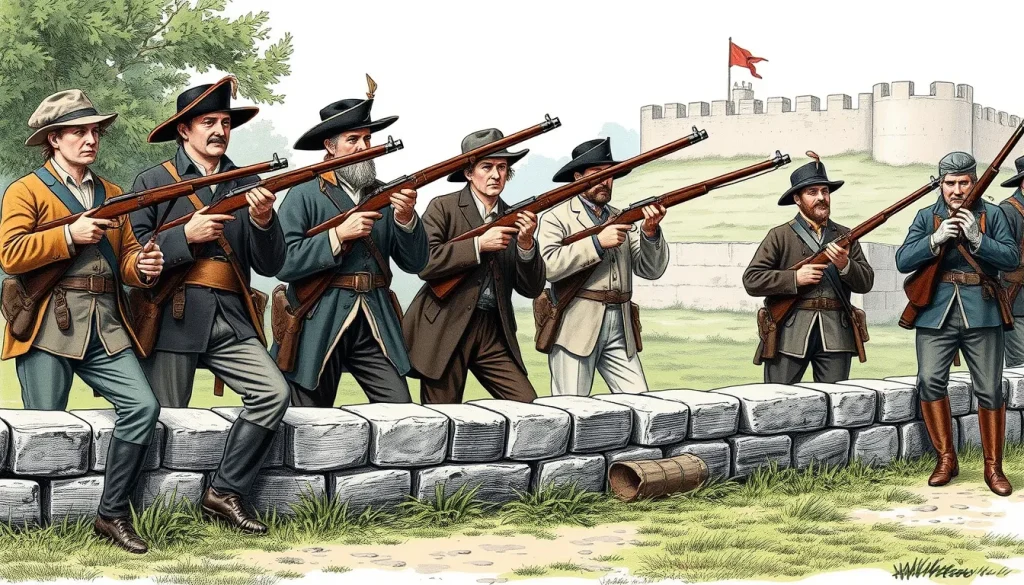
In the War of 1812, the United States relied heavily on state militias to augment a remarkably small regular army. Because militiamen were expected to furnish their own weapons, the muskets they carried were rarely standard-issue military arms; instead, they brought civilian firearms such as fowling pieces, trade guns, and older patterns of muskets. These militia muskets supplemented the regular army’s equipment, but their variety, condition, and lack of bayonets often created tactical and logistical challenges. This article examines what those civilian arms were, how they were used, and why they mattered to the outcome of the war.
Historical Context
The American republic in 1812 inherited a deep suspicion of standing armies, a sentiment rooted in colonial experiences and revolutionary ideology. As a result, the regular army was kept tiny and underfunded; on the eve of war, it numbered fewer than 12,000 officers and men. Congress therefore turned to the state militias, the traditional citizen force, to provide the bulk of land forces for coastal defense, frontier operations, and invasions of British North America. The militia system, however, was decentralized and under state control, and each state had its own laws dictating who must serve and with what equipment. Many states simply required a militiaman to appear with “a good fire arm,” without specifying caliber, type, or condition. This practice mirrored colonial traditions from the Revolution, when Americans had been expected to supply their own guns, often civilian hunting weapons rather than standardized smoothbore muskets.
By 1812, the American population included many hunters and farmers who owned firearms for practical use. The typical civilian long gun was a smoothbore fowler or “long fowler,” often of .60 to .75 caliber, with a barrel of varying length. Some were old British or French military muskets acquired through capture or trade; others were American-made copies or locally built trade guns. Rifles, especially those from the frontier, were also common among some militia units, though they loaded more slowly and rarely had bayonet attachments. The British army, by contrast, deployed regular infantry equipped with the standardized Brown Bess musket and socket bayonet, which gave them an advantage in close combat and volley fire.
What Happened
When war was declared in June 1812, militias were called up en masse for the planned invasions of Canada. In the western theater, General William Hull led an army composed largely of Ohio and Michigan militiamen across the Detroit River, but his force quickly fell back and surrendered at Detroit in August 1812. Many of his militia lacked discipline and were poorly armed, with a variety of personal firearms that complicated ammunition supply and bayonet tactics. At the Battle of Queenston Heights in October 1812, New York militiamen refused to cross the Niagara River, leaving the regulars and Canadian volunteers to fight alone; this refusal was partly due to constitutional objections and partly to poor morale, but the militiamen’s arms were insufficient for a sustained engagement.

As the war continued, militia participation remained uneven. In the northeastern states, particularly Massachusetts and Connecticut, governors refused to place their militia under federal command, leaving these best-equipped forces (often armed with state-purchased muskets) out of the campaign. In contrast, Kentucky and Tennessee sent volunteer militia armed with rifles and long guns that proved effective in skirmishing and at battles like the Thames in 1813, but these troops were often ill-supplied and their varied calibers created resupply problems.
The most infamous militia failure occurred at the Battle of Bladensburg in August 1814, where a hastily assembled force of Maryland and District of Columbia militia broke and fled upon encountering British regulars. Many of these militiamen carried civilian fowling pieces without bayonets, and their lack of training and cohesive firepower contributed to the rout. Yet just a month later, at the defense of Baltimore, militia gunners and infantry, manning earthworks and aided by a mix of old muskets and civilian arms, successfully repelled a British attack. Similarly, at the Battle of New Orleans in January 1815, Andrew Jackson’s force of regulars, militia, volunteers, pirates, and freed men used a mixture of muskets and rifles to devastating effect against a professional British army, though the campaign was fought after the Treaty of Ghent had been signed.
Across the war, militia muskets supplemented the regular army in every major theater: the Niagara campaign, the Chesapeake raids, the Gulf Coast, and the frontier. They allowed American forces to field large numbers of troops quickly, but the arms’ diversity meant that quartermasters often struggled to supply proper ammunition, and many soldiers could not mount bayonets, rendering them vulnerable in close combat. The militia’s performance—and their weapons—therefore became a critical variable that sometimes turned the tide and sometimes precipitated disaster.
Why It Matters
The reliance on militia muskets had immediate consequences: it shaped tactical decisions, undermined logistical efficiency, and contributed to a mixed military record. In the longer term, the war’s experience reinforced arguments for a stronger professional army, leading to reforms in the 1820s that increased the size of the regular establishment and promoted standardized armament. The failures of inadequately equipped militiamen at Bladensburg and elsewhere also influenced public memory, contrasting the heroism of New Orleans with the disgrace of the “Bladensburg Races.” Historians have debated whether citizen soldiers with civilian arms could ever be effective against professional armies; some emphasize their successes in frontier warfare and defensive battles, while others stress their unreliability and the logistical nightmare caused by nonstandard weapons. Ultimately, militia muskets were more than just obsolete tools—they symbolized the young republic’s commitment to a citizen defensive, and their limitations forced a more pragmatic approach to national security.
Definition
Militia muskets in the War of 1812 were the firearms—typically smoothbore long guns—carried by American state militia units. Unlike standard-issue military muskets, these were usually the personal property of the militiaman, brought from home, and ranged from old British Brown Besses to civilian fowling pieces, trade guns, rifles, and even captured muskets. They were “civilian arms” in the sense that they were not produced under military contract or standardized for army use.
Background
The tradition of self-armed citizens dated back to the colonial era, when each colony required all able-bodied men to serve in the militia and furnish their own weapons. This practice continued after independence, as the Second Amendment and various state laws affirmed the right and obligation of citizens to own arms. The Militia Act of 1792 laid out uniform requirements, but it only specified that a militiaman should have “a good musket or firelock” and bayonet, without dictating a precise pattern. Consequently, by the early nineteenth century, American militias remained a motley array of firearms, reflecting their owners’ occupations and regions.
How It Worked
In theory, each militiaman was responsible for his own musket, and state governments sometimes provided ammunition or standardized weapons to those who could not afford them. In practice, most men carried whatever they hunting at home. At muster, officers often inspected weapons and turned away those deemed unfit, but leniency prevailed. When a militia unit was called into federal service, it entered with its own arms, which complicated supply because calibers varied widely. For example, a typical militia company might have some .69-caliber muskets, some .75-caliber Brown Besses, and several .60-caliber fowling pieces. Cartridge boxes and powder horns also varied. This made sustained firefights difficult, as men often ran out of the correct ammunition and could not share with comrades. Furthermore, without bayonets—even if a gun had a bayonet lug, many civilian pieces did not—militiamen were helpless against a bayonet charge. They compensated by fighting from behind fences, barricades, or in skirmish order, where their long smoothbores and rifles could be effective.
Competing Viewpoints
Contemporary observers were deeply divided. Some, like Secretary of War John Armstrong and many regular officers, believed that militiamen with their “militia muskets” were worse than useless, citing the rout at Bladensburg and refusals at Queenston Heights. Others, particularly in the West, argued that citizen soldiers were natural marksmen whose rifles and hunting guns outmatched European smoothbores in accuracy and range. The Kentucky militia’s success at the Battle of the Thames, for instance, was attributed to their long rifles and frontier toughness. Later historians have continued this debate. Donald Hickey, in The War of 1812: A Forgotten Conflict, argues that militias were generally ineffective and their weapons inadequate, while others like J.C.A. Stagg emphasize the constitutional and political constraints that made militias necessary, and note that when properly led and positioned, they fought well. The truth lies between: militia muskets were not inherently inferior, but their lack of standardization and bayonets, combined with short enlistments and political limitations, made them a severe handicap in conventional battles.
Role in the War of 1812
Militia muskets were pivotal in every major American campaign. They formed the bulk of Hull’s invasion army, the Niagara defense force, the Baltimore defenders, and the Crescent City’s mixed force. Even when regulars won victories, like at Chippewa in 1814, militias provided critical reserves or occupied lines. In the Chesapeake raids, militia muskets were the only defense until regular units could arrive. Their role was not always disastrous; at Baltimore and New Orleans, militiamen with civilian arms stood firm and inflicted heavy casualties. Yet the lack of bayonets and uniform calibers often forced American generals to adopt defensive tactics, avoiding open-field engagements where the British infantry’s shock tactics would dominate.
Consequences and Historical Interpretation
The shortcomings of militia muskets contributed to the war’s mixed American performance and fueled postwar military reforms. After 1815, the federal government expanded the standing army, contracted for standard muskets (the 1816 pattern), and encouraged the establishment of national armories. The war also spurred a debate over the Second Amendment and the concept of a militia, with Federalists and Republicans arguing over the need for a professional force. Historians have interpreted the militia muskets as a metaphor for the early republic’s internal tensions: a decentralized citizenry reluctant to fund a standing army, yet unprepared for a major conflict. In the end, the civilian arms supplemented the regular army by providing numbers and a defensive backbone, but they could not replace the discipline and standardization that professional soldiers offered. The war taught that a modern nation could not rely solely on well-meaning citizens with personal fowling pieces; it needed professional soldiers with standardized weapons.
Primary Sources
The most relevant primary sources include militia muster rolls, which list the arms each soldier brought, and procurement records from state and federal governments. For example, the Massachusetts Adjutant General’s records document the state’s efforts to issue muskets to its militia in 1814. Correspondence from officers such as General William Hull and Winfield Scott complains about the poor equipment of militia units. A useful published source is the Autobiography of Thomas J. Morris, a Kentucky militia captain, who described his men’s rifles and long guns. Another important source is the court-martial testimony following the surrender of Detroit, which blamed Hull in part for his poorly armed militia. These sources are uneven in quality and bias; officers often exaggerated militia deficiencies to shift blame. The NPS article provides a modern overview but cites many of these original documents.
Further Reading
- Donald R. Hickey, The War of 1812: A Forgotten Conflict (University of Illinois Press, 1989).
- J.C.A. Stagg, The War of 1812: Conflict for a Continent (Cambridge University Press, 2012).
- Robert S. Quimby, The U.S. Army in the War of 1812: An Operational and Command Study (Michigan State University Press, 1997).
- R. S. Allen, His Majesty’s Indian Allies: British Indian Policy in the Defence of Canada, 1774-1815 (Dundurn Press, 1992).
- U.S. National Park Service, “America’s citizen soldiers: The better bargain of militias?” by David and Jeanne T. Heidler, accessed via NPS.gov.
- American Rifleman, “American Muskets Of The Revolution” and related articles for background on civilian arms (NRA, 2020).
References
- Heidler, David and Jeanne T. “America’s citizen soldiers: The better bargain of militias?” National Park Service, March 10, 2015. https://www.nps.gov/articles/americas-citizen-soldiers.htm
- Neumann, George C. “American Muskets Of The Revolution.” American Rifleman, July 4, 2020. https://www.americanrifleman.org/content/american-muskets-of-the-revolution/
- NRA Staff. “American-Made Muskets in the Revolutionary War.” American Rifleman, July 15, 2012. https://www.americanrifleman.org/content/american-made-muskets-in-the-revolutionary-war-1/
- Hickey, Donald R. The War of 1812: A Forgotten Conflict. University of Illinois Press, 1989.
- Stagg, J.C.A. The War of 1812: Conflict for a Continent. Cambridge University Press, 2012.
FAQ
What types of muskets did American militias use in the War of 1812?
Militias used whatever firearms they owned, including civilian fowling pieces, trade guns, older military muskets (British, French, and American), and rifles. Calibers varied widely, and many lacked bayonets.
Why did the U.S. rely on militias with civilian arms?
The federal government distrusted large standing armies and kept the regular army small. State militias were expected to provide their own weapons under laws like the Militia Act of 1792. Thus, the government had to rely on these self-armed citizens for most land operations.
Did militia muskets perform well in battle?
They were effective in defensive and skirmish roles, such as at Baltimore and New Orleans, but poorly equipped militias often broke under attack, as at Bladensburg. The lack of bayonets and uniform ammunition severely limited their effectiveness in open field combat against British regulars.
Leave a Reply