
Short Answer
Henry Eckford (12 March 1775 – 12 November 1832) was a Scottish-born American shipwright and naval architect who organised and directed the United States Navy’s shipbuilding effort at Sackets Harbor, New York, on Lake Ontario, during the War of 1812. Working under Commodore Isaac Chauncey, his workforce launched a squadron of warships and converted civilian lake schooners into armed cruisers, making Sackets Harbor the principal American naval base on Lake Ontario. The wartime yard established Eckford’s national reputation and influenced how the Navy contracted for warships for the remainder of the nineteenth century.
Historical Context
The Great Lakes formed a strategic frontier that neither the United States nor Britain could ignore once war was declared in June 1812. Lake Ontario and Lake Erie lay across the supply routes connecting Montreal and Kingston to the Niagara peninsula and the American settlements of western New York and Ohio. Control of the lakes meant control of the movement of troops, food, and ordnance. For the United States, a squadron on Lake Ontario was a precondition for supporting any offensive across the Niagara River; for Britain, command of the lake was central to the defence of Upper Canada.
Neither side began the war with a serious freshwater navy. Britain’s Provincial Marine maintained a small flotilla at Kingston and York, and the United States had built only the 14-gun brig Oneida at Oswego in 1808. Both governments therefore faced the same problem: building, arming, manning, and supplying warships hundreds of miles from their seaports, in villages with few shipwrights and scarce iron and naval stores, and in a climate where winter closed the lakes. The result was a shipbuilding race in which the speed with which hulls could be laid down, launched, and fitted out mattered as much as the outcome of any single engagement.
That race is the context in which Henry Eckford must be understood. He was not a naval officer and never commanded a ship in action. His contribution to the war was industrial and logistical, exercised through yards, contracts, materials, and workforces.

What Happened
Eckford was already an established New York shipbuilder with some Navy experience when the war began. In 1806 his yard had built coastal gunboats for the Navy, and in 1808 he had worked with Christian Bergh on the Oneida at Oswego, gaining his first experience of constructing a warship on Lake Ontario under difficult conditions.
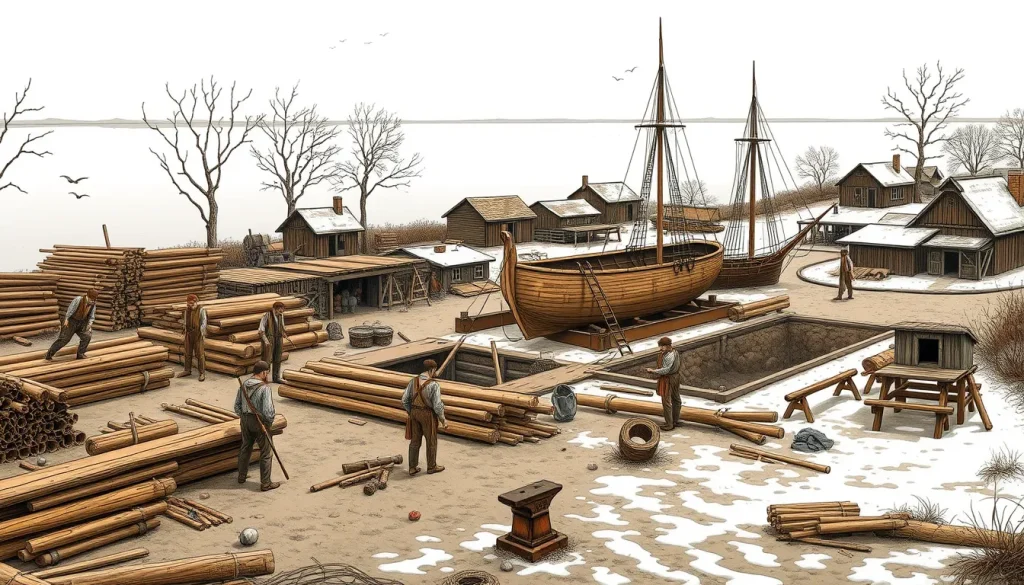
After the declaration of war, Commodore Isaac Chauncey — who knew Eckford from the 1800s, when Chauncey had sailed as master of the Eckford-built ship Beaver, owned by John Jacob Astor — brought him to Sackets Harbor to organise the Navy’s yard there. Eckford arrived in 1812 and turned the small lakeside village into a naval base: laying out building ways, workshops, and storehouses; hiring carpenters, caulkers, joiners, and riggers; and pressing on through hard winters and an unhealthy climate that made the settlement sickly. He also bought property in the area, combining public contracts with private speculation.
Eckford’s yard produced ships with unusual speed. The schooner USS Madison was launched in November 1812 after roughly six weeks of construction, and the pilot-boat schooner Lady of the Lake followed. In 1813 the corvette USS General Pike, designed by Eckford and built at Sackets Harbor, joined the squadron. Later in the war the yard completed the frigate Mohawk; one published account credits the yard with finishing a large frigate in about five weeks, a claim that reflects the yard’s reputation for speed rather than a fully verified schedule. The 3,200-ton ship-of-the-line New Orleans, begun near the end of the conflict, was never completed. By one count eight fighting ships were launched at Sackets Harbor within roughly two years, in addition to the arming and conversion of civilian lake vessels.
Eckford’s ships and yard were directly involved in the war’s events on Lake Ontario. On 29 May 1813 a British force under Sir George Prevost, supported by Commodore Sir James Lucas Yeo’s squadron, attacked Sackets Harbor; the General Pike had been launched only weeks before. American defenders burned storehouses and naval supplies to prevent their capture before the attack was repulsed. On 11 September 1813 the Madison and the Lady of the Lake were among the American vessels in Chauncey’s squadron when it engaged the British fleet on Lake Ontario.
Eckford remained responsible for the Sackets Harbor yard until the end of the war. When fighting ended in 1815, vessels still under construction there were laid up or left unfinished as the two powers wound down their lake armaments.
Why It Matters
The immediate importance of Eckford’s work was that it prevented the Royal Navy and the Provincial Marine from dominating Lake Ontario unopposed. An American squadron based at Sackets Harbor could escort supply convoys, cover the Niagara frontier, and threaten Kingston, and the yard itself became a fortified base that the British attacked in May 1813 without dislodging it. Contemporary American observers credited the lake squadron with helping to sustain land operations that would otherwise have been unsupportable.
The longer-term significance lay in precedent and personnel. Eckford demonstrated that a civilian contractor, working far from a navy yard, could deliver warships quickly in a theatre with almost no industrial base, reinforcing arguments that naval construction should follow commercial practice. He also trained a generation of American shipwrights and naval architects, including apprentices who became prominent builders in their own right, and his reputation for fast hull forms carried into the merchant marine after 1815.
Historians differ on how decisive the Lake Ontario contest actually was. Robert Malcomson and others have argued that the lake campaign was more consequential than its inconclusive battles suggest, because it absorbed men, money, and shipping that both sides needed elsewhere. Other accounts treat the Ontario squadron as a stalemate in which the two fleets largely watched and out-built one another. The share of credit owed to Chauncey’s administration, to Eckford’s management, and to Navy Department priorities is likewise disputed, and no single figure can be credited with the whole result. The description of Eckford as “the father of the U.S. Navy”, used by his Scottish birthplace, is a modern local honorific rather than a settled scholarly judgment.
Early Life
Eckford was born on 12 March 1775 at Kilwinning in Ayrshire, Scotland, the youngest of five sons, and grew up nearby in Irvine, where he attended school and formed a lifelong friendship with the future novelist John Galt. Biographers generally conclude that he trained as a ship’s carpenter somewhere in Ayrshire, probably at the shipyard at Irvine on the Firth of Clyde.
In 1791, aged sixteen, he left Scotland and began a five-year shipbuilding apprenticeship with his maternal uncle, the Scottish-born shipwright John Black, at Black’s yard on the St. Lawrence River at Quebec City in Lower Canada. When Black moved to Kingston, Upper Canada, on Lake Ontario late in 1792, Eckford went with him, then remained at Kingston to continue learning the trade after his uncle returned to Quebec. He completed his apprenticeship in 1796, becoming a shipwright with the title of master builder, and emigrated to the United States, settling in New York City and working as a journeyman in a boatyard on the East River.
Role Before the War
Eckford married Marion Bedell in April 1799; the couple had nine children. In 1799 or 1800 he opened his own yard on the East River in Brooklyn and built his first vessel, the three-masted Sportsman. Around 1802 he sold that yard, returned to New York City, and entered partnership in a new yard; he became a United States citizen on 10 June 1803.
Through the 1800s he built merchant ships for John Jacob Astor and other owners, including Beaver (1805), Magdalen (1805), Sylph (1808), Fox (1809), and Hannibal (1810). The Fox, noted for a fast hull form, made a passage from Calcutta to New York in ninety days, a performance that added to his reputation as a designer. He took his first Navy work in 1806 with gunboat construction, worked on the Oneida at Oswego in 1808, and from 1810 onward trained apprentices who later became shipbuilders themselves. By the time war came, he was one of the best-known naval architects in New York.
Role During the War
At Sackets Harbor, Eckford acted as the Navy’s principal builder and yard organiser on Lake Ontario rather than as a combat officer. He recruited and supervised a large seasonal workforce, obtained timber, cordage, ironwork, and cannon from the seaboard and the surrounding countryside, and managed construction through freeze and thaw. His correspondence with Chauncey and with the Navy Department concerned schedules, labour, materials, and pay as much as design. He continued to develop his own commercial interests in the region while under government contracts, which later critics noted as a conflict inherent in the system of civilian contracting that he himself advocated.
Major Actions
Eckford’s “major actions” were construction campaigns rather than battles. They included the rapid completion of the schooner Madison in November 1812; the building of the pilot-boat schooner Lady of the Lake; the design and construction of the corvette General Pike, launched at Sackets Harbor in 1813; the later frigate Mohawk; the conversion of civilian lake schooners to carry guns; and the beginnings of the ship-of-the-line New Orleans, abandoned unfinished. Eckford’s ships took part in the engagement of 11 September 1813 on Lake Ontario, and his yard was the target of the British attack on Sackets Harbor on 29 May 1813.
Contemporary Accounts
The contemporary record of Eckford’s wartime work is dominated by official documents: Chauncey’s reports to the Secretary of the Navy, requisitions and contracts, and yard accounts. These show what was ordered, built, and launched, and reveal persistent shortages of skilled labour and materials. Newspaper notices of launches at Sackets Harbor, such as those carried in New York papers and in Niles’ Weekly Register, provide useful dates but were often written in a promotional tone and sometimes at second hand. Eckford himself left no substantial memoir, so his own voice survives mainly in business and official correspondence; any reconstruction of his opinions rests on inference from those documents rather than on extended personal statements.
Later Life
After 1815 Eckford returned to New York City, where he became a prominent shipbuilder, businessman, and political figure. He was twice placed in charge of a government yard and argued, from that experience, that naval shipyards should be run on commercial lines under civilian management rather than by officers. His family connections reached into American literary and scientific life: his daughter Sarah married the poet Joseph Rodman Drake in 1816, and another daughter, Janet, married the naturalist James Ellsworth De Kay. In 1828 two of his children, Henrietta and John, died in a fire at his home, and in 1829 a son serving as a midshipman was injured in the explosion of the steam battery Fulton at the Brooklyn Navy Yard.
In the early 1830s Eckford accepted an appointment to build warships for the Ottoman Empire and travelled to Constantinople. He died there on 12 November 1832 and was buried in the cemetery of St. George’s Episcopal Church at Hempstead, New York.
Historical Legacy
Eckford is remembered chiefly for the speed and volume of his wartime output on Lake Ontario and for the craftsmen he trained, several of whom became leading American shipbuilders and naval architects. His later reputation rested on fast hull forms and on his advocacy of civilian management in naval construction, both of which left traces in American practice. Commemoration has been largely local: his birthplace in Ayrshire has claimed him as “the father of the U.S. Navy”, and his grave on Long Island is marked, but he has no monument on the scale of the naval officers he served. Historians treat him as an indispensable contractor and organiser rather than as a strategist, and assessments of his importance vary with how much weight is given to logistics in explaining the outcome of the war on the lakes.
Primary Sources
No verified verbatim text by Henry Eckford is reproduced here; the following are the categories of contemporary material on which any account of his work depends. All statements drawn from them in this article are paraphrases unless marked as a quotation, and no quotation has been invented.
- Official naval correspondence, 1812–1815. Letters and orders exchanged between Commodore Isaac Chauncey, the Secretary of the Navy, and the Sackets Harbor yard, much of it printed in the documentary edition The Naval War of 1812: A Documentary History, edited by William S. Dudley. These record construction schedules, materials, and manning. Limitation: they were written by officials and officers with an interest in justifying requests, costs, and delays, and they rarely record Eckford’s own reasoning.
- Congressional and departmental compilations. American State Papers: Naval Affairs and later Navy Department reports contain contracts, expenditures, and vessel particulars. Limitation: retrospective, selective, and fiscal in emphasis.
- Contemporary newspapers and periodicals. Launch notices and squadron reports in New York papers and in Niles’ Weekly Register. Limitation: patriotic tone, occasional errors, and reliance on secondhand reports.
- Later reminiscence and biography. Recollections by shipwrights connected with Eckford’s yards and nineteenth-century biographical notices. Limitation: written decades after the events and coloured by filial or civic pride.
Researchers seeking Eckford material should begin with the published Dudley documentary volumes and with manuscript collections of War of 1812 naval correspondence held by American research libraries and the National Archives, rather than with any single consolidated Eckford archive, which does not appear to exist.
Further Reading
- Andrew C. A. Jampoler, “Who Was Henry Eckford?”, Naval History 21, no. 6 (December 2007).
- William S. Dudley, ed., The Naval War of 1812: A Documentary History, 3 vols. (Naval Historical Center, 1985–2002).
- Robert Malcomson, Lords of the Lake: The Naval War on Lake Ontario, 1812–1814 (Robin Brass Studio, 1998).
- Robert Malcomson, Warships of the Great Lakes, 1754–1834 (Chatham, 2001).
- Howard I. Chapelle, The History of the American Sailing Navy (W. W. Norton, 1949).
- Theodore Roosevelt, The Naval War of 1812 (G. P. Putnam’s Sons, 1882).
- Sackets Harbor Battlefield State Historic Site, New York State Parks — site interpretation of the 1813 attack and the wartime navy yard.
- Naval History and Heritage Command, War of 1812 subject resources (history.navy.mil).
References
- Andrew C. A. Jampoler, “Who Was Henry Eckford?”, Naval History 21, no. 6 (December 2007), https://www.usni.org/magazines/naval-history-magazine/2007/december/who-was-henry-eckford.
- “Henry Eckford (shipbuilder)”, Wikipedia, https://en.wikipedia.org/wiki/Henry_Eckford_(shipbuilder) — used as a tertiary summary of birth, apprenticeship, marriage, business, and postwar details.
- William S. Dudley, ed., The Naval War of 1812: A Documentary History, 3 vols. (Washington, DC: Naval Historical Center, 1985–2002).
- Robert Malcomson, Lords of the Lake: The Naval War on Lake Ontario, 1812–1814 (Toronto: Robin Brass Studio, 1998).
- Howard I. Chapelle, The History of the American Sailing Navy (New York: W. W. Norton, 1949).
- Theodore Roosevelt, The Naval War of 1812 (New York: G. P. Putnam’s Sons, 1882).
FAQ
What did Henry Eckford do during the War of 1812?
He organised and ran the United States Navy's shipyard at Sackets Harbor, New York, on Lake Ontario. Under Commodore Isaac Chauncey he built and launched warships — including the schooner USS Madison and the corvette USS General Pike — converted civilian lake vessels to carry guns, and constructed the workshops and storehouses that made Sackets Harbor a principal American base.
Was Henry Eckford an American or a British subject during the war?
He was born in Scotland in 1775, apprenticed in Lower and Upper Canada, and emigrated to the United States in 1796. He became a United States citizen on 10 June 1803, so he was an American citizen throughout the War of 1812.
Is Henry Eckford accurately called 'the father of the U.S. Navy'?
That description has been used by his Scottish birthplace, but it is a local honorific rather than a settled historical judgment. Eckford made a major contribution to American naval construction, particularly on Lake Ontario, but the title is contested and is not accepted by most naval historians as a formal designation.
Where did Eckford's wartime ships see action?
His vessels served in Chauncey's squadron on Lake Ontario. The Madison and the Lady of the Lake were among the American ships engaged with the British fleet on 11 September 1813, and the yard itself was the target of the British attack on Sackets Harbor on 29 May 1813.

Leave a Reply