
Short Answer
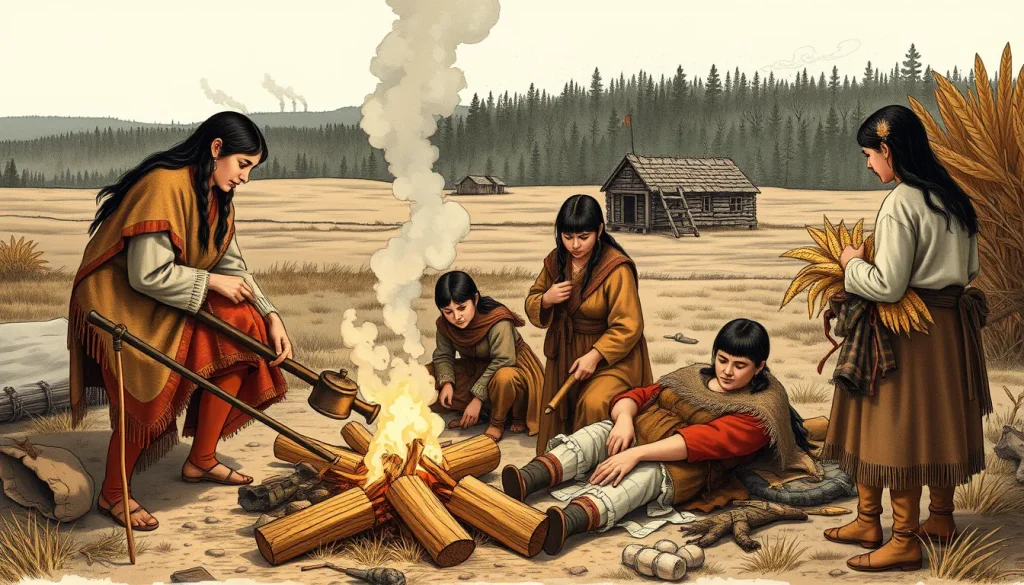
Indigenous women in the War of 1812 (1812–1815) participated in the conflict as cooks, supply providers, nurses, cultural maintainers, and in some cases combatants or combat supporters. Their roles varied across nations and regions, from the Haudenosaunee (Iroquois) Confederacy in New York and Upper Canada to First Nations and Métis communities in the Great Lakes. This article focuses on Indigenous women associated with nations in the Great Lakes, St. Lawrence, and Niagara borderlands. Although documentary evidence is uneven and often filters their contributions through Euro-American military categories such as “cook,” these women helped sustain Indigenous and British-American war efforts and preserve their communities during a period of intense violence and displacement.
Historical Context
The War of 1812 grew out of unresolved tensions between the United States and Great Britain, including maritime disputes, trade restrictions, and American expansion into Indigenous lands. For Indigenous nations, the conflict was also a continuation of earlier struggles over sovereignty and territory. The Treaty of Paris (1783) and subsequent American treaties forced land cessions that many Indigenous peoples did not accept. In the Old Northwest, leaders such as Shawnee chief Tecumseh and his brother Tenskwatawa built an intertribal movement to resist American encroachment. The Battle of Tippecanoe in 1811 and the destruction of Prophetstown intensified Indigenous alliances with Britain, which many saw as the lesser colonial threat.
The Haudenosaunee Confederacy was deeply divided. Some nations and individuals allied with the United States, while others supported Britain. This division made the war a civil conflict within the Confederacy, much as the American Revolution had been. The Niagara Frontier, the St. Lawrence Valley, and the Great Lakes became key theaters. British and American armies depended on Indigenous warriors for scouting, skirmishing, and knowledge of the land. Indigenous women’s roles must be understood within this context of alliance, displacement, and survival.
Before the war, Indigenous women in many nations held significant economic and social responsibilities. Among the Haudenosaunee, matrilineal clan systems gave women influence over property, kinship, and political succession. Women cultivated corn, beans, and squash; processed hides; made clothing; and managed households and trade goods. In Great Lakes and Métis communities, women worked in the fur trade, provided food and clothing, and served as interpreters and cultural mediators. Euro-American and British officials often ignored or misunderstood these roles, viewing women primarily through domestic categories. When war came, those prewar skills became essential to military survival.
What Happened
During the war, Indigenous women contributed in ways that ranged from formal enlistment to informal village support. The best-documented examples come from the Haudenosaunee nations of New York, especially through War of 1812 pension records held in the New York State Archives. Historian Laurence M. Hauptman notes that these records classify several Indigenous women as “cooks” in regiments of Indian volunteers. Arthur C. Parker, a Seneca scholar and museologist, claimed that fifteen Native women from New York served in the war. Pension records confirm that at least five women or their families received military pensions for official service as cooks.
Polly Cooper, an Oneida woman, enlisted in September 1813 at age thirty-one for three months’ service in a regiment of Indian volunteers headed by Captain Peter Elm under the overall command of Seneca chief Farmer’s Brother. In 1857 she sought compensation for clothing, including a hat, leggings, a dress, two blankets, moccasins, and a neckerchief, as well as $22 for 400 miles of transportation between the Oneida Reservation and the Niagara Frontier. Dolly Schenandoah, also Oneida, was twenty-nine when she enlisted in June 1813 for three months in the same regiment. After her death in 1837, her relatives sought $38 in compensation, including $10 for round-trip travel from Oneida to Buffalo.
Julia John, a twenty-five-year-old Seneca from the Allegany Indian Reservation, enlisted in December 1813 for one year in a regiment headed by Governor Blacksnake, an Allegany Seneca chief, under Farmer’s Brother. She later sought $46 in compensation, with only $4 claimed for travel of 140 miles from Allegany to the Niagara Frontier. Susan Jacob(s), a twenty-year-old Onondaga from the Buffalo Creek Reservation, enlisted for three months in a regiment headed by Captain Cold (Ut-ha-wah), the principal Onondaga chief at Buffalo Creek, under Farmer’s Brother. Dinah John, an Onondaga woman, became the most famous of these pensioners. A leading basketmaker and potter, she lived to be a centenarian and was photographed in 1876 by Philip S. Ryder; her portrait is held by the Onondaga Historical Association.
These named women served with American-allied Haudenosaunee forces, but Indigenous women also supported British-allied nations. In the Great Lakes region, First Nations and Métis women helped provision warriors, maintain camps, and care for the wounded. Métis women in particular were often involved in the fur trade and transportation networks that supplied British and Indigenous forces. The documentary record for these women is thinner, partly because British and Canadian military records rarely recorded women’s work in detail. Some women traveled with warriors as camp followers, cooking, laundering, and nursing. Others remained in villages, where they managed farms, gathered food, and preserved community life while men were absent.
The Niagara Frontier saw intense fighting in 1813 and 1814. After the British captured Fort Niagara in December 1813, a joint British and Mohawk force attacked Lewiston, New York, on December 19. Tuscarora men from the local community mounted the most effective resistance and helped escort villagers to safety. Indigenous women were among those whose homes and communities were directly threatened. The war also brought disease, displacement, and food shortages, burdens that fell heavily on women. The Treaty of Ghent in December 1814 ended the fighting, but it did not restore Indigenous sovereignty or land losses.
Why It Matters
Indigenous women’s contributions were immediate and practical: they fed, clothed, healed, and housed warriors and their families, enabling Indigenous nations to participate in campaigns despite limited resources. Their work also sustained communities through the destruction of villages and the disruption of trade and agriculture. Pension records show that some women received official recognition from the United States, but that recognition came decades later and usually classified their service narrowly as cooking. The records themselves are evidence that women’s labor was considered necessary to the war effort, even if officials did not describe it fully.
In the longer term, the war accelerated Indigenous land loss and weakened the political power of many nations. For Haudenosaunee women, the conflict deepened divisions within the Confederacy and complicated their legal and social status. Historical memory has often omitted them. Nineteenth-century histories emphasized male warriors and white heroines, while twentieth-century military histories rarely mentioned Indigenous women. Recent scholarship has begun to recover their stories by reading pension applications, census records, oral traditions, and material culture alongside conventional military sources.
Historians disagree about how to interpret the evidence. Some emphasize continuity: Indigenous women performed wartime tasks that resembled their prewar responsibilities, and their roles remained largely noncombatant. Others argue that the “cook” label was a bureaucratic category that concealed a wider range of contributions, including supply, transport, medical care, and possibly combat. The debate reflects a broader problem in women’s history: when women’s work is recorded through male-dominated institutions, the records often distort or minimize what women actually did.
Definition
“Indigenous women in the War of 1812” refers to women from Native nations who lived in or near the theaters of conflict in North America between 1812 and 1815. It includes Haudenosaunee women from New York and Upper Canada, First Nations women in the Great Lakes and St. Lawrence regions, and Métis women in the fur-trade and provisioning networks. Their roles were not a single formal military category. They included cooking, nursing, laundry, transportation, food production, clothing manufacture, cultural mediation, and community leadership. In a few cases, women may have taken up arms or assisted combatants directly, but the evidence for combat is less consistent than for support work.
Background
Indigenous women’s wartime roles grew out of prewar economies and kinship systems. In Haudenosaunee society, women’s agricultural labor and clan authority made them central to community survival. In Great Lakes and Métis communities, women’s work in trade, translation, and provisioning connected Indigenous and European economies. When the United States declared war in June 1812, these networks became military assets. British officials and American commanders both sought Indigenous allies, and Indigenous nations entered the war to defend land, sovereignty, and trade relationships. Women’s labor helped make those alliances sustainable.
How It Worked
Formal service often took the form of enlistment in “Indian volunteer” regiments, where women were recorded as cooks. They received pay or later sought pensions and compensation. For example, the Oneida, Onondaga, and Seneca women named in New York pension records enlisted for terms ranging from three months to one year. They traveled long distances to the Niagara Frontier, sometimes hundreds of miles, and later claimed reimbursement for clothing and transportation. In camp, women cooked, washed, sewed, and nursed the sick and wounded. In villages, women planted and harvested crops, processed food, made moccasins and clothing, and cared for children and elders. These tasks were not peripheral; they supplied the calories, clothing, and care that warriors needed to fight.
Competing Viewpoints
One interpretation holds that Indigenous women’s roles were primarily logistical and domestic, consistent with gendered divisions of labor in their communities and in Euro-American armies. On this view, the pension records’ use of “cook” accurately describes their main contribution. Another interpretation argues that “cook” was a convenient official label that allowed women to be paid and recognized without challenging military gender norms. Historian Laurence M. Hauptman suggests that Haudenosaunee women were likely more than cooks, especially given the heavy combat on the Niagara Frontier and the precedent of Oneida women fighting at Oriskany during the American Revolution. Sherri Quirke Bolcevic argues that women participated “by any means that they were permitted,” but that their actions were often reinterpreted through a lens of domesticity. The evidence does not allow a single definitive answer for all nations and all women. The safest conclusion is that support roles were essential and widespread, while combat roles were possible but unevenly documented.
Role in the War of 1812
Indigenous women contributed to the war on both sides of the conflict. American-allied Haudenosaunee women from Oneida, Onondaga, and Seneca communities served in volunteer regiments and supported operations on the Niagara Frontier. British-allied First Nations and Métis women supported campaigns in the Great Lakes, including the capture of Michilimackinac in July 1812, the surrender of Detroit in August 1812, and later operations around the Thames and Niagara. Their work helped sustain the Indigenous alliances that were crucial to British success in the early war and to American resistance later. Women also bore the consequences of defeat: displacement, hunger, disease, and the loss of relatives and land.
Consequences and Historical Interpretation
After the war, Indigenous nations faced a difficult peace. The Treaty of Ghent restored prewar boundaries between Britain and the United States but did not restore Indigenous homelands or political autonomy. Many Indigenous peoples who had fought for Britain felt abandoned. In the United States, some Indigenous women received pensions or compensation, but the process was slow and bureaucratic. The stories of Polly Cooper, Dolly Schenandoah, Julia John, Susan Jacob(s), and Dinah John survive mainly because of those claims. Their lives show both the importance of women’s wartime labor and the limits of official recognition.
Historical interpretation has shifted over time. Nineteenth-century accounts celebrated white heroines such as Laura Secord while ignoring Indigenous women. Twentieth-century scholars began to use pension records and tribal histories to recover Indigenous women’s experiences. Today, historians emphasize that Indigenous women were not passive victims or mere helpers. They were actors whose labor, knowledge, and endurance shaped the war’s outcome and their communities’ survival. At the same time, scholars caution against overstating the evidence. Much remains unknown, and the records that exist were created by governments with their own priorities. The history of Indigenous women in the War of 1812 is therefore both a record of contribution and a case study in how archives silence some voices while preserving others.
Primary Sources
The most direct contemporary evidence comes from War of 1812 pension and compensation records held in the New York State Archives. These records document claims by Polly Cooper in 1857, by relatives of Dolly Schenandoah after her death in 1837, and by other Haudenosaunee women. They list service as “cooks,” provide ages, enlistment dates, regiment commanders, and travel distances. Their value is that they name individual Indigenous women and show official recognition of their service. Their limitations are significant: they were created decades after the war, they reflect bureaucratic categories rather than women’s own descriptions of their work, and they rarely record combat, nursing, or community leadership.
Arthur C. Parker’s early twentieth-century writings claimed that fifteen Native women from New York served in the War of 1812. Parker was a Seneca scholar and museum professional, but his claim is not fully documented in the surviving pension records. Thomas Donaldson’s Six Nations of New York, an 1892 federal census publication, describes Dinah John as an elderly Onondaga woman of remarkable vitality. These sources are useful for memory and genealogy, but they must be read critically. British and Canadian records also contain information about Indigenous allies, but they seldom focus on women’s work. No verified transcript of an Indigenous woman’s own wartime diary or letter from this period is known in the sources consulted here.
Further Reading
- Laurence M. Hauptman, “They Also Served: American Indian Women in the War of 1812,” NMAI Magazine, Fall 2015.
- “First Nations and Métis Peoples in the War of 1812,” The Canadian Encyclopedia.
- Sherri Quirke Bolcevic, “Rhetoric and Realities: Women, Gender, and War during the War of 1812 in the Great Lakes Region,” Bowling Green State University thesis, 2015.
- Sharon Adams, “Double Duty,” Legion Magazine, July 4, 2022.
- Emma Stack, “Women in the Shadows of the War of 1812,” Glencoe & District Historical Society, September 3, 2025.
References
- Hauptman, Laurence M. “They Also Served: American Indian Women in the War of 1812.” NMAI Magazine, Fall 2015. https://www.americanindianmagazine.org/story/they-also-served-american-indian-women-war-1812
- “First Nations and Métis Peoples in the War of 1812.” The Canadian Encyclopedia. https://thecanadianencyclopedia.ca/en/article/first-nations-in-the-war-of-1812
- Bolcevic, Sherri Quirke. “Rhetoric and Realities: Women, Gender, and War during the War of 1812 in the Great Lakes Region.” OhioLink ETD Center, 2015. http://rave.ohiolink.edu/etdc/view?acc_num=bgsu1407847108
- Adams, Sharon. “Double Duty.” Legion Magazine, July 4, 2022. https://legionmagazine.com/double-duty-2/
- Stack, Emma. “Women in the Shadows of the War of 1812.” Glencoe & District Historical Society, September 3, 2025. https://glencoehistoricalsociety.ca/2025/09/03/3392/
FAQ
Did Indigenous women fight in the War of 1812?
Some may have, but the evidence is uneven. Pension records and most military documents list Haudenosaunee women as cooks. Historians such as Laurence M. Hauptman argue that some women may have done more, citing the precedent of Oneida women at Oriskany in the American Revolution and the heavy combat on the Niagara Frontier. No single document proves widespread combat service.
What roles did Indigenous women play in the War of 1812?
They cooked, nursed the wounded, washed and mended clothing, carried supplies, produced food, made moccasins and clothing, and maintained villages and families while warriors were away. Some traveled with fighting forces as camp followers; others stayed in communities to keep them functioning.
How do historians know about Indigenous women in the War of 1812?
The main written evidence comes from pension and compensation claims, especially in the New York State Archives, which name Polly Cooper, Dolly Schenandoah, Julia John, Susan Jacob(s), and Dinah John. These records are limited because they were created by government officials and often reduce women's work to the category of 'cook.' Historians also use census records, oral traditions, and material culture.

Leave a Reply