
Short Answer
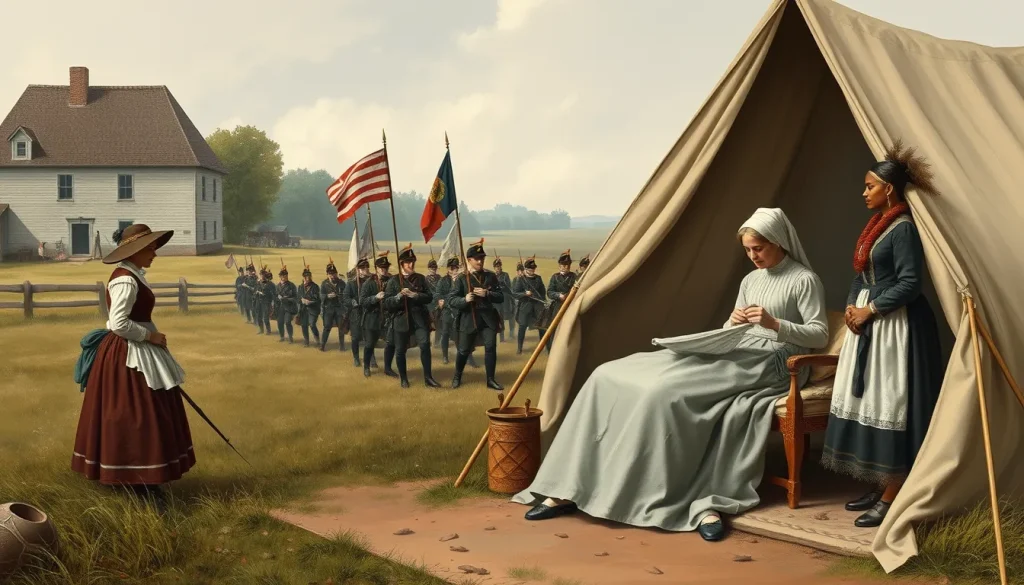
The War of 1812 (1812–1815) involved women across North America in ways that were both ordinary and extraordinary, from managing homes and farms in the absence of men to nursing wounded soldiers, conveying intelligence, and even engaging in military defense. Though often overlooked in traditional battle narratives, women’s contributions were essential to the war efforts of the United States, Great Britain, and Indigenous nations, and their experiences reveal much about gender, society, and the conflict’s broader impact.
Historical Context
In the early nineteenth century, American and Canadian women lived under legal and social restrictions that limited their participation in public life. In the United States and British North America, married women typically could not own property, sign contracts, or vote, and they were expected to focus on domestic duties. However, the war’s disruptions forced many women into new responsibilities. During the preceding decades, an ideology of “republican motherhood” had emerged after the American Revolution, emphasizing women’s role as moral guardians and educators of citizens, yet still confining them to the private sphere. The War of 1812, like most conflicts, destabilized these boundaries, as women took on male-coded tasks to sustain their families and communities. Indigenous women, whose societies often had distinct gender roles, also experienced the war differently, with some participating in diplomatic and military activities. The conflict was fought primarily along the U.S.-Canadian border, the Chesapeake Bay, and the Gulf Coast, exposing women in those regions to invasion, occupation, and destruction.
What Happened
Women’s experiences during the war varied by region, race, class, and proximity to fighting. On the home front, wives and mothers assumed responsibility for farms, shops, and plantations when their husbands enlisted or were killed. In Upper Canada, women filed war loss claims to compensate for property destruction and to rebuild their lives. Some women directly aided military efforts. Laura Secord, a Canadian settler, famously walked miles to warn British forces of an impending American attack in 1813, helping to enable the victory at Beaver Dams. In the United States, First Lady Dolley Madison’s rescue of George Washington’s portrait from the White House in 1814 became a symbol of national preservation. Mary Pickersgill sewed the large American flag that flew over Fort McHenry, inspiring Francis Scott Key’s anthem. Women also served as nurses: Elizabeth Warner Sands tended wounded soldiers after the Battle of North Point, and others like her worked in makeshift hospitals. Enslaved women faced unique hardships; some, like Lucy Hall, escaped to British lines in search of freedom, as the British offered emancipation to those who fled American masters. Free Black women also contributed, such as Grace Wisher, an indentured servant believed to have helped sew the Star-Spangled Banner. Meanwhile, Indigenous women, such as those among the Mohawk and other nations, supported their communities through the war, often providing food and intelligence, and some participated in councils and ceremonies. In the Chesapeake, women reportedly helped defend towns, as with Kitty Knight who persuaded British officers to spare her home and a neighbor’s. Throughout the conflict, women faced violence, displacement, and economic hardship, but they also demonstrated resilience and agency, as revealed in diaries, letters, and official records.
Why It Matters
The war’s immediate effects on women included economic dislocation, the loss of family members, and the destruction of homes, but it also opened new opportunities for self-reliance and public engagement. In the postwar years, many women returned to domestic roles, yet their wartime contributions became a point of pride and sometimes a claim for expanded rights. Historians have debated the extent to which the war constituted a turning point for women. Some argue that women’s actions were extraordinary and helped define national identities, while others contend that their efforts were reinterpreted through a domestic lens that minimized their agency. The memory of women like Laura Secord and Dolley Madison has been shaped by later generations, often obscuring the broader realities of women’s work and suffering. Studying women during the War of 1812 challenges traditional military history and reveals how gender structured both the experience and the memory of the conflict.
Definition: Women’s Roles in the War of 1812
Women’s roles encompassed all activities that supported the war effort or maintained civilian life during the conflict, excluding actual combat (though a few women did fight). These roles included managing farms and businesses, producing goods, nursing soldiers, spying, and defending property. Because women’s legal status was restricted, their contributions often went unrecorded or were attributed to male relatives. The term “women” here includes American, British/Canadian, Indigenous, enslaved, free Black, and white women of various socioeconomic backgrounds.
Background: Gender Ideology and the Revolution’s Legacy
In the decades before the war, gender roles in the United States and British North America became more rigidly defined. The American Revolution had highlighted women’s contributions as mothers and “republican wives” who raised virtuous citizens, but it did not grant them political rights. After the Revolution, a retreat from women’s wartime participation occurred, reinforcing the notion that women’s proper place was in the home, dependent on men for protection. This ideology shaped expectations during the War of 1812, yet the war’s demands forced a practical reality that often contradicted these ideals.
How Women Participated: Daily Life and Wartime Work
Women’s participation took many forms. On the farm, they planted and harvested crops, managed livestock, and made cloth and clothing for soldiers. In towns, they ran shops and inns, often taking over businesses from absent husbands. Some followed armies as camp followers, providing laundry, cooking, and nursing services. Others served as scouts and messengers, like Laura Secord. Women also produced munitions, rolled cartridges, and sewed flags. In the Chesapeake, enslaved women such as Hetty Boulden reportedly helped protect communities from British attacks. Women’s work was essential to sustaining both civilian morale and military logistics.
Competing Viewpoints: Victims, Patriots, and Agents
Historians have interpreted women’s roles differently. Early nationalistic histories often portrayed women as passive victims or as patriotic heroines who performed exceptional deeds. Modern scholarship, however, emphasizes women as active agents who navigated and sometimes manipulated gender norms to achieve their goals. Some argue that women’s contributions were not extraordinary but were embedded in everyday practices of survival and care, which were essential to the war effort. Others point to the limitations of the sources, which often omit the experiences of marginalized women, leading to an incomplete picture. Debates also center on whether the war had lasting effects on women’s status, with some historians seeing little change and others identifying early seeds of women’s rights activism.
Role in the War of 1812: Specific Contributions Across Theaters
Women’s roles varied by geography and conflict intensity. Along the Niagara frontier, women in Upper Canada endured raids and occupied towns, filing claims that document their efforts to rebuild. In the Chesapeake region, women witnessed naval engagements and British invasions, with some like Mary DeButts recording events from their homes. In the American interior, Indigenous women supported their nations’ diplomatic and military efforts, often participating in rituals that prepared warriors for battle. Women in the southern frontier faced raids by both American and British forces. The war also affected enslaved women who sought freedom by joining British lines, a significant but often overlooked dimension of the conflict.
Consequences and Historical Interpretation
The war’s end in 1815 restored prewar boundaries but not prewar conditions. Women’s wartime experiences contributed to a sense of national identity in both the United States and Canada, yet their contributions were largely forgotten in official histories until the twentieth century. The rise of women’s history in the late twentieth century brought new attention to these forgotten figures. Today, scholars recognize that women were not peripheral to the War of 1812 but central to its story, and their experiences offer insights into the social and gendered dimensions of early American and Canadian history.
Primary Sources
Key primary sources include letters and diaries, such as Dolley Madison’s letter to her sister describing the escape from the White House, and Margaret Bayard Smith’s journal accounts of the British attack on Washington. Newspaper obituaries, like that of Elizabeth Warner Sands, attest to women’s nursing roles. Upper Canadian war loss claims provide detailed records of women’s property ownership and financial management. Enslaved and free Black women’s voices are scarcer, but British military records list escaped slaves who settled in Nova Scotia. Indigenous women’s perspectives are rarely recorded directly, but oral traditions and later testimonies offer some insight. These sources must be read critically, as they often reflect the biases of literate elite women or the colonial authorities who recorded them.
Further Reading
- Hickey, Donald R. The War of 1812: A Forgotten Conflict. University of Illinois Press, 1989.
- Oosterom, Nelle. “Women of 1812.” Canada’s History, July 17, 2013.
- Bolcevic, Sherri Quirke. “Rhetoric and Realities: Women, Gender, and War during the War of 1812 in the Great Lakes Region.” MA thesis, Bowling Green State University, 2015.
- “Women in the Chesapeake Region during the War of 1812.” National Park Service, Star-Spangled Banner National Historic Trail.
- “Fortitude and Resolution: Women of Niagara and the War of 1812.” PhD diss., George Mason University, 2021.
References
- Ruggiero, Anthony. “Women’s Roles in the War of 1812.” National Women’s History Museum. Accessed 2025. https://www.womenshistory.org/resources/lesson-plan/women-in-the-war-of-1812.
- Oosterom, Nelle. “Women of 1812.” Canada’s History. July 2013. https://www.canadashistory.ca/explore/women/women-of-1812.
- National Park Service. “Women in the Chesapeake Region during the War of 1812.” Accessed 2025. https://www.nps.gov/stsp/learn/historyculture/women-in-chesapeake-during-the-war-of-1812.htm.
- “Fortitude and Resolution: Women of Niagara and the War of 1812.” George Mason University, 2021. https://doi.org/10.13021/mars/5089.
- Bolcevic, Sherri Quirke. “Rhetoric and Realities: Women, Gender, and War during the War of 1812 in the Great Lakes Region.” Bowling Green State University, 2015. http://rave.ohiolink.edu/etdc/view?acc_num=bgsu1407847108.
FAQ
What did women do during the War of 1812?
Women managed farms and businesses, served as nurses and spies, sewed flags and uniforms, and sometimes defended their homes and communities from enemy attacks.
Who were some notable women of the War of 1812?
Notable women include Laura Secord, Dolley Madison, Mary Pickersgill, Elizabeth Warner Sands, and Kitty Knight, among others.
How did the war affect women's lives after 1815?
Some women gained economic independence briefly, but most returned to domestic roles. The war's memory shaped later movements and historical recognition of women's wartime contributions.
Leave a Reply