Short Answer
Indigenous women in the War of 1812 (1812–1815) were members of Native nations in northeastern North America and the Great Lakes region who contributed to the conflict as military laborers, suppliers, travelers, caregivers, and, in some cases, combatants. Their service is documented most clearly among Haudenosaunee (Iroquois) women from New York, several of whom received pensions for official duties classified as “cook.” Their experiences reveal both the breadth of Indigenous involvement in the war and the limits of records that often filtered women’s labor through colonial categories.
Historical Context
The War of 1812 grew out of tensions between the United States and Great Britain over maritime rights, trade, and American expansion into lands held or claimed by Indigenous nations. For many First Nations and Native American communities, the conflict was also a continuation of earlier struggles to preserve territory and political autonomy. In the Great Lakes and Ohio Valley, leaders such as the Shawnee chief Tecumseh sought to build an intertribal confederacy against American expansion; in the Northeast, the Haudenosaunee Confederacy divided, with some nations and individuals supporting the United States, others Britain, and some trying to remain neutral. The Canadian Encyclopedia notes that most First Nations strategically allied with Britain, viewing the British as the lesser of two colonial evils and the power most interested in maintaining traditional territories and trade.
Indigenous women entered the war from societies with their own gender systems. Among the Haudenosaunee, women had significant agricultural responsibilities, held influence in clan and community decisions, and in some contexts could exert political authority. These roles differed sharply from the Anglo-American ideal that confined women to domestic life and defined warfare as exclusively male. During the American Revolution, Haudenosaunee women had sometimes accompanied warriors and supplied them; one later account describes Dolly, wife of Oneida leader Captain Honyere, fighting alongside him at Oriskany. By 1812, such precedents shaped expectations that women might again support war efforts, even if military records rarely described their work in detail.
The war’s geography also mattered. Campaigns along the Niagara River, the Great Lakes, and the St. Lawrence Valley moved through Indigenous homelands. When warriors left villages for distant campaigns, women managed households, produced food and clothing, and sometimes traveled to military posts. The movement of armies created demand for cooks, laundresses, nurses, and transport workers—roles that colonial officials often recorded without acknowledging Indigenous women’s broader skills or community standing.

What Happened
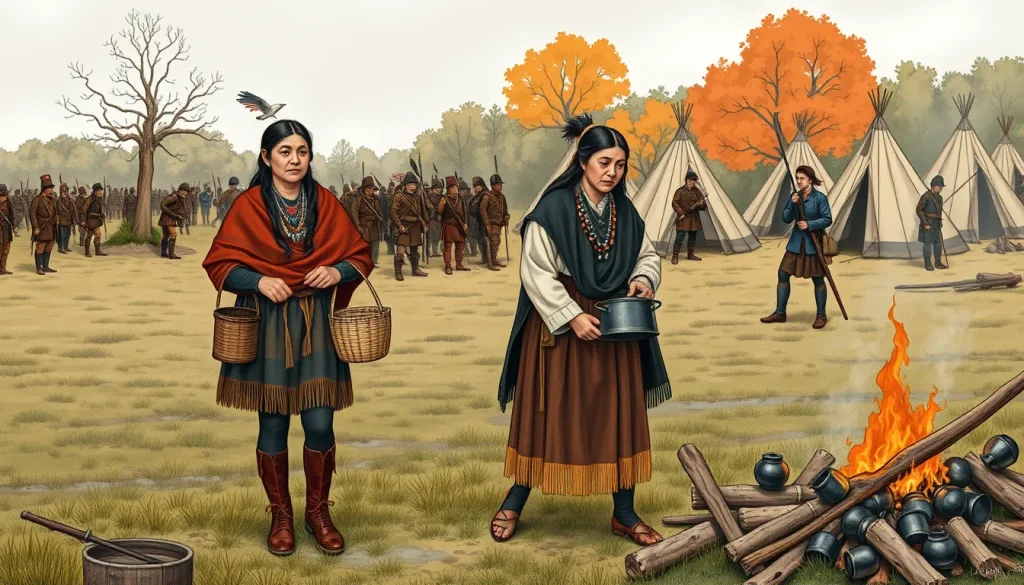
Evidence for Indigenous women’s participation is uneven. The clearest documentation comes from New York State records relating to Haudenosaunee women who served with American volunteer regiments on the Niagara frontier. According to Laurence M. Hauptman’s study in NMAI Magazine, Arthur C. Parker, a Seneca museologist, later claimed that fifteen Native women from New York served in the War of 1812. Records in the New York State Archives identify five women, or their families, who received military pensions for officially serving as “cooks”: Polly Cooper, Susan Jacob(s), Dinah John, Julia John, and Dolly Schenandoah.
These women enlisted or were attached to regiments of “Indian volunteers” under Haudenosaunee leaders. Polly Cooper, age 31, enlisted for three months in September 1813 in a regiment headed by Captain Peter Elm under the overall command of Seneca chief Farmer’s Brother. Dolly Schenandoah, an Oneida aged 29, enlisted for three months in June 1813 in the same regiment. Susan Jacob(s), a 20-year-old Onondaga from the Buffalo Creek Reservation, enlisted for three months in a regiment headed by the Onondaga chief Captain Cold, also under Farmer’s Brother. Julia John, a 25-year-old Seneca from the Allegany Reservation, enlisted for one year in December 1813 in a regiment headed by Governor Blacksnake, the Allegany Seneca chief, again under Farmer’s Brother.
Their later compensation claims reveal the physical distance and material costs of service. Polly Cooper sought reimbursement in 1857 for a hat, leggings, a dress, two blankets, moccasins, and a neckerchief, as well as $22 for 400 miles of transportation between the Oneida Reservation and the Niagara frontier. Dolly Schenandoah’s relatives sought $38 after her death in 1837, including $10 for round-trip travel of 400 miles from Oneida to Buffalo. Julia John sought $46, but only $4 for 140 miles from Allegany to the Niagara frontier. These claims show that women traveled long distances, provided their own clothing and equipment, and performed labor that the military categorized narrowly as cooking.
Dinah John, an Onondaga, became the best known of these pensioners. A prominent basketmaker and potter, she was one of the first Haudenosaunee women portrayed in portraiture. In 1876 the Syracuse photographer Philip S. Ryder photographed her; a painted copy hangs in the Onondaga Historical Association. Widely known as “Aunt Dinah,” she was described in Thomas Donaldson’s 1892 federal census publication Six Nations of New York as an aged but vital figure. Her fame, however, came long after her wartime service and illustrates how Indigenous women’s contributions were remembered through later local memory as much as through military records.
Beyond these documented Haudenosaunee cases, Indigenous women across the Great Lakes and Canadian borderlands contributed in less visible ways. They worked in camps, prepared and transported food, sewed and repaired clothing, nursed the sick and wounded, and maintained households and villages when men were absent. Some may have taken part in combat or scouting, but the surviving evidence is thin and often filtered through non-Indigenous observers. Historians therefore distinguish between documented service, plausible participation, and later tradition.
Why It Matters
The history of Indigenous women in the War of 1812 matters because it challenges the assumption that the war was fought only by male warriors and soldiers. Pension records, compensation claims, and later accounts show that Indigenous women were part of the logistical and social infrastructure of the conflict. Their service helped armies move, eat, and survive, and it sustained Indigenous communities under pressure. At the same time, the label “cook” in official records can obscure the range of labor and knowledge women provided.
For historians, these records also expose the limits of the archive. Military and pension documents were created by colonial and state institutions that had their own categories and biases. They rarely recorded Indigenous women’s own understandings of their roles. The result is a history that must be reconstructed from fragments: enlistment dates, payment claims, travel distances, portraits, and oral or local traditions. Later writers, including Arthur C. Parker and twentieth-century historians, expanded the picture, but their claims must be weighed against the surviving documentation.
The topic also connects to broader questions about Indigenous resilience. During and after the war, Haudenosaunee and other Indigenous nations faced land loss, political division, and pressure to assimilate. Women’s postwar compensation claims and their continued roles as culture bearers—craftworkers, knowledge keepers, and community leaders—show adaptation and persistence. The war did not end Indigenous sovereignty or identity, even as it narrowed the diplomatic and military options of many nations.
Definition
“Indigenous women in the War of 1812” refers to Native women from nations in the northeastern United States and British North America who participated in or supported the conflict between the United States and Great Britain from 1812 to 1815. The category includes women who enlisted or were attached to military units, worked in camps and forts, supplied food and clothing, transported goods, nursed the wounded, maintained Indigenous households and villages, and in some cases may have fought. The most detailed evidence concerns Haudenosaunee women from New York, but the subject also encompasses women from First Nations and Métis communities in the Great Lakes and St. Lawrence regions.
Background
Before 1812, Indigenous societies in eastern North America had experienced decades of war, displacement, and treaty loss. The American Revolution divided the Haudenosaunee Confederacy and forced many communities to relocate. The Treaty of Paris of 1783 ignored Indigenous land rights and opened western territories to American settlement. In response, Indigenous leaders sought new alliances and confederacies to resist expansion. At the same time, colonial gender ideologies increasingly defined women’s proper place as domestic, while Indigenous gender systems often gave women economic and political responsibilities that Europeans and Americans did not recognize. These different expectations shaped how Indigenous women’s wartime work was used, recorded, and remembered.
How It Worked
Indigenous women’s participation operated through both formal and informal channels. In the American volunteer regiments on the Niagara frontier, some Haudenosaunee women were enrolled as “cooks” and later claimed pensions or compensation. This official status gave them a recognized place in military logistics, but it also narrowed their roles in the documentary record. Women traveled dozens or hundreds of miles to reach camps, carried or procured their own clothing and supplies, and performed labor that kept soldiers fed and equipped. In their home communities, women managed farms, produced food, and maintained kinship networks when men were away. On the British-allied side, Indigenous women similarly supported warriors and British forces through camp labor and supply, though fewer names survive in accessible records.
Competing Viewpoints
Historians disagree about how to characterize Indigenous women’s wartime roles. One view emphasizes the evidence of official service and argues that women’s contributions were more extensive than the label “cook” suggests. Laurence M. Hauptman notes that Haudenosaunee women had fought and supplied warriors in earlier conflicts, making it plausible that some did more than cook in 1812. Another view, represented by Sherri Quirke Bolcevic’s study of gender and war in the Great Lakes region, argues that women generally participated “by any means that they were permitted,” and that their actions were often reinterpreted through a domestic lens that minimized their public roles. A more cautious position holds that combat participation by Indigenous women in 1812 is possible but not well documented, and that historians should not overstate the evidence. These interpretations differ because the sources are fragmentary and because later national and gender narratives have shaped how the war is remembered.
Role in the War of 1812
Indigenous women’s roles were part of the wider Indigenous war effort. In the Northeast, Haudenosaunee women supported American volunteer regiments during the Niagara campaigns, as the pension records show. Their service coincided with the divided loyalties of the Six Nations, some of whose warriors fought for the United States, some for Britain, and some tried to avoid the conflict. In the Great Lakes, where Tecumseh and other leaders allied with Britain, Indigenous women sustained communities and supplied warriors, even when their individual names were not recorded. The war’s outcome—secured by the Treaty of Ghent in 1814 and followed by American and British consolidation—left Indigenous nations without the diplomatic guarantees they had sought, making women’s postwar resilience all the more significant.
Consequences and Historical Interpretation
In the immediate aftermath, Indigenous women’s wartime service rarely brought public recognition. Some Haudenosaunee women or their families pursued compensation decades later, using pension and claims processes to document their labor. These claims are now among the most valuable sources for the subject. In the longer term, histories of the War of 1812 tended to celebrate male generals and warriors, while women appeared as victims, camp followers, or occasional heroines. Since the late twentieth century, historians of gender and Indigenous studies have worked to recover women’s contributions and to place them within Native systems of kinship, economy, and diplomacy. The result is not a simple story of heroism but a complex record of service, survival, and contested memory.
Primary Sources
The most direct evidence includes War of 1812 pension and compensation records held by the New York State Archives. These documents list Haudenosaunee women such as Polly Cooper, Susan Jacob(s), Dinah John, Julia John, and Dolly Schenandoah as “cooks” and record their enlistment dates, units, and later claims for clothing and travel expenses. They are essential because they establish names, dates, and payments, but they are also limited: they were created by state and military officials, use colonial categories, and rarely preserve the women’s own voices.
Later accounts and collections provide additional information. Philip S. Ryder’s 1876 photograph of Dinah John and the painted copy at the Onondaga Historical Association document her later fame as a basketmaker and community elder. Thomas Donaldson’s Six Nations of New York (1892), a federal census publication, described Dinah John in old age. Arthur C. Parker’s early twentieth-century writings claimed that fifteen Native women from New York served in the war; this is a later interpretation rather than a contemporary record and should be treated as such. British and Canadian military and war-loss records for the Niagara and Great Lakes regions can also contain information about women’s wartime activities, but Indigenous women are often difficult to identify by name within them.
Further Reading
- Laurence M. Hauptman, “They Also Served: American Indian Women in the War of 1812,” NMAI Magazine, Fall 2015.
- Sherri Quirke Bolcevic, “Rhetoric and Realities: Women, Gender, and War during the War of 1812 in the Great Lakes Region,” Bowling Green State University thesis, 2015.
- “First Nations and Métis Peoples in the War of 1812,” The Canadian Encyclopedia.
- “Fortitude and Resolution: Women of Niagara and the War of 1812,” George Mason University dissertation, 2021.
- Carl Benn, The Iroquois in the War of 1812 (University of Toronto Press, 1998).
- Alan Taylor, The Civil War of 1812: American Citizens, British Subjects, Irish Rebels, and Indian Allies (Knopf, 2010).
- New York State Archives, War of 1812 pension and bounty land records.
- Onondaga Historical Association, Syracuse, New York.
References
- Laurence M. Hauptman, “They Also Served: American Indian Women in the War of 1812,” NMAI Magazine, Fall 2015. https://www.americanindianmagazine.org/story/they-also-served-american-indian-women-war-1812
- Sherri Quirke Bolcevic, “Rhetoric and Realities: Women, Gender, and War during the War of 1812 in the Great Lakes Region,” Bowling Green State University, 2015. http://rave.ohiolink.edu/etdc/view?acc_num=bgsu1407847108
- Sharon Adams, “Double Duty,” Legion Magazine, July 4, 2022. https://legionmagazine.com/double-duty-2/ (Used for context on women’s wartime roles; its principal examples are non-Indigenous women.)
- “Fortitude and Resolution: Women of Niagara and the War of 1812,” George Mason University, 2021. https://doi.org/10.13021/mars/5089
- “First Nations and Métis Peoples in the War of 1812,” The Canadian Encyclopedia. https://thecanadianencyclopedia.ca/en/article/first-nations-in-the-war-of-1812
FAQ
Did Indigenous women fight in the War of 1812?
Some may have participated in combat or scouting, but the most reliable surviving records document Haudenosaunee women officially serving as cooks and performing supply and transport work. Historians treat combat participation as possible but not well documented.
Who were the documented Haudenosaunee women pensioners?
Polly Cooper, Susan Jacob(s), Dinah John, Julia John, and Dolly Schenandoah are identified in New York State records as women who served as cooks or whose families sought compensation for their service.
Why are their roles often described as cooks?
Military and pension officials used “cook” as an official category. This label could obscure the broader labor—travel, supply, clothing, care—that Indigenous women performed.
What sources tell us about them?
New York State Archives pension records, later writings by Arthur C. Parker, Thomas Donaldson's 1892 Six Nations of New York, and collections of the Onondaga Historical Association. These sources must be read with attention to their colonial and later biases.

Leave a Reply