Short Answer
The War of 1812 saw the employment of conventional field artillery by both the British and American armies, despite popular myths emphasizing riflemen and militia. Artillery crews were organized into company-sized units, trained according to contemporary manuals, and proved effective in major campaigns across the northern border and elsewhere. Understanding their organization and training reveals a professional arm that often out-performed infantry and served as a crucial component of both armies.
Historical Context
When the United States declared war on Britain in June 1812, both nations possessed established artillery systems shaped by European practice. The British Royal Artillery, controlled by the Board of Ordnance, consisted of numbered battalions, each containing up to ten companies; the company, also called a brigade, was the basic tactical unit. The U.S. Army had a smaller regular artillery establishment, but wartime expansion created new regiments. Both systems relied on standardized calibres, notably 6-pounder and 12-pounder guns and 5.5-inch howitzers, ammunition for which was often interchangeable between the belligerents. Tension with Britain in the years before the war prompted American efforts to improve training and equipment, including the adoption of iron cannon for cost reasons.
What Happened
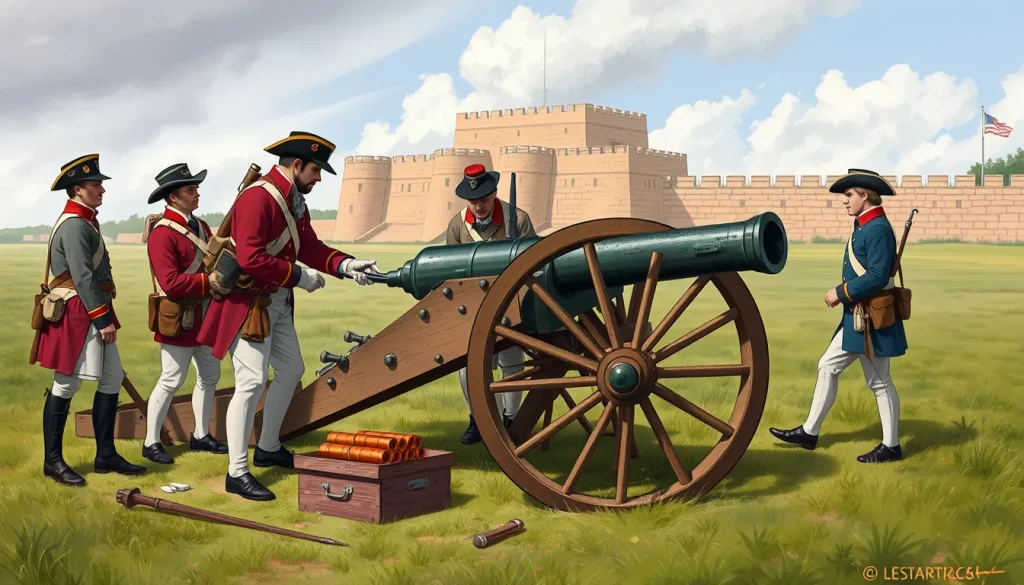
Artillery crews in both armies operated as cohesive teams, typically numbering about 145 officers and enlisted men per British company, plus drivers and horses. The American regular artillery, though smaller per company, followed similar patterns. Crews were composed of gunners and matrosses, with each gun manned by a specific number of men assigned roles such as loading, sponging, and firing. Training was standardized through drill manuals, such as the American Compendious Exercise for the Garrison and Field Ordnance (1810) and the influential works of Kosciuszko, Tousard, and Adye. British crews used manuals from the Royal Artillery. Units drilled in loading and firing procedures until they could execute them by rote, often under fire. The artillery performed exceptionally well during the war, with many American units, such as Winfield Scott’s Second Artillery Regiment, fighting effectively as infantry when needed and providing crucial support in battles like Chippawa and Lundy’s Lane.
Why It Matters
The organization and training of artillery crews determined their battlefield effectiveness, influencing the outcome of engagements and the strategy of commanders. Well-drilled crews could deliver rapid, accurate fire, break up infantry formations, and defend fortified positions. The professionalism of the artillery contrasted with the often poorly trained militia infantry, making it an elite arm. Post-war, both armies drew lessons from the conflict, leading to organizational reforms and continued emphasis on technical training. Historians have increasingly recognized the artillery’s role, moving beyond the myth of the Kentucky rifleman to underscore the importance of regular forces and modern ordnance.

Definition
Artillery crew organization refers to the hierarchical structure and assignment of personnel to operate cannon, howitzers, and other ordnance. Training encompasses the drills, manuals, and procedures used to instruct crews in loading, aiming, firing, and maintaining their pieces, as well as the tactical maneuvering of guns in the field.
Background
European armies in the eighteenth century developed sophisticated systems for field artillery, incorporating gun carriages, standardized calibres, and dedicated crew roles. The French Gribeauval system influenced many nations. Britain’s Royal Artillery adopted its own methods, while the United States initially relied on veterans of the Revolution and borrowed from French and British manuals. By 1812, both nations had formal training texts and official organizations, though American militia artillery often lacked uniform instruction.
How It Worked
Each gun was typically served by a crew of about six to eight men, with a gunner directing the piece and assigning tasks to numbered positions (No.1 through No.6). No.1 and No.2 handled the sponge and rammer, No.3 and No.4 loaded the powder and shot, No.5 tended the vent, and No.6 managed the trail and handspikes. Gunners were often sergeants or corporals with specialized knowledge. Training consisted of constant repetition of loading and firing sequences, using manuals like Stoddard’s Exercise for Garrison and Field Ordnance (1812) or the British Regulations for the Exercise of Field Artillery. Crews drilled in moving guns, laying on targets, and responding to commands. Horses and drivers were essential in field service, though horse artillery was not used in North America; guns were moved by harnessed teams or by manpower in rough terrain.
Competing Viewpoints
Historians debate the relative effectiveness of British versus American artillery. Some argue the British had superior equipment and more experienced personnel, especially after 1813, while others emphasize the American advantage in iron guns and the high quality of West Point-trained officers. A further debate concerns the adequacy of militia artillery: many state units drilled from diverse manuals or lacked formal instruction, leading to inconsistency in performance. However, contemporary accounts generally praise the regular artillery on both sides, while militia gunners were more variable.
Role in the War of 1812
Artillery played a decisive role in several key battles. At the Battle of Chippawa (July 5, 1814), American artillery under Jacob Hindman contributed to the repulse of British forces. At Lundy’s Lane (July 25, 1814), concentrated artillery fire caused heavy casualties on both sides, with each army capturing the other’s guns during the night fighting. In sieges, such as those at Fort Erie and Plattsburgh, artillery crews demonstrated their skill in both attack and defense. The British used Congreve rockets in some actions, though these were less accurate than conventional guns. The artillery also served as infantry during crises, demonstrating the versatility of its well-trained crews.
Consequences and Historical Interpretation
The wartime experience influenced post-war reforms. The American army retained its artillery regiments and gradually adopted standardized manuals, while Britain reorganized its artillery companies and improved training. Later historians, such as Donald E. Graves, have emphasized the professionalism and effectiveness of artillery corps, correcting earlier narratives that downplayed their contribution. The emphasis on technical expertise and discipline in artillery set a precedent for modern military training.
Primary Sources
Amos Stoddard, Exercise for Garrison and Field Ordnance (1812): An official American manual detailing crew roles and loading drills. Stoddard, a major in the U.S. Army, served as a company commander during the war. The manual provides precise instructions for gun detachments, including positions for each numbered man.
Donald E. Graves, “Field Artillery of the War of 1812” (1992): A modern scholarly article that surveys equipment and organization, drawing on primary documents and providing analysis of both armies’ artillery. It appears on the Napoleon Series website.
John R. Grodzinski, “Arms and the Men of the War of 1812” (Canadian Encyclopedia): An overview that describes British artillery organization, including company composition and manpower.
“Compendious Exercise for the Garrison and Field Ordnance” (1810): An official U.S. drill manual published by the Senate, containing drills and safety instructions. It illustrates the official attempt to standardize militia training.
These sources are valuable but must be read critically: some military manuals contain idealized procedures not always followed under combat, and modern accounts may reflect later interpretations.
Further Reading
- Graves, Donald E. “Field Artillery of the War of 1812: Equipment, Organization, Tactics and Effectiveness.” Arms Collecting 30, no. 2 (1992): 39-48.
- Grodzinski, John R. “Arms and the Men of the War of 1812.” The Canadian Encyclopedia, 2011.
- Birkhimer, William E. Historical Sketch of the Organization, Administration, Material and Tactics of the Artillery, United States Army. New York: Greenwood Press, 1968 [1884].
- Hickey, Donald R. The War of 1812: A Forgotten Conflict. Urbana: University of Illinois Press, 1989.
References
- Graves, Donald E. “Field Artillery of the War of 1812: Equipment, Organization, Tactics and Effectiveness.” Arms Collecting 30, no. 2 (1992): 39-48. Reproduced at The Napoleon Series, https://www.napoleon-series.org/military-info/Warof1812/2009/Issue12/c_Artillery.html.
- Grodzinski, John R. “Arms and the Men of the War of 1812.” The Canadian Encyclopedia, March 22, 2011. https://prod-front.thecanadianencyclopedia.ca/en/article/arms-and-the-men-of-1812.
- Stoddard, Amos. Exercise for Garrison and Field Ordnance. New York: Pelsue & Gould, 1812. Digitized at http://www.kelloggscompany1812.org/Docs/Stoddards_Garrison_Manual.pdf.
- Graves, Donald E. “For want of this precaution so many Men lose their Arms: Official, Semi-Official and Unofficial American Artillery Texts, 1775-1815.” Parts 9-10. The Napoleon Series, 2011. https://www.napoleon-series.org/military-info/Warof1812/2011/Issue15/c_Artillery9.html; https://www.napoleon-series.org/military-info/Warof1812/2011/Issue15/c_Artillery10.html.
FAQ
How many men typically served an artillery piece in the War of 1812?
A standard field gun crew numbered about six to eight men, with each man assigned a specific task such as loading, sponging, or firing. British companies had roughly 145 officers and men for four to six guns, while American companies were similarly organized but often smaller.
What manuals were used to train artillery crews?
The British used official Royal Artillery regulations, while Americans relied on manuals by Kosciuszko, Tousard, and the official Compendious Exercise (1810) and Stoddard's Exercise (1812). Officers also consulted Adye's Pocket Gunner for practical guidance.
How well did artillery perform in the war?
Both regular artillery arms performed effectively, frequently proving vital in battles like Chippawa and Lundy's Lane. Gun crews were often better trained than infantry, and some units fought as infantry when needed, demonstrating versatility.
Did the United States use iron or brass cannon?
The United States cast most of its field artillery in iron during the War of 1812, due to cheap domestic ore and the high cost of copper and tin for bronze. Britain used bronze (brass) guns, which were lighter but prone to drooping after heavy use.
Leave a Reply