
Short Answer
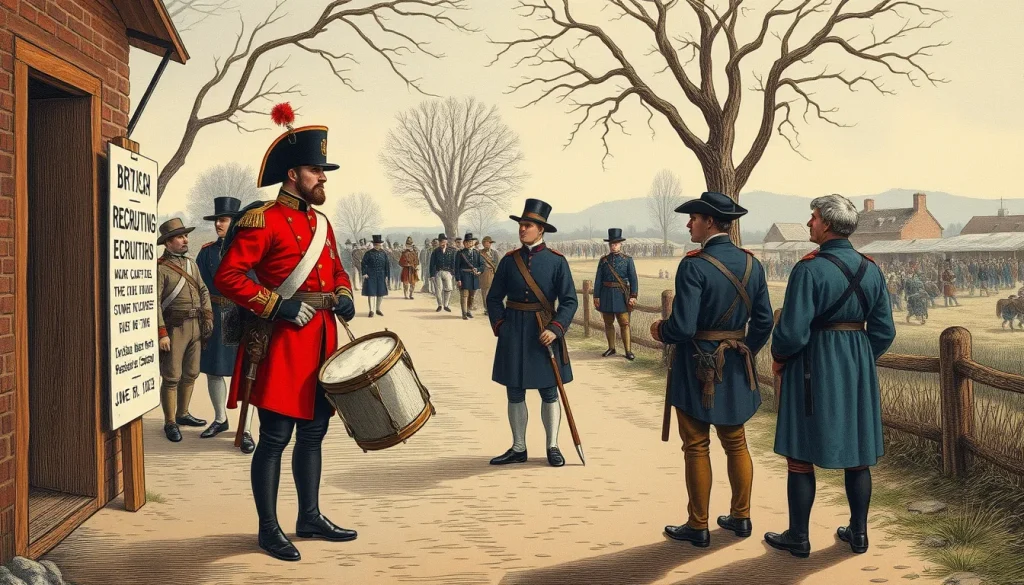
Recruitment for the War of 1812 (1812–1815) involved a patchwork of voluntary enlistment, obligatory militia service, and targeted incentives, reflecting the limited standing armies and decentralised military structures of the early nineteenth century. Both the United States and Great Britain struggled to fill their ranks, relying heavily on state or provincial militias and, in the British case, on Indigenous allies. The methods of recruitment shaped the war’s tactics, outcomes, and the long-term development of military institutions in North America.
Historical Context
The end of the American Revolution left the United States with a tiny regular army, never exceeding a few thousand in peacetime. The British Empire maintained a professional army but had to raise forces for North American service while also fighting Napoleon in Europe. Both governments depended on militias—citizen soldiers liable for local defence—though the legal and practical frameworks varied. In the United States, the Militia Act of 1792 required all able-bodied white male citizens to enroll in state militias, but training and equipment were inconsistent. In British North America (now Canada), the colonial governments maintained their own militias, and the British regular army supplied the core of professional troops. Indigenous nations, including the Haudenosaunee, Shawnee, and Creek, entered the war as allies rather than formal soldiers, and their recruitment was a matter of diplomacy and alliance rather than conscription.
What Happened
As war approached, the U.S. Congress expanded the regular army to roughly 35,000 men, but voluntary enlistment lagged. In 1812 and 1813, recruiting officers offered bounties (cash payments) and land grants to induce enlistment. State militias were called out for federal service, but many militiamen refused to cross the Canadian border, citing constitutional limits. For example, during the Niagara campaign, militia units under Major General Phineas Riall refused to advance. To address shortfalls, the U.S. government in 1814 authorised the enlistment of free Black men, and in 1815 Congress debated a federal draft, though the war’s end precluded its implementation. The British army recruited in Britain and Ireland, sending regular regiments to Canada, while also raising ‘fencible’ units and Canadian militia. The colonial governments offered bounties and enforced militia musters. Indigenous recruitment was led by British Indian Department officers, who distributed gifts and negotiated alliances; Tecumseh’s confederacy, for instance, was a crucial ally. The war also saw American use of privateers and naval impressment, but the focus here is on land soldiers.
Why It Matters
Recruitment difficulties directly influenced the war’s outcome. American militia unreliability hampered campaigns in Canada, while British reliance on Indigenous and Canadian forces shaped frontier warfare and post-war relations. The war prompted later military reforms, including a more professional standing army in the United States and the development of a distinct Canadian military identity. Historians debate the relative effectiveness of volunteers versus militia, and the role of Indigenous allies in the conflict.
Definition
Soldier recruitment in the War of 1812 refers to the methods used by the United States, British Empire, and Indigenous nations to obtain military personnel, including voluntary enlistment, mandatory militia service, conscription alternatives like bounties and substitutes, and alliance-based recruitment among Indigenous peoples.
Background
The eighteenth-century military systems of Western Europe and North America combined long-service regulars with occasional militia levies. By the early 1800s, the British army was a professional force, recruited through voluntary enlistment with bounties, and supplemented by local militias. The United States had a similar but smaller regular army and relied heavily on state militias. The Napoleonic Wars stretched British manpower, while the United States faced a shortage of trained officers and enlisted men. Indigenous nations had their own military traditions and were often recruited through diplomatic incentives and trade relationships.
How It Worked
In the United States, regular army recruitment proceeded through voluntary enlistment, with agents receiving bounties for each recruit. Militia service was compulsory for all able-bodied men, but units were under state control until federalised. Volunteers for federal service could receive bounties, but many demanded higher pay. The British army recruited through similar methods: beating orders and recruiting parties, offering bounties and a limited period of service. In Canada, colonial legislatures passed Militia Acts that required service from all adult men, subject to exemptions and fines. Indigenous recruiting was conducted through the Indian Department, which presented gifts and engaged in diplomatic councils to secure warriors. A pressing issue was the use of substitutes—whereby a man could pay another to serve in his place—and the payment of bounties that some criticised as coercive to the poor.
Competing Viewpoints
American leaders disagreed on the reliability of militia. Federalists feared a large standing army, while Republicans preferred militia but soon discovered its limitations. British officers, like Sir George Prevost, valued Indigenous allies but also faced ethical and strategic questions about their use, especially after the burning of the Niagara frontier. Indigenous leaders saw the war as a defence of their homelands, not as soldiers for the British, and their recruitment reflected complex alliances that shifted over time.
Role in the War of 1812
Recruitment directly affected major operations. American failures at Queenston Heights, Detroit, and other actions were partly due to militia refusal to serve abroad. British and Canadian successes often hinged on the combination of regulars, militia, and Indigenous warriors. The U.S. military’s inability to maintain a strong regular force led to a reliance on militia that frustrated strategic goals. By 1814, both sides had exhausted many manpower resources and sought peace, partly due to recruitment fatigue.
Consequences and Historical Interpretation
The war exposed weaknesses in American militia and regular recruitment, leading to post-war expansion of the U.S. Army and the establishment of a more professional officer corps. In British North America, the war fostered a sense of Canadian identity and strengthened colonial militia institutions. Historians have debated the effectiveness of Indigenous recruiting, the reasons for American enlistment reluctance, and the impact of bounties on social class. Modern scholarship emphasises the complex interactions among regulars, militia, and Indigenous forces, rejecting earlier nationalistic narratives.
Primary Sources
Primary sources include U.S. War Department record books and recruiting broadsides, British army muster rolls and recruiting orders, and Canadian militia lists. The correspondence of military commanders, such as Major General Isaac Brock and Secretary of War John Armstrong, reveal recruitment challenges. Indigenous perspectives are recorded in treaty negotiations and British Indian Department reports, though they are filtered through colonial records.
Further Reading
- Donald R. Hickey, The War of 1812: A Forgotten Conflict (1989).
- Alan Taylor, The Civil War of 1812: American Citizens, British Subjects, Irish Rebels, & Indian Warriors (2010).
- J. Mackay Hitsman, The Incredible War of 1812 (1965).
- Caroline M. Hibbard, Recruiting in Great Britain (Encyclopedia article, 1996).
- William G. Ross, Conscription and Recruitment (Encyclopedia article, 2004).
References
- “Recruiting in Great Britain,” Encyclopedia.com, accessed 2025. https://www.encyclopedia.com/history/encyclopedias-almanacs-transcripts-and-maps/recruiting-great-britain
- “Conscription and Recruitment,” Encyclopedia.com, accessed 2025. https://www.encyclopedia.com/history/dictionaries-thesauruses-pictures-and-press-releases/conscription-and-recruitment
- Tallett, Frank. “Soldiers in Western Europe, c. 1500-1790.” In War and Society in Early-Modern Europe, 2025. https://doi.org/10.4324/9781003695455_ch04
- “Armies: Recruitment, Organization, and Social Composition,” Encyclopedia.com, accessed 2025. https://www.encyclopedia.com/history/encyclopedias-almanacs-transcripts-and-maps/armies-recruitment-organization-and-social-composition
FAQ
Why did the U.S. have trouble recruiting soldiers in the War of 1812?
The United States had a small regular army and relied on state militias, which were often reluctant to serve outside their home states. Bounties were insufficient, and many men preferred to avoid the risks of war.
How did the British recruit Indigenous soldiers?
British Indian Department officers used diplomacy, gift-giving, and treaty alliances to persuade Indigenous nations to fight alongside them. These were alliances, not formal enlistment.
What role did Canadian militia play in the war?
Canadian militia provided crucial local defence and support during key battles like Queenston Heights and Châteauguay, though they were often poorly trained and equipped.
Leave a Reply