
Short Answer
Naval operations on Lake Champlain during the War of 1812 comprised a series of American and British efforts to control the strategically vital lake connecting the Richelieu River to the Hudson River watershed. The central event was the Battle of Lake Champlain, also known as the Battle of Plattsburgh Bay, fought on September 11, 1814, near Plattsburgh, New York. There, a Royal Navy squadron was decisively defeated by a smaller American squadron under Thomas Macdonough, ending the British invasion from Canada and influencing the Treaty of Ghent negotiations.
Historical Context
Lake Champlain formed a natural invasion corridor between British Canada and the United States. Control of the lake allowed an army to move troops and supplies along the strategically important water route connecting the Richelieu River to the St. Lawrence and, via the Lake George-Hudson River portage, to Albany and New York City. During the first two years of the war, both sides engaged in a naval shipbuilding race, aware that naval supremacy on the lake could determine the outcome of any campaign. After the American victory on Lake Erie in 1813, the British shifted their focus to Lake Champlain, while the Americans maintained a small squadron under the command of Master Commandant Thomas Macdonough.
In 1814, with Napoleon’s defeat in Europe, Britain was able to send veteran regulars to Canada. Governor General Sir George Prevost assembled an army of about 10,000 men intended to strike south through Plattsburgh to Albany, isolating New England. Success depended on naval control of the lake, since the army’s flank and supply line would be exposed. The Royal Navy therefore assembled a squadron under Captain George Downie, which was ordered to destroy Macdonough’s force and support the army’s advance.
What Happened
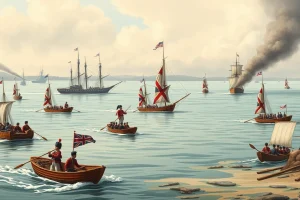
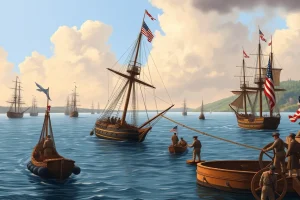
Throughout 1814, both sides worked feverishly to complete ships. Macdonough’s squadron anchored in Plattsburgh Bay, a sheltered anchorage where he hoped to neutralize the British advantage in long guns and use his carronades at close range. On September 11, 1814, Downie’s squadron entered the bay and engaged the American line. The initial exchange was heavily in favor of the British, whose flagship, the frigate Confiance, disabled many American guns. However, Macdonough carried out a risky maneuver, winding his ship by cutting the anchor and using a stern kedge, to bring a fresh broadside to bear on the Confiance. The British flagship surrendered, and by mid-morning the entire British squadron had struck its colors. Prevost, seeing his naval support destroyed, halted his army’s attack and retreated back to Canada.
The American victory at Plattsburgh was decisive. The British land and naval forces were forced to withdraw, ending the invasion threat. The capture of the entire British squadron, and the death of Captain Downie, demoralized the British and contributed to the decision to abandon the campaign.
Why It Matters
The Battle of Lake Champlain is considered one of the most decisive naval actions of the War of 1812. The American victory prevented the British from severing the northern United States and securing a strategic position from which to demand territorial cessions in peace negotiations. The defeat weakened Britain’s bargaining position at Ghent, where negotiators had hoped to establish a boundary along the Great Lakes and Lake Champlain. The battle also demonstrated the effectiveness of defensive anchor tactics and the important role of naval power in continental warfare. In naval history, Macdonough’s maneuver is often cited as a textbook example of tactical resourcefulness under fire.
Prelude
From the outset of the war, both the United States and Great Britain recognized the importance of Lake Champlain. The lake offered a direct invasion route between Canada and New York. In 1812, both sides had only small naval forces on the lake, but by 1813 they began constructing warships at shipyards like Whitehall (U.S.) and St. Jean (Canada). Macdonough took command of the American squadron in 1813 and oversaw the construction of the corvette Saratoga and the sloop Eagle. The British, under Captain Francis Downie, prepared a similar force. By the spring of 1814, the British had a slight advantage in long guns, while the Americans relied more heavily on carronades.
In August 1814, Prevost assembled his army at the Canadian border. American forces at Plattsburgh, under Brigadier General Alexander Macomb, were severely outnumbered, and the American squadron under Macdonough patrolled the lake. On September 11, 1814, Downie’s force arrived off Plattsburgh Bay.
Forces and Commanders
American Squadron (Thomas Macdonough)
- Saratoga – flagship, corvette, 26 guns (including 8 long 24-pounders and 18 carronades)
- Eagle – sloop, 20 guns
- Ticonderoga – schooner, 17 guns
- Preble – sloop, 7 guns
- 10 gunboats, each with 1-2 guns
British Squadron (George Downie)
- Confiance – flagship, frigate, 37 guns (mostly long guns)
- Linnet – brig, 16 guns
- Chub – sloop, 11 guns
- Finch – sloop, 11 guns
- 12 gunboats
Macdonough had approximately 820 men; the British about 880. The key difference was that the British had a larger number of long guns, giving them a longer effective range, while the American squadron had more carronades, powerful at close range.
Battlefield and Map Context
Plattsburgh Bay is a wide bight on the western shore of Lake Champlain, sheltered from the prevailing north winds by Cumberland Head. Macdonough deliberately chose this position because it forced an attacking squadron to approach in a constrained line and reduced the advantage of the British long guns. He anchored his vessels in a north-south line, so that his larger guns faced the expected approach. The bay was also bounded by the shore and the Saranac River, limiting available sea room.
Battle Chronology
At approximately 9 a.m., Downie’s squadron anchored in line ahead and began firing. The British flagship Confiance opened on the Saratoga; the American flagship soon lost several starboard guns. Around 10:30 a.m., the Eagle, having difficulty bringing its guns to bear, cut its cable and shifted position, momentarily exposing the Saratoga. Macdonough then executed his famous wind maneuver: he cut the bow anchor, let out the spring on the stern anchor, and wound the ship 180 degrees, bringing his port broadside to bear on the Confiance. This fresh array of guns forced the Confiance to strike, and within fifteen minutes the Linnet also surrendered. The British gunboats retreated, but the sloops Chub and Finch had been captured earlier. The entire British squadron was taken.
Casualties and Losses
American losses included 52 killed and 58 wounded. British casualties were heavier, with at least 57 killed and 72 wounded, including Captain Downie, who was killed by a cannonball early in the action. Exact numbers vary by source, but the scale of losses on both sides reflects the ferocity of the close-range engagement. The Confiance suffered the heaviest casualties, reportedly losing about half her crew killed or wounded.
Result
The battle was a complete American victory. All four British warships were captured, and the survivors surrendered. The British army, witnessing the naval defeat, abandoned the plan to attack Plattsburgh and retreated to Canada. The American squadron remained in control of Lake Champlain for the remainder of the war.
Strategic Consequences
The victory at Lake Champlain had immediate strategic consequences. It secured the northern frontier of the United States and prevented the isolation of New England. At the peace negotiations in Ghent, the British negotiators had sought territorial cessions based on the principle of uti possidetis. The American victory, along with successful defense at Baltimore and elsewhere, forced Britain to accept the status quo ante bellum. The Treaty of Ghent, signed in December 1814, left boundaries unchanged, in part because the British no longer had a territorial bargaining chip. The battle also restored American naval prestige and validated the strategy of building and fighting on the lakes.
Primary Accounts
Thomas Macdonough’s official dispatch, dated September 11 and 13, 1814, to Secretary of the Navy William Jones, is the principal American account. He described the action and his tactics, noting that the Saratoga came under heavy fire and that he resorted to winding to bring fresh guns to bear. A civilian witness, J. C. Hubbell, described the battle from the shore as “a continuous roar, intermingled with the spiteful flashing from the mouths of guns, and dense clouds of smoke soon hung over the two fleets.” British accounts, including the court-martial proceedings against Prevost, provide a counterpart perspective, though they often emphasize the lack of cooperation between the army and navy.
Battlefield Today
The battle site at Plattsburgh Bay is now part of the Lake Champlain Maritime Museum system and is marked by interpretive displays and monuments. The American squadron’s anchorage area is a National Historic Landmark, and the nearby city of Plattsburgh hosts commemorations. The battlefield remains largely undeveloped, allowing visitors to view the bay and understand the geography of the engagement.
Primary Sources
The most important contemporary document is Macdonough’s official report, printed in the American State Papers and reproduced in documentary collections. It is supplemented by the journal of the American gunboat commander, and by British court-martial records. The Naval Historical Center’s multi-volume Naval War of 1812 documentary history contains transcribed versions of these and other reports. The NPS article quotes Hubbell’s eyewitness description. These sources are available in archives and published editions, and many can be accessed online through the U.S. Navy’s Naval History and Heritage Command.
Further Reading
- Michael J. Crawford, ed., The Naval War of 1812: A Documentary History, Volume III, 1814–1815 (Washington: Naval Historical Center, 2002).
- Willis J. Abbot, The Naval History of the United States, Vol. 2 (New York: Peter Fenelon Collier, 1890).
- Alfred Thayer Mahan, Sea Power in Its Relations to the War of 1812 (Boston: Little, Brown, 1905).
- William B. Skelton, An American Profession of Arms: The Army Officer Corps, 1784–1861 (Lawrence: University Press of Kansas, 1992) – for context on army-navy relations.
References
- “Autumn 1814: The British Navy suffers a decisive defeat at the Battle of Lake Champlain,” U.S. National Park Service, last updated May 24, 2016, https://www.nps.gov/articles/battle-of-lake-champlain.htm.
- “Capture of the British fleet on Lake Champlain,” American State Papers, Navy Department, October 3, 1814, reprinted at ibiblio.org, https://ibiblio.org/pha/USN/1814/18141006Champlain.html.
- H. C. Washburn, “The Battle of Lake Champlain,” U.S. Naval Institute Proceedings, September–October 1914, https://www.usni.org/magazines/proceedings/1914/september/battle-lake-champlain.
- Michael J. Crawford, ed., The Naval War of 1812: A Documentary History, Volume III (Washington: Naval Historical Center, 2002).
- Willis J. Abbot, The Naval History of the United States, Vol. 2 (New York: Peter Fenelon Collier, 1890), ch. 13.
FAQ
What was the significance of the Battle of Lake Champlain?
The American victory prevented the British invasion of northern New York and weakened British territorial claims at the Treaty of Ghent, helping to ensure a return to status quo ante bellum.
Why did the British attack Plattsburgh in 1814?
After Napoleon's defeat, Britain sent veteran troops to Canada. Governor General Sir George Prevost planned to advance down Lake Champlain via Plattsburgh to Albany, cutting off New England and securing a strategic position for territorial demands.
How did Thomas Macdonough achieve victory at Lake Champlain?
Macdonough anchored his squadron in a defensive line and used a wind maneuver—cutting the anchor and using a stern kedge to turn his ship—to bring a fresh broadside to bear on the British flagship, which forced the enemy to surrender.

Leave a Reply