
Short Answer
The Treaty of Ghent, signed on December 24, 1814, ended the War of 1812 between the United States and Great Britain. For the United States, the treaty represented the culmination of nearly three years of conflict that had begun over maritime rights, impressment, and territorial integrity. The American delegation arrived at Ghent with a clear list of war aims, but the final treaty omitted nearly all of them, restoring relations to the pre-war status quo. Understanding what the United States wanted—and why those demands were abandoned—reveals the gap between war objectives and diplomatic reality.
Historical Context
The War of 1812 grew from long-standing grievances against British maritime practices. By 1812, the Royal Navy routinely stopped American ships, seized cargo, and impressed sailors claimed as British subjects—an affront to American sovereignty and commerce. The Orders in Council, which restricted neutral trade with France and its colonies, further damaged American commerce. These issues, combined with British support of Indigenous resistance on the frontier and the desire of some “War Hawks” to annex Canada, led Congress to declare war on June 18, 1812.
By mid-1814, the military situation had turned. The British had defeated Napoleon and could now reinforce their forces in North America. A British army burned Washington in August 1814, but American victories at Baltimore and Plattsburgh in September blunted British momentum. Both sides faced exhaustion: the United States suffered economically from the British naval blockade, while Britain faced mounting public opposition to wartime taxes and had major diplomatic priorities at the Congress of Vienna. These conditions made peace negotiations attractive, and both nations agreed to send delegations to Ghent, Belgium, in July 1814.
What Happened
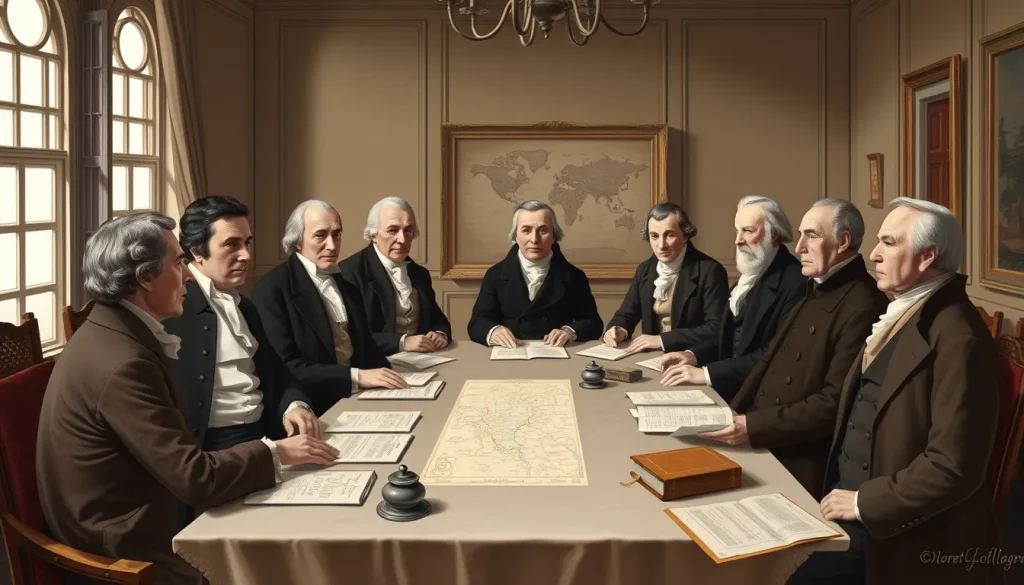
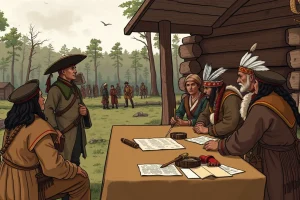
The American delegation consisted of John Quincy Adams, James A. Bayard, Henry Clay, Jonathan Russell, and Albert Gallatin. They received instructions from Secretary of State James Monroe to seek an end to impressment, protection for neutral trade, and restoration of pre-war boundaries—essentially a return to the status quo ante bellum. The British delegation, led by Admiral James Lord Gambier, Henry Goulburn, and William Adams, initially presented far-reaching demands: acknowledgment of British maritime rights, creation of an Indigenous barrier state in the Northwest, territorial concessions in Maine and Minnesota, demilitarization of the Great Lakes, and an end to American fishing privileges.
Negotiations began on August 8, 1814. The Americans flatly rejected the British territorial and Indigenous proposals, viewing the barrier state as a threat to westward expansion. As talks dragged on, the British gradually retreated from their maximalist demands. A crucial factor was the Duke of Wellington’s opinion in November 1814 that Britain could not rightfully demand territorial concessions without controlling the Great Lakes. Moreover, the British government faced domestic pressure against another year of war, which would cost an estimated £10 million. By late December, both sides settled on a simple peace: restoration of all captured territory, return of prisoners, and establishment of commissions to settle boundary disputes. The treaty made no mention of impressment, neutral rights, or Indigenous buffer states—issues that had driven the United States to war.
The final treaty was signed on Christmas Eve 1814. It set a twelve-day waiting period for ratifications, and the British government ratified it on December 27. The treaty then crossed the Atlantic, arriving after the Battle of New Orleans (January 8, 1815). The U.S. Senate unanimously ratified on February 16, 1815, and peace formally took effect on February 17.
Why It Matters
The Treaty of Ghent ended a war that had accomplished none of the United States’ stated objectives. The U.S. failed to secure an end to impressment, gained no concessions on neutral trading rights, and did not acquire any Canadian territory—though the conquest of Canada had never been an official war aim. The treaty restored the status quo ante bellum, which many historians view as a British victory in terms of war aims, because Britain had defended Canada and preserved its maritime policies. However, the war also produced a nationalistic resurgence in the United States and a lasting sense that the republic had held its own against the world’s foremost power.
For Indigenous peoples, the treaty was disastrous. Article IX promised to restore “all possessions, rights, and privileges” enjoyed in 1811, but this provision was never enforced. The United States continued its westward expansion, and Britain’s abandonment of the barrier-state proposal left Indigenous nations without a protector. The treaty’s failure to address these issues has shaped modern interpretations of the war, fueling debates over whether the conflict was a draw, a British victory, or an American moral triumph. The Treaty of Ghent also set precedents: it created commissions to resolve long-standing border disputes, some of which persisted for decades.
Definition
The question “What did the United States want from the Treaty of Ghent?” refers to the war aims and diplomatic objectives that the American peace delegation pursued during the negotiations at Ghent in 1814. These aims derived from the reasons the United States declared war in 1812 and evolved as the military and political landscape changed.
Background
The United States entered the War of 1812 with multiple, sometimes conflicting goals. President James Madison’s war message to Congress on June 1, 1812, cited impressment, violations of neutral commerce, and British interference with American shipping. Congress subsequently declared war, but the war’s aims were not codified in a single document. The administration’s diplomatic instructions, however, consistently emphasized ending impressment, securing neutral trade rights, and restoring the pre-war status quo, which implicitly meant British recognition of American sovereignty. The “War Hawks”—Henry Clay, John C. Calhoun, and other southern and western congressmen—also hoped to annex Canada, though this was never an official administration objective.
How It Worked
At Ghent, the American commissioners operated from instructions that prioritized three goals: 1) an end to impressment, 2) respect for neutral trade under the principle “free ships, free goods,” and 3) restoration of the pre-war territorial boundaries. In practice, the commission quickly realized that impressment was a non-starter—the British viewed impressment as a legal right, and the end of the Napoleonic Wars had reduced its practical significance. By the time talks opened, the Americans privately dropped this demand, focusing instead on preventing territorial losses and protecting American expansion. The British, however, initially demanded a permanent Indian barrier state, which would have created a large buffer zone between the United States and Canada. The Americans rejected this as an infringement on their sovereignty, and after months of back-and-forth, the British withdrew the proposal.
Competing Viewpoints
Historians disagree over how committed the United States was to its declared war aims. Some argue that the war was primarily about impressment and neutral rights, while others emphasize the expansionist ambitions of the War Hawks. In Britain, officials viewed the defense of Canada and maritime supremacy as paramount, and they saw the American war as a minor sideshow to the larger Napoleonic conflict. American Federalists—especially those in New England—opposed the war and sought peace, which influenced the administration’s willingness to compromise. The treaty’s silence on impressment and trade allowed both sides to claim victory, but subsequent interpretations have varied: some scholars label the war a “draw,” while historian Donald Hickey famously called it “a remarkable display of diplomatic failure” for the United States, because none of the original grievances were addressed.
Role in the War of 1812
The U.S. objectives at Ghent were the diplomatic expression of the war’s causes. The failure to achieve them on paper does not mean the war lacked consequences. The American military’s defense at places like Baltimore and Plattsburgh convinced Britain that conquering territory was not worth the cost, while American privateers and naval victories harmed British commerce. The treaty’s return to the status quo ante bellum meant that both sides gave up captured territory, but it did not resolve the fundamental issues of maritime rights or Indigenous sovereignty. The war also strengthened American national identity and gave the United States a sense of international standing, even as it failed to secure its diplomatic objectives.
Consequences and Historical Interpretation
The Treaty of Ghent had immediate consequences: peace, the return of prisoners, and the creation of arbitration commissions for boundary disputes. It also ended the possibility of a British protectorate for Indigenous peoples. Long-term, the war and treaty reshaped American politics—the Federalists’ Hartford Convention discredited them, and the postwar era saw a surge of nationalism and westward expansion. Historians still debate the war’s outcome. American textbooks often portray it as a second war of independence, while British and Canadian historians emphasize the successful defense of British North America. The United States may not have achieved its stated aims, but the war convinced European powers that the young republic was a serious military force. Ultimately, the treaty’s ambiguity allowed both nations to move forward without conceding core principles, but for the United States, the war’s unfulfilled promises remain a central part of its legacy.
Primary Sources
The most important primary source is the Treaty of Ghent itself, signed December 24, 1814. Its full text is available from the U.S. National Archives and other repositories. Another key source is the diplomatic correspondence between the American commissioners and Secretary of State James Monroe, which reveals their instructions and evolving positions. These letters are published in multiple collections, including American State Papers and the Writings of Albert Gallatin. Additionally, the letters of British negotiators, such as Henry Goulburn, offer insight into the British perspective. Limitations: the treaty is a legal document that omits the reasons for its omissions, and the diplomatic correspondence often emphasizes strategic argument rather than personal opinions. Researchers must read these sources alongside later historical analysis to understand the negotiation dynamics.
Further Reading
- Donald R. Hickey, The War of 1812: A Forgotten Conflict (University of Illinois Press, 1989).
- Donald R. Hickey, “Probing for Peace: Weighing the Burdens of War on Two Continents,” National Park Service article (accessed 2023).
- American Battlefield Trust, The Treaty of Ghent: Ending the War of 1812 (2024).
- John Quincy Adams, Memoirs of John Quincy Adams (including his diary during the peace negotiations), ed. Charles Francis Adams.
- “Treaty of Ghent (1814),” U.S. National Archives, Milestone Documents.
References
- U.S. National Park Service, “Summer 1814: Americans and British open peace negotiations at Ghent,” accessed August 2023, https://www.nps.gov/articles/treaty-of-ghent-1.htm.
- Donald R. Hickey, “Probing for Peace: Weighing the Burdens of War on Two Continents,” U.S. National Park Service, accessed August 2023, https://www.nps.gov/articles/probing-for-peace.htm.
- American Battlefield Trust, “The Treaty of Ghent: Ending the War of 1812,” updated April 8, 2024, https://www.battlefields.org/learn/articles/treaty-ghent-ending-war-1812.
- The War of 1812 website, “Treaty of Ghent,” accessed August 2023, https://thewarof1812.org/treaty/.
- U.S. National Archives, “Treaty of Ghent (1814),” accessed August 2023, https://www.archives.gov/milestone-documents/treaty-of-ghent.
FAQ
Did the United States achieve any of its war aims in the Treaty of Ghent?
No. The treaty made no mention of impressment, neutral trading rights, or the Orders in Council. It restored the pre-war boundaries, which was the only U.S. aim that was realized, but that was a return to the status quo, not a concession.
Why did the U.S. drop its demand to end impressment at Ghent?
The end of the Napoleonic Wars made impressment less immediately relevant, and the British refused to consider any restriction on their naval practices. The American commissioners realized that prolonging the war for this demand was not worth the cost and dropped it to secure peace.
What was the Indian barrier state proposal in the Treaty of Ghent negotiations?
Britain proposed creating an independent Indigenous state in the Northwest as a buffer between the U.S. and Canada. The U.S. rejected this, and the British eventually abandoned the proposal, but the treaty's Article IX, which promised restoration of Indigenous lands and rights as of 1811, was never enforced.

Leave a Reply