
Short Answer
John Quincy Adams (1767–1848) was a U.S. commissioner and leading diplomat in the negotiations that produced the Treaty of Ghent, signed on December 24, 1814, in Ghent, then in the Southern Netherlands and now in Belgium. The treaty ended the War of 1812 between the United States and Great Britain but left most of the issues that had caused the war unresolved. Adams’s role as a legally precise, persistent negotiator helped keep a divided American commission together and shaped a peace based on restoring territory rather than redrawing borders.
Historical Context
The War of 1812 grew out of disputes over neutral shipping, the impressment of American sailors, trade restrictions imposed during the Napoleonic Wars, British support for Indigenous resistance in the Great Lakes and Northwest, and American territorial ambitions in British North America and Spanish Florida. The United States declared war on Great Britain on June 18, 1812. Militarily, the conflict soon became a stalemate: American invasions of Canada failed, British offensives into the United States met mixed results, and neither side could force a decisive victory.
In 1814, Napoleon’s abdication allowed Britain to send more experienced troops to North America. British forces raided the Chesapeake, burned public buildings in Washington, and attacked Baltimore and Lake Champlain, while a British expedition moved against New Orleans. At the same time, both governments sought a way out. Earlier Russian mediation efforts gave way to direct Anglo-American talks. The small city of Ghent, in the Low Countries, was chosen as a neutral site, and the American and British commissions arrived in the summer of 1814.
What Happened
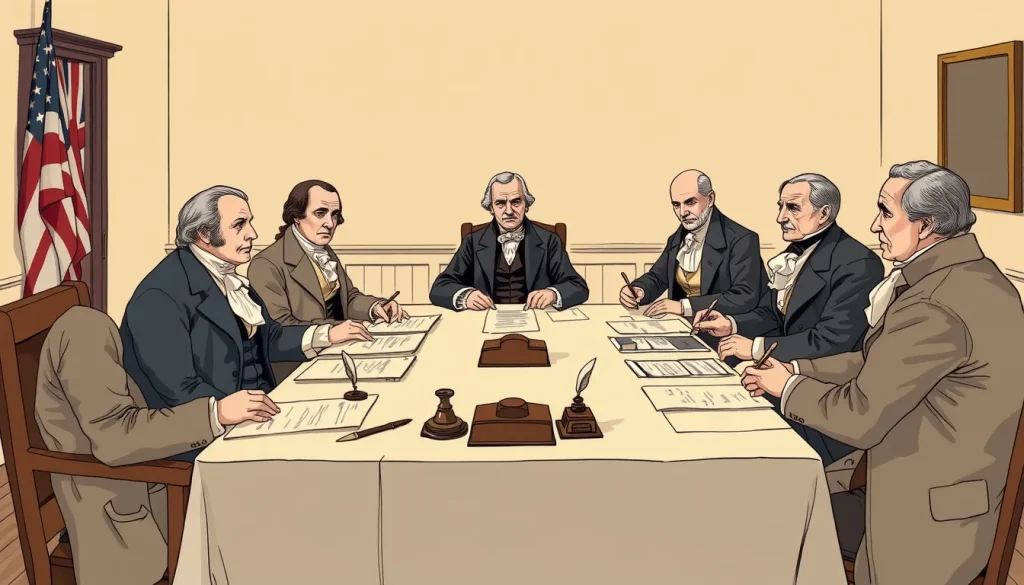
President James Madison appointed John Quincy Adams, then U.S. minister to Russia, to the peace commission. Adams had left St. Petersburg in 1814 and joined Albert Gallatin, Henry Clay, Jonathan Russell, and James A. Bayard at Ghent. The British commission consisted of Admiral James Lord Gambier, Henry Goulburn, and William Adams. The American delegation was talented but deeply divided: Gallatin favored conciliation, Clay was more combative, Bayard was a Federalist, Russell often sided with Clay, and Adams insisted on careful legal language.
At the first substantive meetings in August 1814, the British commissioners presented demands that the Americans rejected as unacceptable. Britain sought uti possidetis—retention of territory actually occupied—a Native American buffer state in the Northwest under British protection, and some control over the Great Lakes. The American commissioners insisted on status quo ante bellum, the restoration of prewar territory and rights. Negotiations stalled for months.
The British position softened in the autumn. The Duke of Wellington advised the British government that it had no right to demand territory from a foreign power merely because it occupied it, and news of British setbacks at Plattsburgh and Baltimore weakened the case for hard terms. On December 24, 1814, the commissioners signed the Treaty of Ghent. Its first article provided for peace and the restoration of captured territory. Prisoners were to be exchanged, boundary disputes were referred to future commissions, and Article IX addressed hostilities with Indigenous nations and promised restoration of their pre-1811 rights, though without creating the buffer state Britain had earlier demanded.
The treaty said nothing about impressment, neutral trade rights, blockade practices, fisheries, or Mississippi River navigation. The British ratified it on December 30, 1814; the U.S. Senate ratified it unanimously on February 16, 1815; ratifications were exchanged the next day. Because communications were slow, the Battle of New Orleans was fought on January 8, 1815, before news of the treaty reached the combatants.
Why It Matters
The Treaty of Ghent ended the war without resolving its stated causes. Immediate consequences included the cessation of fighting, the return of conquests, and the release of prisoners. Longer-term consequences included a series of Anglo-American boundary and arbitration agreements that helped prevent another war. For Indigenous nations, however, the treaty was a serious defeat: despite Article IX, Britain abandoned the idea of a protected Indigenous buffer state, and American expansion continued.
Historians disagree about how to judge the peace and Adams’s role in it. Some portray the treaty as a pragmatic success because the United States escaped a costly war without losing territory. Others emphasize that the failure to address impressment and neutral rights left the underlying disputes formally unresolved, though impressment effectively ended after the Napoleonic Wars. Adams’s own view combined hope and realism: he believed the settlement could become a foundation for lasting peace and hoped it would be "the last treaty of peace between Great Britain and the United States."
Early Life
John Quincy Adams was born on July 11, 1767, in Braintree, Massachusetts, now Quincy. He was the son of John Adams, a leading revolutionary diplomat and later president. As a boy he accompanied his father to Europe, studied at schools and universities there, and at fourteen became private secretary to Francis Dana, the U.S. minister to Russia. He also served as secretary to his father during the negotiation of the Treaty of Paris in 1783. Adams graduated from Harvard in 1787, studied law, and began practicing in Boston in 1790.
Role Before the War
Adams entered public service in 1802 as a Massachusetts state senator and then served as a U.S. senator from Massachusetts from 1803 to 1808. President George Washington had appointed him minister to the Netherlands in 1794, and his father appointed him minister to Prussia in 1797. In 1809 President James Madison appointed him U.S. minister to Russia. From St. Petersburg, Adams observed Napoleon’s invasion of Russia and reported on European diplomacy. His long experience in European courts and treaty negotiations made him a natural choice for the American peace commission.
Role During the War
Adams did not command troops or take part in battles. His wartime service was diplomatic. As minister to Russia, he represented American interests at the Russian court and supported mediation efforts. When direct negotiations with Britain became possible, Madison appointed him to the Ghent commission. Adams left Russia in 1814 and traveled to Ghent, where he became one of the most active members of the American delegation. Although the commission had no single formal chairman, Adams’s seniority, legal training, and detailed diary made him a central figure in its work.
Major Actions
At Ghent, Adams helped draft and revise the American notes and treaty language. He resisted British proposals that he believed endangered American rights, especially any wording that could imply the United States had forfeited its fisheries rights or accepted British navigation of the Mississippi. He also opposed British demands for a Native buffer state and territorial concessions. Working alongside Gallatin, he tried to moderate the disputes between Clay and other commissioners. Adams’s diary records the friction: "Mr. Gallatin," he wrote, "is for striking out any expression that may be offensive to the adverse party." He described Clay as displeased with figurative language, Russell as wanting to amend every sentence, and Bayard as insisting on his own wording.
Adams’s most important contribution was persistence. He insisted that the United States sign no treaty that abandoned essential claims, while accepting that the final settlement would not mention impressment or neutral trade. He signed the Treaty of Ghent on December 24, 1814. Afterward, he served as U.S. minister to Great Britain from 1815 to 1817, where he helped manage the postwar relationship he had helped to preserve.
Contemporary Accounts
The best-known contemporary account of Adams’s role is his own diary, later published as Memoirs of John Quincy Adams. It records the daily arguments, drafting sessions, and social encounters at Ghent. The diary is invaluable but also personal and self-justifying; Adams often portrays himself as the defender of principle against colleagues he found difficult. Another important account is the diary of James Gallatin, the teenage son of Albert Gallatin, who accompanied his father to Europe. James wrote of Adams that "Adams was the storm" and recorded, "Nothing to do. Mr. Adams in a very bad temper. Mr. Clay annoys him. Father pours oil on the troubled waters." These accounts show that the American commission was not a harmonious body but a group of strong personalities negotiating under pressure. British sources, including the commissioners’ correspondence, generally describe the Americans as stubborn but competent. The treaty text itself remains the central primary source for the settlement’s terms.
Later Life
After Ghent, Adams served as minister to Great Britain, then as Secretary of State under President James Monroe from 1817 to 1825. In that office he helped negotiate the Rush-Bagot Pact of 1817, the Convention of 1818, and the Adams-Onís Treaty of 1819. He became president in 1825 after a contested election, served one term, and then returned to Washington as a U.S. representative from Massachusetts from 1831 until his death in 1848. In Congress he opposed the expansion of slavery and argued the Amistad case before the Supreme Court. He died on February 23, 1848, in Washington, D.C.
Historical Legacy
Adams is remembered as one of the most experienced diplomats in American history, and the Treaty of Ghent is a central episode in that reputation. Historians generally agree that he helped secure a settlement that ended the war on acceptable terms, but they disagree about how much credit he deserves relative to Gallatin, Clay, and the British decision to moderate their demands. Some scholars emphasize the delegation’s internal conflict and argue that Adams’s rigidity sometimes slowed progress; others stress that his legal precision and refusal to surrender rights prevented a worse treaty. The treaty’s failure to address impressment and its abandonment of Indigenous interests are now seen as major limitations. Adams himself hoped Ghent would mark a turn toward durable Anglo-American peace, and in that sense the agreement helped establish a framework for later diplomacy.
Primary Sources
Several contemporary sources illuminate Adams’s role. The Treaty of Ghent itself, signed December 24, 1814, is available in a transcript from the U.S. Senate. Adams’s diary, published as Memoirs of John Quincy Adams, records the negotiations in detail. Excerpts from his report of December 12, 1814, show the disputes over fisheries, Mississippi navigation, and treaty language. James Gallatin’s diary offers a younger observer’s view of the delegation’s personal tensions. Official American and British correspondence from the commissioners is scattered in diplomatic archives and published documentary collections. Each source has limitations: Adams’s diary is detailed but self-interested; James Gallatin’s diary is vivid but not an official record; and the treaty text states final terms without revealing the arguments behind them.
Further Reading
- Samuel Flagg Bemis, John Quincy Adams and the Foundations of American Foreign Policy (1949).
- Fred L. Engelman, The Peace of Christmas Eve (1960).
- J. C. A. Stagg, Mr. Madison’s War: Politics, Diplomacy, and Warfare in the Early American Republic, 1783–1830 (1983).
- Alan Taylor, The Civil War of 1812: American Citizens, British Subjects, Irish Rebels, and Indian Allies (2010).
- William Earl Weeks, John Quincy Adams and American Global Empire (1992).
- Library of Congress, Treaty of Ghent: Primary Documents in American History.
References
- U.S. Senate, "Transcript: Treaty of Ghent." https://www.senate.gov/about/powers-procedures/treaties/treaty-of-ghent/transcript-treaty-of-ghent.htm
- Office of the Historian, U.S. Department of State, "John Quincy Adams." https://history.state.gov/departmenthistory/people/adams-john-quincy
- National Park Service, Adams National Historical Park, "Guest Lecture: John Quincy Adams in Ghent: The Diplomacy of the War of 1812." https://www.nps.gov/adam/planyourvisit/guest-lecture-april-2012.htm
- Original Sources, "Discussing the Terms of Peace." https://www.originalsources.com/Document.aspx?DocID=1CQRYEK1ILXQKTL
- On History, "‘Everlasting bickering and matters delayed’: the American delegation and the 1814 Ghent peace negotiations." https://blog.history.ac.uk/2014/12/everlasting-bickering-and-matters-delayed-the-american-delegation-and-the-1814-ghent-peace-negotiations/
- Library of Congress, "Treaty of Ghent: Primary Documents in American History." https://guides.loc.gov/treaty-of-ghent
FAQ
What was John Quincy Adams's role at Ghent?
Adams was one of five American commissioners and a leading diplomat. He helped draft and revise treaty language, resisted British demands on fisheries, Mississippi navigation, and Indigenous territory, and signed the Treaty of Ghent on December 24, 1814.
Did the Treaty of Ghent end impressment?
No. The treaty did not mention impressment or neutral trade rights. Impressment effectively ended after the Napoleonic Wars, but the treaty left the formal maritime disputes unresolved.
Why did the American delegation disagree at Ghent?
The commissioners had different political backgrounds and negotiating styles. Gallatin favored conciliation, Clay was more combative, Bayard was a Federalist, Russell often sided with Clay, and Adams insisted on precise legal language, which caused frequent friction.



Leave a Reply