
Short Answer
The Battle of Horseshoe Bend, fought on March 27, 1814, at a bend of the Tallapoosa River in present-day Alabama, was a decisive United States victory in the Creek War, a southern theater of the War of 1812. It did not by itself cause the Trail of Tears, but it helped set in motion a chain of consequences: the defeat of the Red Stick Creeks, the coerced Treaty of Fort Jackson, the opening of vast Indigenous lands to American settlement, the rise of Andrew Jackson, and the federal removal policies that forced Cherokee, Muscogee, and other southeastern nations west in the 1830s. In this article, Trail of Tears refers primarily to the Cherokee removal of 1838-1839, while also noting the related forced removals of the Muscogee (Creek), Seminole, Chickasaw, and Choctaw. The question is therefore best answered as a study in causation and historical contingency rather than as a simple one-event explanation.
Historical Context
The Creek Confederacy, also called the Muscogee Nation, comprised towns across present-day Alabama, Georgia, Florida, and South Carolina. By the early nineteenth century, divisions between Lower Creek towns, which often accommodated American trade and diplomacy, and Upper Creek towns, which increasingly resisted United States expansion, had become severe. The Treaty of New York in 1790 and the work of U.S. Indian agent Benjamin Hawkins encouraged agricultural changes and closer relations with the United States, but these pressures also deepened factional tensions. The War of 1812 intensified the crisis because Britain and Spain sought Indigenous allies against the United States in the Gulf South, while American settlers and territorial governments demanded security and land.
In 1813, a faction known as the Red Sticks, named for their red ceremonial war clubs, moved toward open resistance. After the Fort Mims attack on August 30, 1813, in present-day southwest Alabama, in which Red Stick warriors killed many settlers and Lower Creek refugees, the Creek Civil War merged with the wider War of 1812. Andrew Jackson, then a major general of Tennessee militia, led U.S. forces and allied Cherokee and Lower Creek warriors against Red Stick strongholds. The geography of the Tallapoosa River, with its sharp bend at Tohopeka, shaped the final campaign.
What Happened
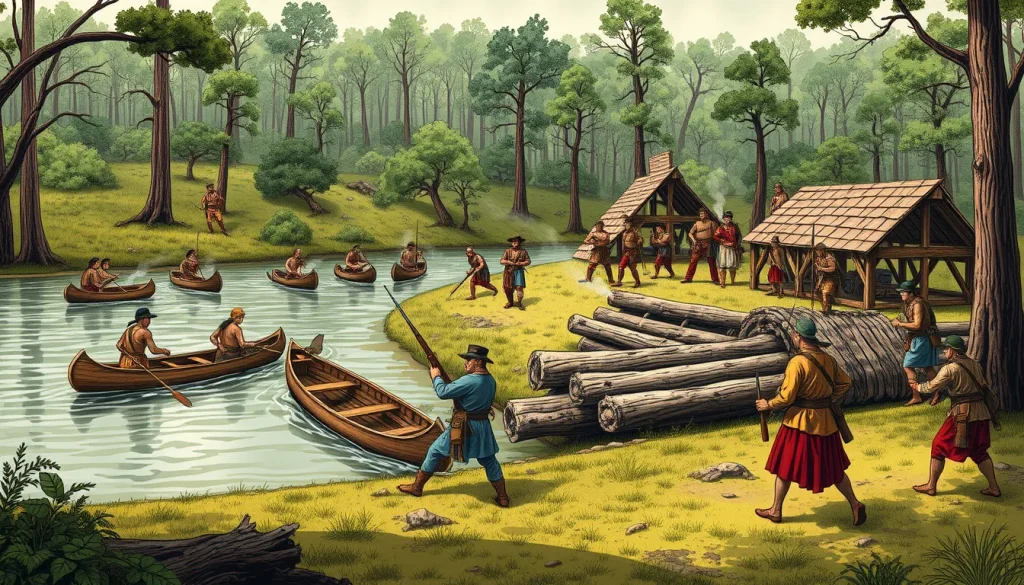
By March 1814, Jackson had assembled a force of roughly 3,000 to 3,300 men, including U.S. regulars, Tennessee militia, and Cherokee and Lower Creek allies. The Red Sticks, led by Menawa and other headmen, fortified Tohopeka inside the horseshoe-shaped bend of the Tallapoosa. They built a log barricade across the neck of the peninsula and relied on the river to protect their rear. Jackson departed Fort Williams on March 22 and approached the bend in late March.
On March 27, Jackson sent Brigadier General John Coffee with mounted troops and Indigenous allies to cross the Tallapoosa downstream and attack the Red Stick rear. Cherokee warriors, including a group led by Tuq-qua, also known as The Whale, swam across the river, seized canoes, and helped ferry others over. The surprise attack from the rear drew Red Stick defenders away from the barricade. Jackson then ordered a frontal assault. Trapped between the two forces, the Red Sticks suffered catastrophic losses. Contemporary U.S. reports claimed roughly 800 Red Stick warriors killed, while Jackson’s command reported about 50 killed and 150 wounded; these figures come from military accounts and should be treated as contemporary claims rather than exact totals. Menawa escaped, but the Red Stick resistance was broken.
On August 9, 1814, Jackson imposed the Treaty of Fort Jackson on Creek leaders. The treaty required the Creek Nation to cede about 23 million acres in present-day Alabama and Georgia, including lands belonging to Lower Creek and other allies who had fought with the United States. The treaty did not immediately remove the Creeks west, but it drastically reduced their land base and opened the region to American settlement.
Why It Matters
The immediate effect of Horseshoe Bend was to end the Creek War, destroy Red Stick military power, and secure the southern frontier for the United States during the War of 1812. The victory also made Jackson a national military figure and helped launch his political career. The Treaty of Fort Jackson established a precedent for severe land cessions imposed after military defeat, and it weakened the Creek Nation at a moment when the United States was expanding rapidly into the Southeast.
The longer-term consequence was the removal era. Jackson was elected president in 1828, and in 1830 he signed the Indian Removal Act, which authorized the federal government to negotiate the exchange of southeastern Indigenous lands for territory west of the Mississippi River. The Cherokee, despite having fought alongside Jackson at Horseshoe Bend and despite legal victories in the U.S. Supreme Court, were forced west under the Treaty of New Echota of 1835. Their removal in 1838-1839 became known as the Trail of Tears. The Muscogee (Creek) also endured removal in 1836-1837, and the Seminole, Chickasaw, and Choctaw faced related forced migrations.
Definition
The question asks how a single 1814 battle is connected to the forced removal of southeastern Indigenous nations in the 1830s. The connection is not a direct legal mechanism. Instead, Horseshoe Bend was a pivotal event that reshaped power in the Southeast, enabled a massive land cession, elevated Andrew Jackson, and contributed to a political environment in which removal became federal policy. The Trail of Tears is best understood as the culmination of multiple pressures, of which Horseshoe Bend was one important cause.
Background
Before Horseshoe Bend, the United States had already pursued treaties that reduced Indigenous landholdings and encouraged assimilation. After the battle, the balance of military power in the Southeast shifted decisively. The Creek Nation lost much of its territory, and American settlers poured into Alabama and Georgia. At the same time, the War of 1812 ended with the Treaty of Ghent in 1814 and Jackson’s victory at New Orleans in 1815. The peace settlement largely ignored Indigenous allies of Britain, leaving southeastern nations exposed to United States expansion. Jackson’s military reputation made him a leading political figure, and his Indian policy became central to his presidency.
How It Worked
The path from Horseshoe Bend to the Trail of Tears operated through several connected mechanisms:
- Military defeat: The destruction of Red Stick power ended organized Creek resistance and left the Creek Nation weakened and divided.
- Coerced land cession: The Treaty of Fort Jackson transferred about 23 million acres, including lands of U.S. allies, creating a legal and demographic foundation for further American expansion.
- Political elevation of Andrew Jackson: Horseshoe Bend and New Orleans made Jackson a national hero, helping him win the presidency in 1828.
- Federal removal policy: Under Jackson, the Indian Removal Act of 1830 provided the framework for negotiating removal treaties with southeastern nations.
- Treaty coercion and state pressure: Georgia and other states extended jurisdiction over Indigenous lands, while federal officials pressured Cherokee and Creek leaders to sign removal treaties. The Treaty of New Echota in 1835, signed by a minority Cherokee faction, led to the Cherokee removal despite widespread Cherokee opposition.
- Military and logistical enforcement: In 1838, U.S. troops rounded up Cherokee people and forced them west along routes that became known as the Trail of Tears. Similar operations removed thousands of Muscogee and other Indigenous people.
Competing Viewpoints
Historians generally agree that Horseshoe Bend was a turning point, but they disagree about how much it directly caused the Trail of Tears. One interpretation emphasizes Jackson’s Indian wars and the Treaty of Fort Jackson as the beginning of a deliberate removal agenda. In this view, the battle broke Indigenous power in the South and made later removal possible. Another interpretation stresses contingency and multiple causes: cotton expansion, the desire to expand slavery, state sovereignty claims, economic depression, and political pressure all played roles. From this perspective, Horseshoe Bend was necessary but not sufficient; removal was not inevitable in 1814.
A third viewpoint focuses on Indigenous agency and division. Cherokee and Lower Creek warriors fought with Jackson for their own strategic reasons, including protecting their communities and distinguishing themselves from the Red Sticks. Their participation did not protect them from removal. This outcome highlights how U.S. policy treated Indigenous nations as obstacles to expansion even when they were military allies. Historians also note that the Trail of Tears is not a single event but a series of removals affecting several nations, each with its own chronology and experience.
Role in the War of 1812
The Creek War was part of the southern theater of the War of 1812. British and Spanish officials provided support to Red Stick Creeks, hoping to check United States expansion and distract American forces. The United States, in turn, sought to secure the Gulf Coast and eliminate Indigenous resistance. Horseshoe Bend helped secure the southern frontier and contributed to Jackson’s later success at New Orleans. The Treaty of Ghent ended the war between Britain and the United States but did not restore Indigenous lands or sovereignty. By removing a major Indigenous military force from the region, Horseshoe Bend strengthened the United States position in the Southeast and set the stage for postwar expansion.
Consequences and Historical Interpretation
The most direct consequence of Horseshoe Bend was the Treaty of Fort Jackson and the loss of Creek land. The broader consequence was the removal era. The Indian Removal Act of 1830, the Treaty of New Echota of 1835, and the forced marches of 1838-1839 were not simply the result of one battle, but they occurred in a political and military landscape that Horseshoe Bend helped create. Andrew Jackson’s role links the battle to the presidency and to the removal policy that bears his name. For the Cherokee, the irony is sharp: warriors who fought with Jackson at Horseshoe Bend later faced removal under his administration. For the Muscogee, the treaty that followed the battle began a process of land loss that culminated in their own forced removal. Horseshoe Bend National Military Park preserves the battlefield and interprets these connections, though public memory has often emphasized military victory more than Indigenous dispossession.
Primary Sources
- Andrew Jackson’s battle report and correspondence, 1814: Jackson’s official letters describe the battle, his tactics, and casualty figures. They are essential but reflect a commander’s perspective and his interest in portraying the victory as complete and justified.
- Treaty of Fort Jackson, August 9, 1814: The treaty text records the land cession imposed on the Creek Nation. It is a legal document written by U.S. officials and does not represent the full range of Creek opinion.
- Treaty of New Echota, December 29, 1835: This treaty, signed by a minority Cherokee faction, provided the legal basis for Cherokee removal. It was opposed by most Cherokee people and by Principal Chief John Ross.
- Indian Removal Act, May 28, 1830: The act authorized the president to negotiate removal treaties. It reveals the federal government’s official rationale and its assumptions about Indigenous lands and sovereignty.
- Andrew Jackson’s annual messages to Congress, 1829-1830: Jackson publicly argued for removal as a policy. These messages are key statements of the administration’s position, but they present a one-sided justification.
- Cherokee petitions and memorials, 1830s: Cherokee leaders and citizens protested removal in petitions, memorials, and legal filings. These sources provide Indigenous perspectives that are often absent from official military and treaty records.
Further Reading
- National Park Service, Horseshoe Bend National Military Park and related battlefield studies.
- National Park Service, Trail of Tears National Historic Trail resources.
- Claudio Saunt, A New Order of Things: Property, Power, and the Transformation of the Creek Indians, 1733-1816 (1999).
- Joel W. Martin, Sacred Revolt: The Muskogees’ Struggle for a New World (1991).
- Theda Perdue and Michael D. Green, The Cherokee Nation and the Trail of Tears (2007).
- Robert V. Remini, Andrew Jackson and His Indian Wars (2001).
- John Ehle, Trail of Tears: The Rise and Fall of the Cherokee Nation (1988).
- Daniel Walker Howe, What Hath God Wrought: The Transformation of America, 1815-1848 (2007).
References
- National Park Service, Alabama: Horseshoe Bend National Military Park, https://www.nps.gov/articles/horseshoebend.htm.
- National Park Service, Spring 1814: The Battle of Horseshoe Bend, https://www.nps.gov/articles/behind-the-sharp-knife.htm.
- Treaty of Fort Jackson, August 9, 1814, in Charles J. Kappler, ed., Indian Affairs: Laws and Treaties, Vol. 2 (Washington: Government Printing Office, 1904).
- Indian Removal Act, May 28, 1830, Statutes at Large, 4:411-412.
- Treaty of New Echota, December 29, 1835, in Charles J. Kappler, ed., Indian Affairs: Laws and Treaties, Vol. 2 (Washington: Government Printing Office, 1904).
- Claudio Saunt, A New Order of Things: Property, Power, and the Transformation of the Creek Indians, 1733-1816 (Cambridge: Cambridge University Press, 1999).
- Theda Perdue and Michael D. Green, The Cherokee Nation and the Trail of Tears (New York: Viking, 2007).
- Robert V. Remini, Andrew Jackson and His Indian Wars (New York: Viking, 2001).
FAQ
Did Horseshoe Bend directly cause the Trail of Tears?
No single battle directly caused the Trail of Tears. Horseshoe Bend was a pivotal event that broke Red Stick Creek power, led to the Treaty of Fort Jackson, and helped elevate Andrew Jackson, but removal resulted from a longer combination of land pressure, state policies, federal legislation, and treaty coercion in the 1830s.
Who fought at Horseshoe Bend?
United States forces under Andrew Jackson, including Tennessee militia and U.S. regulars, fought alongside Cherokee and Lower Creek allies against Red Stick Creeks led by Menawa and other headmen at Tohopeka on the Tallapoosa River.
How did the Treaty of Fort Jackson affect the Creeks?
The treaty forced the Creek Nation to cede about 23 million acres in present-day Alabama and Georgia, including lands of Creek allies who had fought with the United States. It weakened the Creek Nation and opened the region to American settlement.
Why is Horseshoe Bend connected to the Cherokee Trail of Tears?
Cherokee warriors fought alongside Andrew Jackson at Horseshoe Bend, but later, under Jackson's presidency and the Indian Removal Act of 1830, the Cherokee were forced west by the Treaty of New Echota and the removal of 1838-1839.



Leave a Reply