
Short Answer
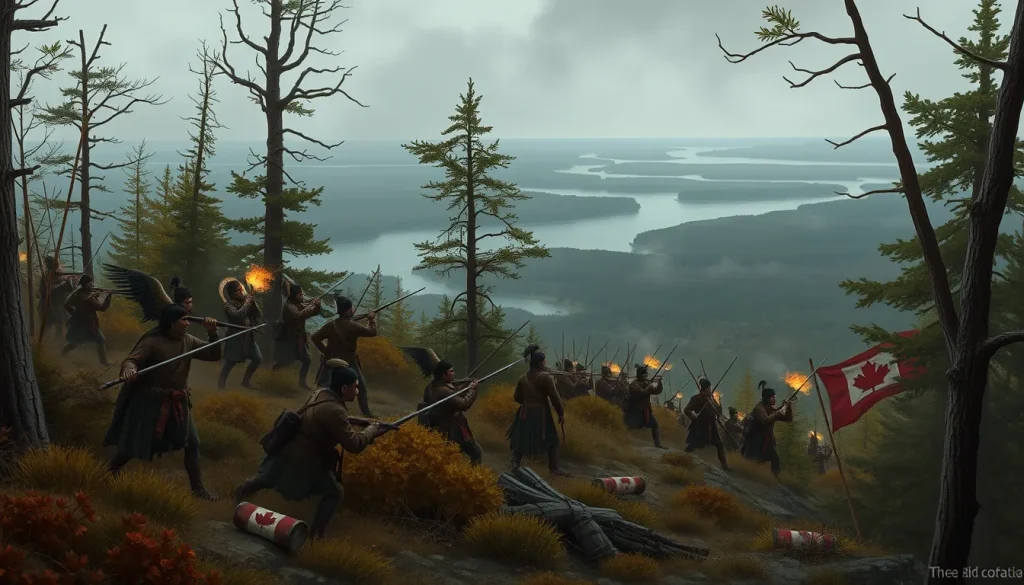
On October 13, 1812, during the Battle of Queenston Heights in Upper Canada, Mohawk and allied Haudenosaunee and Delaware warriors fought with British, Canadian militia, and British-allied forces against an American invasion across the Niagara River. This article uses the term Mohawk warriors to refer specifically to the Mohawk participants from the Grand River and their Haudenosaunee and Delaware allies, while noting that contemporary sources often used the broader label Indians. Their most important contribution came after American troops seized the heights: a small force under Mohawk leaders John Norton (Teyoninhokarawen) and John Brant (Ahyonwaeghs) used the wooded escarpment to pin down and delay the American advance until British reinforcements arrived. The episode is significant because it helped preserve Upper Canada at a critical early moment in the War of 1812 and because it illustrates the central, often underrecognized, role of Indigenous nations in the conflict.
Historical Context
The War of 1812 grew out of tensions between the United States and Great Britain over maritime rights, trade restrictions, impressment, and frontier grievances, including American expansion into Indigenous lands. In the Niagara region, the United States hoped to invade Upper Canada, while Britain relied on a mix of regulars, militia, and Indigenous allies to defend a long and thinly held frontier.
For the Haudenosaunee, especially the Mohawk and other Six Nations communities along the Grand River, the war was not a simple sideshow. The Grand River settlements had been established after the American Revolution for Haudenosaunee people who had allied with Britain. Many leaders sought to defend their lands, maintain their British alliance, and preserve their communities amid pressure from the United States. John Norton, born in Scotland and adopted into the Mohawk nation by Joseph Brant, had become a prominent interpreter, emissary, and war leader. John Brant, Joseph Brant’s son, was another leading Mohawk figure. When war began, Norton recruited warriors from the Grand River and nearby communities, and he received a British captain’s commission.
What Happened
In October 1812, Major General Stephen Van Rensselaer commanded American forces on the Niagara frontier. After an initial crossing was disrupted on the night of October 12, American troops crossed again before dawn on October 13 from Lewiston, New York, to Queenston, Upper Canada. They landed under fire, established a foothold, and discovered a path up the Niagara Escarpment. A portion of the American force climbed to the heights, captured a British gun position or redan, and forced the British from the crest. Major General Isaac Brock, the British commander in Upper Canada, was killed leading a counterattack. His aide-de-camp, Lieutenant Colonel John MacDonell, was mortally wounded in a later charge.
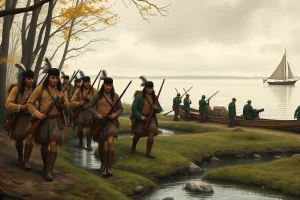
While Brock’s attacks failed, Mohawk and allied Indigenous warriors took up a position on the American flank and rear. According to The Canadian Encyclopedia, John Norton, John Brant, and about 80 Haudenosaunee and Delaware warriors held back the Americans for hours. Norton chose to climb the escarpment west of Queenston along a road that offered an easier ascent and good wooded cover. From the woods on the American right flank, the warriors fired on and contained the American force moving westward along the heights. Their pressure prevented the Americans from consolidating or advancing far enough to secure a decisive victory before British reinforcements could arrive.
Major General Roger Hale Sheaffe arrived from Fort George with regulars, militia, and Captain Robert Runchey’s Company of Coloured Men. He ascended the heights out of sight of the Americans and attacked from the rear. Caught between Sheaffe’s force and the riverbank, the Americans were surrounded. Many surrendered, while some attempted to escape across the Niagara. American militia reserves on the opposite bank refused to cross under fire. The battle ended in a British, Canadian, and Indigenous victory.
Why It Matters
Queenston Heights was one of the first major battles of the War of 1812 and a decisive early check on American efforts to conquer Upper Canada. Brock’s death made the battle a founding moment in Canadian memory, but the victory also depended on the delaying action of Indigenous warriors. Had the American force on the heights been able to organize and press its advantage, the battle could have ended differently and the British position on the Niagara frontier might have collapsed.
For the Mohawk and their allies, the battle demonstrated their military value to British commanders and their own commitment to defending their communities and alliance. At the same time, the war ultimately did not secure Indigenous sovereignty. The peace treaty of 1814, the Treaty of Ghent, did not restore Indigenous homelands or create a recognized Indigenous state, and American expansion continued after the war. Historians therefore interpret Queenston Heights both as a moment of Indigenous military achievement and as part of a broader story of Indigenous nations fighting for their own interests within imperial conflicts that often failed to protect them.
Definition
In this topic, the role of Mohawk warriors means their function as British-allied light infantry and skirmishers at Queenston Heights. They were not a separate formal British regiment but a contingent of Indigenous warriors led by Mohawk chiefs and allied with the British Crown. Sources often call them Indians, Mohawks, or Six Nations warriors. The force at Queenston Heights was broader than Mohawk alone: it included Mohawk, other Haudenosaunee, and Delaware fighters. This article therefore treats Mohawk warriors as the Mohawk leaders and warriors within a larger Indigenous allied force, while acknowledging that exact ethnic composition is not always clear in surviving records.
Background
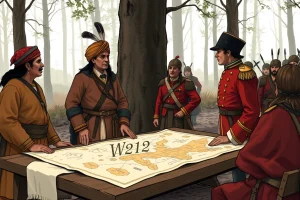
The Mohawk presence at Queenston Heights grew from the Grand River Haudenosaunee alliance with Britain. After the American Revolution, many Six Nations people who had fought for Britain relocated to lands along the Grand River in Upper Canada. They maintained a relationship with British officials, though it was often strained by disputes over land, trade, and sovereignty. John Norton’s position as an adopted Mohawk and British officer made him a key intermediary. John Brant, as Joseph Brant’s son, carried hereditary and community authority.
When the War of 1812 began, British forces in Upper Canada were badly outnumbered. Indigenous allies provided scouting, knowledge of terrain, and psychological impact that regular troops could not easily replace. Norton and other leaders recruited warriors who were motivated by a mixture of alliance, defense of their lands, and opportunity to assert Indigenous power in the region. Their participation was not simply auxiliary; it was central to British frontier defense.
How It Worked
At Queenston Heights, the Mohawk and allied warriors used terrain and mobility to compensate for their small numbers. After the Americans gained the heights, Norton led his force up the escarpment at a point west of Queenston, using a road and wooded ground that provided cover. Rather than forming a linear battle line, the warriors operated as skirmishers, firing from trees and brush, moving to threaten the American flank, and making the American position on the heights unsafe.
This tactic pinned down the American force. The Americans could not easily advance westward without exposing themselves to fire from an enemy they could not clearly see. The warriors’ presence also created uncertainty and delay, buying time for Sheaffe’s column to arrive. When Sheaffe attacked from the rear, the Indigenous skirmishers helped complete the encirclement. The role was thus tactical: reconnaissance, flank security, harassment, and holding action until regular and militia reinforcements could decide the battle.
Competing Viewpoints
British and Canadian accounts have generally praised the Mohawk and allied warriors for saving the day at Queenston Heights. The Canadian Encyclopedia describes their action as critical, and John Norton’s later account emphasizes his own leadership and the importance of Indigenous allies. These sources, however, were often written by British officials or by Norton himself and may magnify or simplify the Indigenous contribution.
American accounts of the battle frequently focused on the failure of Van Rensselaer’s command, the refusal of militia reserves to cross the river, and the death of Brock. They sometimes mentioned Indians as a terrifying or irregular presence, using stereotypes rather than recognizing specific Mohawk leadership. Some American sources minimized the tactical skill of Indigenous fighters or attributed their success to surprise and terrain. Modern historians, including Carl Benn and Alan Taylor, caution against treating either side’s accounts as complete. They emphasize that Indigenous nations pursued their own diplomatic and military goals and were not merely auxiliaries. There is also debate over how many warriors were present and how much credit should go to Norton, Brant, and the broader force. The safest conclusion is that a small Indigenous contingent played an important, perhaps decisive, delaying role at a crucial stage of the battle.
Role in the War of 1812
Queenston Heights was not an isolated example of Indigenous military participation. Mohawk and other Haudenosaunee warriors served with British forces throughout the Niagara campaign and in other theaters. Norton’s warriors later covered the British retreat to Burlington Heights, scouted before the Battle of Stoney Creek, and helped defeat American forces at the Battle of Beaver Dams in 1813. Their contributions illustrate that Indigenous allies made up a significant portion of British effective strength in some campaigns, particularly in frontier warfare.
For the Mohawk specifically, the battle reinforced their reputation as valuable British allies and strengthened their standing with British commanders. It also exposed the limits of that alliance. Despite their service, Indigenous nations did not receive a secure political future in the peace settlement. The war did not stop American expansion or resolve Indigenous land loss in the long term. The role of Mohawk warriors at Queenston Heights therefore belongs to both the military history of the War of 1812 and the diplomatic history of Indigenous-British relations.
Consequences and Historical Interpretation
Immediately, the battle secured the Niagara frontier for Britain and prevented a quick American conquest of Upper Canada. It also made Brock a heroic figure in Canadian memory. For the Mohawk and their allies, the victory demonstrated their military importance but did not produce lasting political gains. In the longer term, the War of 1812 accelerated Indigenous dispossession in the United States and left British-allied Indigenous communities in Canada with unresolved land and sovereignty grievances.
Historians today generally reject the older tendency to treat Indigenous warriors as auxiliaries or background figures. They interpret Queenston Heights as a case study in Indigenous agency: Mohawk leaders chose to fight, negotiated their role with British authorities, and used their own military skills to shape the outcome. The exact weight of their contribution remains debated, but their presence and action are now widely recognized as essential to the British victory. The battle is commemorated at Queenston Heights National Historic Site, where monuments and interpretive materials present Brock’s legacy alongside the wider military history of the War of 1812. Recent scholarship and public commemoration have increasingly included Indigenous participation, though interpretation continues to evolve.
Primary Sources
Surviving primary sources for Mohawk participation at Queenston Heights are fragmentary and mostly filtered through British, American, or later edited accounts. British official dispatches by Major General Isaac Brock before his death and by Major General Roger Hale Sheaffe after the battle report the American crossing, the fighting on the heights, and the arrival of reinforcements. They mention Indian allies but usually do not name individual Mohawk warriors or distinguish Mohawk from other Indigenous nations. These dispatches are held in British colonial records and have been published in E. A. Cruikshank’s Documentary History of the Campaign upon the Niagara Frontier.
John Norton’s journal and memoir offer the most substantial Indigenous-authored account. Norton wrote retrospectively, and his text reflects his own perspective as a Mohawk chief, British officer, and Christian convert. It is valuable for Indigenous motivations, tactics, and leadership, but it is not a neutral or complete battle report. American sources include Stephen Van Rensselaer’s official report and accounts by officers such as Solomon Van Rensselaer and Peter B. Porter. These describe the American defeat, the role of Indians in the battle, and the refusal of militia reserves to cross the Niagara. They are limited by their defensive tone and by the common period practice of describing Indigenous fighters generically as Indians. No verbatim transcript of a Mohawk warrior’s battlefield account from Queenston Heights is known to survive. Researchers should consult published documentary editions and archival collections rather than relying on isolated quotations.
Further Reading
- Carl Benn, The Iroquois in the War of 1812 (University of Toronto Press, 1998).
- Alan Taylor, The Civil War of 1812: American Citizens, British Subjects, Irish Rebels, and Indian Allies (Knopf, 2010).
- Donald R. Hickey, The War of 1812: A Forgotten Conflict (University of Illinois Press, 1989).
- Robert S. Allen, His Majesty’s Indian Allies: British Indian Policy in the Defence of Canada, 1774-1815 (Dundurn, 1992).
- John Norton, The Journal of Major John Norton, 1816, edited by Carl F. Klinck and James J. Talman (Champlain Society, 1970).
- E. A. Cruikshank, ed., The Documentary History of the Campaign upon the Niagara Frontier, 1812-1814 (1896-1908).
- The Canadian Encyclopedia, Battle of Queenston Heights and John Norton and the War of 1812.
- Parks Canada, Battle of Queenston Heights National Historic Site.
References
- The Canadian Encyclopedia, Battle of Queenston Heights, https://thecanadianencyclopedia.ca/en/article/battle-of-queenston-heights.
- The Canadian Encyclopedia, John Norton and the War of 1812, https://thecanadianencyclopedia.ca/en/article/john-norton-and-the-war-of-1812.
- Carl Benn, The Iroquois in the War of 1812 (Toronto: University of Toronto Press, 1998).
- Alan Taylor, The Civil War of 1812: American Citizens, British Subjects, Irish Rebels, and Indian Allies (New York: Knopf, 2010).
- Donald R. Hickey, The War of 1812: A Forgotten Conflict (Urbana: University of Illinois Press, 1989).
- Robert S. Allen, His Majesty’s Indian Allies: British Indian Policy in the Defence of Canada, 1774-1815 (Toronto: Dundurn, 1992).
- Parks Canada, Battle of Queenston Heights National Historic Site.
FAQ
Did Mohawk warriors fight at Queenston Heights?
Yes. Mohawk leaders John Norton and John Brant led about 80 Haudenosaunee and Delaware warriors, including Mohawk, on the British side at Queenston Heights on October 13, 1812.
What did Mohawk warriors do at Queenston Heights?
They climbed the escarpment west of Queenston, used woods and skirmishing tactics to pin down American troops on the heights, and delayed the American advance until British reinforcements under Roger Hale Sheaffe arrived.
Were all Indigenous fighters at Queenston Heights Mohawk?
No. The allied Indigenous force included Mohawk and other Haudenosaunee nations, as well as Delaware warriors. Contemporary sources often used the generic term Indians, which obscures specific identities.
Why was the Mohawk role important at Queenston Heights?
Their delaying action prevented the Americans from consolidating their position on the heights and helped make the British counterattack and victory possible.
Leave a Reply