
Short Answer
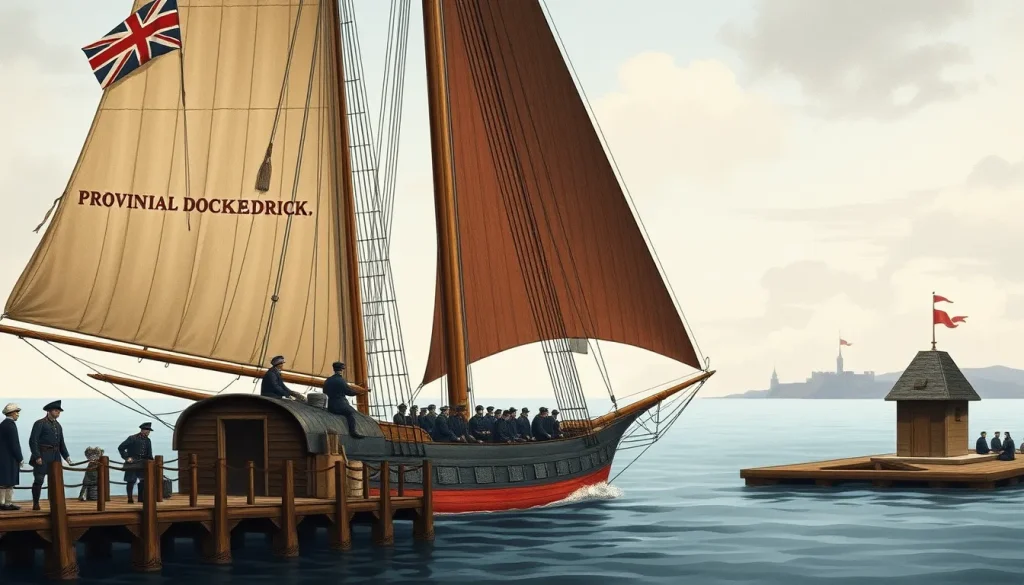
The Provincial Marine, also known as the Marine Department, was Britain’s army-controlled naval and transport service on the Great Lakes, the St. Lawrence River, and parts of Lake Champlain. It originated during the Seven Years’ War and by the War of 1812 was the only British naval force afloat on the lakes. Its ships carried troops, government stores, and fur-trade goods, and in 1812 it briefly served as Britain’s first line of defense on the lakes before the Royal Navy took direct control in 1813.
Historical Context
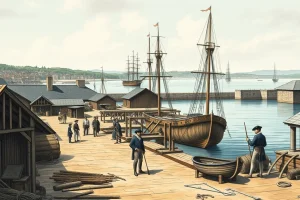
After Britain conquered New France in 1763, its North American empire depended on the Great Lakes and St. Lawrence for communication with interior posts. Roads were poor or nonexistent, so armed vessels and bateaux were essential. The fur trade also relied on the lakes. During the American Revolution, Governor Guy Carleton outlawed private vessels on the lakes in 1777 and brought them into the King’s service, making the Provincial Marine the sole legal carrier of goods and troops on the upper lakes. Haldimand’s 1778 regulations divided Lake Ontario from Lake Erie and the upper lakes, each under a senior naval officer, and required the Articles of War to be read aboard ship monthly. After the war, the force was placed under the British Army’s Quartermaster General’s Department. Its main bases were Carleton Island, then Point Frederick at Kingston from 1789, and Amherstburg after the British evacuated Detroit in 1796. In peacetime it was a frugal transport service, not a battle fleet. Its officers used Royal Navy rank and practice, but most vessels were lightly armed schooners and brigs suited to shallow water and cargo, not fleet combat. Pay was lower than private trade, and the service struggled to keep qualified sailors.
What Happened
The Provincial Marine’s roots lay in 1755, when Britain opened a dockyard at Oswego on Lake Ontario during the Seven Years’ War and built armed vessels to contest French power on the lake. After 1763, the force maintained supply routes to British posts. During the American Revolution it expanded: by 1780 it had thirteen vessels, five on Lake Ontario and nine on Lake Erie. Its gunboats helped defeat an American force on Lake Champlain in October 1776, and in 1777 it carried supplies for Burgoyne’s campaign. In 1779 a base was established at Carleton Island, and patrols operated on Lake Huron between Michilimackinac and Detroit. After 1783 the service shrank and became known as the Provincial Marine. It moved its headquarters to Kingston in 1789 and established a yard at Amherstburg in 1796. By 1812, the Lake Ontario squadron at Kingston had only about nine officers, 101 seamen, and five artificers; the Lake Erie division was in disrepair. When war began in June 1812, the United States had only one commissioned warship on the lakes, the brig Oneida, but it quickly built up. The Provincial Marine nevertheless helped British and Indigenous forces in the Detroit campaign, supporting the movement of troops and stores that led to the surrender of Detroit in August 1812. On Lake Ontario, however, it could not match Commodore Isaac Chauncey’s growing American squadron, and British commanders lost confidence in it. In May 1813 the Royal Navy took direct command under Commodore Sir James Lucas Yeo. The Kingston dockyard at Point Frederick expanded rapidly, and by 1814 it supported the largest squadron on the lakes, with about 1,600 personnel and the flagship St Lawrence. The September 1813 Battle of Lake Erie, fought by a British squadron that included vessels and personnel from the old Provincial Marine establishment, ended in American victory and cost Britain control of Lake Erie. After the war, the Rush-Bagot Treaty of 1817 demilitarized the lakes and limited future naval forces.
Why It Matters
The Provincial Marine mattered because control of the lakes determined who could move armies, supplies, and Indigenous allies across the contested border. In 1812 its vessels helped Britain hold the Detroit frontier and maintain communications between Upper Canada’s eastern and western districts. Its weaknesses also exposed a serious problem: a transport service could not suddenly become a battle fleet against a rapidly expanding American navy. The Royal Navy’s takeover in 1813 was a direct response to that gap. The loss of Lake Erie in 1813 helped force the British retreat from Detroit and contributed to the American victory at the Thames, while the British buildup on Lake Ontario prevented American control there. Later historians disagree about how to judge the Provincial Marine. Some see incompetence and cowardice; others see a small, underfunded logistics force that performed essential work and was blamed for lacking a naval tradition it had never been designed to have. Its story also explains why the Great Lakes became a naval theater and why the Rush-Bagot Treaty later sought to prevent another lake arms race.
Definition
The Provincial Marine was a British government service responsible for armed vessels and water transport on the Great Lakes, the St. Lawrence River, and parts of Lake Champlain. It was not part of the Royal Navy until 1813. It was administered by the British Army’s Quartermaster General’s Department and operated more like a coast guard, supply, and transport service than a full-fledged navy. Its ships could be armed for war, and some were designated HMS, but their main peacetime work was carrying troops, government stores, and commercial freight, including fur-trade goods.
Background
The service began during the Seven Years’ War, when Britain needed armed vessels on Lake Ontario and Lake Champlain against France. After 1763, it helped supply the new British posts in the interior. The American Revolution transformed it. In 1777 Governor Guy Carleton prohibited private vessels on the Great Lakes and brought them into royal service, giving the Provincial Marine control over military and much commercial movement. Governor Frederick Haldimand’s 1778 regulations formalized two geographic commands, one for Lake Ontario and one for Lake Erie and the upper lakes, and imposed naval discipline. After 1783 the force passed to army control, moved its main base to Kingston, and later established a yard at Amherstburg. By the early 1800s it was an aging, peacetime establishment with too few skilled sailors and too many unarmed or lightly armed transports.
How It Worked
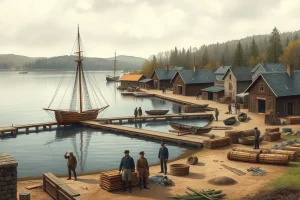
The Provincial Marine used Royal Navy ranks and customs but was recruited and paid through the army. Officers, sailors, soldiers, and local Great Lakes mariners manned the vessels. A report from 1802 shows recruits included English, Irish, Scottish, foreign, and Canadian sailors. The service paid less than private employers, and its practice of keeping the best sailors aboard ship while sending less capable men to the yards helped create a shortage of qualified seamen. Its main bases were Kingston on Lake Ontario and Amherstburg on Lake Erie, with a smaller establishment at Quebec. Vessels were mostly topsail schooners and brigs, shallow-drafted for lake harbors and rivers. In peace they carried troops, stores, and fur-trade cargo; in war they could be armed and used as warships. But they were not built to fight large squadrons, and the Lake Erie division was especially decrepit by 1812.
Competing Viewpoints
Contemporary opinion was divided. The Reverend John Strachan of York wrote in November 1812 that the marine was ineffective and that its officers lacked fighting spirit. Lieutenant James Richardson, who served in the Provincial Marine from 1809, later recalled that his small squadron kept communications open between the eastern and western divisions of the army, a vital service in a roadless country. British commanders including Sir George Prevost shared Strachan’s frustration. Historians have continued the debate. W.A.B. Douglas described the service as incompetent in some respects, while noting that its officers often had Royal Navy experience and that its military role had long been a real concern. Robert Malcomson argues that the Provincial Marine had only a faint tradition of naval tactics because it had been primarily a frugally run transport service for five decades. In his view, its 1812 performance should be judged against that logistics mission, not against the Royal Navy’s battle fleet.
Role in the War of 1812
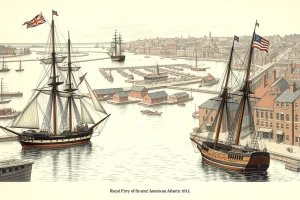
At the start of the war, the Provincial Marine was Britain’s only organized naval force on the Great Lakes. On Lake Erie and the Detroit frontier, its vessels supported the August 1812 Detroit campaign, moving troops and stores and helping Britain and its Indigenous allies secure a major early victory. On Lake Ontario, it faced Commodore Isaac Chauncey’s American squadron and failed to gain control. The Royal Navy took over in 1813 under Commodore Sir James Lucas Yeo, replaced many provincial officers with Royal Navy officers, and expanded the Kingston dockyard. The old Provincial Marine vessels and crews were absorbed into the new lake service. The British squadron at the Battle of Lake Erie in September 1813 included ships from that establishment; its defeat gave the United States control of Lake Erie and helped turn the war in the northwest. By 1814 the Royal Navy commanded the lakes, and the Provincial Marine’s independent wartime role had ended. Some lists include later lake actions such as Plattsburgh, but those were Royal Navy operations.
Consequences and Historical Interpretation
The immediate consequence of the Provincial Marine’s wartime experience was its absorption into the Royal Navy. The British learned that lake control required purpose-built warships, trained crews, and a strong dockyard, and they invested heavily at Kingston. The longer consequence was the Rush-Bagot Treaty of 1817, which limited naval armaments on the lakes and helped create a demilitarized border. For historians, the Provincial Marine is a case study in the limits of a peacetime transport service under wartime pressure. It was neither a great battle fleet nor a useless relic. It performed essential logistics, helped Britain survive the first year of the war, and then failed when asked to fight a naval war. Its reputation has shifted from contemporary criticism toward a more nuanced view that emphasizes its transport role, its shortages, and the structural reasons it could not match the United States Navy on the lakes.
Primary Sources
Key contemporary sources include Governor Guy Carleton’s 1777 order bringing private lake vessels into the King’s service and Frederick Haldimand’s 1778 General Orders and Regulations for the Better Government of His Majesty’s Armed Vessels Employed on the Different Lakes. Both are official documents that show how the service was created, controlled, and divided into lake commands. Lieutenant Colonel A.H. Pye’s report to Governor-General George Prevost, dated 7 December 1811, describes the Provincial Marine’s duties, bases, vessels, and weaknesses on the eve of war; it is published in The Naval War of 1812: A Documentary History. The Reverend John Strachan’s November 1812 criticism and Lieutenant James Richardson’s later memoir recollections offer opposing contemporary views, but both survive through quotation in Robert Malcomson’s article rather than as full transcripts here. The Provincial Marine Papers at the University of Toronto Libraries preserve 1788-1792 records relating to freight, orders, and administration. These sources are valuable but limited: official reports reflect British military priorities, Strachan wrote as a frustrated civilian cleric, and Richardson’s memoir was a later recollection. No verified full transcript is reproduced in this article; researchers should consult the published documentary editions and archives listed below.
Further Reading
- W.A.B. Douglas, Gunfire on the Lakes: The Naval War of 1812-1814 on the Great Lakes and Lake Champlain (Ottawa, 1977).
- Robert Malcomson, Lords of the Lake: The Naval War on Lake Ontario, 1812-1814 (1998).
- Robert Malcomson, "Not Very Much Celebrated: The Evolution and Nature of the Provincial Marine, 1755-1813," The Northern Mariner 11, no. 1 (2001).
- William S. Dudley, ed., The Naval War of 1812: A Documentary History, Vol. I (Washington, 1985).
- Bob Garcia, "The Provincial Marine at Amherstburg 1796-1813," War of 1812.ca.
- University of Toronto Libraries, The Provincial Marine Papers, MS Coll 00022B.
- Parks Canada, Fort Malden National Historic Site.
References
- "Provincial Marine," Wikipedia, https://en.wikipedia.org/wiki/Provincial_Marine.
- "The Provincial Marine Papers," University of Toronto Libraries, Discover Archives, MS Coll 00022B, https://discoverarchives.library.utoronto.ca/index.php/the-provincial-marine-papers.
- Bob Garcia, "The Provincial Marine at Amherstburg 1796-1813," War of 1812.ca, https://www.warof1812.ca/provmarine.htm.
- William S. Dudley, ed., The Naval War of 1812: A Documentary History, Vol. I, Chapter 3, Naval Historical Center, 1985, http://ibiblio.org/anrs/docs/E/E3/dh_1812_v01c03.pdf.
- Robert Malcomson, "Not Very Much Celebrated: The Evolution and Nature of the Provincial Marine, 1755-1813," The Northern Mariner 11, no. 1 (2001): 25-37, https://tnm.journals.yorku.ca/index.php/default/article/download/597/572.
FAQ
What was the Provincial Marine?
It was a British army-controlled naval and transport service on the Great Lakes, St. Lawrence River, and Lake Champlain. It carried troops, government stores, and fur-trade goods and could arm its vessels for war.
Was the Provincial Marine part of the Royal Navy?
Not until 1813. It used Royal Navy ranks and practices, and some ships were designated HMS, but it was administered by the British Army's Quartermaster General's Department. The Royal Navy took direct control in 1813.
Why did the Royal Navy take over in 1813?
British leaders lost confidence after the Provincial Marine failed to match Commodore Isaac Chauncey's American squadron on Lake Ontario in 1812. The Royal Navy under Commodore Sir James Lucas Yeo then took command and expanded the Kingston dockyard.
Leave a Reply