
Short Answer
Congreve rockets were British black-powder rocket artillery used during the War of 1812, most prominently by the Royal Navy and British Army in the Chesapeake campaign of 1814. Designed by Sir William Congreve from 1804, they were launched from ground frames, boats, and specialized rocket vessels against American positions including Bladensburg, North Point, and Fort McHenry. They were valued less for accuracy than for incendiary effect and the panic their noise and trajectory could cause, and they became permanently associated with the War of 1812 through the phrase “rockets’ red glare” in the U.S. national anthem.
Historical Context
The War of 1812 began as a conflict between the United States and Great Britain, with Indigenous nations, British Canada, and American maritime and territorial interests all playing central roles. For much of the war, Britain’s main military effort remained fixed on the Napoleonic Wars in Europe. After the abdication of Napoleon in April 1814, however, Britain could send more experienced troops and naval resources to North America. British strategy in the Chesapeake region combined raids, blockade, and amphibious operations designed to pressure the United States, disrupt its economy, and draw American forces away from the Canadian frontier.
Congreve rockets emerged from this wider era of experimentation in artillery. The British had learned of iron-cased rockets used by the Kingdom of Mysore against the East India Company in the 1790s. William Congreve began developing a British military rocket in 1804, working at Woolwich Arsenal and later relying on production near the Waltham Abbey Royal Gunpowder Mills. By the time of the War of 1812, the weapon had already been tested in Europe, including use against Boulogne in 1806 and at Copenhagen in 1807. Its appeal to British commanders lay in mobility: a rocket needed no heavy cannon barrel, only a simple launcher or frame.
What Happened
Congreve rockets were introduced into British service in the first decade of the nineteenth century and were used by both the Army and Navy. In 1812, the War Office established an independent rocket unit, and rocket detachments were deployed in several theaters. During the War of 1812, their most concentrated use came during the British Chesapeake campaign of 1814 under Rear Admiral George Cockburn and Major General Robert Ross. The campaign included raids along the Patuxent River, the advance on Washington, and the subsequent attack on Baltimore.

At the Battle of Bladensburg on August 24, 1814, British forces used Congreve rockets against American militia and regulars defending the approaches to Washington. The rockets did not win the battle by themselves, but their unfamiliar noise, smoke, and erratic flight contributed to the disorder of some American units. The British victory opened the way to Washington, where they burned public buildings. For many American participants, the rockets were a shocking and demoralizing feature of the battle.
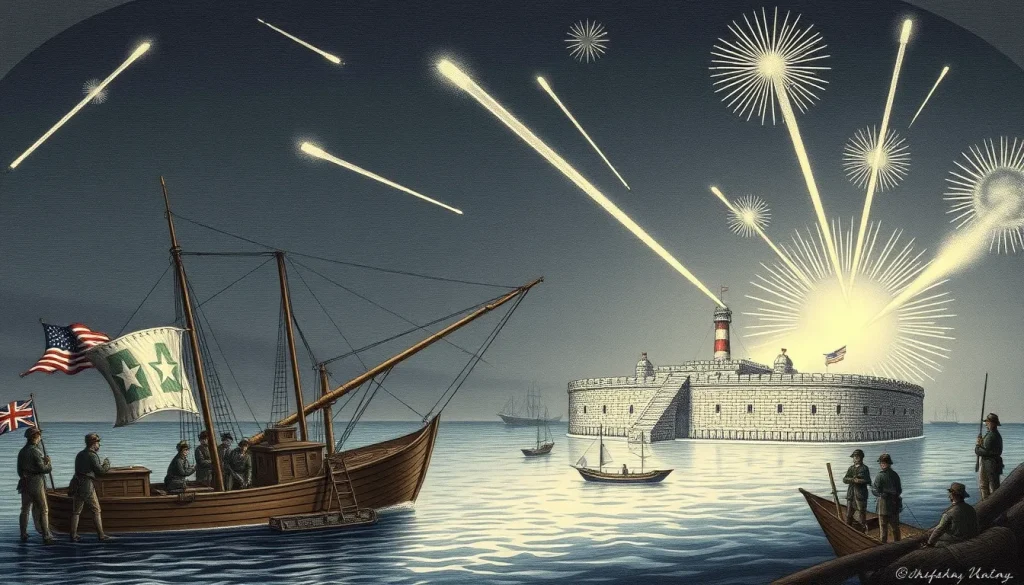
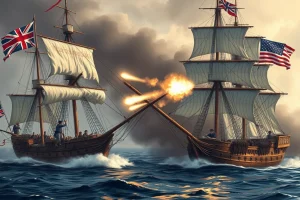
On September 12, 1814, at the Battle of North Point outside Baltimore, British land forces again used rockets. Here the results were less dramatic. American defenders, including militia and regulars, held their ground in a sharp fight that killed Major General Ross. The rockets were part of the British attack but did not break the American line. The next day, September 13–14, the British fleet bombarded Fort McHenry. The rocket ship HMS Erebus, equipped with a 32-pounder rocket battery, took part. Rockets were fired along with mortar shells and cannon shot, but the fort did not surrender. The bombardment failed to reduce the fort or force Baltimore’s surrender, and the British withdrew.
Congreve rockets also appeared in other operations. In August 1814, British naval forces used them during the bombardment of Stonington, Connecticut. In the New Orleans campaign of late 1814 and January 1815, British forces employed rockets, though they contributed little to the outcome of the American victory. In each case, the rockets were part of a combined-arms system that included ships, artillery, infantry, and sometimes marines, rather than a standalone wonder weapon.
Why It Matters
The Congreve rocket’s importance in the War of 1812 lies less in decisive battlefield results than in what it reveals about early nineteenth-century warfare. It was an attempt to solve the problem of mobile firepower by removing the heavy gun tube. It could be carried by boats, launched from improvised frames, and used to start fires in towns or fortifications. But its inaccuracy, sensitivity to weather, and unpredictable flight path limited its tactical value. British records and American accounts alike describe rockets as frightening, but not reliably destructive.
The weapon also became part of American historical memory. Francis Scott Key’s poem “Defence of Fort M’Henry,” written after the bombardment, refers to “the rockets’ red glare.” That phrase fixed Congreve rockets in the popular memory of the War of 1812, even though the rockets failed to bring about the British capture of Baltimore. Historians generally treat the rockets as a psychological and incendiary weapon that sometimes caused panic, especially among inexperienced troops, but not as a technology that changed the war’s outcome.
Definition
A Congreve rocket was a solid-propellant rocket artillery projectile developed by William Congreve for the British military. It used a black-powder propellant packed inside an iron case, with a constricted nozzle at the rear to produce thrust. A long wooden guide stick was attached to the side of the rocket to provide partial stabilization in flight. The rockets were made in several sizes and could carry incendiary, explosive, or case-shot warheads.
Background
The design drew on earlier Indian rocket technology. Tipu Sultan’s Mysore forces had used iron-cased rockets against the East India Company in the 1790s, and examples reached Britain after 1799. Congreve later claimed he had not based his design on the Mysore rockets, but the timing and similar use of iron cases make the connection a subject of historical discussion. Congreve began experiments in 1804, buying commercial rockets and improving their range. With support from the Ordnance Department, he moved production to Woolwich and then to the Waltham Abbey area. By 1806, his rockets were being manufactured in larger sizes, and by 1813 they were classified as heavy, medium, and light types.
How It Worked
The rocket’s principal components were the iron motor case, the black-powder propellant, the nozzle, the warhead, and the wooden guide stick. When the propellant burned, high-pressure gas escaped through the nozzle, producing forward thrust. The stick did not make the rocket stable in the way a modern guided missile is stable; instead, it shifted the center of pressure and partially reduced the tendency to tumble. Even so, rockets often corkscrewed, veered, or fell short. Their range depended on size, powder quality, and launch angle. The largest heavy rockets were cumbersome, while medium and light rockets were more practical in the field.
Warheads varied by mission. Incendiary “carcass” rockets carried combustible mixtures intended to start fires. Explosive rockets used black-powder charges to produce blast and fragmentation. Case-shot rockets contained small balls or fragments for use against troops. Fuzes could be adjusted to burst the warhead in the air or on impact. Launch methods were deliberately simple. Small rockets could be fired from a trough, a hollow copper tube on a tripod, or a frame mounted on a cart. Larger rockets used ladder-like frames. At sea, the Royal Navy mounted frames on small boats and on specialized rocket vessels. The 32-pounder rocket commonly used by the Navy had a cylindrical body about 42 inches long and 4 inches in diameter, with a guide stick around 15 feet long.
Competing Viewpoints
Congreve himself was an enthusiastic advocate. He believed the rocket might replace conventional artillery because it was light, mobile, and did not require a heavy gun. That optimism was not fully shared by commanders in the field. The rockets could be terrifying, especially to troops who had never seen them, but their inaccuracy meant they rarely achieved precise destructive effects. At Bladensburg, British rockets contributed to American panic; at North Point, they were far less effective; at Fort McHenry, they failed to force a surrender. Historians therefore disagree about how much weight to give the weapon. Some emphasize its psychological and incendiary role, while others stress its technical limitations and marginal tactical value. British and American sources also differ in emphasis: British reports often note the rockets as part of a successful combined operation, while American accounts tend to remember them as frightening but ultimately survivable.
Role in the War of 1812
In the War of 1812, Congreve rockets were a British weapon. They were used by the Royal Navy, the Royal Artillery, and associated rocket detachments. Their main theater of use was the Chesapeake campaign of 1814, where they supported amphibious raids, the march on Washington, and the attack on Baltimore. The rocket ship HMS Erebus was the most visible naval platform, but rockets were also launched from small boats and land frames. Outside the Chesapeake, they appeared in coastal attacks such as Stonington and in the New Orleans campaign. They did not operate independently; they were integrated into British combined operations that relied on naval superiority, veteran infantry, and artillery. Their role was to add incendiary and psychological effect to those operations, not to serve as a decisive siege weapon.
Consequences and Historical Interpretation
After the War of 1812, Congreve rockets continued to be used in other conflicts, and other nations experimented with rocket artillery. The British gradually reduced their reliance on the weapon as conventional artillery improved, and rockets remained a secondary system until the development of modern rocket artillery in the twentieth century. In historical interpretation, the Congreve rocket is usually described as an early and imaginative attempt to use self-propelled projectiles, but one limited by the technology of its day. Its fame in the United States comes largely from the “rockets’ red glare” of the Fort McHenry bombardment, an event where the weapon was visually spectacular but strategically unsuccessful. That combination of spectacle and failure makes the Congreve rocket a useful case study in how military technology, fear, and memory interact.
Primary Sources
- William Congreve’s published treatises on rocketry. Congreve wrote several works explaining and promoting his rocket system in the early nineteenth century. They are valuable for understanding the designer’s claims, but they are advocacy as well as technical description and should be read with that bias in mind.
- British naval and military dispatches from the Chesapeake campaign. Reports by Rear Admiral George Cockburn, Major General Robert Ross, and other officers describe the use of rockets in 1814. These documents are held in British archives such as The National Archives (UK), but they reflect the perspective and priorities of British commanders.
- Francis Scott Key, “Defence of Fort M’Henry” (1814). Key’s poem, later retitled “The Star-Spangled Banner,” mentions “the rockets’ red glare” and is a literary eyewitness response to the bombardment. It is not a military report and should not be used as a technical account of rocket performance.
- National Park Service, Fort McHenry handbook. The NPS historical handbook summarizes the British rocket vessel Erebus, the types of rockets used, and the results of the bombardment. It is a public-history synthesis based on primary and secondary research.
Further Reading
- Donald R. Hickey, The War of 1812: A Forgotten Conflict (Urbana: University of Illinois Press).
- John R. Elting, Amateurs to Arms! A Military History of the War of 1812 (New York: Da Capo Press).
- Walter Lord, The Dawn’s Early Light (New York: W.W. Norton).
- National Park Service, Fort McHenry National Monument and Historic Shrine, NPS Historical Handbook.
- Royal Gunpowder Mills, Waltham Abbey, for the production context of Congreve rockets.
References
- Wikipedia, “Congreve rocket,” https://en.wikipedia.org/wiki/Congreve_rocket.
- National Park Service, “Fort McHenry National Monument and Historic Shrine,” NPS Historical Handbook, http://www.npshistory.com/handbooks/historical/5/hh5l.htm.
- Donald R. Hickey, The War of 1812: A Forgotten Conflict (Urbana: University of Illinois Press).
- John R. Elting, Amateurs to Arms! A Military History of the War of 1812 (New York: Da Capo Press).
- Walter Lord, The Dawn’s Early Light (New York: W.W. Norton).
FAQ
How were Congreve rockets used in the War of 1812?
British forces used them as artillery in land and naval operations, especially in the Chesapeake campaign. They were fired from ground frames, boats, and rocket ships to bombard American positions, start fires, and frighten troops.
Were Congreve rockets effective?
They could cause panic—most notably among American militia at Bladensburg—but their inaccuracy limited their military value. At North Point and Fort McHenry they failed to produce decisive results.
Where were Congreve rockets used in the War of 1812?
They were used at Bladensburg, North Point, and Fort McHenry in 1814, and in other coastal operations such as the attack on Stonington, Connecticut, and the New Orleans campaign in 1815.

Leave a Reply