Short Answer
At the Battle of Plattsburgh on September 11, 1814, Master Commandant Thomas Macdonough anchored his squadron in Plattsburgh Bay on Lake Champlain and used spring lines to pivot his ships in place. Springs were not a new invention, but Macdonough’s deployment turned an anchored defensive line into a flexible tactical instrument that could shift broadsides, avoid raking fire, and keep pressure on a more powerful British squadron. The American victory helped halt the British invasion of New York and became a frequently cited example of how springs could shape naval combat in the War of 1812.
Historical Context
Lake Champlain formed a narrow corridor between the United States and British Canada. For either side, control of the lake was necessary to move armies, supplies, and naval forces along the Richelieu River, Lake Champlain, and the upper Hudson corridor. In 1814, British forces in Canada prepared a major invasion southward toward Plattsburgh, New York. A British army under Sir George Prevost advanced along the western shore, while a newly built British squadron under Captain George Downie gathered at Isle aux Noix on the Richelieu River.
Macdonough had commanded American naval forces on Lake Champlain since 1812. He built and refitted ships at Vergennes, Vermont, on Otter Creek, including the 734-ton corvette Saratoga and the brig Eagle. The British built the frigate Confiance, which was larger and more heavily armed than any American vessel on the lake. Geography and weather mattered. The lake runs roughly north-south, and winds were often light or baffling. A defending squadron anchored in Plattsburgh Bay could use the shoreline, shoals, and Cumberland Head to narrow the British approach. In that setting, the ability to turn a moored ship without sails became tactically important.
What Happened
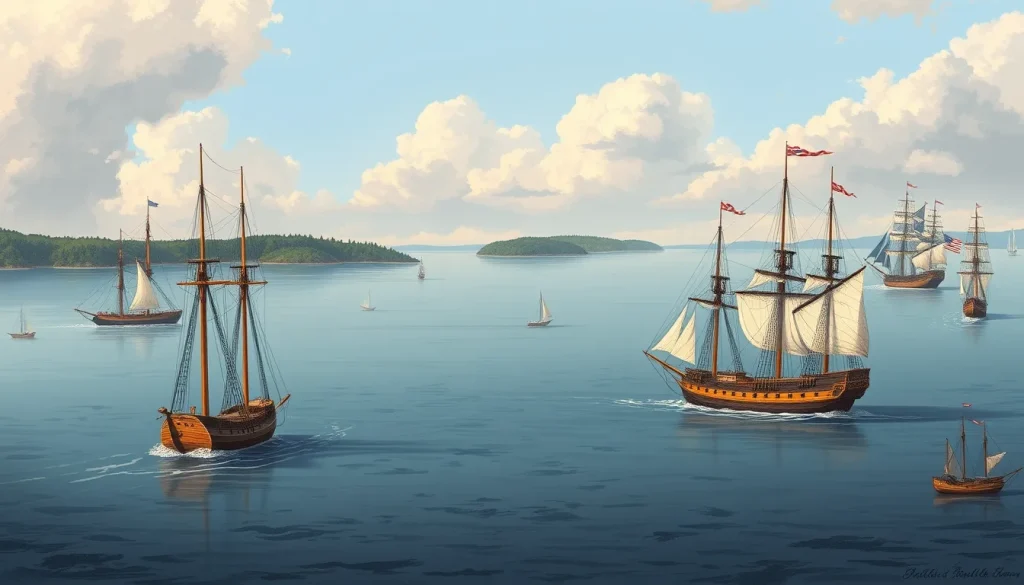
Macdonough chose not to seek a sailing battle on open water. Instead, he anchored his squadron in a north-south line in Plattsburgh Bay, near the mouth of the Saranac River and south of Cumberland Head. His line included Saratoga, Eagle, Ticonderoga, Preble, and a number of gunboats. The northern end of the line was placed close to Cumberland Head so that an enemy trying to turn it would come under heavy fire. To the south, shoals near Crab Island limited a flank attack. The deployment forced Downie to approach bow-on rather than maneuver freely alongside.
Macdonough prepared his ships with springs, stern anchors, and kedges. A spring was a rope or cable led from a ship’s anchor cable to the stern or quarter and then to a capstan or winch. By hauling on the spring, a crew could rotate the anchored ship and aim its broadside without relying on wind. Roosevelt’s later account notes that Saratoga also had kedges planted off each bow, with hawsers leading from the quarters, a further preparation for winding ship or changing broadside.
On the morning of September 11, 1814, Downie’s squadron weighed anchor and entered Plattsburgh Bay. Confiance led, followed by Linnet, Chubb, Finch, and gunboats. The British intended to engage and break the American line. Confiance concentrated on Saratoga, while Linnet engaged Eagle. The firing was destructive on both sides. At a critical point, Saratoga’s engaged battery was badly damaged. Using the springs, Macdonough’s crew turned the ship so that its opposite broadside could be brought to bear. This allowed Saratoga to continue firing when it might otherwise have been silenced.
Downie was killed during the action. Confiance surrendered after severe damage, and the rest of the British squadron was captured or destroyed. The American victory at Plattsburgh Bay coincided with the land battle at Plattsburgh, where Brigadier General Alexander Macomb’s smaller American force held the British advance. Deprived of naval control on the lake, Prevost canceled the invasion and withdrew northward.
Why It Matters
The immediate consequence was strategic. The British loss of the squadron ended their ability to support the invasion of New York by water. It also strengthened the American position in the peace negotiations at Ghent, even though news of the treaty and the Battle of New Orleans later overshadowed the diplomatic effect. Contemporary observers recognized the victory as important because it protected a vulnerable invasion route into the United States.
The tactical significance is more debated. Springs were already known in European and American naval practice. They were used in harbor defense, in attacks on anchored ships, and in situations where a vessel needed to bring its guns to bear without weighing anchor. Macdonough did not invent them. What he did was integrate springs into a carefully chosen anchored line, combine them with shore geography and gunboats, and use them to keep an American ship in action after its first broadside was crippled. In that sense, the Battle of Plattsburgh became a case study in controlled maneuver at anchor.
Historians such as David Curtis Skaggs have argued that Macdonough’s victory on Lake Champlain was more decisive for the War of 1812 than Perry’s more celebrated victory on Lake Erie. The tactical point supports that argument: springs helped make an anchored squadron not merely passive but capable of shifting fire and resisting a heavier opponent. Later naval writers cited the battle when discussing defensive anchorage, broadside control, and the value of preparation over simple weight of metal.
Definition
A naval spring is a line or cable used to control a vessel’s orientation while it is anchored. It is led from the anchor cable or anchor to a point farther aft and then to a capstan or winch. By hauling on the spring, the crew can turn the ship around its anchor. This allows the ship to aim its broadside without setting sail and without relying on the wind.
Background
Springs had long been part of seamanship in the Age of Fighting Sail. They were useful in blockades, harbor defense, and ship-to-ship actions where a vessel needed to keep a target under fire. On Lake Champlain, light and variable winds made sailing maneuver risky. A squadron that could anchor in a strong defensive position and then pivot its ships had an advantage over an attacker forced to approach under sail. Macdonough’s earlier service in the Barbary Wars and his experience building a freshwater squadron likely familiarized him with such practical seamanship, even if the specific use at Plattsburgh reflected his own careful planning.
How It Worked
In practice, a ship anchored by the bow could run a spring from its anchor cable to the stern. When the crew hauled on the spring, the ship turned. If the enemy had damaged the guns on one side, the crew could wind the ship and present the other broadside. If the wind shifted or died, the spring allowed the ship to stay on target. Macdonough’s preparations at Plattsburgh also included anchors astern and kedges off the bows, giving Saratoga additional ways to change position or bring a fresh battery to bear.
This mattered because a sailing warship’s firepower was concentrated in its broadsides. A ship unable to turn could be raked from ahead or astern, where its guns could not reply effectively. Springs reduced that vulnerability. They also helped an anchored line avoid being doubled, or attacked from both sides at once, because each ship could adjust its angle of fire. At Plattsburgh, the springs helped Macdonough keep his line coherent even as Confiance and Linnet pressed the attack.
Competing Viewpoints
One view treats Macdonough’s use of springs as a genuine tactical innovation. In this interpretation, he transformed an anchored defensive position into a maneuverable fighting formation and showed how a weaker squadron could defeat a stronger one by controlling its orientation. Another view stresses that springs were standard technology. In that reading, Macdonough’s achievement lay in deployment, preparation, and leadership rather than in inventing a new tactic. Most recent scholarship falls between these poles: the springs were not novel, but their systematic use in a lake battle was tactically significant and became an influential example.
Role in the War of 1812
The Battle of Plattsburgh was one of the war’s most important naval engagements. It prevented the British from using Lake Champlain as a supply and invasion route. It also contributed to the broader American recovery in 1814, alongside the defense of Baltimore and the Battle of Lake Erie the previous year. Macdonough’s springs were part of a combined land-naval defense. The anchored squadron protected the bay, while Macomb’s troops and militia held the shore. When the British squadron surrendered, Prevost lost the naval cover his army needed.
Consequences and Historical Interpretation
In the short term, Macdonough’s use of springs helped produce a decisive victory and influenced the campaign’s outcome. In the longer term, it did not permanently transform all naval warfare. The Age of Fighting Sail was already changing, and steam power would later reduce dependence on wind and sails. Yet the principle remained relevant: a ship or squadron could use controlled lines and anchors to manage its position in battle. Macdonough’s example showed that springs could be used not only defensively but to keep a ship in the fight after suffering heavy damage.
Historical memory has been uneven. Perry’s victory on Lake Erie became more famous in American culture, partly because of his dramatic transfer of flags and his concise report. Macdonough’s victory was arguably more strategically decisive, but it lacked the same popular imagery. Modern historians have recovered the tactical detail, including the springs, as evidence that Macdonough was a careful and innovative commander within the existing conventions of naval warfare.
Primary Sources
The most important contemporary source is Macdonough’s official report to Secretary of the Navy William Jones in September 1814. It describes the capture of the British squadron and credits the victory to divine favor, while summarizing the action in formal naval language. Like most official reports, it is self-justifying and selective. It does not provide a full technical explanation of how the springs were rigged, but it confirms the outcome and the broad sequence of the battle.
Brigadier General Alexander Macomb’s reports on the land battle at Plattsburgh provide the army side of the combined operation. British accounts are more fragmentary because Captain Downie was killed and the squadron was captured. Surviving British officers and sailors later gave testimony and wrote letters, but these sources are filtered through defeat and captivity. American newspapers reprinted Macdonough’s report and added local detail, though they often blended fact with patriotic celebration. Theodore Roosevelt’s 1882 naval history is not a primary source, but it reproduces and interprets many documents and remains useful for tracing how the tactical story was later understood.
Further Reading
- Skaggs, David Curtis. Thomas Macdonough: Master of Command in the Early U.S. Navy. Annapolis, MD: Naval Institute Press, 2003.
- Roosevelt, Theodore. The Naval War of 1812. New York: G.P. Putnam’s Sons, 1882.
- Dudley, William S., ed. The Naval War of 1812: A Documentary History. 3 vols. Washington, DC: Naval Historical Center, 1985-2002.
- Hickey, Donald R. The War of 1812: A Forgotten Conflict. Urbana: University of Illinois Press, 1989; revised edition, 2012.
- Skaggs, David Curtis. More Important Than Perry’s Victory. Naval History 27, no. 5, September 2013.
- Lake Champlain Maritime Museum, Ferrisburgh, Vermont, for exhibits on the Lake Champlain squadron and the Battle of Plattsburgh.
References
- Skaggs, David Curtis. More Important Than Perry’s Victory. Naval History Magazine 27, no. 5, September 2013. U.S. Naval Institute. https://www.usni.org/magazines/naval-history-magazine/2013/september/more-important-perrys-victory
- Roosevelt, Theodore. The Naval War of 1812. New York: G.P. Putnam’s Sons, 1882. Excerpt at mlloyd.org. https://mlloyd.org/gen/macomb/text/roosevelt.htm
- Hickman, Kennedy. War of 1812: Captain Thomas MacDonough. ThoughtCo, updated June 5, 2018. https://www.thoughtco.com/war-of-1812-captain-thomas-macdonough-2361131
- The Battle of Lake Champlain. Duckworks Magazine, adapted from Theodore Roosevelt. https://www.duckworksmagazine.com/04/s/vintage/champlain/index.htm
- Ossad, Steven. Commodore Thomas MacDonough During the First Barbary War. Warfare History Network, October 2004. https://warfarehistorynetwork.com/article/commodore-thomas-macdonough-during-the-first-barbary-war/
- Dudley, William S., ed. The Naval War of 1812: A Documentary History. 3 vols. Washington, DC: Naval Historical Center, 1985-2002.
FAQ
What is a naval spring?
A naval spring is a rope or cable used to turn a ship while it is anchored. It is attached to the anchor cable and led aft to a capstan or winch, allowing the crew to pivot the vessel and bring its broadside to bear.
Did Macdonough invent the use of springs?
No. Springs were already known in Age of Sail naval practice. Macdonough's significance lies in how systematically he prepared and used them at the Battle of Plattsburgh in 1814.
How did springs affect the Battle of Plattsburgh?
They allowed Macdonough's ships, especially Saratoga, to turn while anchored and present a fresh broadside after the engaged battery was damaged. This helped the American squadron keep fighting against the British attack.
Leave a Reply