Short Answer
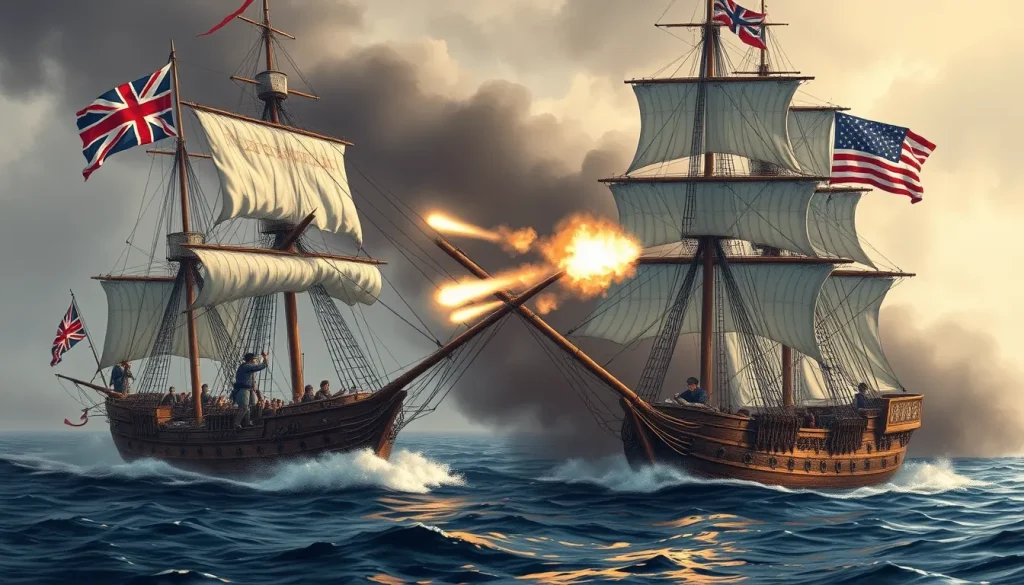
How sailing warships fought refers to the tactical system that dominated naval combat from the seventeenth through the mid-nineteenth century, a period known as the Age of Sail. Centered on the broadside cannon and the line-of-battle formation, this system determined the outcomes of engagements from the Atlantic to the Great Lakes. During the War of 1812 (1812–1815), these tactics shaped the dramatic single-ship duels and small fleet actions that defined the conflict’s naval narrative.
Historical Context
The sailing warship evolved from armed merchantmen and galleys into a dedicated fighting platform by the mid-seventeenth century. The key innovation was the gunport, which allowed heavy cannon to be mounted low on a ship’s side, creating the broadside—a concentrated volley of fire from all guns on one side. The hull’s internal skeleton enabled carvel construction, making gunports practical and strengthening the ship against the recoil of large pieces. As cannon range and accuracy remained poor, battles were fought at close quarters, often within musket shot.
By the eighteenth century, the Royal Navy had codified tactics through the Fighting Instructions and the Articles of War, which required captains to engage the enemy without excuse. The line of battle—a formation where ships followed one another in a single column—became the standard for fleet actions because it maximized broadside fire while protecting vulnerable bows and sterns. The weather gage, or windward position, gave a commander the ability to choose when and how to attack, though it also risked being blown down onto the enemy. These principles were known to all European navies, and American officers were trained in them as well.
The War of 1812 pitted the young United States Navy against the world’s preeminent maritime power. Britain possessed hundreds of ships of the line and frigates, while the U.S. Navy fielded a small force of heavy frigates, sloops, and brigs. On the Great Lakes, both nations hastily constructed squadrons of small warships, where the same sailing tactics were applied in confined waters. The conflict thus became a testing ground for the age-of-sail tactics, with American successes surprising the British and reshaping naval reputation.
What Happened
Naval combat in the War of 1812 generally followed the pattern established in earlier European wars. Ships first sighted each other, made preparations for battle, and maneuvered to gain the weather gage. Each captain sought to fire a devastating broadside while reducing the enemy’s ability to do the same. In practice, engagements often devolved into close-range exchanges of broadsides, with the winner being the ship that maintained fire discipline and inflicted greater damage on the enemy’s hull, masts, and crew.
Notable single-ship actions exemplified these tactics. On 1 June 1813, HMS Shannon and USS Chesapeake met off Boston; Shannon fired a raking broadside that dismasted Chesapeake, and the British boarded and captured her. Earlier, USS Constitution defeated HMS Guerriere and HMS Java in 1812, using superior gunnery and hull construction. On the Great Lakes, the Battle of Lake Erie on 10 September 1813 saw Commodore Oliver Hazard Perry’s squadron break the British line, employing concentrated fire and maneuver. Lake Ontario and Lake Champlain also witnessed fleet actions where line tactics were adapted to shallow waters and fickle winds.
These engagements were not just about firepower. Seamanship, ship handling, and command decisions were paramount. The ability to tack and wear, to shorten or set sail, and to reposition guns quickly could turn a potential defeat into victory. The British Navy’s discipline and well-drilled gun crews were often offset by American gunners’ accuracy and the heavier scantlings of U.S. frigates.
Why It Matters
The tactics of sailing warships determined the outcomes of individual engagements and, cumulatively, influenced the war’s morale and diplomatic standing. American victories at sea, though not strategically decisive, boosted national pride and forced Britain to devote more resources to blockading American ports. On the Great Lakes, control of the waterways hinged on these naval battles, affecting supply lines and the fate of campaigns along the Niagara frontier and into Canada. The war confirmed the effectiveness of the line of battle as the standard for fleet actions, even as the Royal Navy’s reliance on close blockade and convoy protection proved more important in the overall strategy.
Beyond the immediate conflict, the War of 1812’s naval actions helped codify the image of the American sailor as a skilled and daring fighter. Historians have debated whether American victories stemmed from superior gunnery, ship design, or British overconfidence. The war also accelerated the shift toward steam power and ironclads, which would soon render the sailing warship obsolete, making the tactics described here a finite era in naval history.
Definition
“How sailing warships fought” encompasses the operational methods by which square-rigged wooden warships armed with broadside cannon engaged each other in the Age of Sail. This includes the formations (line of battle), ship maneuvering (weather gage, raking fire, crossing the T), weaponry (cannon, carronades, musketry), and the human factors (crew training, command discipline, boarding actions).
Background
The development of sailing tactics was a long evolution from the early modern period. Initially, warships carried soldiers for boarding, with guns used mainly to suppress enemy fire. The introduction of the gunport and heavier cannon by the 1500s made broadside fire possible. By the mid-1600s, the line of battle had emerged as the dominant formation, articulated by English admirals such as Robert Blake. Over the next century, navies issued standing orders—like the Royal Navy’s Fighting Instructions—to standardize engagement procedures.
France and Spain developed similar systems, but the Royal Navy perfected them through rigorous training and enforcement of discipline. The Articles of War, particularly Article XII of 1749, required captains to fight regardless of odds, with the threat of court-martial and execution for cowardice. This legal framework, combined with the incentive of prize money, made British captains particularly aggressive.
How It Worked
Naval battles unfolded in distinct phases. First, ships identified each other and approached, often attempting to gain the weather gage (windward position). The weather gage allowed a captain to choose the distance and angle of attack but also risked being carried onto the enemy. If neither side held a clear advantage, fleets might maneuver for hours or days.
Once within range, ships opened fire with their broadsides. A full broadside discharged all guns on one side, firing round shot, grape, or chain shot. The goal was to damage the enemy’s hull, knock out guns, and kill crew. Raking fire—firing down the length of a ship from bow or stern—was especially devastating because it struck the whole deck and could dismount many guns. Ships often tried to cross the enemy’s bow or stern to achieve a raking position.
If gunfire decided the issue, ships might close and board. Boarding parties armed with cutlasses and pistols would swarm the enemy deck, aiming to capture the vessel. Alternatively, a damaged ship could strike her colors to surrender. The battle ended when one side withdrew, surrendered, or was destroyed.
Communication in fleet actions was limited. Signals were passed by flag hoists, and individual captains were expected to use initiative within the overall plan. This reliance on seamanship and interpretation made command a delicate art, as illustrated by Nelson’s famously “unwritten rules.”
Competing Viewpoints
Historians have debated the relative importance of tactical doctrine versus practical experience. Some argue that the line of battle was overly rigid and stifled initiative, while others see it as a necessary framework for coordinating large numbers of ships. The British “breaking the line” tactics of the late eighteenth century—whereby individual ships would sail through the enemy column—have been interpreted as a revolutionary departure.
Another debate concerns the quality of American gunnery in the War of 1812. Some historians, citing the accuracy of American broadsides, claim that U.S. crews were better trained. Others attribute American successes to the heavier scantling and longer guns of the “super-frigates” like Constitution. British accounts often blamed their own deficiencies, such as poor powder or overconfidence, rather than granting the enemy superior skill.
There is also discussion about the effectiveness of the weather gage. French theorists emphasized the defensive advantage of the lee gage, while British practice favored the weather gage for offensive action. American commanders, such as Perry at Lake Erie, successfully seized the weather gage and used it to break the enemy line.
Role in the War of 1812
The War of 1812 saw sailing tactics applied in three distinct theaters: the open ocean, the West Indies, and the Great Lakes. The U.S. Navy’s heavy frigates, built specifically to outfight any frigate they might meet, relied on superior gunnery and stouter hulls. They fought at close range, with Constitution earning the nickname “Old Ironsides” after cannonballs seemed to bounce off her oak sides.
On the Great Lakes, commanders adapted line tactics to smaller ships and confined waters. At Lake Erie, Perry’s squadron formed a line and attacked the British fleet, using raking fire and boarding to win a decisive victory. The Battle of Lake Champlain in 1814 similarly saw American ships maintain a disciplined line, repelling a British attack. These actions demonstrated that the principles of sailing warfare could be transferred to freshwater lakes, often determining control of vital waterways.
British naval superiority in the Atlantic led to a blockade that choked American trade and forced the U.S. Navy to avoid fleet engagements. American frigates and privateers instead engaged in commerce raiding, using the same seamanship and gunnery skills but often preferring evasion over combat. Thus, the tactical art was not only about winning battles but also about strategic usage of force.
Consequences and Historical Interpretation
The immediate consequences of these tactical practices were the naval victories that bolstered American morale and the effective blockade that weakened the American economy. Over the longer term, the war solidified the reputation of the American Navy and contributed to the development of a professional officer corps. The age of sail itself was drawing to a close; by the 1840s, steam-powered screw frigates and shell guns were changing the nature of naval warfare.
Historians have since viewed the War of 1812’s naval actions as a final flowering of sailing tactics before the transition to modernization. The emphasis on broadside fire, line formations, and boarding would be rendered obsolete by ironclads and rotating turrets. However, the principles of ship handling, gunnery, and command under sail continued to influence naval education well into the twentieth century. The war’s single-ship duels remain celebrated examples of courage and skill, and the tactical lessons from these engagements were studied by later generations of naval officers.
Primary Sources
Contemporary documents are essential for understanding how sailing warships fought. Official despatches from captains and commodores provide detailed accounts of actions. For example, Commodore Perry’s report after the Battle of Lake Erie—written on the back of an envelope—is a celebrated primary source that describes the action and signals his success. Similarly, Captain Isaac Hull’s report on the capture of HMS Guerriere details the exchange of fire and the condition of his ship.
British sources offer a counterpoint. Admiralty records and court-martial transcripts reveal the official perspective on losses and disciplinary actions. The Fighting Instructions themselves, compiled in Julian Corbett’s edition for the Navy Records Society, show the tactical doctrine in force. Personal letters and journals, such as those of sailors and officers, provide insight into the human experience of battle, though they are admittedly biased by individual perspectives.
The limitations of these sources include embellishment, national bias, and the fact that many reports were written after the fact to justify actions. Nevertheless, when used together, they paint a detailed picture of how sailing warships fought.
Further Reading
- Willis, Sam. Fighting at Sea in the Eighteenth Century: The Art of Sailing Warfare. Boydell Press, 2023.
- Corbett, Julian S. Fighting Instructions, 1530-1816. Navy Records Society, 1905.
- Roosevelt, Theodore. The Naval War of 1812. 1882.
- Morison, Samuel Eliot. The Maritime History of Massachusetts, 1783-1860. 1921.
- Hughes, Wayne P. Fleet Tactics: Theory and Practice. Naval Institute Press, 1986.
- Rodger, N.A.M. The Wooden World: An Anatomy of the Georgian Navy. Collins, 1986.
References
- “Naval Warfare – Age of Sail, Tactics, Technology.” Encyclopaedia Britannica, https://www.britannica.com/topic/naval-warfare/The-age-of-fighting-sail.
- “Tactics in the Age of Sail.” GlobalSecurity.org, https://www.globalsecurity.org/military/systems/ship/sail-tactics.htm.
- “Sailing Ship Tactics.” Wikipedia, https://en.wikipedia.org/wiki/Sailing_ship_tactics.
- Willis, Sam. Fighting at Sea in the Eighteenth Century: The Art of Sailing Warfare. Boydell Press, 2023.
- Corbett, Julian S. Fighting Instructions, 1530-1816. Navy Records Society, 1905. Project Gutenberg, https://www.gutenberg.org/cache/epub/16695/pg16695.html.
FAQ
What was the most important tactical formation for sailing warships?
The line of battle, where ships formed a single column and discharged broadsides, allowed maximum firepower while protecting vulnerable ends.
Why was the weather gage so important?
Holding the weather gage meant being upwind of the enemy, giving a commander the initiative to attack or avoid action, and allowing smoke to blow away from his own guns.
How did American frigates defeat British ships in the War of 1812?
American victories often came from heavier guns, thicker hulls, and carefully aimed fire, as seen with USS Constitution. British ships sometimes had experienced crews but were caught off guard.
What role did boarding play in sailing battles?
Boarding remained a central objective until cannon fire became decisive. Capturing an enemy ship as a prize was often the goal, and boarding parties armed with cutlasses and pistols were common.



Leave a Reply