
Short Answer
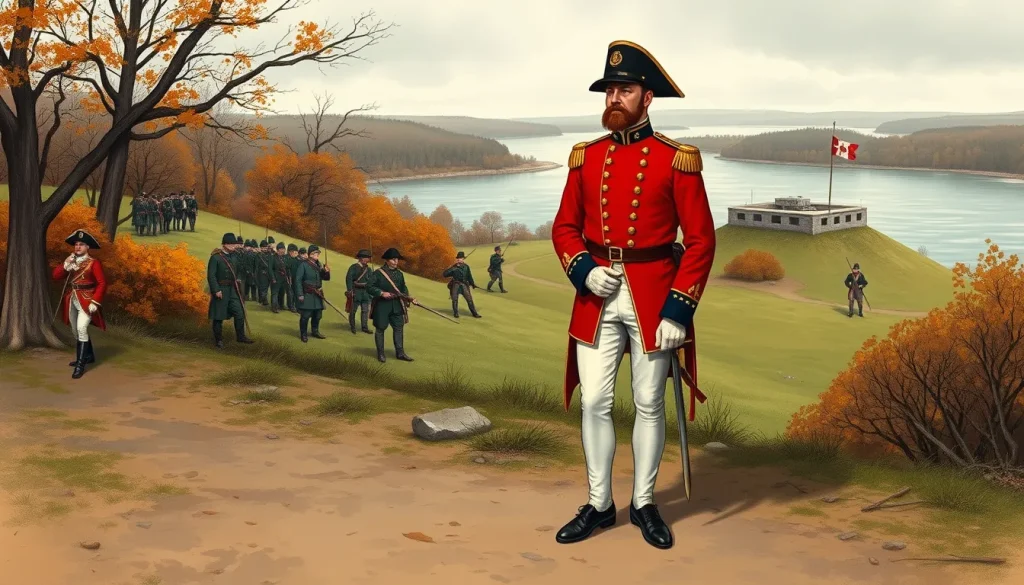
Lieutenant-Colonel Cecil Bisshopp (25 June 1783 – 16 July 1813) was a British Army officer, a Member of Parliament, and the Inspecting Field Officer of Militia in Upper Canada during the War of 1812. He is chiefly remembered in the War of 1812 for commanding the British troops at Frenchman’s Creek on the Niagara frontier in November 1812 and for leading the successful but costly raid on Black Rock, New York, in July 1813. Mortally wounded in that raid, he died at Stamford, Upper Canada, and was buried in the Lundy’s Lane Battlefield Cemetery. His career illustrates the small, understrength British and Canadian forces that defended Upper Canada and the importance of militia organization in that defense.
Historical Context
The War of 1812 began after the United States declared war on Great Britain in June 1812. On the Niagara frontier, the Niagara River separated Upper Canada (now Ontario) from New York State. The river was a natural invasion route, and both sides understood that control of its crossings, forts, and batteries could determine the fate of the province. Fort Erie, Chippawa, Fort George, Queenston, and Black Rock were among the key points along this border. British forces in Upper Canada were far smaller than the American armies that could be raised in the region. To compensate, British commanders relied on regular soldiers, embodied militia, and Indigenous allies. The militia was unevenly trained and equipped, and its organization required experienced British officers. Cecil Bisshopp was one of those officers. As Inspecting Field Officer of Militia, he was responsible for training, inspecting, and preparing Upper Canadian militia units. His local rank of lieutenant-colonel gave him authority in a theater where regular British officers were scarce. Frenchman’s Creek, a small waterway emptying into the Niagara River near Fort Erie, became a point of contact and conflict in this contested borderland.
What Happened
Bisshopp came to Upper Canada in 1812 and was designated Inspecting Field Officer for the militia, with the local rank of lieutenant-colonel. During 1812 he commanded the regular troops in the Niagara district between Chippawa and Fort Erie. In November 1812, he commanded the British troops at Frenchman’s Creek. American forces under Brigadier-General Alexander Smyth crossed the Niagara River from the Black Rock area and attacked the British position there. The American raiders briefly overran the post, spiked guns, and withdrew, while British forces under Bisshopp attempted to respond. The action was limited in scale but formed part of the wider American effort to test and disrupt British defenses along the Niagara. Bisshopp survived the engagement and continued in command.
In 1813, the strategic situation changed when American forces captured Fort George. Brigadier-General John Vincent ordered a British withdrawal to Burlington Heights, and Bisshopp moved his forces there in accordance with that plan. At Burlington Heights he commanded the reserve. He played a nominal role in the British victory at Beaver Dams in June 1813. On 11 July 1813, Bisshopp led a large raid against Black Rock, New York, from Fort George. Regular and militia forces under his command stormed the fort, overran the batteries, and burned blockhouses, barracks, a naval yard, and a large schooner. They also captured a considerable quantity of public stores and ordnance, including eight pieces of artillery. Bisshopp delayed returning to the Canadian side of the river to oversee the securing of a large number of barrels of salt, a commodity scarce in Upper Canada. During that delay, the defenders regrouped and counterattacked. Bisshopp was wounded in the left thigh, left wrist, and upper right arm. He was expected to recover, but his condition worsened. He died on 16 July 1813 at Stamford, Upper Canada, and was buried on 17 July 1813.
Why It Matters
Bisshopp’s command at Frenchman’s Creek was a small episode in a much larger war, but it demonstrates how the Niagara frontier was contested through raids, river crossings, and local defensive actions rather than only through set-piece battles. His later raid on Black Rock was one of the more successful British offensive operations on the Niagara in 1813, though it cost him his life. His death removed an experienced officer from a theater where experienced officers were in short supply. Bisshopp’s dual career as a British Army officer and a Member of Parliament also illustrates the close connections between military service and political office in Britain during the Napoleonic Wars. Historians have generally treated him as a capable and popular officer, and his burial at the Lundy’s Lane Battlefield Cemetery has made his grave a point of historical memory. At the same time, the evidence for his life and actions is uneven: official military records are terse, and much of what is known about his personality and reputation comes from later family and commemorative sources.
Early Life
Cecil Bisshopp was born on 25 June 1783, the son of Sir Cecil Bisshopp, 8th Baronet Bishopp, of Parham Park in Sussex, England, and Harriet Anne Southwell. He was heir to his father’s title and estates. He began his military service as a Cornet in the Sussex Yeomanry from 1797 to 1799. In 1799 he entered the First Foot Guards as an Ensign, the most junior commissioned rank. He was promoted Lieutenant and Captain in 1800, and later Major in 1812. In politics, he unsuccessfully contested New Shoreham in Sussex in 1807. He then served as Member of Parliament for Newport, Isle of Wight, from 1811 to 1812. He did not seek re-election because of his military service in Canada. His father later became the 12th Baron Zouche in 1815; had Cecil survived, he would eventually have become the 9th Baronet Bisshopp and the 13th Baron Zouche.
Role Before the War
Before coming to North America, Bisshopp served in the Napoleonic Wars. He was a veteran of the campaigns at La Coruna, Spain, and Walcheren in the Netherlands. That experience made him a useful officer for the defense of Upper Canada. In 1812 he was appointed Inspecting Field Officer of Militia in British North America, with the local rank of lieutenant-colonel. This role involved organizing, training, and inspecting the militia of Upper Canada. It was an administrative and operational position that placed him in the middle of the province’s defensive preparations. When war came, he was already in place to take field command on the Niagara frontier.
Role During the War
During 1812 Bisshopp commanded the regular troops in the Niagara between Chippawa and Fort Erie. His sector included some of the most sensitive crossings on the Niagara River. In November 1812 he commanded the British troops at Frenchman’s Creek, where he faced an American raid. After the American capture of Fort George in 1813, he withdrew his forces to Burlington Heights in accordance with Brigadier-General Vincent’s plan. There he commanded the reserve. Following the American withdrawal to Fort George, Bisshopp played a nominal role in the British victory at Beaver Dams. His most significant offensive action came on 11 July 1813, when he led the raid on Black Rock. The raid was successful in destroying enemy facilities and capturing stores, but Bisshopp was wounded during the withdrawal and died a few days later.
Major Actions
Frenchman’s Creek, November 1812. Bisshopp commanded the British troops at Frenchman’s Creek when American forces under Brigadier-General Alexander Smyth crossed the Niagara River from Black Rock and attacked the British position. The Americans briefly overran the post and spiked guns before withdrawing. The action was limited but signaled that the Niagara frontier would be contested through repeated raids and crossings.
Raid on Black Rock, 11 July 1813. Bisshopp led a large raid from Fort George against Black Rock, New York. His regular and militia forces stormed the fort, overran the batteries, and burned blockhouses, barracks, a naval yard, and a large schooner. They captured public stores and eight pieces of artillery. Bisshopp delayed the withdrawal to secure barrels of salt. During the delay, the defenders counterattacked and wounded him in the left thigh, left wrist, and upper right arm. He died of his wounds on 16 July 1813 at Stamford, Upper Canada.
Contemporary Accounts
Contemporary evidence for Bisshopp’s service consists mainly of British military correspondence and returns, American reports of the Niagara raids, and newspaper notices. These sources provide dates, units, and command assignments, but they are often brief and written from a particular military perspective. British official accounts tend to emphasize defensive success and the conduct of officers, while American accounts may emphasize the raid’s damage or minimize its costs. Later family and commemorative sources, including an engraved portrait of Bisshopp by James Godby after Francois Huet Villiers, published by Katherine Pechell between 1826 and 1849, offer visual and personal details but are not operational records. No full contemporary diary or letter collection from Bisshopp himself is known to be readily available, so historians must rely on these indirect sources.
Later Life
Bisshopp did not have a later life in the ordinary sense: he died on 16 July 1813 at the age of 30 from wounds received in the raid on Black Rock. He was buried on 17 July 1813. After his death, his father, Sir Cecil Bisshopp, 8th Baronet, lived until 11 November 1828 and died without surviving male issue. The baronetcy passed to a cousin, while the Barony of Zouche fell into abeyance between Bisshopp’s two sisters, Harriet Anne Curzon and Katherine Annabella, Lady Brooke-Pechell. His brother Charles-Cecil, a Royal Navy officer, had died in Jamaica in 1808.
Historical Legacy
Bisshopp is remembered primarily as the British commander at Frenchman’s Creek and as the leader of the Black Rock raid. His grave in the Lundy’s Lane Battlefield Cemetery in Niagara Falls, Ontario, is a tangible link to the War of 1812 on the Niagara frontier. Historians such as John R. Grodzinski have described him as a popular and competent officer whose death was a loss to the British command in Upper Canada. His career also reflects the interconnected worlds of British politics, military service, and colonial administration during the Napoleonic era. Although he is not as well known as figures such as Isaac Brock, his experience illustrates the daily realities of command, militia organization, and border warfare in the War of 1812.
Primary Sources
British military correspondence and returns from Upper Canada, 1812-1813, held in repositories such as Library and Archives Canada and The National Archives (United Kingdom), are the most important contemporary sources for Bisshopp’s movements and the actions at Frenchman’s Creek and Black Rock. They were created by British officers and officials during the war. They contribute order-of-battle, casualty, and command information. Their limitations include terseness, incomplete coverage, and a British command perspective. Paraphrase should be distinguished from quotation; no verbatim quotation is offered here because the exact wording of these documents has not been verified in the supplied research context.
The engraved portrait of Bisshopp by James Godby after Francois Huet Villiers, published by Katherine Pechell between 1826 and 1849, is a posthumous family memorial. It contributes visual evidence of how Bisshopp was remembered but is not a battlefield record. Newspaper reports from Upper Canada, Britain, and the United States provide notices of the Black Rock raid and Bisshopp’s death. They are useful for public reaction and memory, but they vary in accuracy and often reflect partisan or local perspectives.
Further Reading
- John R. Grodzinski, “A Portrait of Lieutenant-Colonel Cecil Bisshopp,” The War of 1812 Magazine, Issue 26 (December 2016).
- History of Parliament, “Bisshopp, Cecil (1783-1813), of Parham Park, Sussex.”
- Library and Archives Canada, War of 1812 records and military correspondence.
- Niagara Falls History Museum, resources on the Lundy’s Lane Battlefield Cemetery and the Niagara frontier.
- J. Mackay Hitsman, The Incredible War of 1812: A Military History. Toronto: Robin Brass Studio, 1999.
References
- Wikipedia contributors, “Cecil Bisshopp,” Wikipedia, The Free Encyclopedia, https://en.wikipedia.org/wiki/Cecil_Bisshopp (accessed 2025).
- John R. Grodzinski, “A Portrait of Lieutenant-Colonel Cecil Bisshopp,” The War of 1812 Magazine, Issue 26 (December 2016), https://www.napoleon-series.org/military-info/Warof1812/2016/Issue26/BisshoppPortrait1.pdf.
- History of Parliament, “Bisshopp, Cecil (1783-1813), of Parham Park, Sussex.”
- Library and Archives Canada, War of 1812 records, Ottawa.
FAQ
Who was Cecil Bisshopp?
Lieutenant-Colonel Cecil Bisshopp (1783–1813) was a British Army officer and MP who served as Inspecting Field Officer of Militia in Upper Canada and commanded British troops at Frenchman's Creek in November 1812.
What happened at Frenchman's Creek?
In November 1812, American forces under Brigadier-General Alexander Smyth crossed the Niagara River and attacked the British post at Frenchman's Creek, which was commanded by Bisshopp. The Americans briefly overran the position and withdrew.
How did Cecil Bisshopp die?
He was wounded in the left thigh, left wrist, and upper right arm during the British raid on Black Rock on 11 July 1813. He died of his wounds on 16 July 1813 at Stamford, Upper Canada.
Leave a Reply