
Short Answer
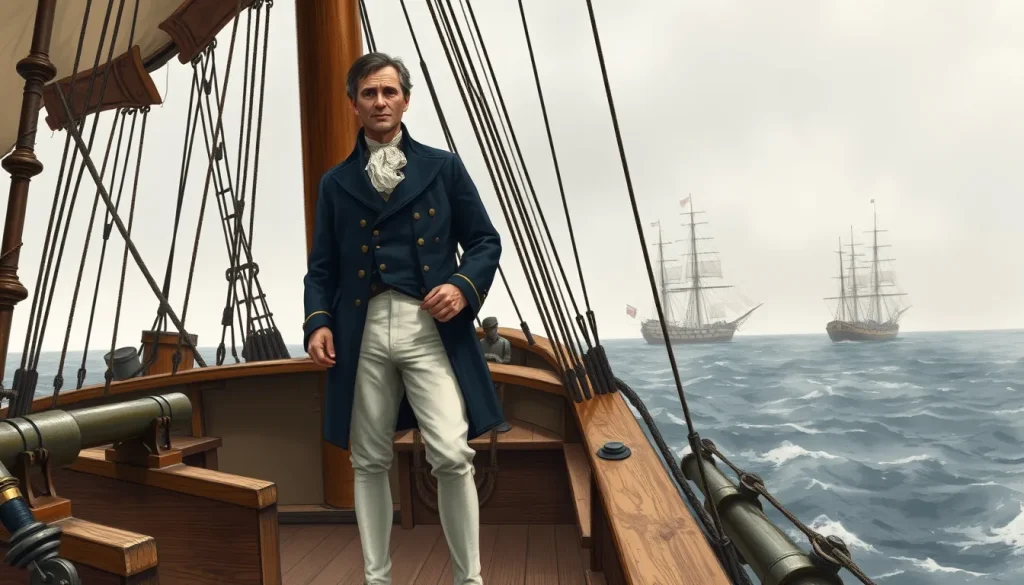
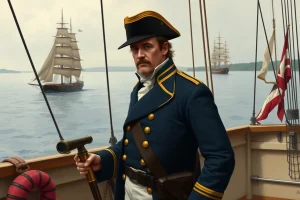
John Surman Carden (15 August 1771 – 22 April 1858) was a British Royal Navy officer whose career spanned the French Revolutionary Wars, the Napoleonic Wars and the War of 1812. He is remembered chiefly for the action of 25 October 1812, when his frigate HMS Macedonian was captured in the Atlantic by the American frigate USS United States. A subsequent court-martial acquitted him of responsibility for the loss but criticised his handling of the action; he never again served at sea, though he continued to be promoted by seniority until he reached the rank of full admiral.
Historical Context
By 1812 the Royal Navy was the largest and most confident maritime force in the world, and frigate captains in particular competed for reputation in single-ship actions. Aggressive ship-handling, the pursuit of an enemy cruiser and the refusal to decline action were professional ideals, and an officer who brought an enemy frigate to battle was expected to press the engagement hard. That culture shaped how Carden and his contemporaries judged both the conduct and the outcome of a frigate duel.
The United States Navy fielded a small force of unusually powerful frigates. The largest, authorised under the Naval Act of 1794 and designed with substantial input from Joshua Humphreys, included USS United States, Constitution and President. Rated at 44 guns, they were longer, beamier and more heavily framed than British frigates of comparable nominal rating, and their gun decks carried 24-pounder long guns. HMS Macedonian, a Lively-class frigate launched at Woolwich in 1809, was rated at 38 guns and carried 18-pounder long guns on her gun deck with 32-pounder carronades on the quarterdeck and forecastle. In a prolonged exchange of broadsides, that difference in weight of metal mattered.
The United States declared war on 18 June 1812 while Britain remained heavily committed against Napoleonic France. News that USS Constitution had captured HMS Guerriere on 19 August 1812 caused public shock in Britain and turned every subsequent single-ship encounter into a test of national standing.

What Happened
Carden took command of HMS Macedonian, a 38-gun frigate, around 1810–1811 after a series of appointments in ships of the line, and he was her captain when war with the United States began. In the autumn of 1812 Macedonian was cruising in the Atlantic. On 25 October 1812 she sighted USS United States, commanded by Commodore Stephen Decatur, in the mid-Atlantic. Carden chose to engage rather than run.
The American ship was substantially the larger and more heavily armed. Decatur opened the action at long range, where his 24-pounder long guns could damage masts, rigging and the exposed upper works of the British frigate without exposing his own hull to equal punishment. Carden attempted to close the range in order to bring his broadside to bear effectively, a decision consistent with contemporary British practice but one that placed Macedonian within reach of the American ship’s heavier guns.
Within roughly an hour and a half, Macedonian was reduced to a wreck. Her masts were shot away, much of her armament was dismounted, and she had suffered heavy casualties. The figure consistently reported for the British ship is 104 killed and wounded out of a complement of about 300, while American losses were far lighter. With his ship unmanageable and unable to continue the fight, Carden struck his colours and surrendered.
Macedonian was taken as a prize and brought into New York, where she was purchased into the United States Navy and served under the American flag. Carden and his surviving officers were carried to the United States and subsequently returned to Britain, where the loss of a ship of war automatically triggered a court-martial. The court acquitted Carden of blame for the loss of Macedonian but expressed criticism of aspects of his conduct of the action; accounts differ on the precise grounds, with some emphasising his decision to engage a superior opponent and others his handling of the ship once engaged.
Why It Matters
The loss of Macedonian was one of a series of British frigate defeats in the first year of the war, alongside Guerriere in August 1812 and HMS Java in December 1812. At the time these reverses were reported in Britain with alarm and in the United States with celebration, and they helped shape popular perceptions of the naval war out of proportion to their strategic weight. Carden’s own reputation was made and fixed by the event: he is remembered as the officer who lost Macedonian, not as the officer who served in the Channel Fleet, the Helder expedition or the Red Sea.
Interpretation of his conduct has divided historians. Nineteenth-century British writers such as William James were severe in their assessment of Carden’s tactics, and Theodore Roosevelt’s influential study of the naval war was also critical. Later scholarship has stressed the material disparity between the two ships, arguing that the American heavy frigates were effectively a different class of vessel and that a British 38-gun frigate was badly overmatched. The debate turns less on whether Carden acted courageously than on whether a captain of a weaker ship should have declined action, and on how he should have fought once action was joined.
Early Life
Carden was born on 15 August 1771 at Tewkesbury in Gloucestershire, the eldest son of Major John Carden of Tredington Court and his wife, a Miss Surman. His father served in North America during the American Revolutionary War in a provincial regiment, the Prince of Wales’s Royal Americans, and died of wounds received in action. His mother died young, and Queen Charlotte’s earlier proposal to take the boy as a royal page and obtain him an ensigncy lapsed after his mother declined to accept it without her husband’s consent. Carden was educated privately until he entered the Royal Navy in 1788, joining HMS Edgar under Captain Charles Thompson, and later serving in the frigate HMS Perseverance in the East Indies.
Role Before the War
Carden became a midshipman in 1790 and joined HMS Marlborough at the outbreak of the French Revolutionary Wars. He was badly wounded in an ammunition explosion at the Glorious First of June on 1 June 1794, suffering permanent damage to his eyesight, and was promoted lieutenant. He subsequently served in HMS Formidable, HMS Barfleur and HMS Queen Charlotte before becoming first lieutenant of the frigate HMS Fisgard under Captain Thomas Byam Martin. In the action that captured the French frigate Immortalite off Brest in 1798, Carden’s conduct was singled out for praise and he was promoted commander on 25 October 1798.
He commanded the armed storeship HMS Sheerness, served off the Netherlands and the Vendee, convoyed troopships to the Red Sea in support of the Egyptian campaign, and was commended for clearing a burning powder store. During the Peace of Amiens he served with the Sea Fencibles in the Firth of Forth, returning to sea in 1804 in HMS Moselle. He became a post captain in 1806, commanded the 110-gun HMS Ville de Paris from 1808 and assisted in the evacuation of the British army from Spain after Corunna in January 1809. Further appointments followed in HMS Ocean and HMS Mars.
Role During the War
When the United States declared war in June 1812, Carden was in command of HMS Macedonian, his first sustained frigate command and the appointment on which his reputation would rest. His wartime service consisted essentially of that single cruise and its outcome on 25 October 1812. After his return to Britain and the court-martial, he received no further seagoing command, and his active participation in the War of 1812 therefore ended with the loss of his ship.
Major Actions
His principal actions were the Glorious First of June (1794), the capture of Immortalite by HMS Fisgard (1798), the landing operations at the Helder (1799), and the action of 25 October 1812 against USS United States. The last was the most consequential for his reputation, but the earlier actions explain why contemporaries regarded him as a capable and gallant officer before 1812.
Contemporary Accounts
British accounts of Carden’s early career are uniformly favourable. Captain Thomas Byam Martin’s official letter to Lord Bridport after the capture of Immortalite recommended, in the words reproduced in John Marshall’s Royal Naval Biography, “the steady good conduct of Mr. Carden, first Lieutenant of the Fisgard on this occasion.” Marshall’s biographical sketch, drawing on material supplied from Carden’s own circle, treats his later career sympathetically. William R. O’Byrne’s A Naval Biographical Dictionary records that Carden received marks of public respect after his return from captivity, including the freedom of Worcester, Gloucester and Tewkesbury. American accounts, including Decatur’s official letter to the Secretary of the Navy in October 1812, describe the action from the victor’s perspective and emphasise the damage inflicted on Macedonian.
Later Life
Carden remained on the Navy List for decades without further employment at sea. He was superannuated in 1836 and promoted rear-admiral the same year, and although he was later reinstated and continued to advance by seniority, he held no further naval post. He eventually reached the rank of full admiral. He married and had a daughter, Jemima, born about 1800; relatively little else about his private life is documented. He died at Ballycastle, County Antrim, on 22 April 1858, aged 86.
Historical Legacy
Carden’s legacy is inseparable from the frigate actions of 1812. His court-martial acquittal is frequently cited in modern discussions of the naval war as evidence that the Admiralty did not hold him personally responsible for a contest against a markedly superior ship, while the criticism attached to the verdict is cited by those who judge his tactics harshly. His career also illustrates how quickly a long and creditable record could be overshadowed by a single defeat, and how the memory of the War of 1812 at sea has been shaped as much by national narratives as by the material realities of ship design and gunnery.
Primary Sources
The central British documents are Carden’s own report of the action and the minutes of the court-martial held after his return; these derive from Admiralty correspondence and court-martial records, for which the principal repositories are The National Archives at Kew (Admiralty record series) and, for captured and related American material, the United States National Archives. Specific archival references are not reproduced here because they must be verified against the repositories themselves rather than assumed.
On the American side, Commodore Stephen Decatur’s official letter to the Secretary of the Navy, written in October 1812, reports the capture and the damage to Macedonian; it is a victor’s account and should be read alongside British testimony. The logbooks of USS United States and HMS Macedonian provide navigational and chronological detail but are terse and rarely record motive. John Marshall’s Royal Naval Biography, which reproduces correspondence and official letters relating to Carden, and William R. O’Byrne’s A Naval Biographical Dictionary are useful nineteenth-century compilations, though both are sympathetic and depend partly on family-supplied information.
Further Reading
- John Marshall, Royal Naval Biography (London, 1823–1835), entry for John Surman Carden.
- William R. O’Byrne, A Naval Biographical Dictionary (London, 1849).
- William James, The Naval History of Great Britain (London, 1822–1824), volumes covering the War of 1812.
- Theodore Roosevelt, The Naval War of 1812 (New York, 1882).
- Alfred Thayer Mahan, Sea Power in Its Relations to the War of 1812 (Boston, 1905).
- William S. Dudley, ed., The Naval War of 1812: A Documentary History, 3 vols. (Washington, D.C.: Naval Historical Center, 1985–2002).
- Nicholas Tracy, Who’s Who in Nelson’s Navy (Chatham Publishing, 2006).
- Donald R. Hickey, The War of 1812: A Forgotten Conflict (University of Illinois Press).
- The National Archives (Kew), Admiralty records; National Maritime Museum, Greenwich (Caird Library); Naval History and Heritage Command, Washington, D.C.
References
- John Marshall, Royal Naval Biography (London, 1823–1835), “Carden, John Surman.”
- William R. O’Byrne, A Naval Biographical Dictionary (London, 1849).
- Nicholas Tracy, Who’s Who in Nelson’s Navy (Chatham Publishing, 2006), 71–72.
- William S. Dudley, ed., The Naval War of 1812: A Documentary History, 3 vols. (Washington, D.C.: Naval Historical Center, 1985–2002).
- Theodore Roosevelt, The Naval War of 1812 (New York, 1882).
- Wikipedia, “John Surman Carden,” https://en.wikipedia.org/wiki/John_Surman_Carden.
- Wikisource, “Royal Naval Biography/Carden, John Surman,” https://en.wikisource.org/wiki/Royal_Naval_Biography/Carden,_John_Surman.
FAQ
Who was John Surman Carden?
He was a British Royal Navy officer born in 1771 who served from 1788 and reached the rank of admiral. He is best known as the captain of HMS Macedonian when she was captured by USS United States on 25 October 1812 during the War of 1812.
Was Carden blamed for losing HMS Macedonian?
A court-martial acquitted him of responsibility for the loss of the ship, but the proceedings criticised aspects of his handling of the action, particularly his conduct in engaging and fighting a more heavily armed opponent. He received no further seagoing command afterwards.
Why did HMS Macedonian lose to USS United States?
USS United States was a larger and more heavily armed ship, carrying 24-pounder long guns against Macedonian's 18-pounders, and its heavier broadside dismantled the British frigate's masts and armament. Carden's decision to close the range exposed his ship to that superior firepower, and after about ninety minutes of action he surrendered with 104 killed and wounded aboard.


Leave a Reply