
Short Answer
The Treaty of Ghent, signed on December 24, 1814, ended the War of 1812 between the United States and Great Britain, but it did not immediately open the prison gates. Article III required that prisoners of war taken on land or sea be restored “as soon as practicable” after ratification, once they paid debts contracted during captivity. The result was a slow, uneven release in 1815 that varied by location, nationality, rank, and the administrative capacity of the two governments. The subject is significant because it shows how a diplomatic promise was tested by logistics, money, disease, and violence—most famously at Dartmoor Prison in England.
Historical Context
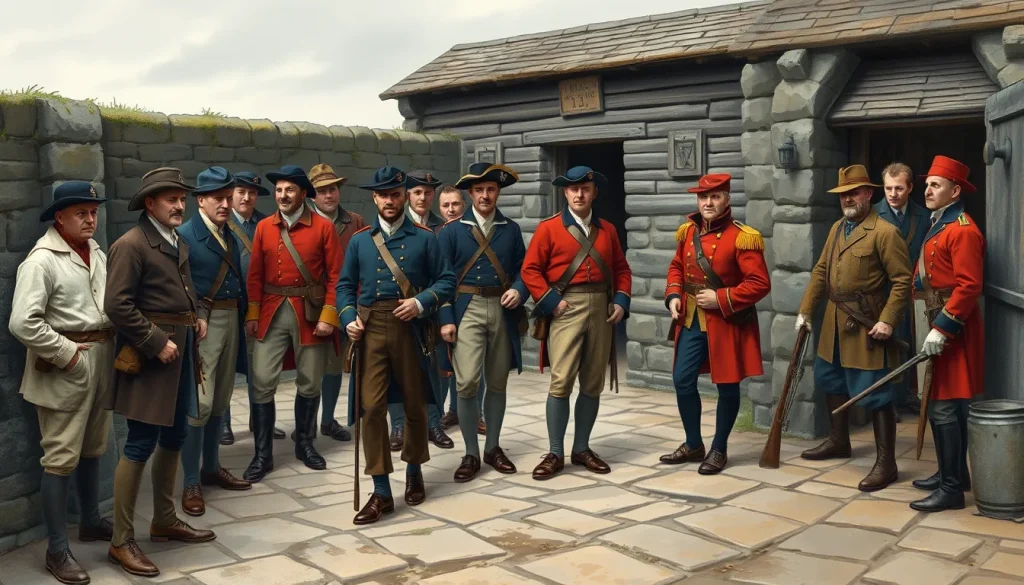
During the War of 1812, neither the United States nor Britain had a single, smooth system for handling prisoners. Captures occurred in frigate duels, lake actions, frontier campaigns, and privateering. Officers were often paroled or confined in relatively comfortable quarters, while enlisted men and sailors were held in prison hulks, barracks, camps, and purpose-built prisons. Wartime cartels allowed rank-for-rank exchanges, but exchanges frequently stalled over numbers, nationality, and whether captured sailors were British subjects or American citizens. Britain’s Royal Navy captured many American seamen and privateersmen; the United States held British soldiers and sailors in places such as camps and prison ships. By 1814, thousands remained in captivity.
The Treaty of Ghent was negotiated in Belgium by American commissioners John Quincy Adams, James A. Bayard, Henry Clay, Jonathan Russell, and Albert Gallatin, and British commissioners Lord Gambier, Henry Goulburn, and William Adams. The treaty avoided major territorial concessions and referred several disputes to future commissions. Article III addressed prisoners directly. It stated that all prisoners taken by either side, by land or sea, “shall be restored as soon as practicable after the Ratifications of this Treaty,” on paying debts contracted during captivity. The two governments also promised to reimburse each other in specie for advances made for prisoners’ sustenance and maintenance.
Because the treaty required ratification, prisoners remained legally captive after the December signing. News traveled slowly. American prisoners at Dartmoor learned of the peace on December 29, 1814, but British and American ratifications were not exchanged until February 1815. In the interval, the war continued in some theaters, including Andrew Jackson’s victory at New Orleans on January 8, 1815.

What Happened
After ratification in February 1815, both governments sent orders to release prisoners, but implementation depended on prisoner agents, transport ships, and financial settlements. The British government initially insisted that each side supply ships to return its own prisoners. Because Britain held far more American prisoners than the United States held British prisoners, that arrangement favored Britain. Eventually, British authorities agreed to expedite repatriation and settle costs later.
American prisoners in Britain were the most visible case. Many had been held at Dartmoor Prison on the moor near Princetown, Devon, which had originally been built for French prisoners during the Napoleonic Wars. American prisoners arrived there from 1813 onward. In the winter of 1814–1815, smallpox and other diseases spread through the crowded barracks; one later account places the disease death toll at about 270, most during that final winter. News of peace briefly raised hopes, but release did not come. American agent Reuben G. Beasley informed prisoners that those who had contracted debts and did not pay them could be detained in Britain, and that prisoners would depart only on authorized cartel ships. As weeks passed without ships, tensions rose.
On April 6, 1815, guards at Dartmoor fired into a crowd of prisoners during a disturbance. Seven Americans were killed and thirty-one wounded. Accounts differ on the exact trigger and on who bore responsibility; some prisoners later claimed the agent or governor had provoked the confrontation, while officials described a riot that guards fired to suppress. Whatever the precise cause, the shooting shocked both governments. Releases accelerated. Americans who could provide for themselves were freed at once, and others left on cartel ships in the following weeks. Many returned home destitute; some arrived with little more than the clothes they wore.
British prisoners in the United States followed a less publicized but similar path. After ratification, they were released from camps, barracks, and prison ships and sent home on cartels, though transport shortages and accounting delays stretched the process into 1815. Prisoners exchanged earlier in the war had already returned. Some captives died of disease before release; others remained in hospitals or were too ill to travel. The treaty’s debt clause created additional friction, because prisoners who had purchased necessities on credit could be held until accounts were settled. Governments eventually handled many of these claims, but not before individual prisoners suffered delays.
Indigenous participants in the war present a more difficult record. Article III’s language did not exclude Indigenous captives, but the treaty’s implementation was shaped by how officials classified prisoners. Article IX of the Treaty of Ghent addressed Indian nations allied with Britain and promised restoration of possessions, rights, and privileges enjoyed before 1811, but repatriation of Indigenous captives is far less documented in the same administrative records and was often entangled with local negotiations. Historians therefore treat the release of Indigenous prisoners as uneven and incompletely understood.
Why It Matters
The prisoner release mattered immediately because it ended years of confinement for thousands of men and returned them to families and communities. It also exposed the human cost of delay. The Dartmoor deaths, the April 6 shooting, and the destitution of returning sailors became part of American memory of the war, often cited as evidence of British cruelty. In Britain and in later scholarship, the same events have been examined as a breakdown of prison administration, crowd control, and wartime propaganda rather than as a simple morality tale.
For historians, the episode illuminates the limits of treaty-making. Article III was brief and conditional: “as soon as practicable” left room for interpretation, and the debt provision placed a financial burden on prisoners. The release process depended on ratification, communication, shipping, and the willingness of officials to cooperate. It also reflected asymmetry: Britain held more American prisoners, so the logistics of return weighed more heavily on the United States. The treaty did not create a permanent international prisoner regime, but it reinforced the principle that peace settlements should include the return of captives. Later historians disagree about how much the delays resulted from policy, negligence, or unavoidable wartime chaos, and about whether Dartmoor should be called a massacre or a riot.
Definition
In this context, “restoration of prisoners of war” meant the release and return of captured combatants to their own side after peace, not a battlefield exchange. Article III of the Treaty of Ghent applied to prisoners taken on land and sea and required return as soon as practicable after ratification. It also required prisoners to pay private debts contracted during captivity and committed the two governments to reimburse each other for maintenance advances.
Background
The treaty’s prisoner clause grew out of wartime practice. During the conflict, Britain and the United States used cartels to exchange prisoners, often rank for rank. These exchanges were never comprehensive. Naval prisoners were especially difficult because Britain claimed the right to impress British-born sailors from American ships, while the United States claimed them as citizens. Officers often received parole, but enlisted men and sailors endured hulks, crowded barracks, and inadequate food and medical care. By the time peace was signed, both sides held a mixture of long-term captives, recent captures, and sick or wounded men.
How It Worked
After ratifications were exchanged in February 1815, orders went out to armies, squadrons, and prison officials to cease hostilities and prepare releases. Prisoner agents on each side managed accounts, arranged transport, and corresponded with governments. Cartel ships carried released prisoners across the Atlantic. The process was not automatic. Prisoners with debts could be detained; governments haggled over who would pay for ships and maintenance; and some ports lacked enough vessels. At Dartmoor, release came only after the April 6 violence forced officials to act faster. In the United States, British prisoners were similarly processed through camps and ports before sailing home.
Competing Viewpoints
Contemporary American accounts often emphasized British mistreatment, especially at Dartmoor, and celebrated returning sailors as victims of tyranny. British officials emphasized legal obligations, debt claims, and the difficulty of managing large numbers of prisoners. Modern historians generally agree that conditions were poor on both sides, but they disagree about the degree of deliberate cruelty. Some see the Dartmoor shooting as a preventable tragedy caused by poor leadership and panic; others stress the volatile environment, escape attempts, and communication failures. The debate is complicated by the fact that most surviving prisoner narratives are autobiographical, emotionally charged, and written after the fact.
Role in the War of 1812
Prisoners of war were a persistent diplomatic and humanitarian problem throughout the War of 1812. They affected public opinion, recruitment, and negotiations at Ghent. Article III was one of the treaty’s few provisions that directly addressed individual lives rather than borders or commissions. The treatment of prisoners also fed national narratives: Americans remembered Dartmoor and the hardships of sailors, while British and Canadian accounts focused more on the broader military and diplomatic settlement. For the United States, the return of prisoners formed part of the war’s aftermath, alongside the restoration of territory and the resolution of boundary disputes.
Consequences and Historical Interpretation
Most surviving prisoners were repatriated by the summer of 1815, though the process was neither quick nor uniform. The treaty’s debt clause and the shortage of transport caused hardship, and disease killed many before they could leave. The Dartmoor shooting became a symbol of American grievance, but it also prompted faster releases. In the longer term, the episode showed that peace treaties must be implemented, not merely signed. Historians continue to study prisoner experience to understand the war’s social and human dimensions, especially the lives of sailors, privateersmen, and ordinary soldiers who left few written records. The incomplete documentation of Indigenous captives remains a significant gap in the historiography.
Primary Sources
Treaty of Ghent, Article III (December 24, 1814). Negotiated by American and British commissioners, this article is the legal foundation for prisoner release. It is concise and does not explain how release would be organized, which is why later disputes arose. The National Archives and U.S. Senate provide transcriptions.
Letters of Reuben G. Beasley, American prisoner agent in Britain. Beasley corresponded with American prisoners, including those at Dartmoor, about debts, transport, and release. These letters show how official policy reached prisoners and why many believed they were abandoned. They reflect an official American perspective and must be read alongside British records.
Diary of Benjamin Palmer, American prisoner at Dartmoor. Palmer’s diary, quoted in later histories, describes daily conditions, tensions over food and guards, and the April 6, 1815, shooting. It is a valuable eyewitness account but is personal, partisan, and written under extreme stress.
Journal of Assheton Humphreys, acting chaplain of USS Constitution (1815). Humphreys recorded the capture of HMS Cyane and HMS Levant and the behavior of British prisoners aboard the American frigate. His journal offers a naval officer’s perspective on captivity and exchange, but it is limited to one ship and one period.
Further Reading
- National Archives, “Treaty of Ghent (1814).” https://www.archives.gov/milestone-documents/treaty-of-ghent
- U.S. Senate, “Transcript: Treaty of Ghent.” https://www.senate.gov/about/powers-procedures/treaties/treaty-of-ghent/transcript-treaty-of-ghent.htm
- Matthew Brenckle, British and American Naval Prisoners of War During the War of 1812 (USS Constitution Museum, 2005). https://ussconstitutionmuseum.org/wp-content/uploads/2020/05/British-and-American-Naval-Prisoners-of-War-During-the-War-of-1812.pdf
- Justin Jones, The Prison on the Moor: A Study of the American Prisoner-of-War Experience Within Dartmoor Prison, 1813–1815 (MA thesis, University of Texas at Arlington, 2011). http://hdl.handle.net/10106/5632
- Stephen Budiansky, Perilous Fight: America’s Intrepid War with Britain on the High Seas, 1812–1815 (Knopf, 2010).
- Donald R. Hickey, The War of 1812: A Forgotten Conflict (University of Illinois Press, revised ed., 2012).
- J. C. A. Stagg, The War of 1812: Conflict for a Continent (Cambridge University Press, 2012).
References
- National Archives, “Treaty of Ghent (1814),” Milestone Documents, https://www.archives.gov/milestone-documents/treaty-of-ghent.
- U.S. Senate, “Transcript: Treaty of Ghent,” https://www.senate.gov/about/powers-procedures/treaties/treaty-of-ghent/transcript-treaty-of-ghent.htm.
- Matthew Brenckle, British and American Naval Prisoners of War During the War of 1812 (Boston: USS Constitution Museum, 2005), https://ussconstitutionmuseum.org/wp-content/uploads/2020/05/British-and-American-Naval-Prisoners-of-War-During-the-War-of-1812.pdf.
- Justin Jones, The Prison on the Moor: A Study of the American Prisoner-of-War Experience Within Dartmoor Prison, 1813–1815 (MA thesis, University of Texas at Arlington, 2011), http://hdl.handle.net/10106/5632.
- Stephen Budiansky, Perilous Fight: America’s Intrepid War with Britain on the High Seas, 1812–1815 (New York: Knopf, 2010).
- Donald R. Hickey, The War of 1812: A Forgotten Conflict (Urbana: University of Illinois Press, revised ed., 2012).
- J. C. A. Stagg, The War of 1812: Conflict for a Continent (Cambridge: Cambridge University Press, 2012).
FAQ
Did the Treaty of Ghent immediately free all prisoners of war?
No. Article III required restoration as soon as practicable after ratification, not upon signing. Ratifications were exchanged in February 1815, and transport, debts, and administrative delays kept many prisoners confined for months.
What was the Dartmoor Massacre?
On April 6, 1815, British guards at Dartmoor Prison fired on American prisoners during a disturbance, killing seven and wounding thirty-one. The shooting accelerated releases, and historians debate responsibility and whether the term massacre is accurate.
Did prisoners have to pay debts before they could be released?
Article III said prisoners were to be restored on paying debts contracted during captivity. This provision caused delays and hardship, though governments eventually handled many maintenance and transport costs.

Leave a Reply